
News
Tinubu Nominates Three New Board Members For Code of Conduct Bureau


President Bola Tinubu has nominated three new members to fill existing vacancies on the board of the Code of Conduct Bureau (CCB) as part of efforts to strengthen oversight mechanisms.
The nominations were communicated in a formal letter to Senate President Godswill Akpabio and disclosed in a statement by the President’s Special Adviser on Information and Strategy, Bayo Onanuga. The nominees are Alhaji Fatai Ibikunle (Oyo State), Kennedy Ikpeme (Cross River), and Justice Ibrahim Buba, a retired judge of the Federal High Court.
Established in 1979, the CCB oversees integrity within public service and enforces ethical compliance. The Bureau operates with a 10-member board, chaired by Dr. Abdullahi Usman Bello, who was sworn in by President Tinubu on October 23, 2024. Other board members include Barr. Muritala Aliyu Kankia, Hon. E.J. Agbomayinma, Barr. Ben Umeano, Prof. Juwayriyya Badamasiuy, Bulus I. Zephaniah, and Hon. Abdulsalam Taofiq Olawale.
Tribunal Chairmanship Controversy
The nominations come amid a leadership controversy at the Code of Conduct Tribunal (CCT), with allegations of corruption and misconduct against its chairman, Umar Danladi. Both chambers of the National Assembly have moved to address the matter.
Last Wednesday, the Senate, led by Majority Leader Opeyemi Bamidele, cited Section 157 (1) of the Nigerian Constitution to initiate Danladi’s removal. Similarly, the House of Representatives invoked paragraph 17 (3), Part 1, Fifth Schedule of the Constitution to back its call for the chairman’s dismissal.
However, during Tuesday’s plenary, the Senate admitted citing the wrong constitutional provision. Senate Leader Bamidele clarified that the applicable laws are Section 17 (3) of the Nigerian Constitution and Section 22 (3) of the Code of Conduct Bureau and Tribunal Act, 2004. These provisions require a two-thirds majority vote from both legislative chambers to formally advise the President on removing a public officer.
“The Senate erroneously based its resolution on Section 157 (1), which does not apply to the chairman of the Code of Conduct Tribunal. The correct provisions are Section 17 (3) of the Constitution and Section 22 (3) of the Code of Conduct Bureau and Tribunal Act, 2004. We must correct this for the resolution to take legal effect,” Bamidele explained.
The Senate unanimously adopted Bamidele’s motion to amend its resolution. With concurrence from the House of Representatives, the resolution formally advises President Tinubu to remove Danladi from office.
Allegations Against Danladi
Danladi faces allegations of corruption and misconduct, which lawmakers argue undermine the credibility of the CCT. The resolution’s correction and adoption signal a unified push by the legislature to ensure accountability at the Tribunal, even as President Tinubu moves to bolster the CCB’s leadership.








News
UK court jails Nigerian man for masturbating in front of a woman
British Transport Police said Odutola approached a woman on the train, looked her up and down and became aggressive when she refused to engage with him. He then exposed himself while sitting in a wheelchair and began masturbating while staring at the woman and telling her to “come over”


•A Nigerian man and registered sex offender, Babatunde Odutola
A Nigerian man and registered sex offender, Babatunde Odutola has been jailed in the UK after exposing himself and masturbating in front of a woman on a train travelling towards Manchester.
Odutola, 36, of no fixed address, was sentenced to 44 weeks in prison at Manchester Magistrates’ Court on Monday, September 14, after pleading guilty to outraging public decency and breaching a suspended sentence order.
The incident occurred around 7pm on Friday, September 11, on a train travelling through Cheshire towards Manchester Piccadilly railway station.
British Transport Police said Odutola approached a woman on the train, looked her up and down and became aggressive when she refused to engage with him. He then exposed himself while sitting in a wheelchair and began masturbating while staring at the woman and telling her to “come over”.
A fellow passenger intervened and escorted the distressed woman from the carriage.
According to police, CCTV footage showed Odutola continued masturbating as other passengers walked through the carriage.
British Transport Police officers arrested him after the train arrived at Manchester Piccadilly. He was subsequently prosecuted and jailed within 72 hours of the incident
News
Digital Economy Minister Says NDPC Now Properly Functional With New HQ
” An asset recovered on behalf of the Nigerian people has now been returned to productive use for the Nigerian people. That is reform made tangible,” he said .

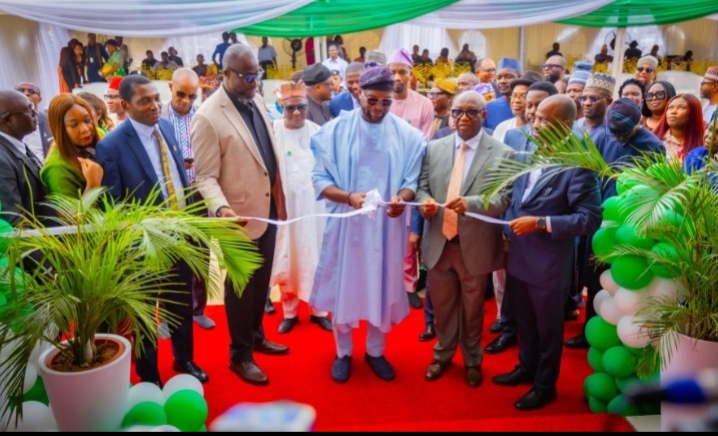
Abuja| NDPC new headquarters commission , Tuesday, 15 September,2026.
An EFCC-recovered property allocated to the Ministry of Communications, Innovation & Digital Economy, has been transformed to the new headquarters of the Nigeria Data Protection Commission (NDPC) in Abuja, as its headquarters.
Speaking during the commissioned ceremony of the building, the Honourable Minister incharge of the ministry, Dr. ‘Bosun Tijani, described the facility as a tangible demonstration of the visionary leadership of President Bola Ahmed Tinubu, and his commitment to building strong institutions that can support Nigeria’s growing digital economy.
The Minister emphasised that said the occasion represented more than the opening of a new office, but a reflection of the administration’s commitment to strengthening the institutions required to protect Nigerians and build trust in the country’s digital economy.
Dr. Tijani said, “Shortly after assuming office in 2023, President Tinubu signed the Nigeria Data Protection Act into law, giving the NDPC the appropriate legal foundation and authority to protect the data and privacy rights of Nigerians.
The President also directed Ministries, Departments and Agencies of the Federal Government to comply with established data protection laws and frameworks, demonstrating that government must lead by example in upholding the standards it expects from citizens and businesses.”
He added, “In the early days of the Commission, it was difficult to ask an institution to protect the data of over 200 million Nigerians and support one of Africa’s largest digital economies without the institutional resources to do so.
President Tinubu recognised this challenge and moved to solve it, approving the resources required for the NDPC to become properly operational and functional, while building towards becoming a sustainable institution in its own right.
He also directed that an EFCC-recovered property be allocated to the Commission as its headquarters.
“An asset recovered on behalf of the Nigerian people has now been returned to productive use for the Nigerian people. That is reform made tangible,” he said .

Boko Haram has strongly denied reports of a ceasefire agreement with the Federal Government and insisted that it will continue its campaign of attacks.
In a statement released by the group, the militants dismissed claims of any truce or negotiated pause in hostilities, describing such reports as false and misleading.
The group reaffirmed its commitment to ongoing operations against government forces and other targets, vowing that its attacks will persist without interruption.
The denial comes against the backdrop of persistent insecurity in the northeast and other affected regions, where the group has maintained a long-standing insurgency.
Security sources note that the latest statement appears aimed at clarifying the group’s position and rejecting any suggestion of dialogue or de-escalation with the authorities.
Military and government officials have not issued an immediate detailed response to the claim, though security operations against the militants remain active. Authorities continue to urge vigilance as the group signals its intention to sustain violence.


CBN, MOF sign pact to align monetary, fiscal policies

Macron Hosts Tinubu for Private Dinner at Élysée Palace (Photos)

Madonna Returns To MTV Video Music Awards, After 23 years

Tech Expert, Zuckerberg trains with UFC champions, Adesanya, Alexander

Organ Trafficking: Ekweremadu bags 10 years in UK prison

