News
Sanwo-Olu Introduces Law to Regulate Electricity Production and distribution in Lagos


Lagos State Governor, Babajide Sanwo-Olu, on Tuesday signed the Lagos State Electricity Bill 2024 into law. The law is aimed at teansforming electricity production and distribution in Lagos State, especially the Independent Power Plants (IPP).
The event held at Lagos House, Alausa, Ikeja, was attended by key officials including Deputy Governor Dr. Femi Hamzat, Chairman of the Lagos State House Committee on Energy and Mineral Resources Sabur Oluwa, Attorney General and Commissioner for Justice Pedro Lawal, Commissioner for Energy and Mineral Resources Biodun Ogunleye, and Commissioner for Information and Strategy Gbenga Omotoso.
Sanwo-Olu, said that the Lagos State Electricity Law 2024 aims to: Establish a technically sound, financially viable, and well-regulated Lagos Electricity Market.
Ensure access to affordable, reliable, and sustainable electricity for all residents. Promote diverse energy sources, including renewable energy, and encourage energy efficiency.
Foster investment, competition, and innovation in the electricity sector. Extend electricity access to underserved areas to support sustainabledevelopment.
Commissioner for Energy and Mineral Resources Biodun Ogunleye announced that the law’s implementation will begin within six months, pending final approval from the Federal Government .
The law creates several regulatory bodies to manage the electricity market: Lagos State Electricity Regulatory Commission (LASERC): Ensures compliance and oversees licensing. Lagos Independent System Operator (ISO): Responsible for maintaining system reliability and operational efficiency.
Lagos State Electrification Agency: Tasked with expanding electricity access to underserved communities.
Electrification Funds: Allocated for financing electrification projects and sustainable energy solutions in underserved areas.
Community Trust Fund: Requires power generating companies to allocate a percentage of their previous year’s operating expenditure to host community development.
Power Enforcement Unit: Charged with addressing electricity theft and infrastructure damage.
The Lagos State Electricity Law 2024 represents Governor Sanwo-Olu’s commitment to resolving long standing energy challenges, laying the foundation for economic growth, industrial development, improved quality of life, and environmental sustainability.


Former Delta State Governor Dr. Emmanuel Eweta Uduaghan is dead. He passed away on the morning of Monday, October 19, 2026, at the age of 71, after a period of illness.
A family statement announced his death, describing it as a devastating loss. Uduaghan, a medical doctor, served as Delta State Commissioner for Health (1999–2003) and Secretary to the State Government (2003–2007) before becoming governor from 2007 to 2015. He was known for contributions to infrastructure and human capital development in the state.
Delta State Governor Sheriff Oborevwori has expressed deep sadness over the passing. In a condolence message, he described Uduaghan as a detribalised leader whose service left a lasting mark on Delta State.
Oborevwori extended heartfelt condolences to Uduaghan’s wife, Roli, his children, the Uduaghan family, the Itsekiri nation, and the people of Delta State, praying for the peaceful repose of his soul.
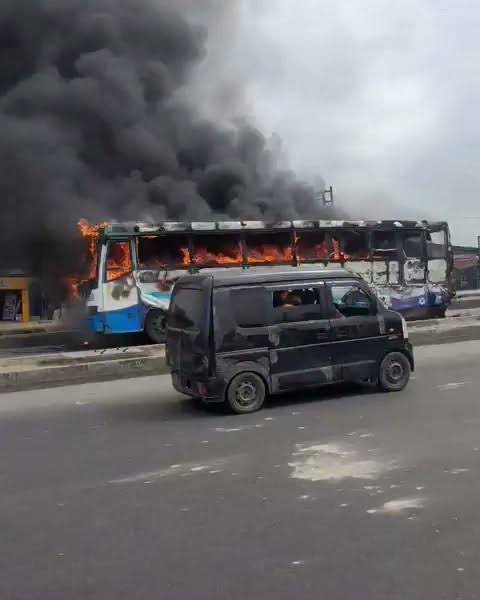
An angry mob has set a Bus Rapid Transit (BRT) bus on fire after it reportedly crushed a commercial motorcyclist to death at Ogolonto Bus Stop along Ikorodu Road in Lagos State.
The incident occurred on Friday, October 16, 2026. Eyewitness accounts and social media reports indicate that the motorcyclist was riding alone along the restricted BRT lane when the collision happened. He died at the scene.
Enraged residents and youths then attacked the bus driver and set the vehicle ablaze. Police officers and officials of the Lagos Neighbourhood Safety Corps (LNSC), who were nearby, intervened promptly and rescued the driver unharmed.
The identity of the deceased motorcyclist and the exact circumstances of the crash had not been officially confirmed at the time of filing this report. It was also unclear whether any arrests had been made in connection with the burning of the bus.
News
ARISE News Wins Seven Honours At Nigerian Broadcasters Merit Awards
The awards recognised the network’s achievements in television journalism and programming, with ARISE News winning the Best TV Channel (Viewer’s Choice) category.

• ARISE News Anchor and host of What’s Trending Ojy Okpe was named Best Newscaster (TV – Female)
ARISE News has emerged as one of the major winners at the just ended Nigerian Broadcasters Merit Awards (NBMA).
ARISE News won seven honours across television broadcasting, news reporting, presentation and production during the ceremony.
The awards recognised the network’s achievements in television journalism and programming, with ARISE News winning the Best TV Channel (Viewer’s Choice) category.
The network’s flagship breakfast programme, The Morning Show, also won the Best TV Talk Show award, further strengthening its recognition in television broadcasting.
ARISE News Anchor and host of What’s Trending Ojy Okpe was named Best Newscaster (TV – Female).
Rufai Oseni was named Nigerian Broadcaster of the Year (Male), while Vimbai Mutinhiri-Ekpeyong received the Nigerian Broadcaster of the Year (Female) award.
The recognition extended to the network’s newsroom, with Ovieteme George winning Best TV News Reporter (Male) for his contributions to television news reporting.
Behind the camera, Sam Adeyemi received the Best Camera Operator/Cinematographer award, recognising his work in television production and visual storytelling.


Mbappé wins Onze d’Or award for 2025/26 season

Ronaldo Gets 30-Day Suspension For Portugal Camp Walkout

JUST IN: Ex-Delta Gov Uduaghan Dies at 71, Oborevwori Mourns

BREAKING: Lagos Govt Declares Today, Thursday Work-Free to Mark 2026 Ìṣẹ̀ṣe Day

Tech Expert, Zuckerberg trains with UFC champions, Adesanya, Alexander