
News
Nnamdi Kanu: MASSOB leader dissociates self from IPOB, Dokubo’s face-off


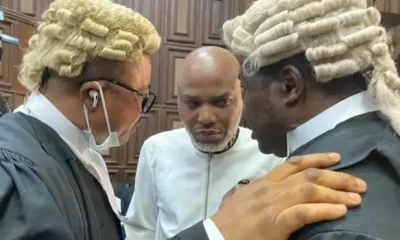
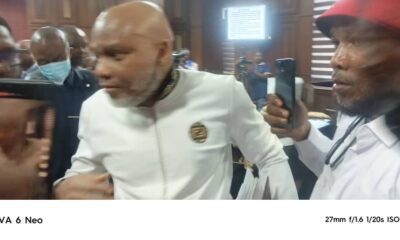
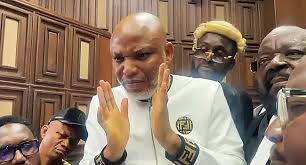
The head of Biafra Independence Movement and Movement for the Actualisation of Sovereign State of Biafra, Chief Ralph Uwazuruike, has disassociated himself from the conflict between the Indigenous people of Biafra and Alhaji Mujahid Asari Dokubo, the former head of the Niger Delta People’s Volunteer Force, on Friday.
According to a statement made on his behalf by Mazi Chris Mocha, his Director of Information and Senior Special Assistant on Media and Publicity, Uwazuruike is only concerned with how IPOB leader, Nnamdi Kanu, can be freed from the Department of State Services prison, not what Asari Dokubo said on social media.
Uwazuruike said those accusing him of conniving with Dokubo should go and verify from Dokubo if both of them had spoken as friends for the past three years.
He recalled how he visited Dokubo in 2002 in Port-Harcourt when the former militant leader told him that the issue of Biafra was not one to be achieved through non-violence, stressing that violence was the only language that the Federal Government understood.
He said, “I do not even have Asari Dokubo’s phone number, let alone talking with him on the phone. It has gotten to about three years now since we last talked, either on the phone or in a friendly conversation.
“If you had a problem with Asari Dokubo, you should better clarify that with him and not drag Ralph Uwazuruike into the matter.
“I am a non-violent crusader, known all over the world and everyone should fight his own battles, carry the cross and not call me to do that for you.
“So Asari had never worked with me on the path of non-violence struggles, and when he was championing the cause for Niger Delta people, he took up arms and ammunition against the Federal Government, which everyone could testify to.”
Uwazuruike described Dokubo as a man who matches his words with action and urged those who are insulting him on social media platforms to go and face him squarely.
He added that Dokubo’s comments asking the Federal Government not to release Nnamdi Kanu were his personal opinion, as guaranteed by the 1999 Constitution as amended.
He noted that his opinion cannot override those of the apex Igbo socio-cultural organisations, Ohanaeze Ndigbo and South-East Governors Forum, among others, that have been demanding his release.
Uwazuruike said he is only preoccupied with the process that will lead to the release of the leader of IPOB from DSS custody, not talking about irrelevant matters about who said what and who said the other.
He urged the Federal Government to release Kanu because it is against the rule of law that one should be held incommunicado for this long in a DSS facility, even after several courts of competent jurisdiction had ordered his immediate release.





News
Police begins enforcement on vehicles with covered number plates
Lagos State police public relations officer SP Abimbola Adebisi, in a statement, explained that ,” The exercise will commence today, June 15, 2026, and will be led by the Commissioner of Police,Tijani Fatai.

The Lagos State Police Command has directed all Area Commanders, Divisional Police Officers (DPOs), across the State to commence enforcement exercise against vehicles with covered, obscured, unauthorised, defaced or no registration number plates.
This was n compliance with the directive of the Inspector-General of Police, IGP Olatunji Disu.
The Command said that the enforcement is aimed at enhancing public safety, strengthening security, and denying criminal elements the opportunity to conceal their identities and activities.
Lagos State police public relations officer SP Abimbola Adebisi, in a statement, explained that ,” The exercise will commence today, June 15, 2026, and will be led by the Commissioner of Police,Tijani Fatai.
He further directed that any vehicle found violating the directive be impounded and subjected to thorough investigation in accordance with extant laws and established procedures.
News
DHQ vows justice for slain retd Gen Rabe
Receiving the delegation on behalf of Governor Dikko Radda, Deputy Governor Faruk Jobe thanked the military leadership for the show of solidarity and support.
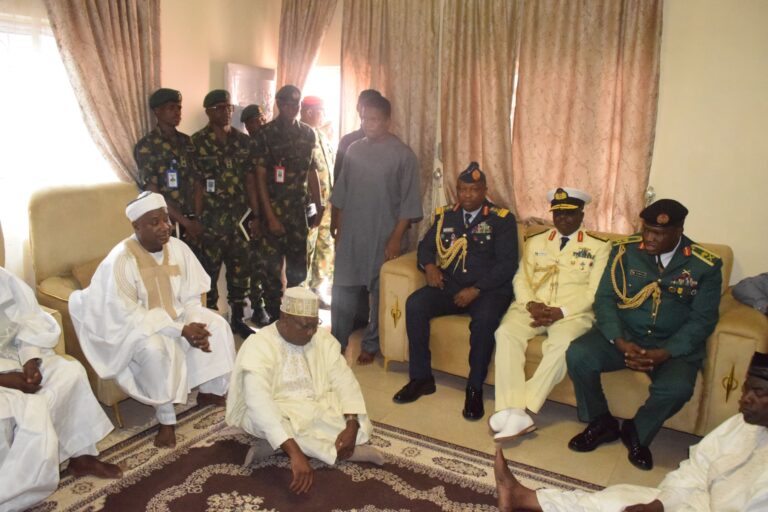
Photo: Other members of the delegation included Maj.-Gen. W.B. Idris, Rear Adm. A.H. Haruna, Maj.-Gen. B.P. Koughna, Brig.-Gen. I.M. Ibrahim, Brig.-Gen. S.K. Usman (retd), S.I. Kaita (retd), Maj.-Gen. M.S. Bindawa (retd) and A.Y. Abdullahi.
The Defence Headquarters (DHQ) has assured that those responsible for the death of retired Maj.-Gen. Rabe Abdullahi will be brought to justice.
The assurance was given yesterday when a high-powered military delegation paid a condolence visit to the Katsina State Government.
The delegation, led by the Chief Administration Officer, Defence Headquarters, Maj.-Gen. I.M. Abdullahi, conveyed the condolences of the Armed Forces of Nigeria to the government and people of Katsina State over the death of the retired senior military officer.
Abdullahi described the late Rabe as a distinguished officer whose service and sacrifice to the nation would remain indelible.
He said that the retired general’s death was a painful loss to his family, Katsina State, the Armed Forces and the nation at large.“We share in the grief of the people of Katsina and the family of the deceased.
The Armed Forces will continue to work with relevant security agencies to ensure that those responsible are identified and brought to justice,” he said.
Other members of the delegation included Maj.-Gen. W.B. Idris, Rear Adm. A.H. Haruna, Maj.-Gen. B.P. Koughna, Brig.-Gen. I.M. Ibrahim, Brig.-Gen. S.K. Usman (retd), S.I. Kaita (retd), Maj.-Gen. M.S. Bindawa (retd) and A.Y. Abdullahi.
Receiving the delegation on behalf of Governor Dikko Radda, Deputy Governor Faruk Jobe thanked the military leadership for the show of solidarity and support.
Jobe said the visit underscored the strong partnership between the state government and the military in the fight against insecurity.
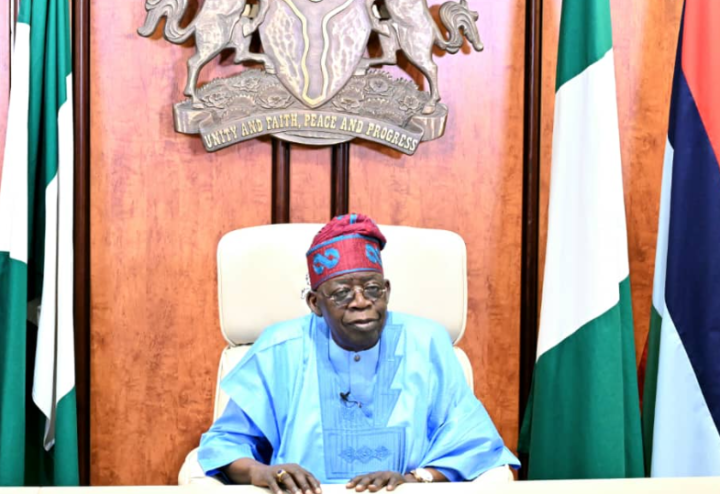
Nigeria’s President, Bola Ahmed Tinubu has addressed Nigerians following the marking of June 12 Democracy Day today.
The President speaks on economic reforms, and new minimum wage.
Read full speech below:
Fellow Nigerians
Today, we celebrate not only democracy but also the enduring Nigerian spirit. For 27 unbroken years, since May 29, 1999, Nigerians have chosen their leaders through the ballot, witnessed peaceful transitions of power, and resolved disagreements in courtrooms and legislative chambers—not through violence. We have experienced the longest stretch of civilian rule in our history. Our democracy is not perfect, but it is ours, and we must continue to defend and strengthen it.
In the coming days, Ekiti and Osun States will hold elections. I urge INEC, security agencies, and all parties to ensure these polls are peaceful and credible. Democracy fails when citizens doubt the process. To our National Assembly, Judiciary, the Press, and Civil Society: you are the guardrails of our republic. Criticise me, disagree with me, but never stop believing in Nigeria.
To our young people: Nigeria is your home and your future. Build here, code here, work here, and vote here. Every great nation was built by those who stayed to solve problems, not by those who abandoned ship.
To our armed forces, police, and intelligence services: Nigeria salutes your sacrifice. To our traditional rulers, faith leaders, and community heads: thank you for your support of peace and reconciliation. The government cannot do it alone.
Today, we honour the resilience of Nigerians who refused to surrender their faith in freedom, and the courage of those who stood firm against intimidation. We pay tribute to patriots who endured persecution, imprisonment, exile, and even death so that future generations could enjoy democracy. I salute labour leaders, journalists, activists, students, women, professionals, political leaders, and soldiers—both those who have passed and those still with us—for their patriotic contributions.
Though this year’s mood is dampened by the abduction of our children in Oyo and Borno, we remain hopeful for their safe return. Democracy without security is a mirage. That is why this administration declared a security emergency and approved the recruitment of more than 50,000 new police officers and thousands of military recruits. Our 2026 budget commits N5.41 trillion—our largest ever—to defence and security. Our administration is ever ready to do much more to secure our people.
We have moved from training with our allies, the United States, France and other European countries, to precision targeting. In Arege, Borno State, we degraded ISWAP’s command centre. Terror-related deaths are down by 81% since 2015. Over 13,000 terrorists have been neutralised in the past year. But we also keep the door of surrender open. Over 124,000 fighters and dependents have laid down their arms since 2023 through Operation Safe Corridor.
To bandits, kidnappers, and sponsors of terror: Surrender or face the full force of the Nigerian State. These windows of surrender will not remain open forever. No mercy will be shown to those who trade in the blood of Nigerians.
At a time like this, let us not assign blame or point fingers. Crime has no ethnicity. We must stand united and be assured that the enemies of our nation shall soon be history. We will triumph over terror and continue to build a more prosperous nation.
June 12 occupies a sacred place in our national memory. It represents more than an election; it is a defining chapter in our story. We remember Chief M.K.O. Abiola, who won a pan-Nigerian mandate transcending ethnicity and religion. We remember Alhaja Kudirat Abiola.
We also remember Chief Gani Fawehinmi, Chief Bola Ige, Chief Alfred Rewane, Pa Abraham Adesanya, Chief Anthony Enahoro, Alhaji Balarabe Musa, Commodore Dan Suleiman, Dr Beko Ransome-Kuti, Frank Kokori, Arthur Nwankwo, Chima Ubani, Shehu Musa Yar’Adua, and the many other heroes and heroines of democracy whose sacrifices helped secure the freedoms we enjoy today.
As beneficiaries of their struggle, we have a duty to strengthen and deepen the democratic institutions for which they fought. The greatest tribute we can pay is to build a Nigeria where freedom is protected, justice is upheld, opportunity is expanded, and government is accountable.
June 12, 1993, revealed the possibility of a true Nigerian nation. The heroes of June 12 secured political freedom. Our challenge is to secure economic freedom. Democracy must be felt in the quality of people’s lives—in opportunities for youth, in prosperous farmers, successful entrepreneurs, and the dignity of our workers.
The reforms we are undertaking were not chosen for ease, but for necessity. Three years ago, our public finances were under severe strain, investment was discouraged, and economic uncertainty threatened our future. We chose to act, embracing reforms to advance Nigeria’s economic freedom.
Since 2023, our reforms have restored stability and credibility to economic management. Federation revenues have risen, providing states and local governments with more resources for infrastructure, education, healthcare, and security. Fiscal transparency has improved, leakage has been reduced, and public funds are better directed to national priorities. Investor confidence has returned, with investments in agriculture, energy, manufacturing, technology, mining, transportation, and the creative industries growing.
Domestic refining capacity has increased, strengthening energy security and reducing our reliance on imported petroleum products.
By 2023, when we came on board, the electricity sector was characterised by chronic generation shortfalls, an unreliable gas supply, and transmission infrastructure so fragile that it could not evacuate available power. Distribution companies were burdened by massive losses and a metering deficit of over four million. Worst of all, the value chain was drowning in legacy debt. The result was a sector that generated less than the 13,500 Megawatts installed capacity, a sector that transmitted less than it generated, distributed less than it transmitted and collected revenue far below what it needed to sustain itself.
To address the problems besetting the sector, I signed the Electricity Act, which grants states authority to generate, transmit, and distribute power. The Presidential Power Sector Task Force is working hard to reduce the metering deficit. It has also been authorised to raise N4 trillion bond to settle verified legacy debts. The Rural Electrification Agency, supported by the World Bank and the African Development Bank, has deployed off-grid and mini-grid power to underserved communities, universities, markets, and hospitals. Electricity is a democratic dividend we owe every Nigerian. We intend to deliver it.
Across the country, infrastructure projects are connecting producers to markets and creating opportunities for enterprise and employment. The National Agricultural Development Fund is deploying 10,000 tractors over five years. Over 1,000 SMEs have been certified for export. Non-oil exports grew by 21% last year.
Yet, many Nigerians still face economic hardship. We remain focused on reducing inflation, expanding food production, creating jobs, improving living standards, rebuilding confidence in our economy, and creating conditions for sustainable prosperity.
We are moving from uncertainty to stability. The next phase is about accelerating growth and ensuring the benefits are felt in every home, every community, and every region. We believe that Democracy must be felt in the pocket.
Recognising that democracy is undermined when people do not feel its impact, my administration has sought financial autonomy for our 774 local councils. A fundamental challenge to our nation’s advancement has been ineffective local government administration. The insecurity we are addressing is partly due to the collapse of grassroots governance. The Renewed Hope Agenda is about ensuring that all Nigerians benefit from governance.
Every generation has a defining responsibility. The generation of our founding fathers secured independence—the generation of June 12 secured democracy. Our generation must secure prosperity.
Let us move forward together—rejecting division, cynicism, and despair; embracing unity, hope, and confidence. Let us build a Nigeria united by a common purpose, strengthened by diversity, where justice is accessible, liberty is secure, and opportunity is abundant.
Among the architects of modern democratic Nigeria, we honour General Shehu Musa Yar’Adua for his vision of national partnership. In recognition of his contributions, the Federal Government has approved the revitalisation and renaming of the completed Institute of Petroleum Studies, Kaduna, as the General Shehu Musa Yar’Adua University of Geological Sciences and Engineering Technology.
I am also pleased to announce national awards to the following Nigerians, who suffered persecution, endured indignities, exile, incarceration, and, at times, solitary confinement, so that we have democracy today.
Barrister Ayoka Lawani
Tunde Fagbenle
Oladele Alake
Olatunji Bello
Louis Odion
Segun Babatope
Sam Omatseye
Sir Ademola Osinubi
Bola Bolawole
Lade Bonuola
Femi Kusa
Debo Adeniran
Chief Ayo Opadokun
Chief Ralph Obiora
Ose Osayande
Barrister Osa Director
Prof. Sylvester Odion-Akhaine
Dr Arthur Nwankwo (Posthumous)
Dr Osagie Obayuwana
Dr Joe Okei-Odumakin
Barrister Titus Mann
Joe Igbokwe
Richard Akinnola
Ben Charles-Obi (Posthumous)
George Mbah
Dr Niran Malaolu
Major-General Ishola Williams (rtd)
Femi Aborisade
Jenkins Alumona
Gbemiga Ogunleye
Muyiwa Adekeye
Babajide Kolade-Otitoju
Ike Okonta
We also recognise the soldier-democrats of the June 12 struggle:
Major General MA Garba
Brigadier General Lawal Jaafaru Isa
Col Umar Farouk Ahmed;
Col Sambo Dasuki;
Col Lawan Gwadabe;
Brigadier Jonathan Ndam Temlong
Col Musa Shehu;
Major General Chris Eze;
Major General Harris Dzarma;
Col Isa Jibrin;
Maj. General Joseph Oshanupin;
Col Olusegun Oloruntoba, Olugbede of Gbede Kingdom)
Lieutenant Colonel Happy Kefas Bulus
Col J Okai;
Col Emmanuel Ndubueze;
Lt Col Yakubu Muazu
Brigadier Yahaya Abubakar, the Current Etsu Nupe, who is already the holder of the CFR title.
The honours list will be released in the next few days.
Fellow Nigerians, 27 years ago, many doubted democracy would survive here because of our diversity. Today, our diversity sustains our democracy. The road ahead is steep. But June 12 reminds us: Nigerians do not break. We bend, we bleed, but we do not break.
Let us renew our covenant: That the labours of our heroes past shall never be in vain, and that government of the people, by the people, for the people, shall not perish from this land.
May God bless the heroes of our democracy. May God bless the Federal Republic of Nigeria. May God continue to bless us all.
Happy Democracy Day.
BOLA AHMED TINUBU, GCFR
President and Commander-in-Chief of the Armed Forces, Federal Republic of Nigeria


Edo Queens Win 2025/26 NWFL Title

World Cup: Japan Holds Netherlands To 2-2 Draw

Police begins enforcement on vehicles with covered number plates

Tech Expert, Zuckerberg trains with UFC champions, Adesanya, Alexander

Organ Trafficking: Ekweremadu bags 10 years in UK prison

SAINT OBI: Between his marriage and his death
-
 Opinions3 days ago
Democracy Still Struggling 33 Years After June 12, PDP Laments by Comrade Ini Ememobong
-
 Crime2 days ago
Bandits Kill 19 Farmers, Injure 12 Others in Fresh Attack in Zamfara
-
 Crime2 days ago
BREAKING: Retired General Dies in Kidnappers’ Captivity, Demand Release of Gang Members
-
 Sports4 hours ago
World Cup: Sweden beats Tunisia 5-1
-
 Sports2 days ago
Balogun: This is something I dreamed of for a long time
-
 Sports2 days ago
FIFA World Cup 2026 Day 3: Qatar draws Switzerland 1: 1
-
 Sports2 days ago
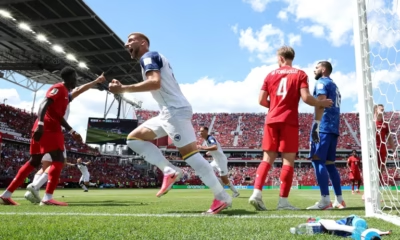
FIFA World Cup Day 2: Canada holds 1-1 Bosnia-Herzegovina
-
 International4 hours ago
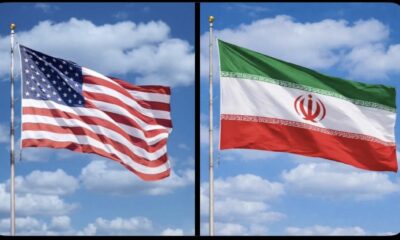
US and Iran to sign historic peace deal June 19 in Switzerland