
Business
CBN orders banks to reverse failed ATM transactions immediately
The requirement will be implemented gradually over three years, with banks expected to meet 30 percent of the threshold in 2026, 60 percent in 2027 and full compliance by 2028.

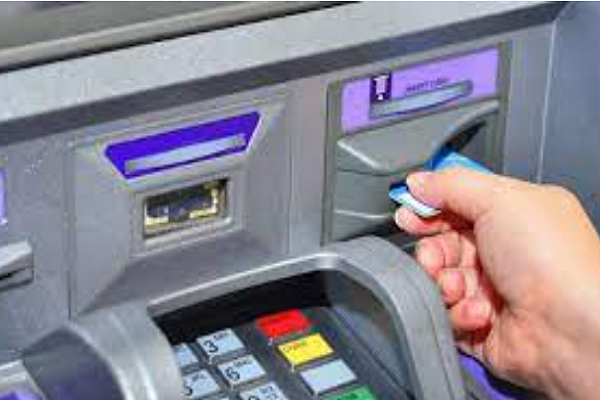
The Central Bank of Nigeria (CBN) has directed banks to immediately reverse failed automated teller machine (ATM) transactions.
The apex bank said that the revised framework is designed to strengthen ATM service reliability, improve fraud monitoring, enhance security and ensure stronger consumer protection across Nigeria’s fast-growing digital payments ecosystem., tightening rules aimed at improving consumer protection and reliability across the country’s payment infrastructure.
Beyond refund timelines, the regulator introduced new requirements for ATM deployment nationwide.
All card issuers are required to deploy at least one ATM for every 7,500 payment cards issued.
The requirement will be implemented gradually over three years, with banks expected to meet 30 percent of the threshold in 2026, 60 percent in 2027 and full compliance by 2028.
Under new Guidelines on the Operations of Automated Teller Machines in Nigeria, the apex bank said failed “on-us” ATM transactions, where a customer uses the ATM of their own bank, must be reversed instantly. Where an instant reversal fails due to technical issues or system glitches, banks are required to complete a manual reversal within 24 hours.
For failed “not-on-us” transactions, where a customer uses another bank’s ATM, the refund timeline must not exceed 48 hours.
The guidelines also state that automated reversals for on-us transactions should occur in less than five minutes, while not-on-us transactions should be resolved in less than 15 minutes where automated systems function properly.
The CBN added that in cases where transaction failures arise from biometric mismatch or device errors, ATM operators must provide an immediate fallback to non-biometric verification where it is considered safe.
Such events must also be logged for diagnostics while the stipulated refund timelines are maintained.
The Central Bank also directed that ATMs must be located within reasonable proximity to one another across both urban and rural areas, while deployment, relocation or decommissioning of machines must receive prior written approval from the regulator.
The guidelines also set operational and service benchmarks for ATM operators.

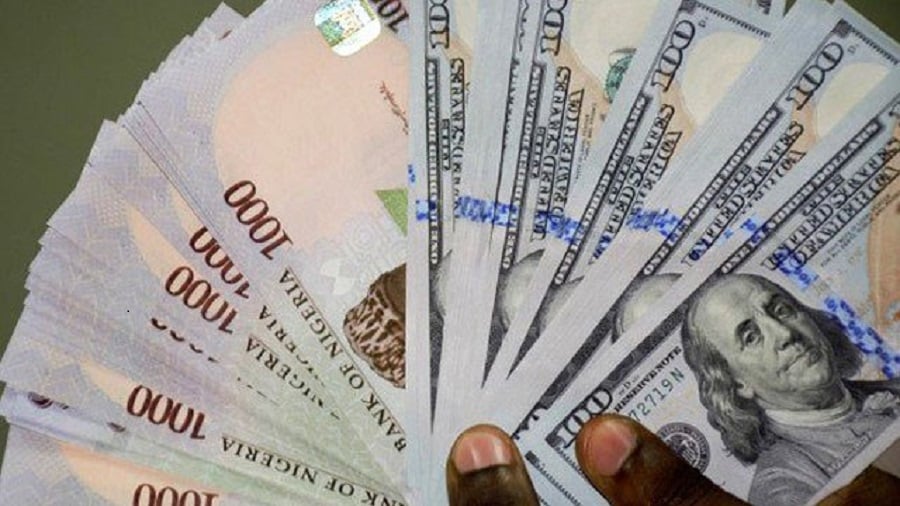
BLACK MARKET RATES
US DOLLAR (USD) Buy ₦1,416 Sell ₦1,423
GREAT BRITISH POUND (GBP) Buy ₦1,890 Sell: ₦1,910
EURO (EUR) Buy ₦1,590 Sell ₦1,610
CANADIAN DOLLAR (CAD) Buy ₦1,020 Sell ₦1,080
SOUTH AFRICAN RAND (ZAR) Buy ₦75 Sell ₦90
UAE DIRHAM Buy ₦350 Sell ₦370 CHINESE YUAN Buy ₦190 Sell ₦205
GHANA CEDI (GHS) Buy ₦95 Sell ₦110
WEST AFRICAN CFA Buy ₦2, 300 Sell ₦2, 400
CENTRAL AFRICAN CFA Buy ₦2,150 Sell 2,250
AUSTRALIAN DOLLAR Buy ₦800 Sell ₦900
CBN Exchange Rates
US DOLLAR (USD) ₦1,357. 65
GREAT BRITISH POUND (GBP) ₦1,834.04
EURO (EUR) ₦1,567.00
SWISS FRANC (CHF) ₦1,671. 98
JAPANESE YEN (JPN) ₦8.53
CHINESE YUAN (CNY) ₦201. 34
WEST AFRICAN CFA (XOF) ₦2. 39
WEST AFRICAN UNIT ACCOUNT (WAUA) ₦1,858.02
SAUDI RIYAL (SAR) ₦361.62
SOUTH AFRICAN RAND (ZAR) ₦84.23
Business
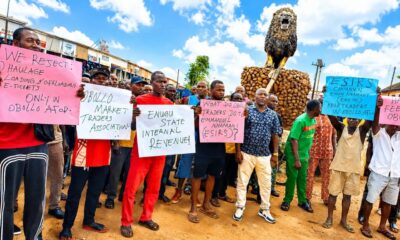
Traders shut down Enugu ‘s Obollo-Afor market over N25,000 haulage levy
However, Chairman of ESIRS, Emmanuel Nnamani, in a letter to the traders, said the haulage levy was not paid by traders buying or selling goods in the markets, but was applicable strictly to truck drivers plying interstate routes.
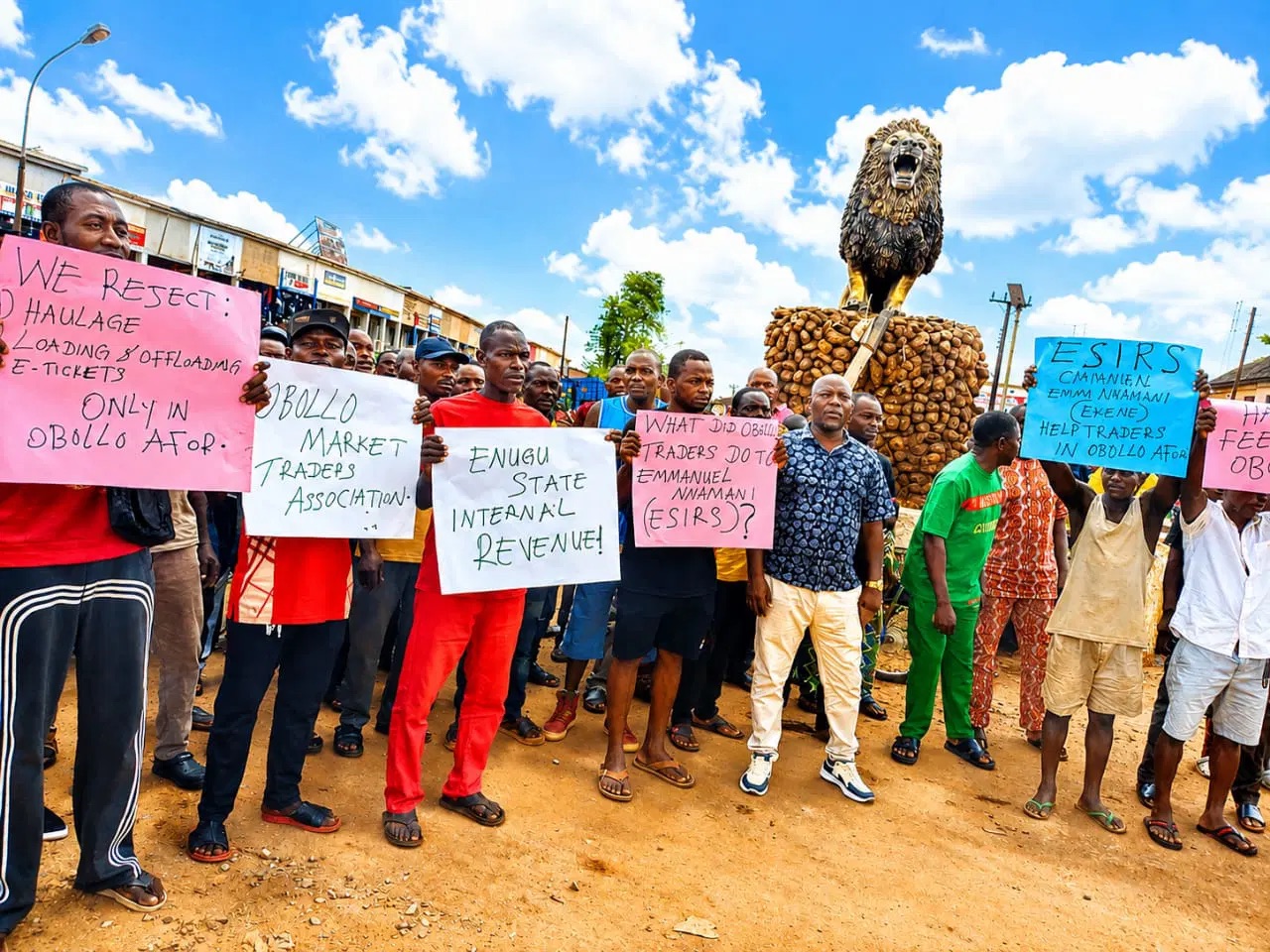
All shops and markets at Obollo-Afor, Udenu Local Government Area of Enugu State were shut yesterday, as traders staged a peaceful protest against alleged selective collection of a N25,000 haulage levy in the market.
The traders, who locked their shops and took to the streets in large numbers, carried placards with various inscriptions, alleging that the Enugu State Internal Revenue Service (ESIRS) had singled out Obollo-Afor Market for the collection of N25,000 haulage fee on every truckload of goods loaded or offloaded in the market.
However, Chairman of ESIRS, Emmanuel Nnamani, in a letter to the traders, said the haulage levy was not paid by traders buying or selling goods in the markets, but was applicable strictly to truck drivers plying interstate routes.
Addressing officials of the Udenu Local Government Council at the council secretariat, where the protesters marched to present their grievances, Chairman, Obollo-Afor Market Traders Association, Charles Eze, lamented that truck operators bringing foodstuffs, building materials, and other commodities to the market had stopped coming because of the levy.
Business
Nigeria’s oil production dropped by 4% in July – NUPRC
“In the month under review, the daily peak production of crude oil and condensate was 1.78mbpd, while the lowest daily production was 1.57mbpd.”

The Nigerian Upstream Regulatory Commission (NUPRC) data has shown Nigeria’s average daily oil production fell by four percent in July, 2026.
According to the NUPRC, Nigeria produced 1.505 million barrels per day (bpd) of crude oil and 0.17 million bpd of condensate, bringing the combined daily production to 1.67 million bpd.
The commission said the country met and exceeded its Organisation of the Petroleum Exporting Countries (OPEC) quota of 1.5 million bpd for the third consecutive month.
“In the month under review, the daily peak production of crude oil and condensate was 1.78mbpd, while the lowest daily production was 1.57mbpd.”


Osun Poll: Youths Accuse APC of Vote-Buying in Ejigbo (Video)

HAPPENING NOW: Security Beefed up at INEC Office in Osun Ahead of Saturday’s Governorship Election

Gov Mbah Invest in world-class Enugu International Hospital

Tech Expert, Zuckerberg trains with UFC champions, Adesanya, Alexander

Organ Trafficking: Ekweremadu bags 10 years in UK prison

SAINT OBI: Between his marriage and his death
-

 Business3 days ago
Guaranty Trust Bank doubles naira card international spending limit to $40,000
-

 Business3 days ago
FG approves tax waivers for 4,000 electric vehicles
-

 Business3 days ago
Azikel Refinery in Bayelsa Set To Add 25,000 bpd To National Capacity
-

 Business3 days ago
Naira Exchange Rates Thursday, August 13
-

 Business3 days ago
Nigeria’s oil production dropped by 4% in July – NUPRC
-

 Sports3 days ago
Katsina United player declared dead found alive in mortuary
-

 Politics1 day ago
Osun Election: President Tinubu mobilises Voters “Go Out to Vote Candidate of Your Choice on Saturday Without Fear
-
 Business3 days ago
Traders shut down Enugu ‘s Obollo-Afor market over N25,000 haulage levy