
Business
Nigeria To Privatise Raw Materials Sector for Growth – Minister

Set up Council for Industrial Revitalisation
▪︎ MAN, RMRDC agog
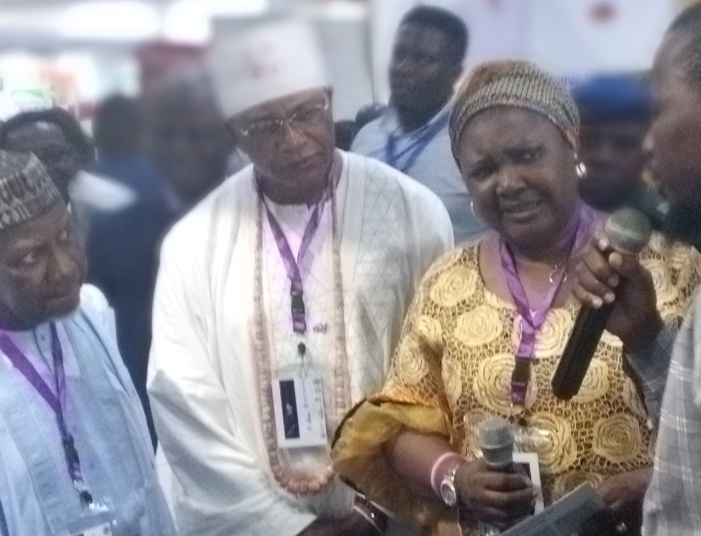
Cover image: From left to right: Interim Chairman of Pan African Manufacturers Association, Engr Mansur Ahmed; MAN President, Otunba Francis Meshioye; Deputy Director, Federal Ministry of Industry, Trade and Investment, Olumuyiwa Ajayi-Ade, at the NME, and NIRAM EXPO 2023 in Lagos.
By Ocheneyi Alli
The Federal Government of Nigeria is considering to privatise the country’s industrial raw materials sector for development by local or foreign investors.
Doris Anite Uzoka, the Minister of Industry, Trade and Investment, gave this hint, during the Manufacturers Association of Nigeria (MAN), and the Raw Materials Research and Development Council (RMRDC)’s ongoing Manufacturing Equipment and Raw Materials Exposition, in Lagos.
At the event which will end tomorrow, themed ‘ Future Manufacturing: A Roadmap To Enabling Environment With Sustainable Industrialisation,’ the Minister said ,” we must privatise our raw materials sector to support our Manufacturing industries and by focusing on value addition and local content development; we can reduce our reliance on imported raw materials and improve the overall competitiveness of our products.
This will also contributes to the growth of the SMEs and empower local entrepreneurs to participate actively in the manufacturing value chain.
Represented by Olumuyiwa Ajayi- Ade, a Deputy Director at the ministry, the Minister, also disclosed : ” since my assumption of office, with the approval of President Tinubu, a Presidential Council For Industrial Revitalisation, has been established, with the Minister of Finance and Coordinating Minister of the Economy – Wale Edun, as the Chairman, and myself as the Vice Chair.
In addition, various Task Forces have been formed to effectively implement the mandates of the Presidential Council…”
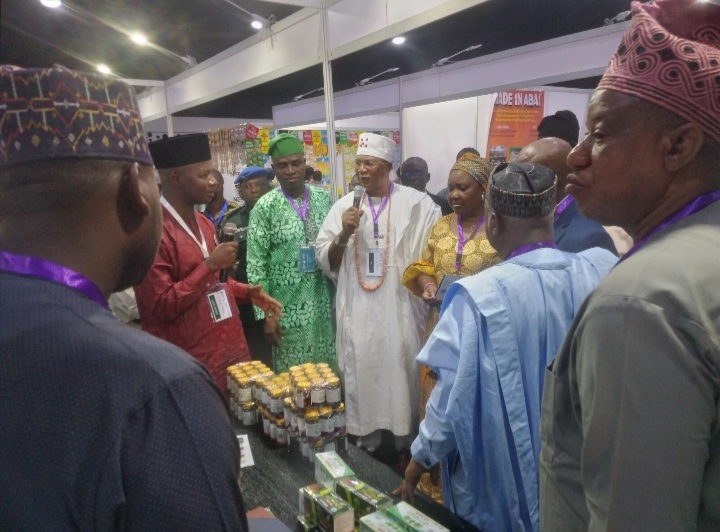
In picture: A tour of the RMRDC exhibition stand by the representative of the Minister, Olumuyiwa Ajayi -Ade, led by Otunba Francis Meshioye, President of MAN, and other top dignitaries
The Minister enjoined all the stakeholders- manufacturers, policy makers , investors including the industry experts to ” let us work together to shape the manufacturing sector in Nigeria, in-line with Mr. President’s “Renewed Hope Agenda.”
There are so many projects now at the RMRDC… if only we can get genuine and willing investors to take over these projects and start the raw materials productions in large quantity. It will go a long way in the supply of raw materials for our industries
Dr. Abubakar Aliyu, a former Permanent Secretary of the Ministry of Innovation, Science and Technology , applauded the government’s policy intention to privatise the country’s raw materials sector, given the facts that the efforts of the RMRDC alone coupled with the 100 companies operating in the sector are not enough to meeting the industrial sector’s demands for local raw materials.
Dr. Aliyu, a former Director-General of the RMRDC, spoke as the guest speaker on the topic ‘ Opportunities For Jobs Creation and Wealth Generation with Emphasis on Raw Materials Value Addition.
He said that since the establishment of the RMRDC in 1987 till- date , it had researched , developed, patented and established 100 Technology Innovation Centers (TICs) to address local raw materials development.
All these TIC have been brought under one umbrella because of the insecurity situations across the country now.
We can hardly move to every sites where there are raw materials to establish model factories. This was why the TIC have been brought under one location in Abuja.
There are so many projects now at the RMRDC.. if only we can get genuine and willing investors to take over these projects and start the raw materials productions in large quantity. It will go a long way in the supply of raw materials for our industries.
He further said that besides the 100 TICs, there are 100 individual companies that have been producing fertiliser raw materials in Nigeria.
” Unfortunately, the 100 companies are not able to produce enough to meeting local demand. Nigeria needs about 3 million metric tons of the urea fertiliser and 5 million metric tons of the NPk fertiliser.
We need to do more; that’s why I said if we can get correct investors to invest in organic fertiliser, I believe that after few years, we can ban the importation of organic fertiliser in Nigeria,” he said.
Otunba Francis Meshioye, the President of MAN, also the government to also establish synergy between trade and industrial policies.
” It will be a great legacy if this is achieved during your tenure because industry and trade are under your portfolio.
In addition, it will also be great if your tenure births a new Industrial Policy for the country,” he said.
He said that beyond the government’s solutions, local manufacturers should begin to switch their manufacturing plants to Industry 4.0 advanced manufacturing technologies into their production processes, so that they can realize greater revenue and profits from their investments.
” If manufacturers can efficiently balance a combination of efficient economies of production and supply chains; strong and reputable products; loyal customers; an established logistics network; as well as reliable on-line business elements, they will be well-positioned in the future to compete favourably in the industrial marketplace,” he said.
Business
Dangote at IPO Listing, Charges Public,”I don’t want to be called richest man in Africa”
“I don’t want anybody again to call me the richest man in Africa. I want to be called the wealthiest man in Africa so that I can create wealth for others,” he said.
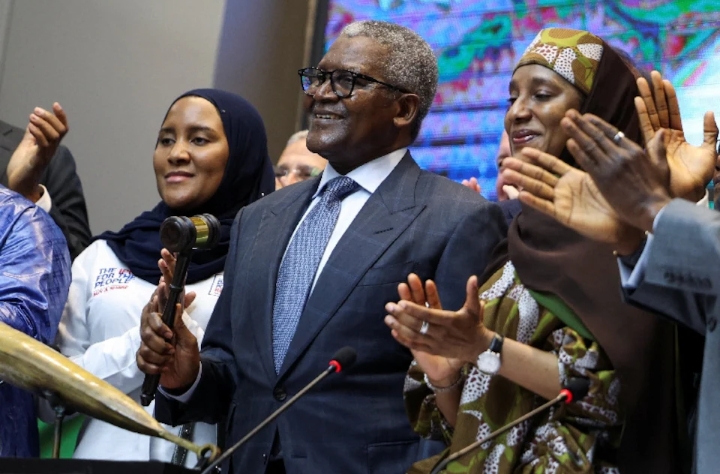
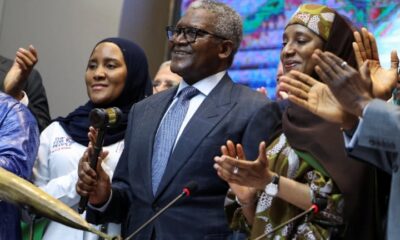
The trading floor of the Nigeria Exchange Limited (NGX) is agog this morning as billionaire industrialist,Aliko Dangote, declared opened trading activities for the day.
“I don’t want anybody again to call me the richest man in Africa. I want to be called the wealthiest man in Africa so that I can create wealth for others,” he said.
Dangote made the remarks on Monday while sounding the gong at the Nigerian Exchange (NGX) in Lagos to formally launch the Initial Public Offering (IPO) of Dangote Petroleum Refinery and Petrochemicals.
The billionaire businessman said the IPO provided an opportunity for investors to participate in what he described as a transformational phase for Nigeria and Africa’s economies.
“Today, we are not merely offering shares. We are offering an opportunity to participate in the transformational chapter of not only Nigeria’s economy, but Africa’s economy,” Dangote said.
He urged Nigerians to deepen the capital market and promote wider ownership of wealth.
“Together, let us deepen our capital market. Together, let us create prosperity through ownership. Together, let us build a stronger Nigeria. Together, let us ensure prosperity for Africa,” he said.
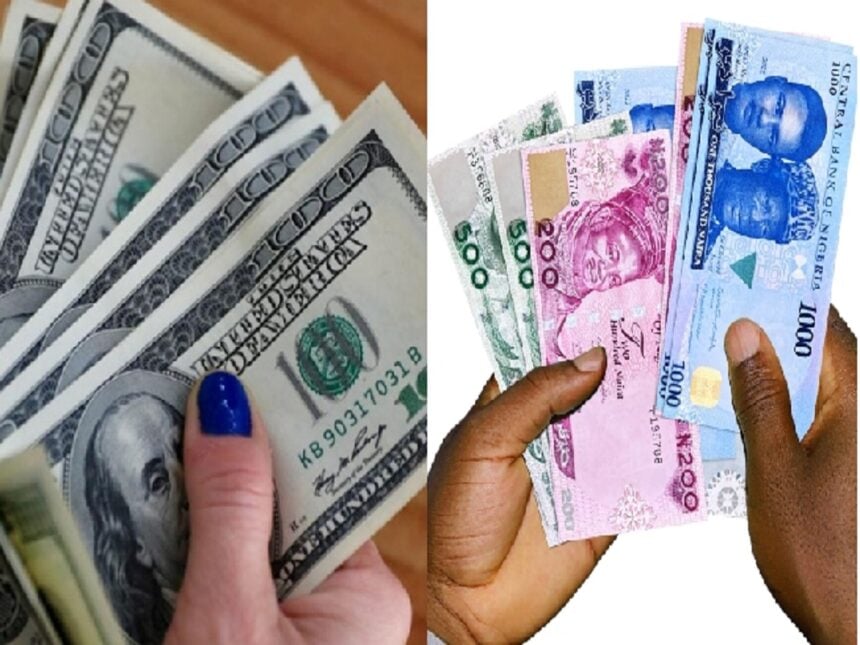
BLACK MARKET
US DOLLAR ₦1385
POUND (GBP) ₦1880
EURO (EUR) ₦1580
CANADIAN DOLLAR (CAD) ₦1000
SOUTH AFRICAN RAND (ZAR) ₦90
UAE DIRHAM (AED) ₦370
CHINESE YUAN (CNY) ₦190
GHANA CEDI (GHS) ₦100
Central Bank of Nigeria Rates
DOLLAR (USD)₦1326.52
POUND (GBP)₦1794.52
EURO (EUR)₦1540.22
SWISS FRANC (CHF)₦1627.83
JAPANESE YEN (JPN)₦8.64
CFA FRANC (XOF)₦2.34
WEST AFRICAN UNIT OF ACCOUNT (WAUA)₦1811.58
CHINESE YUAN (CNY)₦197.74
SAUDI RIYAL (SAR) ₦353.20
SOUTH AFRICAN RAND (ZAR) ₦82.24
Business
Dangote Refinery’s IPO Officially Opens Today On NGX
Speaking on the significance of the IPO, President and Chief Executive of Dangote Industries Limited, Aliko Dangote, said:“Today marks the beginning of a new chapter in the history of Dangote Refinery and, indeed, in the economic future of our nation…”
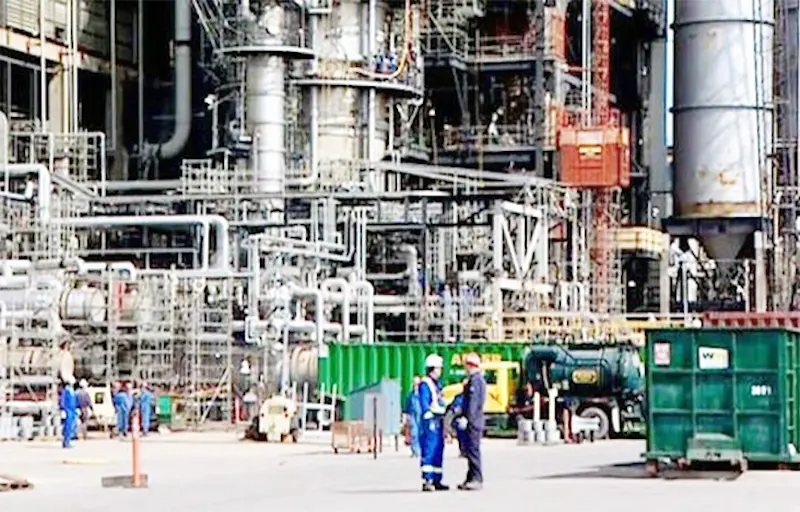
Dangote Petroleum Refinery & Petrochemicals FZE today announced the commencement of its Initial Public Offering (IPO) to the investing public.
The offer will be formally launched at a ceremony on the trading floor of the Nigerian Exchange (NGX) Limited in Lagos.
The IPO, which opens today, September 14, 2026, consists of 4.1 billion new ordinary shares offered at N525 per share, with a minimum subscription of 10 shares valued at N5,250.
The offer is expected to remain open until October 13, 2026, subject to the terms outlined in the Prospectus. The transaction is targeted at retail, institutional, and eligible African investors, reinforcing Dangote Refinery’s commitment to broadening ownership and deepening participation in Nigeria’s capital market.
The public offer is expected to raise approximately N2.15 trillion, making it one of the largest equity offerings ever undertaken in Africa.
The proceeds will support the Refinery’s long-term growth plans, operational expansion, strategic investments, and the creation of additional value for shareholders and stakeholders alike.
Speaking on the significance of the IPO, President and Chief Executive of Dangote Industries Limited, Aliko Dangote, said:“Today marks the beginning of a new chapter in the history of Dangote Refinery and, indeed, in the economic future of our nation. This offering is about more than raising capital; it is about creating an opportunity for ordinary Nigerians, Africans, and investors across the globe to participate directly in one of the most transformative industrial projects ever built on the continent.
We established this refinery to transform Africa’s energy landscape, create jobs, conserve foreign exchange, and unlock shared prosperity. With this IPO, we are extending that vision by democratising ownership and ensuring that millions of people can benefit from the value being created.”


Dangote Refinery IPO: SEC Warns Investors, ‘Don’t Pay Into Wrong Hands’

Again, Desmond Elliot begs political mentor,Gbajabiamila , “I’m sorry, Daddy”
Dangote at IPO Listing, Charges Public,”I don’t want to be called richest man in Africa”

Tech Expert, Zuckerberg trains with UFC champions, Adesanya, Alexander

Organ Trafficking: Ekweremadu bags 10 years in UK prison

SAINT OBI: Between his marriage and his death
-
 News2 days ago
Bamanga Tukur, former Adamawa gov, ex-PDP Chair dies at 90
-
 Business19 hours ago
Filling Stations Selling Petrol, Diesel Higher Driven By Global Crude Prices
-
 Business16 hours ago
Naira Exchange Rates To Dollar, Pound , Euro… September 14
-
 Business17 hours ago
Dangote Refinery’s IPO Officially Opens Today On NGX
-
 Business15 hours ago
Dangote at IPO Listing, Charges Public,”I don’t want to be called richest man in Africa”
-
 Politics13 hours ago
Again, Desmond Elliot begs political mentor,Gbajabiamila , “I’m sorry, Daddy”
-
News8 hours ago
Dangote Refinery IPO: SEC Warns Investors, ‘Don’t Pay Into Wrong Hands’