
News
LASG Prepares Great Nigeria Insurance Building for Demolition
..the Lagos State Government has constituted a Technical Recovery and Demolition Committee, chaired by the Honourable Commissioner for Special Duties and Inter-Governmental Relations

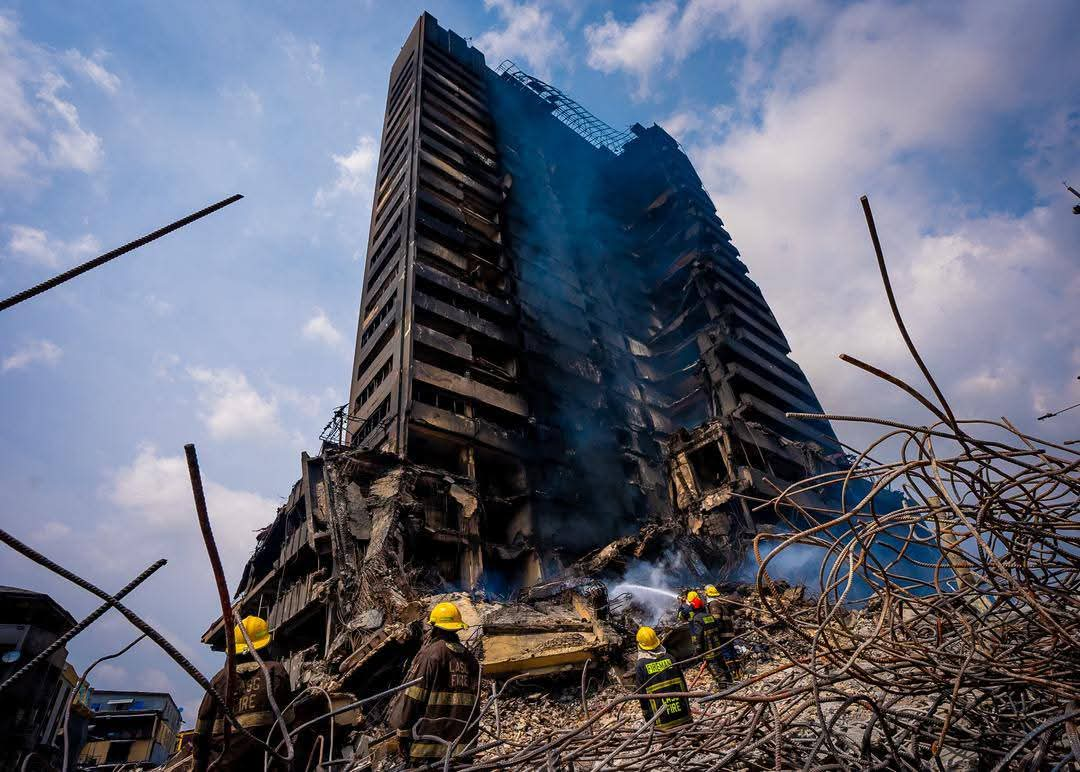
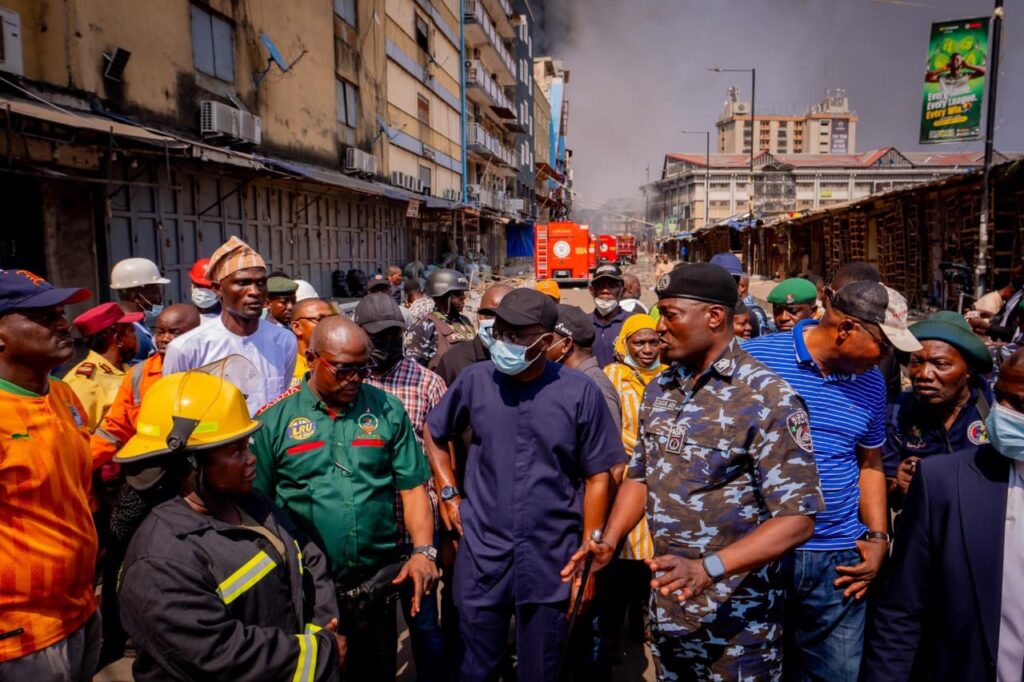
The Lagos State Fire and Rescue Service declared that the fire that engulfed the Great Nigeria Insurance (GNI) Building has significantly weakened the building’s foundation, rendering it structurally unsafe and unfit for any commercial use.
Margaret Adeseye, Controller -General Lagos State Fire and Rescue Service, stated this while giving a comprehensive update on the fire incident.
She explained that following a second on-site assessment by the Governor of Lagos State, Mr. Babajide Sanwo-Olu, on January 2nd, 2025, the Lagos State Government has constituted a Technical Recovery and Demolition Committee, chaired by the Honourable Commissioner for Special Duties and Inter-Governmental Relations.
The committee is tasked with developing and implementing a controlled and safe demolition plan for the affected structure and its immediate surroundings in the shortest possible time, while prioritising public and responder safety.
Current Situation on Ground
- The Lagos State Fire and Rescue Service, alongside sister emergency agencies, remains fully deployed on-site.
- The incident scene is highly sensitive and volatile, with substantial rubble still in place.
- There are intermittent pockets of fire, primarily originating from combustible materials such as textiles and clothing stockpiled within the building, not from the structural elements of the building itself.
- These materials are buried deep within the debris, and accessing them requires extreme caution and specialised technical planning.
It is important to clarify that:
- The presence of these pocket fires does not pose immediate external danger; however, improper or hurried evacuation of debris could compromise the already weakened structure.
- Some rubble may currently be providing unintended structural support, and removing it without a carefully sequenced plan could trigger a collapse, endangering first responders.
For this reason, all operations are being conducted in line with global disaster response best practices, ensuring that rescuer safety precedes all other actions. - As universally recognised in emergency management, disasters of this nature may take days, weeks, or even months to fully resolve.
Public Safety Advisory
The entire area remains unsafe for commercial or public activity.
- The market and surrounding areas remain closed.
- Only authorised first responders are permitted within the cordoned zone.
- The public is urged to remain calm and cooperative, understanding that their safety is directly linked to the safety of emergency personnel.
An Information Centre has been established at the site to address enquiries from families, stakeholders, and the general public.
Casualties
- 8 fatalities have been confirmed (5 identified, 3 yet to be identified).
- 13 persons have been successfully rescued.
- Search operations continue, particularly in safer sections of the debris, to ensure no one remains trapped.
Preliminary Observations
Preliminary assessments indicate serious fire safety violations, including:
- Overstocking of combustible materials from floor to ceiling with little or no ventilation.
- Absence of proper fire safety infrastructure.
- Unsafe market practices such as generator usage within buildings, shops constructed around transformers, and other hazardous activities.
Such conditions can lead to self-generated heat build-up and spontaneous ignition, even without external triggers.
Global Context
For perspective, similar complex fire recovery operations have occurred worldwide.
Notably, firefighting and recovery operations at the World Trade Center (Ground Zero) in New York lasted over 100 days, with underground fires officially extinguished nearly three months after the incident, and full recovery concluding more than eight months later.
These realities underscore the complexity and time-intensive nature of large-scale structural fire incidents.
The Lagos State Fire and Rescue Service reassures the public that all actions being taken are deliberate, professional, and safety-driven.
Operations will continue until ground zero is fully reached, all risks are eliminated, and the incident is conclusively resolved.
We appreciate the patience, understanding, and cooperation of Lagosians during this period.
Your safety is our priority. A safe rescuer ensures a safe rescue.”



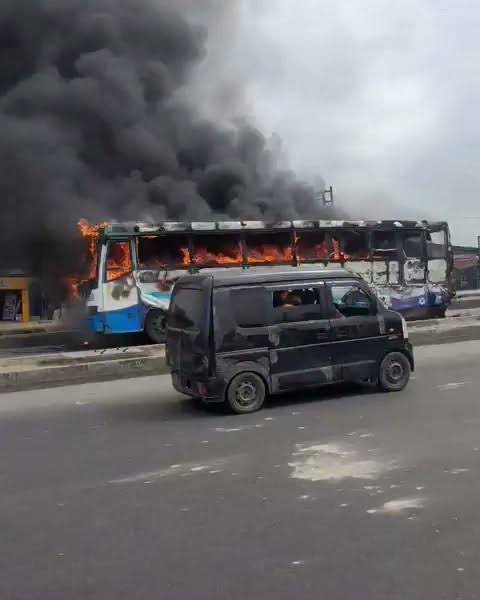
An angry mob has set a Bus Rapid Transit (BRT) bus on fire after it reportedly crushed a commercial motorcyclist to death at Ogolonto Bus Stop along Ikorodu Road in Lagos State.
The incident occurred on Friday, October 16, 2026. Eyewitness accounts and social media reports indicate that the motorcyclist was riding alone along the restricted BRT lane when the collision happened. He died at the scene.
Enraged residents and youths then attacked the bus driver and set the vehicle ablaze. Police officers and officials of the Lagos Neighbourhood Safety Corps (LNSC), who were nearby, intervened promptly and rescued the driver unharmed.
The identity of the deceased motorcyclist and the exact circumstances of the crash had not been officially confirmed at the time of filing this report. It was also unclear whether any arrests had been made in connection with the burning of the bus.
News
ARISE News Wins Seven Honours At Nigerian Broadcasters Merit Awards
The awards recognised the network’s achievements in television journalism and programming, with ARISE News winning the Best TV Channel (Viewer’s Choice) category.

• ARISE News Anchor and host of What’s Trending Ojy Okpe was named Best Newscaster (TV – Female)
ARISE News has emerged as one of the major winners at the just ended Nigerian Broadcasters Merit Awards (NBMA).
ARISE News won seven honours across television broadcasting, news reporting, presentation and production during the ceremony.
The awards recognised the network’s achievements in television journalism and programming, with ARISE News winning the Best TV Channel (Viewer’s Choice) category.
The network’s flagship breakfast programme, The Morning Show, also won the Best TV Talk Show award, further strengthening its recognition in television broadcasting.
ARISE News Anchor and host of What’s Trending Ojy Okpe was named Best Newscaster (TV – Female).
Rufai Oseni was named Nigerian Broadcaster of the Year (Male), while Vimbai Mutinhiri-Ekpeyong received the Nigerian Broadcaster of the Year (Female) award.
The recognition extended to the network’s newsroom, with Ovieteme George winning Best TV News Reporter (Male) for his contributions to television news reporting.
Behind the camera, Sam Adeyemi received the Best Camera Operator/Cinematographer award, recognising his work in television production and visual storytelling.
News
Meta removes 3.7 million accounts in West Africa scam crackdown
The joint operation led to 28 arrests, identified more than 30 suspected scam centres and rescued 117 people allegedly trafficked and forced to work in scam compounds in Ghana.
Meta, the parent company of Facebook and Instagram, has removed more than 3.7 million Facebook and Instagram accounts, pages and groups linked to suspected scam networks operating in West Africa.
The joint operation led to 28 arrests, identified more than 30 suspected scam centres and rescued 117 people allegedly trafficked and forced to work in scam compounds in Ghana.
The company announced the crackdown in a statement on Tuesday, October 13, 2026. It involved 14 technology companies and law enforcement agencies from 10 countries.
The United Kingdom’s National Crime Agency coordinated the operation with the US Department of Justice, the Federal Bureau of Investigation and other agencies. Nigerian authorities were involved.
Other countries included Ghana, Australia, Canada, New Zealand and India.Tech companies that took part included Google, Microsoft, OpenAI, Coinbase, Starlink and Adobe.
Meta said the partnership let participants share intelligence across digital platforms, countries and financial systems to identify criminal networks.


JUST IN: Mob Sets BRT Bus Ablaze After Motorcyclist’s Death in Lagos

BREAKING: DSS Arrests Fugitive Maina Son, Hands Him to EFCC

BREAKING: 5 Arrested Over Imo NYSC Abduction

BREAKING: Lagos Govt Declares Today, Thursday Work-Free to Mark 2026 Ìṣẹ̀ṣe Day

Tech Expert, Zuckerberg trains with UFC champions, Adesanya, Alexander

Organ Trafficking: Ekweremadu bags 10 years in UK prison
-

 Business3 days ago
NAFDAC scolds fake manufacturers: “You are killing Nigerians in order to make money”
-
 Business2 days ago
Naira Exchange Rates For Thursday, October 15
-
 Business3 days ago
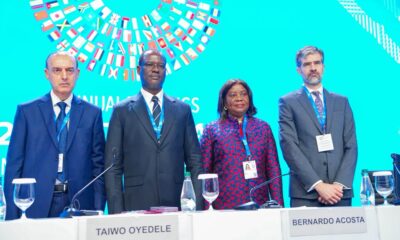
Oyedele Chairs G-24 Call for Fairer Global Financial System, Affordable Development Financing
-
 Sports2 days ago
CAF Increases Annual Funding for Member Federations to $700,000
-
 Business2 days ago
Germany plans tax on sugary drinks
-
 Politics3 days ago
Exclusion of candidates from INEC list: CD cautions INEC against manipulation by politicians
-
 News2 days ago
ASCON To Be Rebranded “National School Of Government”
-
 Business2 days ago
WEF could appoint Lagarde as its next chair, sources say