
International
JUST IN: UK’s Sunak Apologises To Public As He Leaves Office

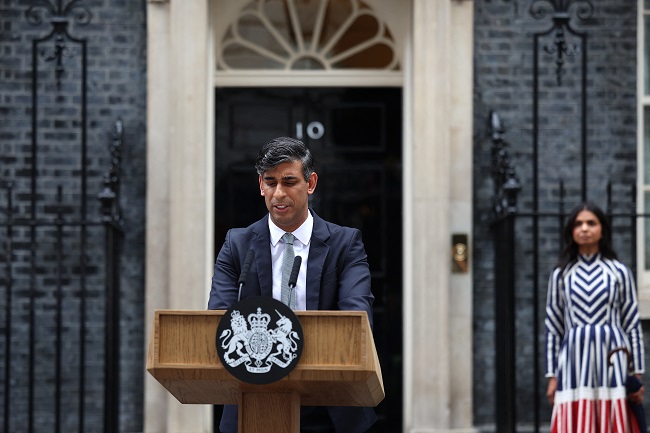
Rishi Sunak on Friday apologised to the public after his Conservatives were trounced by Labour in the UK general election, and said he would step down as party leader.The 44-year-old former financier gambled on going to the country six months before he had to, hoping that better economic data would swing public support back towards the Tories.But Thursday’s vote indicated that Britons wanted to send a clear message to the party by kicking them out of power after 14 years of economic hardships, Brexit upheaval and Tory infighting.“To the country, I would like to say first and foremost, I am sorry,” he said outside the Prime Minister’s residence at Downing Street, before heading to Buckingham Palace to tender his resignation as prime minister to King Charles III.
“I have given this job my all, but you have sent a clear signal that the government of the United Kingdom must change. And yours is the only judgement that matters.”“I have heard your anger, your disappointment, and I take responsibility for this loss.”The scale of the defeat made it inevitable that Sunak — the conservative party’s fifth leader since 2010 — would have to step down as Tory head as well.But he said that he would stay on in the role until the arrangements were made for an internal leadership contest, which is expected to be a fight for the ideological soul of the party.
Sunak saw a record number of his top ministerial team lose their seats, including defence secretary Grant Shapps and House of Commons leader Penny Mordaunt.His immediate predecessor as prime minister, Liz Truss, also lost her seat.Sunak — an observant Hindu who is Britain’s first prime minister of colour — wished his successor Keir Starmer well, calling him “a decent, public-spirited man who I respect”.“One of the most remarkable things about Britain is just how unremarkable it is that two generations after my grandparents came here with little, I could become prime minister,” he added.
“And that I could watch my two young daughters light Diwali candles on the steps in Downing Street. We must hold true to that idea of who we are.”
International
Japan beer giants raided over alleged price-fixing cartel
Asahi, Kirin and Sapporo all saw their share price fall after news of the investigation broke on Wednesday. Suntory’s beer business is not publicly-listed.


Image credit: BBC| GETTY Images
Japanese officials have raided the country’s biggest beer makers over allegations they worked together to raise the price of their beverages.
Asahi, Sapporo, Kirin and Suntory Spirits confirmed to the BBC that their premises had been searched by the Japan Fair Trade Commission (JFTC), adding that they would fully cooperate with the regulator.
The four firms dominate Japan’s beer market, with their drinks a common sight in supermarkets and convenience stores across the country.
Asahi, Kirin and Sapporo all saw their share price fall after news of the investigation broke on Wednesday. Suntory’s beer business is not publicly-listed.
“I do not deny that an investigation is being conducted today, but I’d like to refrain from commenting on the details as a preliminary review is underway,” JFTC Secretary General Iwanari Hiroo said, according to local media.
International
Belgian Students Protest Over Rising Education Costs
Tuition fees for most students in Belgium’s French-speaking Community, was increased from €835 to €1,194.

Hundreds of students in the Belgian city of Liège took to the streets protesting rising education costs, according to Belga news agency.
Tuition fees for most students in Belgium’s French-speaking Community, was increased from €835 to €1,194.
Local media reported that 107 people had been arrested in recent days, for offences linked to property damage and arson.
The protesters are challenging conditions in Belgium’s French-language education system, citing rising costs, overcrowded classrooms and difficulties accessing study materials.
Students carried placards expressing their frustration, including messages calling for education to be treated as a right rather than a privilege.
International
Ethiopian woman says she hasn’t eaten or drunk water since age 10
Despite claiming not to eat, Ambaw said she enjoys preparing meals for her family and visitors.

•Muluwork Ambaw
An Ethiopian woman, Muluwork Ambaw, has claimed that she has not eaten food or drunk water since she was 10 years old, saying she suddenly lost her appetite as a child.
Ambaw, who is now 26 and lives in Jimma, Ethiopia, said her last meal was lentil stew before she stopped eating and drinking.
Her extraordinary claim gained international attention after travel content creator Drew Binsky visited her in Ethiopia and documented her story and daily life.
According to Ambaw, the change began when her family would ask her to have breakfast before going to school.
Her extraordinary claim gained international attention after travel content creator Drew Binsky visited her in Ethiopia and documented her story and daily life.
According to Ambaw, the change began when her family would ask her to have breakfast before going to school.
“I used to live with my family, and they asked me to eat breakfast and go to school. I said I had eaten, but I was pretending,” she said, according to an account shared by Binsky.
Ambaw said she simply stopped feeling hungry or thirsty and has continued living without consuming food or water.
Despite claiming not to eat, Ambaw said she enjoys preparing meals for her family and visitors.
She reportedly grows vegetables in her garden so she can cook fresh food when her sister or guests visit.
“I cook as much as I want, but I have no appetite,” she said.


Obi advocates policy support for manufacturers

Japan beer giants raided over alleged price-fixing cartel

Belgian Students Protest Over Rising Education Costs

Tech Expert, Zuckerberg trains with UFC champions, Adesanya, Alexander

Organ Trafficking: Ekweremadu bags 10 years in UK prison

SAINT OBI: Between his marriage and his death
-

 Politics2 days ago
BREAKING: APC Chairmen Accused of Leading Armed Attacks on ADC Members in Igueben
-

 News1 day ago
Military Chiefs Visit Ondo Crash Site As Underwater Search Intensifies
-

 News3 days ago
Military Aircraft Crashes Near Ondo Naval Base; 32 On Board
-

 News2 days ago
UPDATE: NAF Release Identities of Ondo Crash Victims
-

 News11 hours ago
NAF Helicopter Makes Precautionary Landing In Makurdi
-

 Politics2 days ago
I sleep And Eat Thinking About Tinubu’s Re-Election – Wike
-

 Business1 day ago
African Union launch continent’s first credit rating agency
-

 Business11 hours ago
Naira Today Exchange Rates, Thursday October 8