
News
JUST IN: All 133 Catholic cardinals arrive in Rome ahead of conclave to elect new Pope

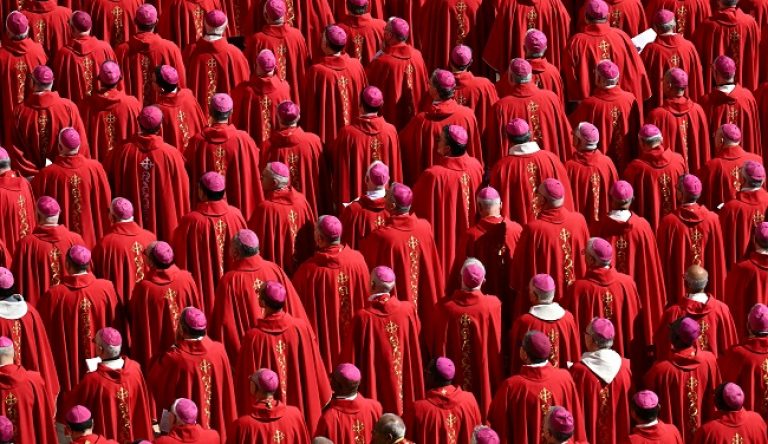
All 133 Catholic cardinals eligible to vote for a new pope have arrived in Rome, the Vatican confirmed today, ahead of the conclave beginning this week.
They will enter into seclusion in the Sistine Chapel at 4:30 pm (1430 GMT) on Wednesday, voting in secret until one of them secures the required two-thirds majority to become the next head of the Roman Catholic Church, reports AFP.
Summoned following the death of Pope Francis on April 21, the group — representing 70 countries across five continents — is the largest and most diverse conclave in the Church’s history.
At stake is the direction of the Catholic Church, a 2,000-year-old institution with huge global influence but which is battling to adapt to the modern world and recover its reputation after the scandal of widespread child sex abuse by priests.
The 133 so-called “Princes of the Church” who will vote — all those aged under 80, minus two who are absent for health reasons — will gather on Wednesday afternoon under the frescoed splendour of the Sistine Chapel at the Vatican.
Voting once that day and four times a day thereafter until a pope is chosen, they will stay at the nearby Santa Marta guesthouse but are forbidden from contacting the outside world until they have made their choice.
They will inform the waiting world of their progress by burning their ballots and sending up smoke — black if no candidate has reached the two-thirds majority of votes, or white if they have a winner.
This morning, technicians installed red curtains on the balcony of St Peter’s Basilica, where the new pontiff will make his first appearance.
At issue is whether the new pontiff will follow the popular Argentine pontiff’s progressive line or whether the Holy See will pivot towards a more conservative traditionalist leader.
Francis, an energetic reformer from Buenos Aires, ran the Church for 12 years and appointed 80 percent of the current cardinal electors.
But experts caution they may not choose someone in his model, with many warning there could be surprises.
Vatican affairs specialist Marco Politi told our correspondent that, given the unknowns, the conclave could be “the most spectacular in 50 years”.
‘Calm The Waters’
Cardinals met this morning for the latest in a series of preparatory meetings, so-called general congregations, and will gather again in the afternoon.
All cardinals are invited to these, not just those eligible to vote in the conclave, taking the opportunity to discuss the issues that will face Francis’s successor.
“Nobody campaigns, for crying out loud. That would be extraordinarily stupid and indiscreet, and improper and counterproductive,” said Cardinal Timothy Dolan, the archbishop of New York.
“But you just want to get to know folks, and it works well,” he said on his own podcast.
Among the pilgrims and sightseers who gathered in the square on Monday, opinions varied widely about who could or should take over.
“Maybe more of Pope Francis than Pope Benedict,” said German visitor Aurelius Lie, 36.“
As long as he’s not too conservative (and) influenced by modern political leaders — (Giorgia) Meloni, (Donald) Trump,” he said, referring to the Italian prime minister and the US president.
“Maybe the Church will be thinking: ‘We need a tough pope now to deal with these people.’ But their terms will end in a couple of years.
”But Canadian priest Justin Pulikunnel did not hide his frustration at the direction Francis tried to take the Church, saying he personally sought a return to a more traditional leadership.
“Well, I hope and I pray that the new pope will kind of be a source of unity in the Church and kind of calm the waters down after almost a dozen years of destabilisation and ambiguity,” he said yesterday.
“Changing World’
The conclave begins on Wednesday afternoon and could continue for days, weeks or even months — although both Francis and Benedict XVI — who was pope from 2005 until his resignation in 2013 — were elected within two days.
Italy’s Pietro Parolin, who was secretary of state under Francis, is one of the favourites, as is Pierbattista Pizzaballa, the Latin Patriarch of Jerusalem.
Among the so-called “papabili” are also Luis Antonio Tagle from the Philippines and Hungarian conservative Peter Erdo.
But many more names have been discussed, and just like when Francis — then an Argentinian known as Jorge Bergoglio — was picked in 2013, a surprise candidate could emerge.
Cardinal Louis Raphael Sako of Iraq told reporters before today’s meetings that he wanted “a pastor, a father who preserves the unity of the Church and the integrity of the faith but who also knows the challenges of today”.
“The world is always changing. Every day there is news. The Pope must read the signs of the times to have the right answer and not be closeted in his palace.”





News
Breaking: Military rescue 20 corps members, civilian in Imo
The victims were reportedly abducted while travelling through the state, prompting security agencies to launch an operation to locate and rescue them.

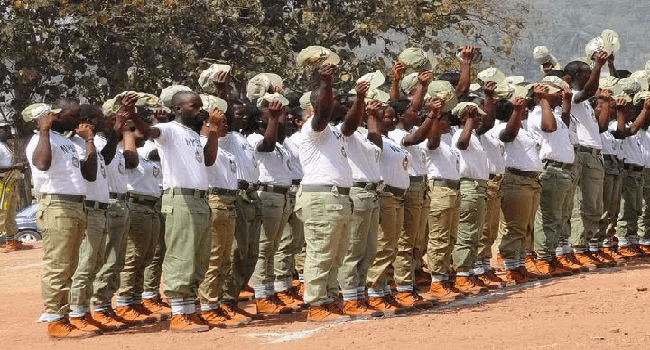
The military, Department of State Services, DSS, police and other security agencies have rescued twenty prospective National Youth Service Corps, NYSC, members and one civilian abducted in Imo State.
The victims were reportedly abducted while travelling through the state, prompting security agencies to launch an operation to locate and rescue them.
The rescued victims are currently receiving medical attention at a DSS facility, according to security sources, while efforts are ongoing to establish the circumstances surrounding the abduction and apprehend any remaining suspects.
News
Military Chiefs Visit Ondo Crash Site As Underwater Search Intensifies
The Nigerian Navy has also brought in specialized hydrographic divers to map the murky waters while plans are underway to use swamp buggies for excavation.
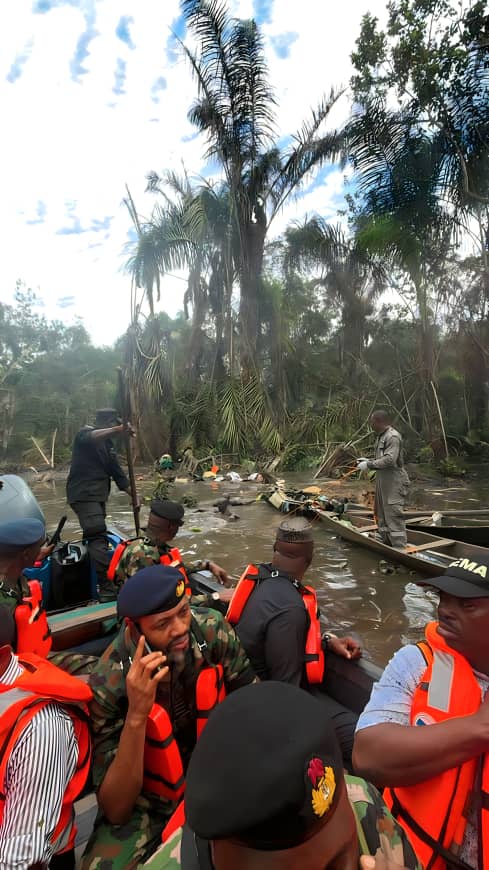
Top military chiefs have visited the crash site of the Nigerian Air Force ATR-42 aircraft in Igbokoda, Ondo State.
The Western Naval Command FOC, Rear Admiral Abubakar Mustapha and Logistics Command AOC, Air Vice Marshal Abubakar Abdul Suleh led the visit to inspect ongoing recovery efforts.
To locate the submerged aircraft, teams have deployed advanced underwater sonar equipment and drones across the difficult mangrove terrain.
The Nigerian Navy has also brought in specialized hydrographic divers to map the murky waters while plans are underway to use swamp buggies for excavation.
Rear Admiral Mustapha thanked the Ondo State Government, local communities and emergency agencies for their support while appealing to the public to remain calm as the operation continues.
The Nigerian Air Force (NAF) has released the identities of the people who died in the crash involving an NAF ATR 42 aircraft in the Igbokoda area of Ondo State, on Monday.
The aircraft, NAF 931, was carrying five crew members and 20 passengers when it crashed during a routine mission from Benin to Lagos.
In a statement, Air Commodore Ehimen Ejodame, NAF spokesperson, said no survivor had been found following the accident, which prompted the immediate activation of search-and-rescue operations in coordination with relevant authorities.
Those killed include five crew members: Squadron Leader MI Aburime, the flight captain; Squadron Leader AP Man-Ugwueje, co-pilot; Flight Lieutenant IS Bako, co-pilot; Warrant Officer Abubakar A, aircraft technician; and Corporal Uguru HC, aircraft technician.
The 20 passengers were identified as Flight Lieutenant TL Lazarus; Flight Lieutenant M Akinloye; Flying Officer IM Adeshina; Master Warrant Officer Onwuka F; Master Warrant Officer Matini BA; Warrant Officer Nuhu FS; Flight Sergeant James RB; Flight Sergeant Mohammed AI; Sergeant Ani AE; Sergeant Izibenikien SI; Sergeant Alafuka C; Sergeant Mbadugha AN; Lance Corporal Ugwuba FC; Lance Corporal Eledan GE; Mrs Ezeh Nneka; Godstmine Tarabina; Joy Micheal; Sunday Micheal; Ukeme David; and Gideon Omotola.
The Chief of the Air Staff, Air Marshal Sunday Kelvin Aneke, expressed profound condolences to the families, loved ones and colleagues of those who lost their lives in the crash.
Aneke described the incident as a deeply painful moment for the Nigerian Air Force and the country, while assuring the bereaved families of the Service’s full support during the difficult period.


Breaking: Military rescue 20 corps members, civilian in Imo

African Union launch continent’s first credit rating agency

Military Chiefs Visit Ondo Crash Site As Underwater Search Intensifies

Tech Expert, Zuckerberg trains with UFC champions, Adesanya, Alexander

Organ Trafficking: Ekweremadu bags 10 years in UK prison

SAINT OBI: Between his marriage and his death
-

 Sports3 days ago
FIFA to decide 2030 World Cup final venue in 2028 as Morocco, Spain wait
-

 News3 days ago
NGE Tasks Newsrooms, INEC on Must-Do Measures for Credible 2027 Polls
-
 International3 days ago
Italy marks 800 years since death of Saint Francis of Assisi
-

 Entertainment2 days ago
BBNaija season 11: “And The Winner is Temi Nkem”
-
 International3 days ago
Ethiopian woman says she hasn’t eaten or drunk water since age 10
-
 News3 days ago
Nigerian-Born Former Texas Professor Gets 78 Months For $921,000 Student Aid Fraud
-

 Business2 days ago
Naira Rates To Dollar , Pound, EURO… Monday, October 5
-

 Politics23 hours ago
BREAKING: APC Chairmen Accused of Leading Armed Attacks on ADC Members in Igueben