
Business
How the Nigerian Housing Deficit Affects Real Estate Opportunities by Dennis Isong
This article explores how the Nigerian housing deficit affects real estate opportunities, why the demand keeps rising, and how smart players in the market can position themselves to benefit while solving a critical social issue.


IN 2019, Chinedu returned from the UK after almost a decade of studying and working.
He had saved enough to buy a house in Lagos, hoping for comfort and stability. But his excitement quickly met reality.
Despite his budget, every option he found was either overpriced, half-finished, or located in neighborhoods he couldn’t imagine living in.
He kept asking himself, “Why is it so hard to find a good home in Nigeria?”
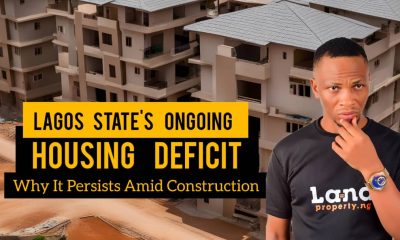
The answer lies in a persistent national challenge: the Nigerian housing deficit. This shortfall has been estimated at more than 20 million housing units, and the gap keeps widening as the population grows.
But here’s the interesting part—while the deficit represents a crisis for many Nigerians struggling to find affordable homes, it also opens doors for investors, developers, and realtors who can see the opportunities hidden within the problem.
This article explores how the Nigerian housing deficit affects real estate opportunities, why the demand keeps rising, and how smart players in the market can position themselves to benefit while solving a critical social issue.
1. Understanding the Nigerian Housing Deficit
The Nigerian housing deficit refers to the huge gap between the number of houses needed and the number of houses available.
With a population of over 200 million people, and with more people migrating into urban centers like Lagos, Abuja, and Port Harcourt every year, the demand for housing keeps climbing.
Unfortunately, supply struggles to keep pace.Several factors contribute to this gap.
Land acquisition challenges, high construction costs, bureaucratic bottlenecks in getting approvals, and limited access to mortgage financing all combine to slow down the rate of housing delivery.
For the average Nigerian, renting remains the only feasible option, but even rental prices continue to rise because demand far exceeds supply.
For real estate investors and developers, this gap is both a problem and an opportunity.
The reality is simple: people will always need homes, and in Nigeria, the number of people looking for housing far outstrips what’s available.
This imbalance creates a constant market for new developments, whether in luxury, middle-income, or affordable housing.
2. Why the Housing Deficit Creates Investment
OpeningsTo understand how the Nigerian housing deficit affects real estate opportunities, think of it like a river that never dries up.
Every year, hundreds of thousands of Nigerians—both at home and in the diaspora—look for houses to buy or rent.
This never-ending demand ensures that any serious developer or investor who delivers value has a ready market.Take Lagos as an example.
The city attracts thousands of people from other states daily because of its economic opportunities.
But with limited land and skyrocketing demand, property values keep appreciating. For investors, this means capital growth is almost guaranteed in prime areas.
Even in developing parts of Lagos like Ibeju-Lekki, Ajah, and Epe, the housing deficit ensures that today’s affordable plots can quickly become tomorrow’s goldmine.
Furthermore, the deficit pushes developers to innovate.
Instead of building only luxury estates, some are now experimenting with more compact, affordable units or rent-to-own schemes. Investors who align with this trend not only make profits but also help close the housing gap.
3. The Diaspora Angle: A Market Fueled by Trust
Another way the Nigerian housing deficit affects real estate opportunities is through the growing interest of Nigerians in the diaspora.
Many, like Chinedu, want to own property back home—either for family, future retirement, or as an investment.
The problem they face is trust. Stories of fraud and disappointment have made many cautious.
Here lies a clear opportunity for credible realtors and developers.
Nigerians abroad are willing to pay for transparency, quality, and security. If they can be assured that their investment is safe, they become loyal clients.
The deficit means demand from this group is unlikely to slow down soon. In fact, as the population grows, the diaspora will continue to play a huge role in bridging the housing gap through remittances and property investments.
For real estate professionals, building a reputation for honesty and delivering on promises is not just good ethics—it’s good business.
The housing deficit guarantees a steady stream of prospects, but trust is the bridge that converts them into long-term investors.
Developers and investors who can crack the affordability puzzle—through innovative financing, use of local building materials, or flexible payment plans—stand to win big.
4. Balancing Profit and Affordability
One of the criticisms developers often face is that most new housing projects are priced beyond the reach of ordinary Nigerians.
Luxury estates keep springing up, while the vast majority of people who need homes can’t afford them.
This reality is part of what sustains the housing deficit.However, this challenge also signals untapped opportunity.
Developers and investors who can crack the affordability puzzle—through innovative financing, use of local building materials, or flexible payment plans—stand to win big.
Affordable housing doesn’t mean low returns; in fact, because the demand is so large, the volume of buyers and renters can make up for slimmer margins.
The Nigerian housing deficit has made it clear that the real winners in the market are not those who chase quick profits alone, but those who build with a long-term view. Balancing affordability with profitability ensures sustainability for both investors and society.
5. The Future of Real Estate in a Deficit-Driven Market
Looking ahead, how the Nigerian housing deficit affects real estate opportunities will become even more pronounced.
Nigeria’s population is projected to hit 400 million by 2050, with urban centers expanding at breakneck speed. If the housing gap isn’t addressed, the deficit could double, creating both social strain and massive demand.
For investors and realtors, this means that real estate will remain a resilient and rewarding sector for decades to come.
Those who position themselves today—whether by buying land in growth corridors, developing estates, or offering diaspora-friendly services—will reap the benefits tomorrow.
Chinedu, from the opening story, eventually found his footing. After struggling to find a ready-made home, he decided to buy land in a developing part of Lagos and build gradually.
Today, not only does he have his dream home, but the value of his land has tripled.
His story mirrors what countless Nigerians are discovering: the housing deficit may be a burden, but within it lies immense opportunity for those who can see ahead.
Conclusion
The Nigerian housing deficit is not just a number—it is a daily reality for millions of Nigerians searching for homes.
But as overwhelming as the challenge is, it continues to shape the real estate landscape in powerful ways.
It fuels demand, drives innovation, attracts diaspora investment, and guarantees that housing will remain one of the most essential markets in the country.
For anyone asking, “How the Nigerian housing deficit affects real estate opportunities,” the answer is simple: it creates them.
Every problem holds within it the seed of a solution, and in Nigeria’s case, the housing crisis is also a call to action.
For real estate investors, developers, and Nigerians abroad, the opportunities are abundant—but only for those willing to engage with the market realistically, ethically, and with a vision for the future.



Business
Dangote Refinery’s IPO Ends Tomorrow
“The level of investor interest reflects growing confidence in our business and in the strong financial results we have delivered,” the company said.


[File photo] Opening ceremony of Dangote Refinery’s IPO on the NGX, September 14,2026
Dangote Petroleum Refinery & Petrochemicals has confirmed that its Initial Public Offering (IPO) will close on Tuesday, 27 October 2026 as scheduled, with no extension.
In a statement, the management said that the IPO has become a historic ownership moment, an opportunity for Africans at home and abroad to own a stake in one of the continent’s most strategic industrial assets.
“Investors recognise that this refinery is not merely an energy asset. It is a platform for industrial growth, foreign-exchange generation, regional trade, energy security and economic development across Africa,” management said.
The offer was structured to ensure ordinary investors participate alongside institutions, broadening ownership of the world-class asset.
“The level of investor interest reflects growing confidence in our business and in the strong financial results we have delivered,” the company said.
Business
Dangote Visit London Stock Exchange Ahead of November Cement Listing
Unlike an initial public offering, a secondary listing would let Dangote Cement, already listed on the Nigerian Exchange, set up an additional presence in London.

Aliko Dangote visited the London Stock Exchange on Friday, October 23, 2026, as Dangote Cement Plc prepares a proposed $1 billion share sale and a secondary listing in the United Kingdom.
The company is reportedly targeting November 2026 for the listing, subject to market conditions and regulatory approval.
A video circulating on social media captured the visit, with exchange officials and attendees welcoming Africa’s richest man.
The trip is part of efforts to pull international investment into his business empire.
The proposed deal could see Dangote Cement offer about 10% of its equity to international investors, potentially raising roughly $1 billion.
The final timetable is not fixed and remains subject to market conditions and regulatory requirements.
Unlike an initial public offering, a secondary listing would let Dangote Cement, already listed on the Nigerian Exchange, set up an additional presence in London.
That could raise the company’s visibility with international institutional investors, including pension funds, asset managers and other investment firms.
The share sale has not been completed. Its final structure, valuation and pricing are still subject to confirmation.
Business
Olagunju to head JPMorgan’s Proposed Nigerian Merchant Bank
The proposed bank would expand JPMorgan’s presence beyond its representative office in Lagos. It could undertake a broader range of regulated banking activities after securing a final licence.

The Central Bank of Nigeria has granted JPMorgan approval-in-principle to establish a merchant bank in Nigeria.
The regulator also approved Adedapo Adedayo Olagunju as Managing Director of the proposed JPMorgan Merchant Bank Nigeria Limited.
The approval came on Friday, October 23, 2026. The bank has not received its final operating licence.
Olagunju has led JPMorgan’s West African operations since 2018.
He is an Oxford-trained banker with more than two decades of experience in treasury management, financial markets, institutional banking and structured finance.
His appointment puts him in line to head the American bank’s proposed Nigerian merchant bank once final licensing is completed.
The CBN also approved four non-executive directors and three independent non-executive directors for the proposed institution.
The proposed bank would expand JPMorgan’s presence beyond its representative office in Lagos. It could undertake a broader range of regulated banking activities after securing a final licence.


FG Approves ₦70k Transport Allowance for Civil Servants

Suffocation, Overcrowding Kill 37 Niger Miners – Panel

Nigeria’s First Imported Ebola Patient Moved to Switzerland

BREAKING: Lagos Govt Declares Today, Thursday Work-Free to Mark 2026 Ìṣẹ̀ṣe Day

Tech Expert, Zuckerberg trains with UFC champions, Adesanya, Alexander

Organ Trafficking: Ekweremadu bags 10 years in UK prison
-

 News2 days ago
BREAKING: Former Arise News Anchor, Constance Ikokwu Appointed NDC National Campaign Council Spokesperson
-
 Business2 days ago
Dangote Visit London Stock Exchange Ahead of November Cement Listing
-

 International2 days ago
Brazil’s Lula Wins Fourth Term In Presidential Runoff
-

 Health2 days ago
EBOLA: Lagos Heightens Watch at Airports After Abuja Case
-

 Business2 days ago
History of Naira Revaluation and Devaluation (1973–2026) (Part 2)
-
News2 days ago
Sanwo-Olu: Opebi-Ojota Link Bridge Will Open Before Christmas
-

 Business2 days ago
Naira To Dollar, Pound, Euro…Rate Monday, October 26
-
Business2 days ago
Olagunju to head JPMorgan’s Proposed Nigerian Merchant Bank