
News
FG Lashes Out At Sanusi “We Don’t Need Your Stamp of Approval for Our Laudable Policies”
He expressed disappointment that reforms widely recognized as essential by global experts, including the Emir, are now being subtly condemned “because of a shift in loyalty


The Federal Government has reacted to the comment of the 16th Emir of Kano, Alhaji Muhammad Sanusi II, that he would not help President Bola Tinubu’s administration to correct the administration’s policies affecting the citizens.
Sanusi stoked controversy on Wednesday in Lagos as the chairman of the 21st Anniversary of Gani Fawehinmi’s Annual Lecture 2025.
According to the Emir, he would not help the President Bola Ahmed Tinubu-led because “they don’t behave like friends.”
But on Thursday, Mohammed Idris, Minister of Information and National Orientation, in a statement, said that the federal government does need Sanusi’s stamp of approval for its ‘laudable policies’.
He expressed disappointment that reforms widely recognized as essential by global experts, including the Emir, are now being subtly condemned “because of a shift in loyalty”.
Given Sanusi’s background in economics, the minister said the Emir has a unique responsibility to contribute constructively rather than undermine reforms aimed at collective progress because he feels estranged from his “friends” in government.
The statement reads in parts:“ The Federal Government notes the recent remarks by His Highness, Emir Muhammadu Sanusi II, regarding the economic reforms introduced under President Bola Ahmed Tinubu’s administration, at a public event in Lagos.
We note the emir’s acknowledgment of the noble initiatives which, he said, he could explain away but for his decision “not to help the government”.
“First, we acknowledge that Sanusi, and indeed any Nigerian, has the inalienable right to express an opinion either in the form of commendation or criticism on how the government is being run.
“It is pertinent to state that Nigeria is at a pivotal juncture where bold and decisive actions are necessary to tackle entrenched economic challenges.
“This administration has implemented transformative reforms not because they are easy, but because they are essential for securing Nigeria’s long-term stability and growth, as Emir Sanusi had consistently advocated.








The Court of Appeal in Abuja on Friday stalled the hearing of two appeals filed by the Incorporated Trustees of the Socio-Economic Rights and Accountability Project (SERAP) and its Deputy Director, Kolawole Oluwadare, against a ₦101 million judgment debt.
The appeals challenge the May 5 judgment of a High Court of the Federal Capital Territory (FCT), which held that SERAP and Oluwadare defamed two Department of State Services (DSS) officials through a false publication on September 10, 2024.
A three-member panel led by Justice Danlami Senchi first took the SERAP appeal marked CA/ABJ/CV/1114/2026. When the related appeal by Oluwadare (CA/ABJ/CV/1105/2026) was called, counsel Hannah Ayanwale informed the court that it was not ripe for hearing. She said the appellant’s brief was only filed on Thursday and served on the respondents in court on Friday morning, just before sitting began.
The justices expressed displeasure that the court had not been informed earlier that the sister appeal was not ready. Because both appeals arose from the same judgment, the panel set aside the proceedings already conducted on the SERAP appeal and ordered that the two matters be heard together.
The court adjourned both appeals to October 13. It directed the respondents to file their briefs by October 12 and the appellants to file any reply briefs before the next sitting.
In the May 5 judgment, Justice Halilu Yusuf of the FCT High Court found that SERAP and Oluwadare made false claims on the organisation’s website and social media platforms alleging that DSS officials Sarah John and Gabriel Ogundele invaded SERAP’s Abuja office on September 9, 2024, and subjected staff to harassment.
The judge held that the claimants established all the ingredients of defamation. He rejected the defence of justification, noting that the defendants admitted at trial that the DSS officials did not forcibly enter the premises or brandish weapons. Words such as “invasion,” “forceful entry” and “harassment” were therefore used inaccurately.
Justice Yusuf ruled that the publications injured the claimants’ professional reputation and standing. He awarded ₦100 million in damages and ₦1 million as costs, ordered a public apology to be published on SERAP’s website, its X handle, two national newspapers and two television stations, and directed that the judgment sum attract 10 per cent interest per annum until fully paid.

The Omi Eko Project Management has dismissed as misleading a circulating online report claiming that no physical infrastructure has been delivered seven months after the project’s kick-off.
In a statement signed by Dr. Segun Alabi, Head of Communications and Media, the management said the narrative fails to recognise the established processes required for a project of this scale and complexity.
The Omi Eko Project is being implemented in line with global best practices for major infrastructure development. These involve a structured progression through planning and procurement, design, infrastructure development, implementation, and evaluation phases. Such preparatory stages are essential to ensure the project is technically sound, financially responsible, environmentally sustainable, and capable of delivering its intended benefits.
“The absence of visible physical structures at an early stage should therefore not be misconstrued as an absence of progress,” the statement noted. Infrastructure projects of this magnitude require extensive technical assessments, detailed engineering designs, procurement processes, stakeholder engagement, and other essential groundwork before major construction activities begin.
The Omi Eko Project is a transformative initiative aimed at modernising Lagos State’s waterways transportation system. It is being pursued with a long-term vision of delivering a safer, more efficient, and environmentally sustainable transport network for residents.
Project management urged the public and media practitioners to verify information through official channels rather than circulating narratives that could misrepresent the implementation process. It reaffirmed its commitment to transparency, accountability, and the successful delivery of the project for the benefit of Lagosians.
News
South African Human Rights Lawyer, Navi Pillay, Wins 2026 Nobel Peace Prize •”It must be a joke,”she reacts
The Nobel Prizes come with a financial award, which this year is 12 million Swedish kronor per prize, or about $1.2 million.
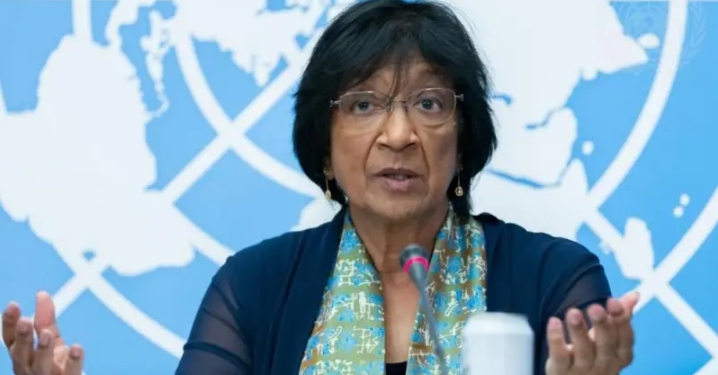
The Norwegian Nobel Committee announced on Friday the 2026 Nobel Peace Prize winner is Navi Pillay, a South African human rights lawyer.
Pillay is recognised for her “efforts to promote peace and international law”, the Norwegian Nobel Committee says.
After being told she has won, Pillay jokes that she doesn’t quite believe the news is real, going on to have a jibe at the US president: “If you clap a little bit more I may share this prize with Trump”
Ms. Pillay, formerly the United Nations’ top human rights official, also served as a judge at the International Criminal Court and on an international tribunal investigating the 1994 genocide in Rwanda.
Last year, a United Nations commission led by Ms. Pillay determined that Israel had committed genocide against Palestinians in Gaza, a finding that the Israeli government rejected.
“This year’s laureate has been instrumental in ensuring that war crimes, crimes against humanity and genocide are prosecuted,” the Nobel committee said in a statement.
The prize is awarded annually to a person or organization that has advanced “fraternity between nations,” worked toward disarmament or promoted peace conferences, according to the 1895 will of Alfred Nobel, the creator of the prize.
Over time the criteria for selection have expanded to include other areas, including championing human rights and environmental protections.
The Nobel Prizes come with a financial award, which this year is 12 million Swedish kronor per prize, or about $1.2 million.
Last year, the Nobel Peace Prize went to María Corina Machado, the Venezuelan opposition leader, for her efforts to advance democracy “in the face of ever-expanding authoritarianism” in the country, according to the Nobel committee.
In January, Ms. Machado presented her medal to President Trump after U.S. troops captured Nicolás Maduro, Venezuela’s president.
The Norwegian Nobel Institute said the award itself cannot be transferred.


Investors Rush For Airtel Money IPO on LSE

JUST IN: NNPC Clarifies Petrol Discount: Relief Initiative, Not Subsidy Restoration

JUST IN: A’Court Stalls SERAP, Oluwadare Defamation Appeals Over Late Briefs

Tech Expert, Zuckerberg trains with UFC champions, Adesanya, Alexander

Organ Trafficking: Ekweremadu bags 10 years in UK prison

SAINT OBI: Between his marriage and his death
-

 News2 days ago
NAF Helicopter Makes Precautionary Landing In Makurdi
-

 Business2 days ago
Naira Today Exchange Rates, Thursday October 8
-

 News1 day ago
Tears, Embraces as Rescued NYSC Members Reunite with Families in Ibadan
-

 Business2 days ago
Obi advocates policy support for manufacturers
-

 Business1 day ago
Naira Exchange Rates Friday, October 9
-

 International2 days ago
Belgian Students Protest Over Rising Education Costs
-

 International2 days ago
Japan beer giants raided over alleged price-fixing cartel
-
 News2 days ago
VON now broadcast in nine languages — DG