
International
ECOWAS Intensifies Efforts On Regional Single Currency

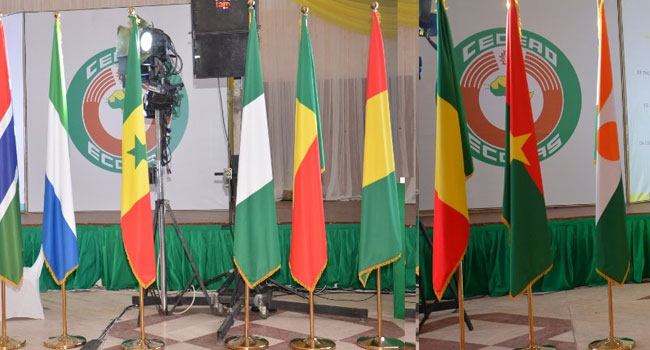
The Economies of West African States (ECOWAS) has intensified efforts on practical arrangements for the launch of the single currency, ECO for the region following consensus reached in the implementation of the directives issued at its 65th Ordinary Session.
This was revealed in a communiqué issued at the end of the 66th ordinary session of the authority of the head of state and government meeting held in Abuja on Sunday.
The ECOWAS bloc of 15 countries had previously planned to launch the currency in 2020, but the coronavirus pandemic caused delays.
The new launch date is 2027.
The Authority said it adopted the criteria proposed by the High-Level Committee for the selection of candidate Member States for the launch of ECO or those which would join at a later stage.
It instructed the Commission, in collaboration with the West African Monetary Agency (WAMA), to ensure that these criteria are incorporated into the protocol establishing the ECOWAS Monetary Union Agreement.
The Authority also endorses the proposals of the High-LevelCommittee on the costs, sources and modalities for financing the implementation of the reforms and institutions needed to launch the ECO.
It urged the central banks and member states to take the necessary measures for the payment of their financial contributions for the operationalisation of these institutions as soon as the decision on the effective date for the launch of the ECOWAS single currency is taken.
The Heads of State also urged the High-Level Committee, in collaboration with the ECOWAS Commission, to intensify its efforts to ensure that the deadlines set for the establishment and operationalisation of the institutions needed to launch the ECO are met.
The body said it welcomed the results achieved in the implementation of the ECOWAS Agricultural Policy (ECOWAP) within the framework of food security and nutrition.
Considering the critical role of agriculture in the socio-economic development of ECOWAS member states, the Authority directed the commission to ensure a swift implementation of the regional strategy for the Development of Livestock Farming and the Security of Pastoral Systems; the Regional Rice Self-sufficiency Initiative and its road map 2025-2035; and domesticate the Comprehensive African Agriculture Development Programme (CAADP) Action Plan 2026-2035.
The Authority also welcomed the strengthening of cooperation with technical and financial partners and urged member states to work together with community institutions towards the achievement of these initiatives for food security and nutrition in the region.
The ECOWAS currency is intended to:
Improve trade
A single currency could lower trade costs and improve intraregional trade, which is currently hindered by the use of different national currencies that are not convertible within ECOWAS.
· Boost economic prosperityA single currency could boost the economic well-being and prosperity of ECOWAS countries.
Some say that the transition to a single currency will involve a short period where both the national currencies and the common currency circulate side by side.
Others suggest that the first phase of implementation should involve two distinct ECO zones, where countries peg their national currency to the ECO.
International
Global media leader Annecchino dies at 55
Widely recognised as a transformative figure in global media, he was known for his strategic vision, entrepreneurial drive and ability to steer major organisations through periods of sweeping change.


|•Raffaele Annecchino
Raffaele Annecchino, the former President and CEO of Paramount International has died at the age of 55.
Widely recognised as a transformative figure in global media, he was known for his strategic vision, entrepreneurial drive and ability to steer major organisations through periods of sweeping change.
His career spanned more than 25 years at Paramount and ViacomCBS, starting in a commercial role in Madrid before rising to lead the company’s international operations across Europe, the Middle East, Africa, Latin America and Asia.
As CEO of Paramount International, Annecchino oversaw the company’s pivot from broadcast to digital, spearheading the international rollout of Paramount+, the global expansion of Pluto TV, and the creation of the SkyShowtime joint venture with Comcast.
He also built long-standing partnerships with major industry players, including Sky, Canal+, MultiChoice and Viaplay, and helped grow networks such as MTV, Nickelodeon, BET and Channel 5 in the UK, while backing production hubs across Africa, Asia, Europe and Latin America.
International
Meet The highest paid world leader
Lawrence Wong will see an increase of 1.4 million Singapore dollars ($1.1m; £818,000) in his annual pay package. He has said he will donate this pay increase to charity over the next five years.

•Lawrence Wong / BBC
Singapore’s government says it will raise the annual salaries of its ministers and other office holders, including its prime minister who is the highest paid political leader in the world.
Lawrence Wong will see an increase of 1.4 million Singapore dollars ($1.1m; £818,000) in his annual pay package. He has said he will donate this pay increase to charity over the next five years.
Wong said that raising the pay of ministers was necessary to attract better talent.
The government has previously argued that paying ministers high salaries deters corruption.
But the move has attracted criticism in Singapore where there is deep concern about job security and the rising cost of living.
Even before his pay raise kicks in, Wong is still by far the highest paid world leader.
He currently receives an annual salary of S$2.2m and will now see his pay go up by more than 60% to S$3.6m ($2.8m).
Next is Hong Kong chief executive John Lee, who earns about $719,000, followed by Switzerland’s president Guy Parmelin with $606,000.
US president Donald Trump earns $400,000 a year, while British PM Andy Burnham takes in $230,000.
On Tuesday, Wong acknowledged that Singapore ministers’ salaries have attracted scrutiny given that they were much more than what most citizens earn. The median monthly income in the country is S$5,775.
(BBC)
International
Kenya gives foreign workers 90 days to formalise status or leave
On Monday, hundreds of Burundians flocked to their embassy, seeking a return home, amid fears Kenya could see the sort of xenophobic violence experienced in South Africa in recent months.
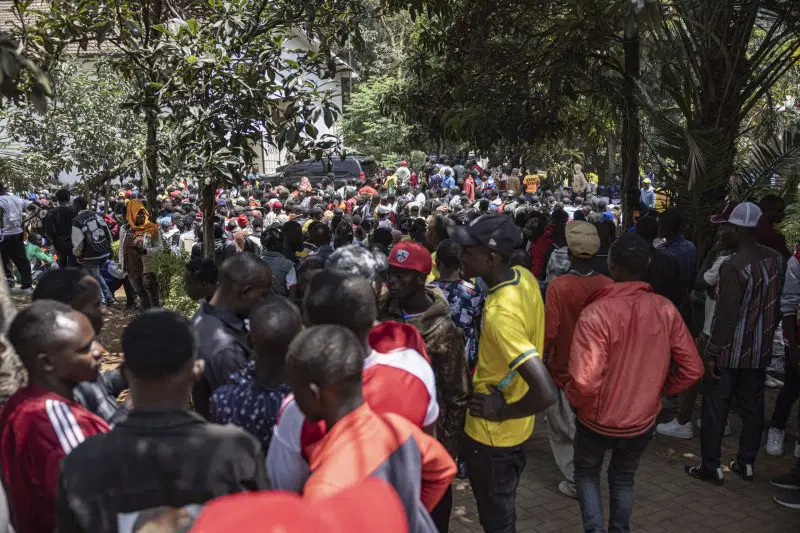
Burundian nationals gather outside their embassy to apply for border passes as they prepare to travel back to their country following the Kenyan government’s directive on undocumented small-scale traders, in Nairobi on September 7, 2026. Photo by SIMON MAINA / AFP.
Kenya warned foreign workers they had 90 days to regularise their status as it sought to backtrack from a panic triggered by President William Ruto’s order to close immigrant-owned small businesses.
AFP reported that as the regional powerhouse, Kenya attracts migrants from across the East African Community (EAC), whose members enjoy freedom of movement within the regional bloc.
But last week Ruto said foreigners were not allowed to be hawkers or run small shops, and gave them until Monday to cease activity.
” We have made efforts to improve the economy, we have not improved investor confidence for hawkers to come to Kenya,” Ruto said in a speech.
It was widely seen as a bid to rally support among Kenyan hawkers ahead of elections next year but it sparked fear among many foreigners, particularly Burundians who make a living through street vending in Nairobi.
On Monday, hundreds of Burundians flocked to their embassy, seeking a return home, amid fears Kenya could see the sort of xenophobic violence experienced in South Africa in recent months.
The government has now backtracked, saying it only wanted to ensure no one was illegally operating a business.
Work permits are free for citizens of EAC countries but many have not gone through the registration process.
In a statement issued on Tuesday, the president’s office said it “will conduct an orderly regularisation exercise” over the next 90 days to ensure migrants have the correct work permits and licences.
At the end of the 90-day period, immigration rules “will be enforced firmly and strictly in accordance with the law”, it warned.
Burundi, a country of about 15 million people and one of the world’s poorest, is part of the EAC alongside Kenya. There have been reports some Burundians were attacked following Ruto’s order.


AfCFTA : Nigerian Goods In High Demand In Africa, says Minister

Abia ranks top in BudgIT 2026 report

FG inaugurates Committee for nationwide activation of Nigeria’s unified 112 emergency number

Tech Expert, Zuckerberg trains with UFC champions, Adesanya, Alexander

Organ Trafficking: Ekweremadu bags 10 years in UK prison

SAINT OBI: Between his marriage and his death
-

 Business1 day ago
NAFDAC Goes After Chinese Logistics Firms Over Products Counterfeiting
-
 Politics2 days ago
Obidient Connect Texas Plans Grand Rally for Obi-kwakwanso October 10
-

 Business2 days ago
Dangote Refinery Signs IPO Document Today
-
 News2 days ago
FG announces two-week traffic delays on Kara–Berger Bridge for repairs
-
 Politics2 days ago
Nigerians better off under military than democracy – Duke
-
 News1 day ago
JUST IN: Traffic Chaos Expected on Lagos-Ibadan Expressway From Tuesday
-

 Sports2 days ago
Infantino To Seek Re-Election As FIFA President In 2027
-

 Sports1 day ago
Falconets lose World Cup opener to Spain