
News
CPPE Tells FCCPC Stop Intimidation of Traders

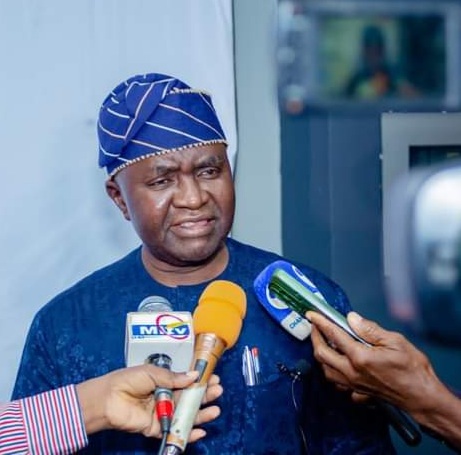
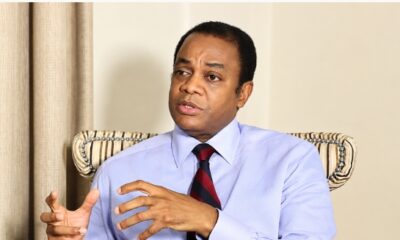
▪︎Dr Muda Yusuf, the CEO of CPPE
The Centre for the Promotion of Private Enterprises (CPPE) has charged at the Federal Competition and Consumer Protection Commission [FCCPC], to refrain from further intimidation of the operators in the retail sector of the economy most of whom are micro and small businesses, with many in the informal sector.
Dr Muda Yusuf, the CEO of CPPE, made the call, while reacting to the last week’s threat by the FCCPC to traverse markets across the country with objective of forcing traders, supermarkets owners, market men and women to reduce the prices of essential food items.
Dr Yusuf, told journalists in Lagos, at the weekend : ” The FCCPC appears to be unwittingly transforming into a price control agency rather than a consumer protection commission.
The disproportionate focus of the commission on the retail segment of the economy and pricing issues underscores this assertion.
The core mandate of the commission is the creation of a robust competition framework across sectors and protection of consumer rights and interests.
Consumer protection is not about directly seeking to control price at the retail end of the supply chain.
This is why the CPPE is concerned about the approach, methodology, targeting and the recent threats by the FCCPC to market leaders, traders and supermarket owners.”
The commission seem to be fighting the symptoms rather than dealing with the causes of the current inflationary pressure in the economy.
Even then, the core mandate of the commission is not to fight inflation.
The fiscal and monetary authorities are statutorily responsible for macroeconomic policy issues and are better placed to deal with the challenge of high prices,” he said.
He urges the FCCPC, to have a proper comprehension of the dynamics of pricing and the key drivers of inflation.
” These factors include the naira exchange rate depreciation, high energy cost, high cost of logistics, seasonality of food production, high cost of funds, extortions on the highways, high post-harvest losses, high cargo clearing cost, impact of the insecurity on food production, climate change and global factors disrupting supply chains.
” Our view is that the proposal by the FCCPC is unlikely to yield concrete outcomes. This is not a sustainable strategy.
What we need to fix are the fundamentals driving production, operating and distribution costs which resulted in spiraling inflation in the first place.
The dynamics of pricing and prices in an economy are much more complex and fundamental and do not seem aligned with the comprehension of the FCCPC on the issue. The variables are numerous, multidimensional and dynamic.
It is difficult to make pronouncements on issues profiteering in such circumstances without a rigorous analysis based on data.”








News
Abia ranks top in BudgIT 2026 report
The BudgIT 2026 Report ranked Abia second in aggregate revenue growth, third in Internally Generated Revenue (IGR) growth, first in total expenditure growth, capital expenditure growth, and personnel expenditure growth
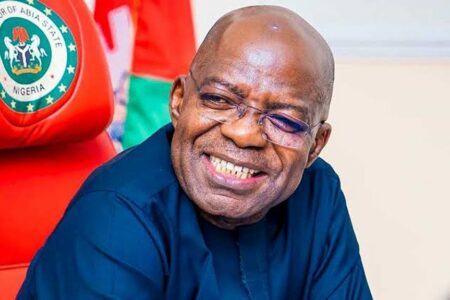
• Governor Otti
Abia state has emerged among the top-performing states in the 2026 BudgIT Report, covering 2017-2025.
The Abia State Commissioner for Information, Okey Kanu, who made the disclosure in Umuahia during a chat with newsmen, noted that the BudgIT 2026 Report ranked Abia second in aggregate revenue growth, third in Internally Generated Revenue (IGR) growth, first in total expenditure growth, capital expenditure growth, and personnel expenditure growth.
The commissioner said the performance reflected the administration’s prudent and strategic management of public resources.
“Abia State’s combination of revenue mobilisation, capital investment expansion, and administrative cost restraint points to a story of adroit and prudent management of resources,” said Kanu .
News
FG inaugurates Committee for nationwide activation of Nigeria’s unified 112 emergency number
Vice President Kashim Shettima, urged the committee to ensure its decisions were based on global best practices in order to develop a clear roadmap.
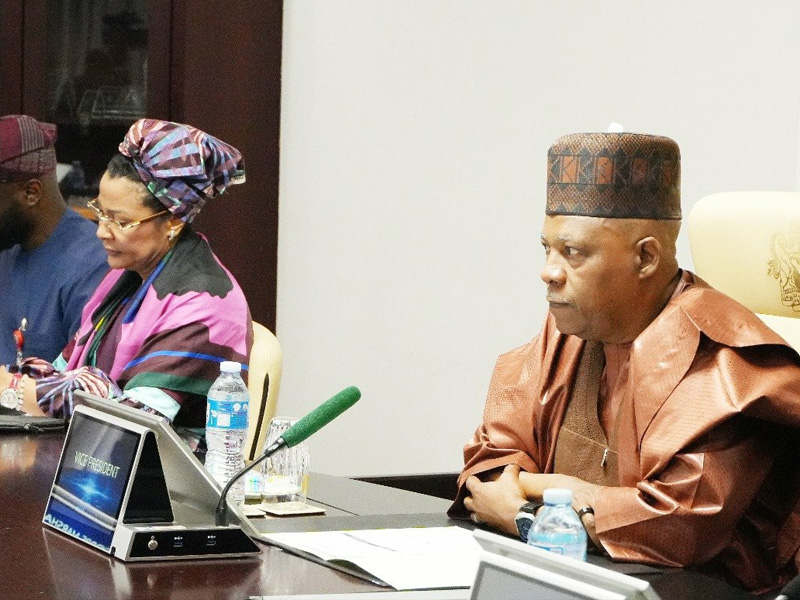
The Federal Government has set up a committee for the activation of the 112 national emergency number.
The committee comprises the Nigeria Police Force (NPF), Nigerian Communications Commission (NCC), National Emergency Management Agency (NEMA), Federal Road Safety Corps (FRSC) and other relevant agencies.
NEC had recently approved 112 as Nigeria’s single universal toll-free emergency number to replace fragmented and slow response lines, with a view to eliminating bureaucratic red tape and allowing citizens easy access to rapid assistance during fires, accidents, medical crises or security breaches.
Addressing stakeholders during the National Emergency Number 112 Project meeting , yesterday, Vice President Kashim Shettima, urged the committee to ensure its decisions were based on global best practices in order to develop a clear roadmap.
He charged the committee to finalise the roadmap and standard operating procedures for formal NEC endorsement,
Shettima stressed the need to make significant progress, assuring stakeholders that resources would be made available to fund the process once progress became visible.
“Let’s make progress so that whatever time we have spent here is worth spending. And most importantly, the engine is finance. It is resources to drive the process. And I want to assure you that we will get the resources,” the Vice President stated.
News
Presidency Loses Media Aide, Onwubuariri
Onwubuariri, a veteran journalist and staff member of the News Agency of Nigeria, died at the age of 48, according to his wife, Catherine Ezinna Onwubuariri.

•Peter Onwubuariri
Assistant Director, Media, at the Presidential Villa, Peter Onwubuariri, has died in Kano after a prolonged illness.
Onwubuariri, a veteran journalist and staff member of the News Agency of Nigeria, died at the age of 48, according to his wife, Catherine Ezinna Onwubuariri.
He reportedly died on Monday after receiving treatment for about a month at the Kano Cancer Hospital under the state government’s treatment authorisation.
His remains were released from the Aminu Kano Teaching Hospital on Tuesday for burial in Owerri, Imo State.
The corpse was handed over to Deputy Director, Information and Public Relations, State House, Oche Egwa, on behalf of the Special Adviser to the President on Information and Strategy, Bayo Onanuga.


AfCFTA : Nigerian Goods In High Demand In Africa, says Minister

Abia ranks top in BudgIT 2026 report

FG inaugurates Committee for nationwide activation of Nigeria’s unified 112 emergency number

Tech Expert, Zuckerberg trains with UFC champions, Adesanya, Alexander

Organ Trafficking: Ekweremadu bags 10 years in UK prison

SAINT OBI: Between his marriage and his death
-

 Business1 day ago
NAFDAC Goes After Chinese Logistics Firms Over Products Counterfeiting
-

 Business2 days ago
Dangote Refinery Signs IPO Document Today
-
 Politics2 days ago
Obidient Connect Texas Plans Grand Rally for Obi-kwakwanso October 10
-
 Politics2 days ago
Nigerians better off under military than democracy – Duke
-

 News2 days ago
FG announces two-week traffic delays on Kara–Berger Bridge for repairs
-

 News2 days ago
JUST IN: Traffic Chaos Expected on Lagos-Ibadan Expressway From Tuesday
-

 Sports2 days ago
Infantino To Seek Re-Election As FIFA President In 2027
-

 Entertainment1 day ago
Ikenga becomes highest-grossing Igbo film of all time