
News
Adelabu Submits Resignation Letter to SGF, Recommends Creation of Coordinating Minister for Energy
In a resignation letter dated April 22, 2026, and addressed to President Bola Ahmed Tinubu, Adelabu stated that his resignation will take effect on April 30, 2026, to enable him to focus on his governorship ambition in Oyo State.

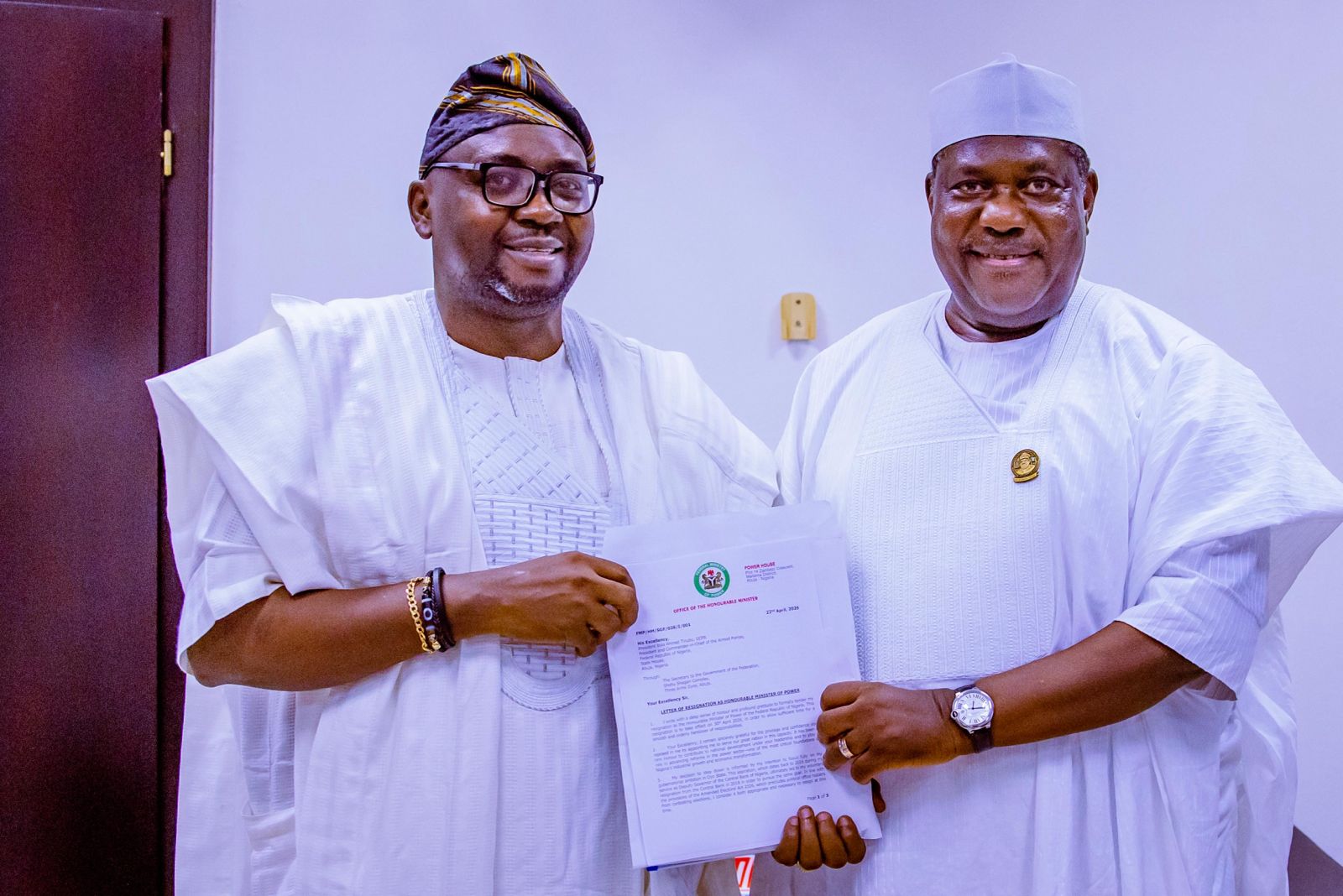
Photo: Chief Bayo Adelabu, and SGF George Akume
The Minister of Power, Chief Adebayo Adelabu, has formally tendered his resignation and proposed the establishment of a Coordinating Minister for Energy to drive integrated reforms across Nigeria’s power, gas, and related sectors.
In a resignation letter dated April 22, 2026, and addressed to President Bola Ahmed Tinubu, Adelabu stated that his resignation will take effect on April 30, 2026, to enable him to focus on his governorship ambition in Oyo State.
He, however, emphasised that sustaining and consolidating the gains recorded in the power sector requires stronger coordination at the highest level, including the appointment of a central authority to harmonise policy direction and execution.
Confirming the development, the Special Adviser to the Minister on Strategic Communications and Media Relations, Bolaji Tunji, said the Minister expressed deep appreciation to the President for the opportunity to serve, describing his tenure as a privilege to contribute to national development.
Adelabu noted that his decision aligns with the provisions of the Amended Electoral Act 2026, which precludes serving political office holders from contesting elections.
He further disclosed that his gubernatorial aspiration dates back to 2016 during his tenure as Deputy Governor of the Central Bank of Nigeria.
In his three-page letter, the Minister outlined key achievements recorded during his tenure, including the implementation of the Electricity Act 2023, which decentralised the electricity market and improved the investment climate.
He highlighted that peak power generation rose to over 6,000 megawatts, driven by the integration of the Zungeru Hydropower Plant and the rehabilitation of thermal power plants. Transmission capacity was also strengthened through grid upgrades under the Presidential Power Initiative.
He further cited notable improvements in the distribution segment, including enhanced regulatory oversight, improved revenue collection, and progress in reducing Aggregate Technical, Commercial and Collection (ATC&C) losses.
Efforts to close the metering gap, he added, gained momentum through the Presidential Metering Initiative and the World Bank-supported Distribution Sector Recovery Programme (DISREP).
On the financial front, Adelabu stated that tariff reforms and a ₦4 trillion debt restructuring programme increased market revenues from ₦1 trillion in 2023 to ₦2.3 trillion in 2025, restoring investor confidence and placing the sector on a path to sustainability.
Despite these gains, the Minister acknowledged persistent challenges, including gas supply constraints, infrastructure vandalism, and the need for full commercialisation of the electricity value chain.
He therefore proposed key measures to sustain progress, including the implementation of cost-reflective tariffs with targeted subsidies, recapitalisation of distribution companies, accelerated nationwide metering, sustained transmission investments, and strengthened regulatory enforcement.
Central to his recommendations is the creation of a Coordinating Minister for Energy to provide strategic oversight and ensure synergy across power, gas, water resources, and environmental sectors.
According to him, this approach is critical to improving gas supply for thermal generation, optimising hydroelectric resources, and accelerating renewable energy deployment.
Tunji added that Adelabu remains committed to ensuring a smooth and seamless handover process, while expressing gratitude to the President for the confidence and support extended to him throughout his tenure.


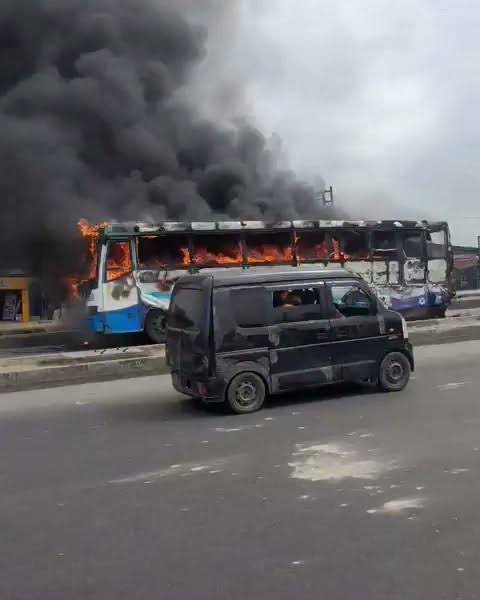
An angry mob has set a Bus Rapid Transit (BRT) bus on fire after it reportedly crushed a commercial motorcyclist to death at Ogolonto Bus Stop along Ikorodu Road in Lagos State.
The incident occurred on Friday, October 16, 2026. Eyewitness accounts and social media reports indicate that the motorcyclist was riding alone along the restricted BRT lane when the collision happened. He died at the scene.
Enraged residents and youths then attacked the bus driver and set the vehicle ablaze. Police officers and officials of the Lagos Neighbourhood Safety Corps (LNSC), who were nearby, intervened promptly and rescued the driver unharmed.
The identity of the deceased motorcyclist and the exact circumstances of the crash had not been officially confirmed at the time of filing this report. It was also unclear whether any arrests had been made in connection with the burning of the bus.
News
ARISE News Wins Seven Honours At Nigerian Broadcasters Merit Awards
The awards recognised the network’s achievements in television journalism and programming, with ARISE News winning the Best TV Channel (Viewer’s Choice) category.

• ARISE News Anchor and host of What’s Trending Ojy Okpe was named Best Newscaster (TV – Female)
ARISE News has emerged as one of the major winners at the just ended Nigerian Broadcasters Merit Awards (NBMA).
ARISE News won seven honours across television broadcasting, news reporting, presentation and production during the ceremony.
The awards recognised the network’s achievements in television journalism and programming, with ARISE News winning the Best TV Channel (Viewer’s Choice) category.
The network’s flagship breakfast programme, The Morning Show, also won the Best TV Talk Show award, further strengthening its recognition in television broadcasting.
ARISE News Anchor and host of What’s Trending Ojy Okpe was named Best Newscaster (TV – Female).
Rufai Oseni was named Nigerian Broadcaster of the Year (Male), while Vimbai Mutinhiri-Ekpeyong received the Nigerian Broadcaster of the Year (Female) award.
The recognition extended to the network’s newsroom, with Ovieteme George winning Best TV News Reporter (Male) for his contributions to television news reporting.
Behind the camera, Sam Adeyemi received the Best Camera Operator/Cinematographer award, recognising his work in television production and visual storytelling.
News
Meta removes 3.7 million accounts in West Africa scam crackdown
The joint operation led to 28 arrests, identified more than 30 suspected scam centres and rescued 117 people allegedly trafficked and forced to work in scam compounds in Ghana.

Meta, the parent company of Facebook and Instagram, has removed more than 3.7 million Facebook and Instagram accounts, pages and groups linked to suspected scam networks operating in West Africa.
The joint operation led to 28 arrests, identified more than 30 suspected scam centres and rescued 117 people allegedly trafficked and forced to work in scam compounds in Ghana.
The company announced the crackdown in a statement on Tuesday, October 13, 2026. It involved 14 technology companies and law enforcement agencies from 10 countries.
The United Kingdom’s National Crime Agency coordinated the operation with the US Department of Justice, the Federal Bureau of Investigation and other agencies. Nigerian authorities were involved.
Other countries included Ghana, Australia, Canada, New Zealand and India.Tech companies that took part included Google, Microsoft, OpenAI, Coinbase, Starlink and Adobe.
Meta said the partnership let participants share intelligence across digital platforms, countries and financial systems to identify criminal networks.


JUST IN: Mob Sets BRT Bus Ablaze After Motorcyclist’s Death in Lagos

BREAKING: DSS Arrests Fugitive Maina Son, Hands Him to EFCC

BREAKING: 5 Arrested Over Imo NYSC Abduction

BREAKING: Lagos Govt Declares Today, Thursday Work-Free to Mark 2026 Ìṣẹ̀ṣe Day

Tech Expert, Zuckerberg trains with UFC champions, Adesanya, Alexander

Organ Trafficking: Ekweremadu bags 10 years in UK prison
-
 News3 days ago
ASCON To Be Rebranded “National School Of Government”
-

 Business3 days ago
Germany plans tax on sugary drinks
-
 Business3 days ago
WEF could appoint Lagarde as its next chair, sources say
-

 International3 days ago
“Mother of all bombs,” Trump Plans To Hit Iran
-

 Business2 days ago
Naira Exchange Rates Friday, October 16
-
 Crime2 days ago
BREAKING: 5 Arrested Over Imo NYSC Abduction
-

 News2 days ago
ARISE News Wins Seven Honours At Nigerian Broadcasters Merit Awards
-
 News3 days ago
BREAKING: Explosion Rocks Rivers, Many Rushed to Hospital