
Business
BREAKING: Interest Rate, Increase to 15-Year High – Bank Of England


The Bank of England on Thursday lifted its key interest rate to the highest level since the 2008 financial crisis, noting inflation remained stubbornly high but that the economy would now avoid recession this year.
The BoE hiked the rate by a quarter-point to 4.5 percent — its 12th increase in a row with UK annual inflation stuck above 10 percent, fuelling a cost-of-living crisis across Britain.
Global policymakers are battling elevated inflation caused largely by runaway energy bills following last year’s invasion of Ukraine by major oil and gas producer Russia.
Following a regular policy meeting, the BoE warned of “considerable uncertainties” on when UK inflation would return to its two-percent target, as soaring food prices offset sharp drops to energy costs.
At the same time, the central bank made a record upgrade to its British GDP forecast, adding there would be only a small impact from recent turmoil in the commercial banking sector.
“Six months ago, we were expecting a shallow but long recession,” BoE governor Andrew Bailey told a press conference.
“Since then, energy prices have fallen substantially and economic activity is holding up much better than expected.”
– ‘Modest but positive’ growth –
Bailey said the UK would this year experience “modest but positive economic growth and a much smaller increase in unemployment.
“We think inflation will fall quite sharply over the coming months,” he added.
Official data Friday is expected to show the UK economy grew during the first quarter of this year after narrowly avoiding recession in the last three months of 2022.
The rate decision comes one week after UK Prime Minister Rishi Sunak’s Conservative government suffered a drubbing in local elections, as voters gave their verdict over rampant living costs despite government efforts to partly subsidise energy bills.
The nation has been plagued by strikes as high inflation erodes the value of wages. Train staff will walk out again on Friday following months of industrial action across the private and public sectors.
The latest BoE hike is set to deepen the crunch in living standards as retail banks pass on the increase, resulting in higher repayments on loans, including mortgages.
At the same time, those who can afford to save will benefit for increased fixed returns on investments.
“Although it is good news that the Bank of England is no longer forecasting recession, today’s interest rate rise will obviously be very disappointing for families with mortgages,” said British finance minister Jeremy Hunt.
– Highest inflation in G7 –
Thursday’s news took British borrowing costs to a level last seen in October 2008, before rates were slashed during the global financial crisis.
The BoE has ramped up borrowing costs from a record-low of 0.1 percent in December 2021.
Its latest hike came one week after the European Central Bank and the Federal Reserve implemented quarter-point rate increases as inflationary pressures ease only slightly in the eurozone and the United States.
UK annual inflation stood at 10.1 percent in March, the highest level in the Group of Seven richest nations.
Sunak and the BoE blame the high level in part on rises to pay and have urged employers to show restraint.
BoE chief economist Huw Pill recently stated that Britons need “to accept that they’re worse off and stop trying to maintain their real spending power by bidding up prices via higher wages”.
AFP



Business
Manufacturers sitting on N40trn untapped opportunities, says report
The Nigerian Manufacturing Opportunity Report 2026 provides decision-makers with the insights on opportunities that are most immediate, where Nigeria is already making progress and what needs to be done better to unlock greater value.

SEID, a marketing communications and market intelligence firm in Lagos, has estimated that the Manufacturing industries in Nigeria is sitting on more than N40 trillion in untapped manufacturing opportunities.
The Managing Partner at SEID, Tubosun Akeju, disclosed this in a report -The Nigerian Manufacturing Opportunity Report 2026 launched by the during the 54th Annual General Meeting of the Manufacturers Association of Nigeria, held at the Oriental Hotel.
Akeju emphasised that the report provides decision-makers with the insights on opportunities that are most immediate, where Nigeria is already making progress and what needs to be done better to unlock greater value.
“The opportunity is to understand where those strengths exist, deepen them, and build the competitiveness required to capture more value locally and compete beyond our borders,” he said .
The report examines manufacturing opportunities across Nigeria’s subsectors, states, value chains and industrial clusters, while identifying areas where existing strengths can be deepened and competitiveness improved.
It said that Nigeria’s manufacturing landscape was shaped by distinct areas of industrial strength, with different states, regions and value chains demonstrating varying levels of scale, specialisation and competitiveness.
The report noted that this created an opportunity to build on existing capabilities rather than adopt a one-size-fits-all approach to industrial development.
Manufacturing activity is spread across states with different levels of scale, specialisation and growth.
The South-West remains the country’s largest manufacturing zone, while other regions are developing strengths in areas ranging from food and agro-processing to textiles, chemicals, pharmaceuticals, cement, steel and light manufacturing.
The report maps these differences to show where investment and industrial development can build on existing capabilities.
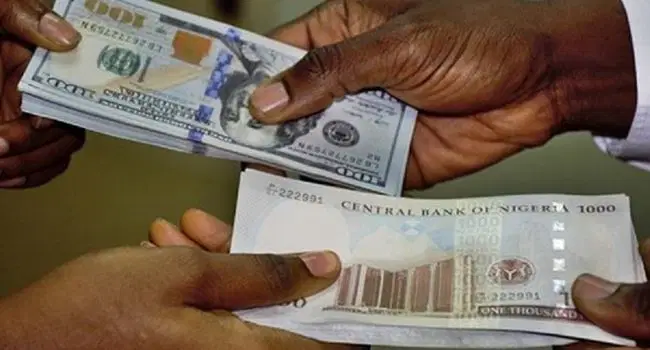
BLACK MARKET RATES
₦1375 DOLLAR (USD)
₦1830 POUND (GBP)
₦1530 EURO (EUR)
₦970 DOLLAR (CAD)
₦65 SOUTH AFRICAN RAND (ZAR)
₦350 UAE DIRHAM (AED)
₦190 CHINESE YUAN (CNY)
₦100 GHANAIAN CEDI (GHS)
₦2300 CFA F.(XOF)
₦2200 CFA F.(XAF)
₦850 AUSSIE (AUD)
OFFICIAL CBN RATES
DOLLAR (USD)₦1332.10
POUND (GBP)₦1759.17
EURO (EUR)₦1490.22
SWISS FRANC (CHF)₦1597.44
JAPANESE YEN (JPN)₦8.42
SWISS FRANC (CHF) ₦159
JAPANESE YEN (JPN) ₦8.42
CFA FRANC (XOF) ₦2.27
WEST AFRICAN UNIT OF ACCOUNT (WAUA) ₦1800.13
CHINESE YUAN (CNY)₦198.75
SAUDI RIYAL (SAR) ₦354.80
SOUTH AFRICAN RAND (ZAR)₦80.00


Business
Obi advocates policy support for manufacturers
Obi made the call following his attendance at the inauguration ceremony of the newly installed President of the Manufacturers Association of Nigeria (MAN), Dr. Eric Okoye, in Lagos, where he interacted with current and former leadership of the association.

Nigeria Democratic Congress (NDC) presidential candidate Peter Obi has called for stronger collaboration between government and private sector stakeholders to unlock the potential of Nigeria’s manufacturing industry.
He stressed that the country must transition from a consumption-oriented economy to a productive powerhouse.
Obi made the call following his attendance at the inauguration ceremony of the newly installed President of the Manufacturers Association of Nigeria (MAN), Dr. Eric Okoye, in Lagos, where he interacted with current and former leadership of the association.
According to him, targeted policies and a more favourable business environment are vital to increasing the manufacturing sector’s contribution to the nation’s gross domestic product (GDP).
“With the right government policies, an enabling business environment, and stronger collaboration between the public and private sectors, Nigeria can significantly increase the contribution of manufacturing to our GDP,” Obi stated.
Highlighting current economic figures, Obi noted that manufacturing accounts for approximately 7.5 per cent of Nigeria’s GDP, a figure he argued lags behind several other developing and emerging economies.
“Manufacturing currently contributes about 7.5 per cent of Nigeria’s GDP, compared with about 14 per cent in Egypt, 15 per cent in Morocco, 25 per cent in Vietnam, 19 per cent in Indonesia, and 20 per cent in Bangladesh,” he observed.


Millions of bedbugs crawl out of mattresses and walls in huge outbreak

National Sports Commission Changes Secretaries

2027: INEC Displays Voter Register, Begins PVC Distribution Today

Tech Expert, Zuckerberg trains with UFC champions, Adesanya, Alexander

Organ Trafficking: Ekweremadu bags 10 years in UK prison

SAINT OBI: Between his marriage and his death
-

 News1 day ago
NAF Helicopter Makes Precautionary Landing In Makurdi
-

 Politics3 days ago
BREAKING: APC Chairmen Accused of Leading Armed Attacks on ADC Members in Igueben
-

 News2 days ago
Military Chiefs Visit Ondo Crash Site As Underwater Search Intensifies
-

 News3 days ago
UPDATE: NAF Release Identities of Ondo Crash Victims
-
 Business1 day ago
Naira Today Exchange Rates, Thursday October 8
-

 Business2 days ago
African Union launch continent’s first credit rating agency
-

 International1 day ago
Belgian Students Protest Over Rising Education Costs
-

 News2 days ago
Breaking: Military rescue 20 corps members, civilian in Imo