
News
WHO announces end of COVID-19 as a global health emergency
The WHO states that globally, 13.3 billion doses of COVID-19 vaccines have been administered


After more than three years of declaring the COVID-19 outbreak as a Public Health Emergency of International Concern (PHEIC), the World Health Organization (WHO) has declared an end to it. WHO’s Director-General, Dr Tedros Ghebreyesus, announced on Friday that COVID-19 no longer constitutes a PHEIC.
The decision was made by the WHO’s International Health Regulations Emergency Committee during its 15th meeting on COVID-19. While acknowledging the uncertainties posed by the potential evolution of the virus, the committee advised that it is time to transition to long-term management of the pandemic. The Director-General concurred with the advice and determined that COVID-19 is now an established and ongoing health issue which no longer constitutes a PHEIC.
The global health body noted that the global risk assessment for COVID-19 remains high, but there is evidence of reducing risks to human health driven mainly by high population-level immunity from infection, vaccination, or both. Improved clinical case management and consistent virulence of currently circulating SARS-CoV-2 Omicron sub-lineages compared to previously circulating Omicron sub-lineages have also contributed to a significant global decline in the weekly number of COVID-19-related deaths, hospitalizations, and admissions to intensive care units since the beginning of the pandemic.
The WHO also provided updates on the status of global vaccination, stating that globally, 13.3 billion doses of COVID-19 vaccines have been administered, with 89% of health workers and 82% of adults over 60 years having completed the primary series.
The Director-General will convene an IHR Review Committee to advise on Standing Recommendations for the long-term management of the pandemic, taking into account the 2023-2025 COVID-19 Strategic Preparedness and Response Plan. During this transition, States Parties are advised to continue following the issued Temporary Recommendations. The WHO expressed its gratitude to the Committee for their engagement and advice during the last three years.
COVAX will continue to provide funded doses and delivery support throughout 2023 in line with demand. Although the PHEIC declaration has ended, the Director-General will continue to authorize the use of Emergency Use Listing (EUL) procedure. The termination of the PHEIC should not affect access to vaccines and diagnostics that have already received an EUL, and States Parties will still be able to access these vaccines and diagnostics (provided the manufacturers continue production).



The Nigerian Midstream and Downstream Petroleum Regulatory Authority (NMDPRA) and operatives of the Economic and Financial Crimes Commission (EFCC) on Tuesday stormed an illegal Chinese-operated refinery in Ogere-Remo, Ikenne Local Government Area of Ogun State.
The joint operation followed intelligence reports that revealed a well-fenced but crude yet technically sophisticated facility occupying more than three hectares of land.
During the inspection, officials observed underground tanks believed to have been used for heating and processing sludge oil, refining waste products, and substances suspected to be Automotive Gas Oil (AGO), popularly known as diesel. NMDPRA officials immediately sealed the facility.
Ogun State Coordinator of NMDPRA, Dr. Atilola Akinyemi, described the plant as a complete illegality operating without any permit from regulatory authorities.
“The underground storage facility behind the site has an estimated capacity of more than 90,000 litres, complete with underground heating systems, water hydrants for cooling, locally fabricated tanks and silos for separation,” Akinyemi told journalists.
He warned that if such adulterated products entered the market, they would pose serious risks to vehicles and engines. All recovered products have been confiscated by the Federal Government.
Director of the Department of Proceeds of Crime Management at the EFCC, Gbolahan Latona, stressed the need for collective patriotism in tackling economic crimes.
“Upon conclusion of investigation, the suspects will have their day in court and the proceeds of crime will be put to meaningful use,” Latona said.
Watch video below:
News
Sanusi: Critics Are Not Enemies Of The Govt
” It’s not every time people talk about poverty or talk about difficulty that they’re just enemies of the government or making an attack on the president. That is not how to respond to economic distress,” he said.

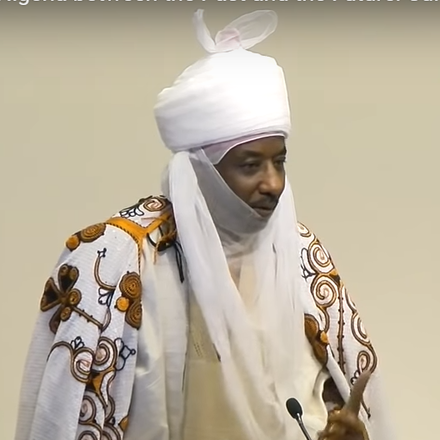
The Emir of Kano, Alhaji Muhammadu Sanusi II, has advised the Federal Government against treating every comment about the administration as an attack on President Bola Tinubu.
The royal father gave the advise on the occasion of the Oxford Global Think Tank Leadership Conference, organised by the Oxford Global Think Tan.
Speaking virtually to the audience at the event, on Tuesday, Sanusi advised the government to tolerate constructive criticism.
“It’s not every time people talk about poverty or talk about difficulty that they’re just enemies of the government or making an attack on the president. That is not how to respond to economic distress,” he said.
News
Urbanisation: Lagos To Fall Behind Luanda as sub-Saharan Africa’s biggest city by 2050
The report titled ‘Sub-Saharan Africa’s Urban Awakening: Catalyzing Economic Growth and Job Creation’, also calculated that sub-Saharan Africa’s urban population will increase by 748 million between 2025 and 2050, reaching about 1.7 billion.

A report conducted by the World Bank and the European Commission’s Joint Research Centre, has projected that Angola’s capital, Luanda,will overtake Lagos as sub-Saharan Africa’s most populous city by 2050, rising by 78 percent from 11.4 million to 20.3 million.
The report titled ‘Sub-Saharan Africa’s Urban Awakening: Catalyzing Economic Growth and Job Creation’, also calculated that sub-Saharan Africa’s urban population will increase by 748 million between 2025 and 2050, reaching about 1.7 billion.
The report estimated that Luanda’s population would increase from 11.4 million in 2025 to 20.3 million in 2050, adding 8.9 million residents over the period.
Lagos, the region’s most populous city in 2025 with an estimated 12.8 million residents, is projected to grow to 16.2 million by 2050, an increase of more than 25 percent.
Despite the growth, Lagos is expected to fall behind Luanda, whose population is projected to exceed that of Nigeria’s commercial hub by 4.1 million.
“Over this period, the population of Angola’s capital city, Luanda, is projected to increase by 78 percent from 11.4 million to 20.3 million.
In doing so, Luanda will overtake Lagos as SSA’s most populous city,” the report said.


JUST IN: Ronaldo Ends 23-year Portugal Career, Hangs National Team Boots

JUST IN: Court sacks Mark-led ADC, invalidates Atiku Abubakar’s nomination

Naira Exchange Rates Thursday, 5 Nov 2026

BREAKING: Lagos Govt Declares Today, Thursday Work-Free to Mark 2026 Ìṣẹ̀ṣe Day

Tech Expert, Zuckerberg trains with UFC champions, Adesanya, Alexander

Organ Trafficking: Ekweremadu bags 10 years in UK prison
-

 Business2 days ago
NNPCL wants to sell 10% equity via IPO on NGX, LSE
-

 Business2 days ago
Naira Exchange Rates Wednesday, 4 Nov 2026
-
 Business1 day ago
Naira Exchange Rates Thursday, 5 Nov 2026
-

 News2 days ago
Sanusi: Critics Are Not Enemies Of The Govt
-

 Politics2 days ago
2027 Elections Campaign: NDC Reacts To Today’s Attack On Peter Obi in Cross River
-
 Sports21 hours ago
JUST IN: Ronaldo Ends 23-year Portugal Career, Hangs National Team Boots
-

 International2 days ago
Democrats Win US midterm elections
-

 News2 days ago
NMDPRA, EFCC Storm Illegal Chinese Refinery in Ogun (Video)