
Politics
Tinubu Breaks fast with Fubara, Wike, other Governors, Ministers…
Breaking of fast with governors, Ministers, heads of MDAs and Security Chiefs is part of the annual rituals of the President.

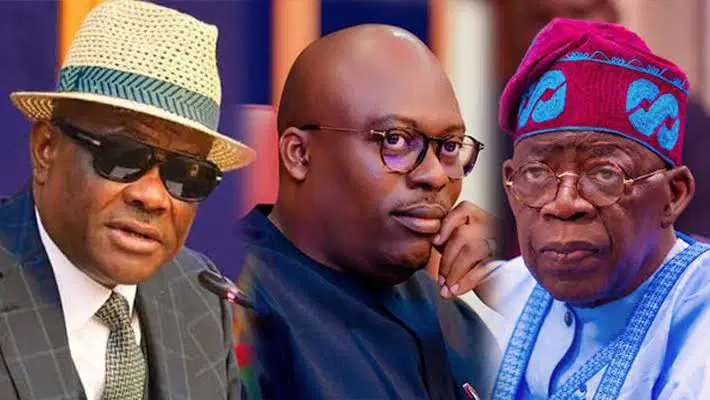
President BolaTinubu is currently breaking fast with the Rivers State governor, Sim Fubara, his estranged godfather and Minister of the Federal Capital Territory, FCT, Nyesom Wike, other governors, Ministers and heads of ministries, departments and agencies at the presidential Villa, Abuja.
Breaking of fast with governors, Ministers, heads of MDAs and Security Chiefs is part of the annual rituals of the President.
Also present at the Iftar dinner are Vice President Kashim Shettima, the Chief of Staff to the President, Rt. Hon. Femi Gbajabiamila and Minister and cabinet members.
Among the state governors in attendance are Dr. Alex Otti of Abia State, Pastor Umo Eno of Akwa Ibom, Bala Mohammed of Bauchi, Hyacinth Alia of Benue , Babagana Zulum of Borno, Sheriff Oborevwori of Delta,
Monday Okpebholo of Edo, Muhammad Yahaya of Gombe, Umar Namadi of Jigawa and Uba Sani of Kaduna, Others are Abba Kabir Yusuf of Kano, Nasir Idris of Kebbi, AbdulRahman AbdulRazaq of Kwara, Abdullahi Sule of Nasarawa,
Mohammed Bago of Niger, Dapo Abiodun of Ogun, Lucky Aiyedatiwa of Ondo, Duoye Diri of Bayelsa, and Francis Nwifuru of Ebonyi State.
Also in attendance were heads of key government agencies: the Chairman of the National Hajj Commission of Nigeria, Professor Abdullahi Mukhtar Muhammad, the Acting Controller General of the Nigerian Correctional Service, Sylvester Ndidi Nwakuche, the Comptroller General of the Federal Fire Service, Jaji Abdulganiyu, and the Comptroller General of the Nigeria Customs Service, Bashir Adeniyi.
The Group Chief Executive Officer of the Nigerian National Petroleum Company Limited, NNPCL, Abba Kyari and the Chief Executive Officer of the Nigerian Midstream and Downstream Petroleum Regulatory Authority, Farouk Ahmed.
Credit: Vanguard


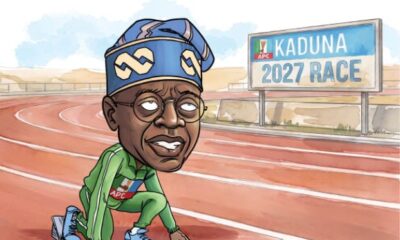
President Bola Ahmed Tinubu is expected to formally flag off his 2027 re-election campaign this morning in Kaduna, North-West Nigeria, marking a critical early test of his support in the region that delivered the bulk of his votes in 2023.
The main event is scheduled for the Kaduna Township Stadium, with all seven North-West governors expected to attend. The Independent National Electoral Commission opened the official campaign window for the presidential and National Assembly elections on 19 August 2026; it runs until 15 January 2027. The presidential poll itself is set for 16 January 2027.
Kaduna was chosen as the launch venue despite lingering insecurity concerns, the political fallout from the detention of former governor Nasir el-Rufai, and the fact that Atiku Abubakar has historically performed strongly there. Party officials and analysts describe the state as a strategic northern hub—centrally located, historically significant as the former capital of the Northern Region, and home to a diverse population that draws people from across the North. Governor Uba Sani’s close ties with Tinubu and the practical constraints of other venues (Ahmadu Bello Stadium under construction and Murtala Square hosting a polo tournament) also influenced the decision. The smaller Township Stadium, with a capacity of around 10,000, has raised questions about expected turnout and security management.
The North remains the decisive electoral battleground. The 19 northern states plus the FCT account for roughly 54–56 million of Nigeria’s registered voters—more than half the national total. In 2023, the region supplied about 60 per cent of Tinubu’s winning votes. Vice-President Kashim Shettima, APC National Chairman Nentawe Yilwatda, northern governors, and groups such as Arewa for Asiwaju have publicly pledged even stronger backing this time, with some forecasting more than 70 per cent of northern votes for the president. They point to infrastructure projects, agricultural interventions, and the political understanding on power rotation as reasons for continuity.
At the same time, economic hardship, the cost-of-living crisis, and insecurity continue to fuel discontent. Chants of “Ba ma yi” (we will not) have been reported at some northern gatherings, and opposition figures including Atiku Abubakar (African Democratic Congress) and Peter Obi are actively competing for the same votes. Analysts note that while Tinubu retains institutional advantages and a network of governors, the region’s support is not automatic and will be tested by voters’ lived experience of reforms.
The Kaduna flag-off is widely seen as the moment full-scale campaigning begins in earnest across the country. How the president is received today—and the messages he delivers on security, the economy, and northern priorities—will set the tone for the contest ahead.
Politics
NDC Plans Fresh Congresses To Replace Defector Members
The NDC alleged that some of its candidates had been induced to defect to the APC through financial offers, political appointments and other material incentives.

The Nigeria Democratic Congress (NDC), has announced plans to conduct fresh congresses to replace candidates, who have defected to the ruling All Progressives Congress (APC).
The party, in a statement in Abuja by its National Publicity Secretary, Osa Director, said it would immediately begin the process of electing new candidates in the affected constituencies , assuring that the development would not derail its preparations for the 2027 general election.
The NDC alleged that some of its candidates had been induced to defect to the APC through financial offers, political appointments and other material incentives.
It, however, did not identify the affected candidates or provide details of the alleged inducements.
Describing the defections as a setback that would not undermine its political objectives, the party said those who had left lacked the ideological commitment and values it expected of its members.
,
Politics
Exclusion of candidates from INEC list: CD cautions INEC against manipulation by politicians
The organisation maintained that it was deeply troubling that candidates who emerged through primaries monitored by INEC itself could be so brazenly excluded without immediate explanation.
• Demands untainted integrity ahead of 2027 elections
A leading pro-democracy group in Nigeria, the Campaign for Democracy (CD) has raised concerns over the omission of some political parties’ candidates from the list of candidates to contest in the 2027 general elections, particularly some governorship candidates.
The pro-democracy group warned the Independent National Electoral Commission against manipulation by desperate politicians, saying any threat to what it described as “political pluralism and participatory democracy” would be resisted.
In a strongly worded statement, signed by its President, Comrade Ifeanyi Odili, and released on Wednesday, CD wondered how the candidates’ names were excluded from the final list, without any immediate explanation, and when INEC, in its earlier list made available to the public on August 29, 2026, had cleared and published them.
The statement made particular reference to the Peoples Democratic Party’s governorship candidate in Gombe State, Isa Pantami; the party’s governorship candidate in Ogun State, Ladi Adebutu, and his deputy, Yemi Sowunmi-Kolapo.
The Campaign for Democracy said the development was particularly disturbing in Ogun State, where citizens had witnessed repeated boasts and triumphalism by members of the All Progressives Congress in the state that the PDP governorship candidate would be excluded from the final list.
According to CD, as if to validate that boast, INEC went ahead to publish a list that excluded both the PDP candidate, and his deputy, Hajia Yemi Sowunmi-Kolapo, without stating any reason for their omission.
CD said, “The timing of the omissions was even more disturbing, and this was where we became concerned and alarmed. A particular instance was that of Ogun State where the state’s citizens had witnessed repeated claims and apparent triumphalism by elements within the All Progressives Congress (APC) and their supporters that the PDP governorship candidate would be disqualified from participating in the forthcoming election.
“As if to validate that boast, INEC published a list that excluded both PDP candidates without stating the reason for their omission.”
“This troubling sequence of events raises legitimate questions about the independence and impartiality of the Commission that Nigerians cannot afford to ignore,” the pro-democracy group added.
It said, “Under your leadership, Mr. Chairman, INEC bears an enormous responsibility to demonstrate impartiality, transparency, and strict adherence to the law. Unfortunately, this development has raised serious doubts about the Commission’s preparedness to conduct a credible, transparent, and inclusive election in 2027.
“The clarification by the Commission published late yesterday, three days after the incident was belated.”
The group stated, “To the best of our knowledge, these are candidates that emerged through the primaries conducted by their various political Parties which were monitored by the Independent National Electoral Commission (INEC). Information in the public domain shows clearly that these candidates were on the earlier list published on the 29th of August, 2026.
“Even though the Commission has just published a belated clarification on the incident, we consider this development deeply troubling and a serious blow to public confidence in the electoral process, particularly because the published list provided no immediate explanation for the omissions of the governorship and other candidates.”
CD, which was formed in 1991 and was among the prominent civil society organisations that fought the military for restoration of civil rule in 1999, said it decided to intervene because the omission threatens Nigeria’s democratic credentials, warning INEC Chairman, Joash Amupitan, to avoid orchestrating anything that could set the nation on fire.
The organisation maintained that it was deeply troubling that candidates who emerged through primaries monitored by INEC itself could be so brazenly excluded without immediate explanation.
The group warned that an electoral umpire must not only be independent but must be seen to be independent.
CD said information from the affected states already showed heightened anxiety that could have exploded into intractable violence before the Commission’s belated clarification, describing the delay as inexcusable tardiness.
The pro-democracy body further demanded an immediate investigation into allegations circulating in the public that some candidates’ names were electronically removed after they were duly submitted.
It vowed that as a committed pro-democracy group, it would not hesitate to mobilise citizens and pro-democracy organisations across the nation for lawful mass civic action against any threat to political pluralism and participatory democracy.
“We remind INEC that elections belong to the Nigerian people, not to any political party, individual, or governing interest.
No institution should take actions that create the impression that opposition participation can be determined by administrative discretion without transparent, constitutional justification and due process,” CD stated.


Nigeria’s First Imported Ebola Patient Moved to Switzerland

Dangote Refinery’s IPO Ends Tomorrow

Ebola: Nigeria Sends Back Swiss Woman Via Medivac Plane

BREAKING: Lagos Govt Declares Today, Thursday Work-Free to Mark 2026 Ìṣẹ̀ṣe Day

Tech Expert, Zuckerberg trains with UFC champions, Adesanya, Alexander

Organ Trafficking: Ekweremadu bags 10 years in UK prison
-
 Politics2 days ago
2027 presidential election: Tinubu’s Northern test begins today
-

 News14 hours ago
BREAKING: Former Arise News Anchor, Constance Ikokwu Appointed NDC National Campaign Council Spokesperson
-
 Health2 days ago
Ebola patient in Abuja showing signs of recovery – FG
-
 Business13 hours ago
Naira To Dollar, Pound, Euro…Rate Monday, October 26
-
 Business12 hours ago
Dangote Visit London Stock Exchange Ahead of November Cement Listing
-
 Health1 day ago
EBOLA: Lagos Heightens Watch at Airports After Abuja Case
-
 Business24 hours ago
History of Naira Revaluation and Devaluation (1973–2026) (Part 2)
-
News13 hours ago
Sanwo-Olu: Opebi-Ojota Link Bridge Will Open Before Christmas