
News
The 9 Longest Rivers in the World

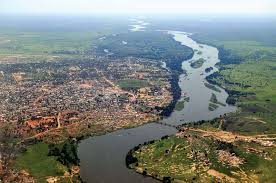
From the Nile to the Congo (Howstuffworks): Rivers are great collectors. As freshwater molecules flow along the landscape, gravity forces them to seek the lowest possible ground, where they gather with other water molecules.
The collected water soon becomes a trickle. Trickles join together to form small creeks, which then join to form larger streams and, ultimately, rivers.
A watershed is an area of land that drains all the water in a particular area to a single point: the place where a river meets the ocean. The size of a watershed can be big or small, depending on the landscape, and some watersheds can be massive.
Massive watersheds often make for humongous rivers. Where a few creeks and streams running together end and a river begins is difficult to determine, but in order to rank rivers by their length, they’ve got to start somewhere and a bit of arbitrary fudging has to happen in order to measure them.
However, according to the U.S. Geological Survey, “the length [of a river] may be considered to be the distance from the mouth to the most distant headwater source (irrespective of stream name) or from the mouth to the headwaters of the stream commonly identified as the source stream.”
So, here they are, from the Nile to the Congo — the nine longest rivers in the world:
1. The Nile River The longest river in the world is different, depending on who you ask.
Is it the Nile in Africa or the Amazon in South America? They’re comparable in length, but in 2009, a study in the International Journal of Digital Earth determined the Nile to be a bit longer at 4,132 miles (6,650 kilometers).
The Nile also is recognized by the Guinness World Records as the world’s longest river.
The Nile has two major tributaries — the White Nile and the Blue Nile, which meet up in Khartoum, the capital of Sudan.
The Nile drains an area of 1,293,056 square miles (3,349,000 square kilometers) of Sudan, Ethiopia, Egypt, Uganda, Tanzania, Kenya, Rwanda, Burundi, Eritrea and Democratic Republic of the Congo, before emptying into the Mediterranean Sea.
2. The Amazon River The Amazon River flows through Peru, Colombia and Brazil. Although the Nile is officially the longest river in the world, many disagree with that assessment and insist the Amazon is longer.
Certainly, it’s the world’s largest river based on the enormous volume of water it deposits into the Atlantic Ocean every day; it has a greater output of fresh water than the next seven largest rivers combined.
It also has the largest drainage area — 2,400,000 square miles (6,300,000 square kilometers) — which occupies almost 40 percent of the entire continent of South America.
Be that as it may, most researchers agree that it is only 4,000 miles (6,500 kilometers) long compared with the Nile’s 4,132 miles (6,650 kilometers).
3. The Yangtze RiverMost of the world’s longest rivers are in Asia, and the Yangtze is the longest of them all.
It’s actually pretty comparable in length to the Nile and Amazon rivers, measuring 3,900 miles (6,300 kilometers) long.
It is also the longest river that flows entirely within the borders of a single country, and it drains a fifth of the land area of China, a country which makes up 6.3 percent of the world’s landmass.
The mighty Yangtze River has over 700 tributary rivers and streams and its 698,265-square-mile (1,808,500-square-kilometer) watershed is home to a third of the population of China.
4. The Missouri River The longest river in North America and the fourth-longest river in the world starts as the Missouri River, which drains 500,000 square miles (1,300,000 square kilometers) of the Rocky Mountains of the U.S., as well as two Canadian Provinces.
The 2,341-mile-long (3,767-kilometer-long) Missouri meets the Mississippi River — America’s second-longest, which is only slightly shorter than the Missouri — near St. Louis, Missouri, and together their waters flow to the Gulf of Mexico.
The river system drains 32 U.S. states.
5. The Yenisey River The Yenisey River in Siberia, at 2,167 miles (3,487 kilometers) long, empties into the Arctic Ocean, and is fed by Lake Baikal, the deepest, oldest lake in the world — as well as one of the clearest.
The 616-mile (992-kilometer) Selenga River begins in northern Mongolia, empties into Lake Baikal, and then the lake spits out the Angara River, which becomes the Yenisey.
Put together, the Yenisey-Angara-Selenga river system, the fifth longest river in the world, is 3,442 miles (5,539 kilometers) long.
6. The Yellow River China’s Yellow River, also called the Huang He, is 3,395 miles (5,464 kilometers) long. Its headwaters are in the Bayan Har Mountains of central China and it flows east across nine provinces and into the Bohai Sea.
Its total drainage area is 307,000 square miles (795,000 square kilometers), and archaeological evidence points to the Yellow River watershed being the cradle of ancient Chinese civilization.
7. The Ob-Irtysh River The seventh-longest river in the world is the Ob-Irtysh river system. The Ob River originates in western Siberia in the Altai Mountains and is met by the Irtysh River that begins in Mongolia and flows through China and Kazakhstan before entering Russia.
Together the two rivers drain 1,154,445 square miles (2,990,000 square kilometers) of land and are 3,360 miles (5,410 kilometers) long.
8. The Rio de la Plata-Paraná-Rio Grande Rivers The Rio Grande, which feeds the Paraná River, which empties into the Rio de La Plata, which ultimately arrives at the Atlantic Ocean at the border or Uruguay and Argentina, is the eighth-longest river in the world and the second-longest river system in South America.
The river system is 3,032 miles (4,880 kilometers) long and drains an area of 997,175 square miles (2,582,672 square kilometers) of Brazil, Argentina, Paraguay, Bolivia and Uruguay.
9. The Congo River The Congo River of west-central Africa is the ninth longest in the world and the second longest in Africa.
On a map, it looks a bit like a many-limbed tree, but the headwater stream farthest from its mouth into the Atlantic Ocean is the Chambeshi River high in the mountains of Zambia, giving it a length of 2,920 miles (4,700 kilometers).
The Congo river system drains 1,550,000 square miles (4,014,500 square kilometers) and is the second-largest discharge of any river in the world.
News
South African kills Nigerian bar worker
Olaleye was allegedly shot by a South African national following an argument over whether a drinking glass should be taken outside the bar.

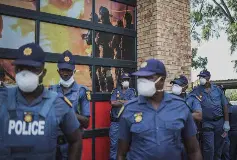
• South African police
The Nigerian Union in South Africa (NUSA) says Olatunde Olaleye, a 40-year-old father of two, has been shot dead in the country.
According to NAN, NUSA said Olaleye, an indigene of Ikere-Ekiti, was killed on September 21 while working at Spanata Bar and Grills in Mamelodi, Pretoria.
Smart Nwobi, NUSA president-general, in a statement on Thursday, said Olaleye was a husband and father of two children, adding that his death has left his family devastated.
He said the union is concerned by reports that Olaleye was allegedly shot by a South African national following an argument over whether a drinking glass should be taken outside the bar.
According to him, there were also reports that the suspect returned to the premises to threaten the bar’s management, with a promise that members of his crew would return.
Nwobi called for a thorough, transparent and impartial investigation into the circumstances surrounding the incident.
“We cannot continue to lose Nigerians under circumstances that leave families devastated and communities traumatised,” he said.
News
Nigerian Editors Brace for Democracy Protection Ahead of 2027 Elections
“As editors, we must remain above board in an increasingly polarised environment. We must not become agents of disorder. Neither should we display contradictory tendencies that cause the citizenry to question our credibility,” Anaba said.
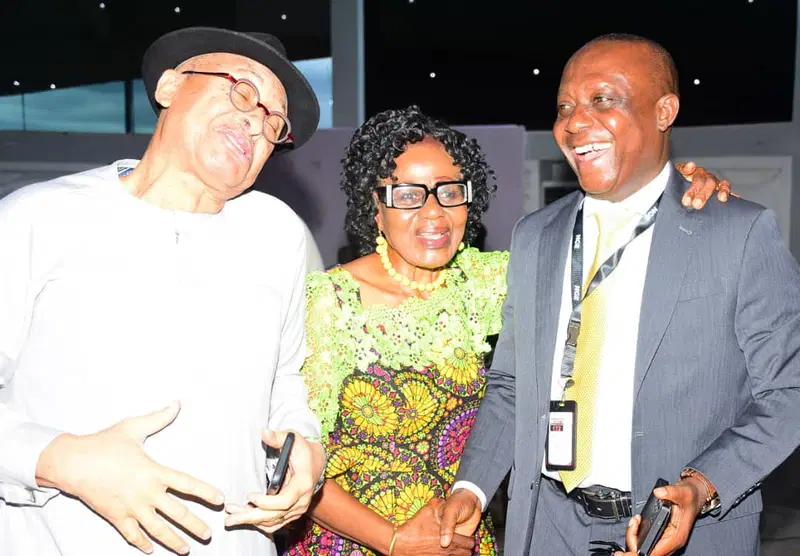
Enugu|•L-R Prof Pat Utomi; Prof Chinyere Okunna and Eze Anaba President Nigerian Guild of Editors at the 22nd All Nigerian Editors Conference in Enugu. Photo. Nwankpa Chijioke
Nigerian editors have been urged to protect the credibility of the ballot and help safeguard democracy as the country prepares for the 2027 general elections.
The call was made by Eze Anaba, President of the Nigerian Guild of Editors (NGE) and Editor of Vanguard Newspaper, in his welcome address at the 22nd Annual All Nigerian Editors Conference, which opened today in Enugu.
The conference is themed, “The Ballot, the Media and the Task of Keeping Democracy Alive.”
Anaba said the media, alongside other critical institutions, had a responsibility to nurture democracy by ensuring that voters were adequately informed and that electoral outcomes reflected the choices of the people.
According to him, the ballot can only fulfil its democratic purpose when voters have access to credible information and are able to make their choices freely, without intimidation or undue influence.
He urged editors and journalists to uphold verification, independence, accuracy, fairness, accountability and courage, particularly in an era of social media, artificial intelligence, deepfakes and the rapid spread of misinformation.
“As editors, we must remain above board in an increasingly polarised environment. We must not become agents of disorder. Neither should we display contradictory tendencies that cause the citizenry to question our credibility,” Anaba said.
He stressed that the media’s overarching responsibility was to serve the public good and help ensure that government derived its legitimacy from the consent of the people.
News
Works Minister Orders Tinubu’s Pictures On First Niger Bridge
“The President has worked so hard and we need to reward his hard work by decorating this bridge with his pictures.”

Minister of Works, David Umahi, has ordered the removal of illegal advertisements from the rehabilitated First Niger Bridge and their replacement with pictures of President Bola Tinubu, saying the display would recognise the President’s work on infrastructure.
Umahi gave the directive during an inspection of ongoing rehabilitation works on the bridge linking Anambra and Delta states.
He said the bridge was expected to reopen to motorists next week, subject to the completion of critical structural work.
“Once we are done with work on this bridge, I want all the illegal adverts on this bridge removed. Anyone who wants to advertise should apply to the Ministry of Works. For now, the bridge will be decorated with the pictures of President Tinubu,” Umahi said.
“The President has worked so hard and we need to reward his hard work by decorating this bridge with his pictures.”


TIME Names Moniepoint CTO Felix Ike Among 50 Global Executives of the Year

Naira Exchange Rates, Friday September 25

South African kills Nigerian bar worker

Tech Expert, Zuckerberg trains with UFC champions, Adesanya, Alexander

Organ Trafficking: Ekweremadu bags 10 years in UK prison

SAINT OBI: Between his marriage and his death
-
 Business2 days ago
FG Engages Stakeholders On Nigeria’s Rice Value Chain
-
 Business2 days ago
Naira To Dollar, Pound , Euro Rate Wednesday September 23
-

 Business1 day ago
MAN Urges CBN To Consider CRR Cut Next Phase of Monetary Easing
-

 Health3 days ago
BREAKING: Lassa fever kills 259, infects 1,086 in 24 Nigerian states — NCDC
-

 Business3 days ago
CBN reduces interest rate to 23% on market stability
-
 Entertainment3 days ago
Gov Mbah Appoints Nollywood’s Eucharia Anunobi, Rachael Okonkwo aides
-

 Business2 days ago
Cardoso Says Multiple FX Windows Cost Nigeria 3% of GDP, Higher Than Fuel Subsidy
-
 Business2 days ago
Airtel Money Targets October Listing On London Stock Exchange