
News
Rivers crisis: N’Delta groups threaten violence as budget ultimatum expires today

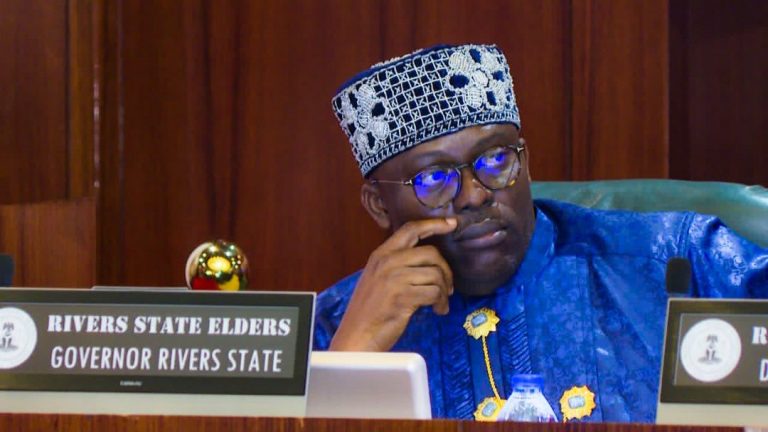
Tensions in Rivers State have escalated as Ijaw groups, including the Ijaw National Congress and the Ijaw Youths Council, issued a strong warning against the impeachment of Governor Siminalayi Fubara.
The groups declared their readiness to defend Fubara’s mandate, cautioning that any move to remove him could destabilise the Niger Delta and disrupt oil production in the region.
The warning follows the expiration of the 48-hour ultimatum issued by the Martin Amaewhule-led Rivers State House of Assembly for Fubara to resubmit the 2025 budget for approval.
The Assembly’s stance comes after a Supreme Court judgment on Friday, February 28, 2025, reaffirmed its legitimacy, intensifying the ongoing political battle between the governor and lawmakers loyal to his predecessor and Minister of the Federal Capital Territory, Nyesom Wike.
The apex court judgment also ordered the seizure of allocations to the state and nullified the October 5, 2024, local government election conducted by the Rivers State Independent Electoral Commission.
Exercising its authority, the Assembly, at its first sitting after the judgment on Monday, March 3, 2025, asked Fubara to present the budget within 48 hours as it would, on Friday, March 7, 2025, commence its 12-week recess.
The ultimatum expires Wednesday, March 5, 2025.
The Assembly also faulted the governor’s directive to the Heads of Local Government Administration to take over the affairs of the 23 council headquarters in the state.
In anticipation of the pronouncement by the Assembly in its plenary today, the INC, IYC and other groups in the state warned that removing Fubara would cause a crisis.
In a statement, the INC President, Prof Benjamin Okaba, condemned the impeachment threats, warning that the Ijaw people would not stand by while their first riverine governor in decades was undermined.
He further criticised the apex court ruling on the Rivers political crisis, pointing out that it failed to acknowledge the historical and political sacrifices made by the Ijaw people in the governance of Rivers State.
He warned that any attempt to undermine Fubara would have dire consequences for national peace and economic stability, especially in the crude oil and gas-rich region.
“If Governor Fubara’s tenure is truncated by the Martin Amaewhule-led Assembly or anybody else, the INC cannot guarantee the sustenance of the current peace in the Niger Delta, nor the continued rise in oil production,” Prof Okaba said.
Recalling the contributions of the Ijaw people in the governance of Rivers State, he said, “In 1999, an Ijaw leader, Chief Marshal Harry, was instrumental in securing the Peoples Democratic Party ticket for Dr Peter Odili, despite a formidable challenge from Sergeant Awuse.
“Harry further ensured Odili’s victory against a Kalabari opponent, Chief Ebenezer Isokariari of the All Peoples Party.“
In 2003, the INC recalled that when Marshal Harry backed Sergeant Awuse’s governorship ambition, it was not Awuse but Harry himself who was assassinated, marking a painful loss for the Ijaw people.
“By 2007, Ijaw leaders such as Soboma George and Farrah Dagogo played a decisive role in securing victory for Sir Celestine Omehia, while Prince Igodo, a Kalabari-Ijaw warlord, was killed during Omehia’s swearing-in to prevent security breaches.”
He further recalled that “In 2011, when Rotimi Amaechi sought to nominate Pastor Tonye Cole as a minister, Mrs Patience Jonathan, wife of the then President, Dr Goodluck Jonathan, ensured that Nyesom Wike took the slot instead.”
He lamented that despite these sacrifices by the Ijaw people, a political elite from the Ikwerre ethnic group sought to frustrate the first riverine governor in decades.
He vowed that the Ijaw nation would defend Fubara “with every pint of blood in their veins.”
Okaba regretted that while the INC worked tirelessly to preserve peace in the Niger Delta, leading to increased oil production and revenue for the nation, the same resources were being used to marginalise the people.




News
Bamanga Tukur, former Adamawa gov, ex-PDP Chair dies at 90
Tukur, who died three days before his 91st birthday, was one of the prominent political figures whose career cut across Nigeria’s military and civilian administrations, the private sector and continental business circles.

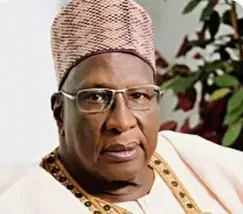
BAMANGA Tukur, former National Chairman of the Peoples Democratic Party, PDP, and former governor of Gongola (now Adamawa)State, is dead, aged 90.
Family’s sources confirmed his death on Saturday, although details surrounding his passing were not immediately made public.
Tukur, who died three days before his 91st birthday, was one of the prominent political figures whose career cut across Nigeria’s military and civilian administrations, the private sector and continental business circles.
Born on September 15, 1935, he began his public service career at the Nigerian Ports Authority, NPA, where he served as General Manager from 1975 to 1982.
He moved into elective politics and won the Gongola State governorship election in 1983, but his tenure was cut short by the military coup in December of the same year.After leaving office, Tukur turned to business and founded BHI Holdings, popularly known as the DADDO Group of Companies.
He later returned to government as Minister of Industries between 1993 and 1995 under the military administration of General Sani Abacha.Tukur also played prominent roles in African business and economic affairs, serving as Executive President of the African Business Roundtable and Chairman of the NEPAD Business Group.
He held advisory positions with several international trade organisations.
In March 2012, he returned to partisan politics when he was elected National Chairman of the PDP with the backing of then-President Goodluck Jonathan.
His tenure, however, was overshadowed by prolonged internal disagreements within the party, culminating in his resignation as national chairman in January 2014.
News
Albert Horsfall, Ex-SSS Director-General dies
“Details of funeral arrangements and other related activities will be communicated in due course.”
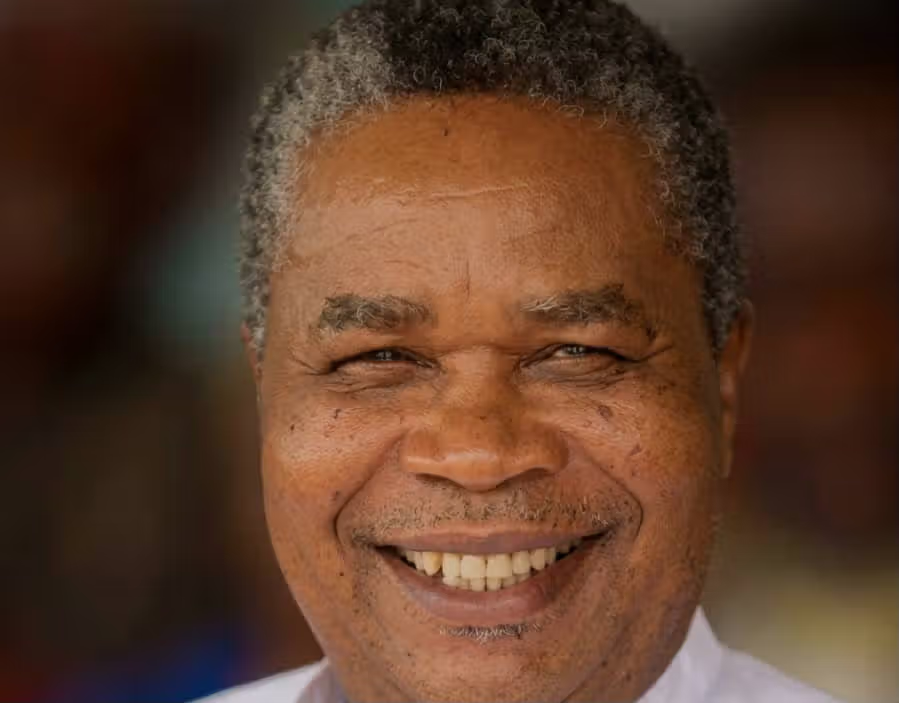
A former Director-General of the State Security Service and pioneer Director-General of the National Intelligence Agency, Albert Horsfall, has passed on.
Horsfall’s death was announced in a statement released on Friday, signed by his son, Donald Horsfall, and obtained by our correspondent.
According to the statement, the transition of the elder statesman and great son of Rivers State occurred peacefully, describing him as a “beloved patriarch.”
While the family mourns his death, the statement said they would be comforted by the extraordinary life he lived and the indelible mark he left on the sands of time.
“Details of funeral arrangements and other related activities will be communicated in due course,” it added.
News
US delivers military equipment to Nigeria
The US Africa Command (AFRICOM), in a statement on its website on Thursday, said the equipment was delivered in September through a US Air Force C-17 aircraft.

The United States has delivered military equipment to the Nigerian Air Force in Lagos and Kainji, Niger State, to support counterterrorism operations.
The US Africa Command (AFRICOM), in a statement on its website on Thursday, said the equipment was delivered in September through a US Air Force C-17 aircraft.
According to the command, the delivery was part of a foreign military sales agreement between the United States and Nigerian militaries.
“The delivery furthers the strategic partnership between the two nations in order to enhance Nigerian-led efforts to counter terrorism in the region.
U.S. military support to the Armed Forces of Nigeria is by its invitation and rooted in respect for Nigerian sovereignty,” AFRICOM said.


Bamanga Tukur, former Adamawa gov, ex-PDP Chair dies at 90

Bayelsa deploying 19 doctors, 210 nurses to strengthen primary healthcare centres

Albert Horsfall, Ex-SSS Director-General dies

Tech Expert, Zuckerberg trains with UFC champions, Adesanya, Alexander

Organ Trafficking: Ekweremadu bags 10 years in UK prison

SAINT OBI: Between his marriage and his death
-
 News3 days ago
Police arrest 46 for obstruction of Obi’s convoy in Benue
-

 News3 days ago
JUST IN: One Dead, Many Feared Trapped as Two-Storey Building Collapses in Lagos
-

 News3 days ago
Lagos Confirms 6 Diphtheria Cases, Says no Outbreak
-

 Business3 days ago
Brent Holds Above $101bp
-

 Politics3 days ago
Trump promises $5,000 ‘dividend’ to U.S. citizens if Republicans win midterms
-

 Entertainment3 days ago
Rema to release new single ‘Oh No’ Friday
-
 Politics3 days ago
I will concede defeat if 2027 election is credible — Obi
-
 News2 days ago
FG scraps data charges for students, plans internet restrictions to under 16s