
News
Moghalu says economy better under PDP, presidency faults claim


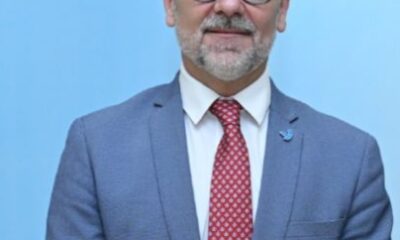
The Senior Special Assistant to the President on Media and Publicity, Temitope Ajayi, and a former Deputy Governor, Central Bank of Nigeria, Kingsley Moghalu, on Wednesday, traded blame on the state of the nation’s economy under the administrations of the ruling All Progressives Congress and opposition Peoples Democratic Party.
Moghalu had claimed in a series of tweets via his X handle on Wednesday that the nation’s economic state, which had experienced a downward trajectory in the past 40 years, only saw the light of the day “briefly” under the administration of former President Olusegun Obasanjo.
Moghalu added that the improved economy was also observed during subsequent PDP-led governments of the late Umaru Yar’Adua, and Goodluck Jonathan.
The former CBN deputy governor, who served from 2009 to 2014, added that from 2015 till date, Nigeria has fallen under a “completely incompetent economic management.”
The tweet read, “Nigeria’s economic distress is simply part of a 40-year downward trajectory that was broken only briefly by the Obasanjo civilian presidency and to some degree under Yar’Adua/Jonathan (up to mid-2014). Ever since, especially from 2015, we fell under completely incompetent economic management and have not recovered.”
The political economist called on the Federal Government to lay a “real foundation for longer-term economic transformation,” while stating that “80% of Nigeria’s exports in 2023 was oil tells you we have yet to get serious..”
Moghalu noted that the presidential palliatives initiative is not a good economic tool to curb poverty, and consequently improve wealth distribution.
“Palliatives (just google the dictionary definition of the word) will never reverse poverty. Wealth is positively created,” he stated.
Moghalu, a former presidential candidate of the Young Progressives, also criticised the appointments of the nation’s economic management team, stating, “Real economic thinking is not happening, so economic transformation can’t follow. Like it or not, individuals in certain positions matter. Sanusi and Ngozi Okonjo-Iweala made a huge difference in their roles. That’s because they had capacity. Their appointments went above politics of cronyism. The results, which is what matters more than sound and fury at the end of the day, followed.”
The tweet concluded, “May we recover one day. Like it or not, appointments have real consequences.”
Reacting to the tweets later in the day, President Bola Tinubu’s aide, Ajayi, admitted that the Obasanjo-led administration from 1999-2007 truly paved the way for some economic reforms, yet “Nigeria didn’t see any progress in infrastructural development” that would have a “direct bearing on the quality of life.”
Ajayi wondered how Moghalu and some others claimed that their era in government was the “golden era of competence” in the nation’s economic management.
Ajayi lamented how Moghalu and his former principal, Sanusi, at the CBN, couldn’t explain the whereabouts of the missing $20 billion in oil revenue, adding that “hundreds of millions of dollars were looted under various guises yet Moghalu wants us to believe that that period was the gold standard in economic management in Nigeria.”
“That period till 2015 was a period of trillions of unpaid salary and pension arrears. A period when contractors were owed hundreds of billions with thousands of abandoned and uncompleted projects,” Ajayi stated.
The presidential aide also noted that since 2015, the nation enjoyed key reforms and changes under the ruling APC government, part of which were the payments of owed salaries and pensions, “massive investments in critical economic infrastructure,” and the “reconstruction of 13,000 kilometres of roads across the country out of 33,000 kilometres of Federal roads in 8 years of President Buhari.”
Ajayi claimed that during the handover of government from Jonathan to the immediate past president, Muhammadu Buhari, on May 29, 2015, Nigeria’s Gross Domestic Product “declined from 7% growth rate to 2% and Nigeria was already primed for recession which eventually happened with collapse of crude oil price.”
“It should be said too that every indices of measuring economic growth significantly declined from 2010- May 2015, a period when Moghalu was Deputy Governor at CBN,” he added.
Ajayi lamented that Nigeria’s foreign reserve dropped about 52 per cent “from the height of $60 billion to $29 billion when Moghalu was part of the ‘competent leaders’ in government and Excess Crude Account dropped from $20 billion to $2 billion at the time crude oil sold for $100 per barrel for straight 4years from 2011-2014.
“The period between 2010-2014 was when Nigeria made most money from crude oil in history yet nothing to show for it.”






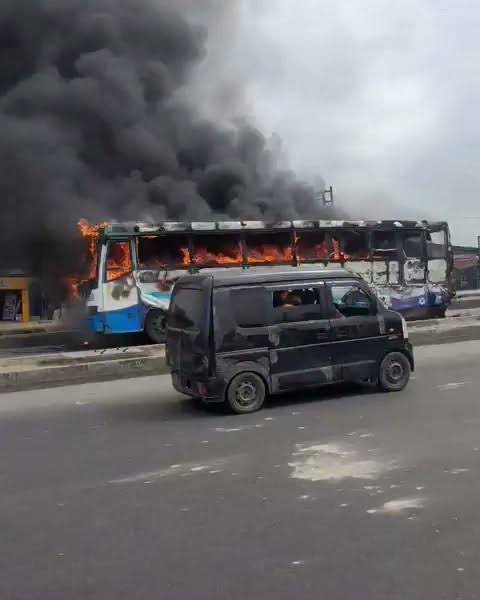
An angry mob has set a Bus Rapid Transit (BRT) bus on fire after it reportedly crushed a commercial motorcyclist to death at Ogolonto Bus Stop along Ikorodu Road in Lagos State.
The incident occurred on Friday, October 16, 2026. Eyewitness accounts and social media reports indicate that the motorcyclist was riding alone along the restricted BRT lane when the collision happened. He died at the scene.
Enraged residents and youths then attacked the bus driver and set the vehicle ablaze. Police officers and officials of the Lagos Neighbourhood Safety Corps (LNSC), who were nearby, intervened promptly and rescued the driver unharmed.
The identity of the deceased motorcyclist and the exact circumstances of the crash had not been officially confirmed at the time of filing this report. It was also unclear whether any arrests had been made in connection with the burning of the bus.
News
ARISE News Wins Seven Honours At Nigerian Broadcasters Merit Awards
The awards recognised the network’s achievements in television journalism and programming, with ARISE News winning the Best TV Channel (Viewer’s Choice) category.


• ARISE News Anchor and host of What’s Trending Ojy Okpe was named Best Newscaster (TV – Female)
ARISE News has emerged as one of the major winners at the just ended Nigerian Broadcasters Merit Awards (NBMA).
ARISE News won seven honours across television broadcasting, news reporting, presentation and production during the ceremony.
The awards recognised the network’s achievements in television journalism and programming, with ARISE News winning the Best TV Channel (Viewer’s Choice) category.
The network’s flagship breakfast programme, The Morning Show, also won the Best TV Talk Show award, further strengthening its recognition in television broadcasting.
ARISE News Anchor and host of What’s Trending Ojy Okpe was named Best Newscaster (TV – Female).
Rufai Oseni was named Nigerian Broadcaster of the Year (Male), while Vimbai Mutinhiri-Ekpeyong received the Nigerian Broadcaster of the Year (Female) award.
The recognition extended to the network’s newsroom, with Ovieteme George winning Best TV News Reporter (Male) for his contributions to television news reporting.
Behind the camera, Sam Adeyemi received the Best Camera Operator/Cinematographer award, recognising his work in television production and visual storytelling.
News
Meta removes 3.7 million accounts in West Africa scam crackdown
The joint operation led to 28 arrests, identified more than 30 suspected scam centres and rescued 117 people allegedly trafficked and forced to work in scam compounds in Ghana.
Meta, the parent company of Facebook and Instagram, has removed more than 3.7 million Facebook and Instagram accounts, pages and groups linked to suspected scam networks operating in West Africa.
The joint operation led to 28 arrests, identified more than 30 suspected scam centres and rescued 117 people allegedly trafficked and forced to work in scam compounds in Ghana.
The company announced the crackdown in a statement on Tuesday, October 13, 2026. It involved 14 technology companies and law enforcement agencies from 10 countries.
The United Kingdom’s National Crime Agency coordinated the operation with the US Department of Justice, the Federal Bureau of Investigation and other agencies. Nigerian authorities were involved.
Other countries included Ghana, Australia, Canada, New Zealand and India.Tech companies that took part included Google, Microsoft, OpenAI, Coinbase, Starlink and Adobe.
Meta said the partnership let participants share intelligence across digital platforms, countries and financial systems to identify criminal networks.


JUST IN: Mob Sets BRT Bus Ablaze After Motorcyclist’s Death in Lagos

BREAKING: DSS Arrests Fugitive Maina Son, Hands Him to EFCC

BREAKING: 5 Arrested Over Imo NYSC Abduction

BREAKING: Lagos Govt Declares Today, Thursday Work-Free to Mark 2026 Ìṣẹ̀ṣe Day

Tech Expert, Zuckerberg trains with UFC champions, Adesanya, Alexander

Organ Trafficking: Ekweremadu bags 10 years in UK prison
-
 Business2 days ago
Naira Exchange Rates For Thursday, October 15
-
 Sports2 days ago
CAF Increases Annual Funding for Member Federations to $700,000
-
 News2 days ago
ASCON To Be Rebranded “National School Of Government”
-

 Business2 days ago
Germany plans tax on sugary drinks
-
 Business2 days ago
WEF could appoint Lagarde as its next chair, sources say
-

 International2 days ago
“Mother of all bombs,” Trump Plans To Hit Iran
-

 News3 days ago
Sanwo-Olu Appoints Olatunbosun Ogunbanwo, 5 Others as Perm Secs
-
 Business1 day ago
Naira Exchange Rates Friday, October 16