
International
Japan targets 40-50% power supply from renewables by 2040


(Reuters) – Japan wants renewable energy to account for up to 50% of its electricity mix by fiscal year 2040 with nuclear power taking up another 20%, according to a draft of its revised basic energy policy, as it makes a clean energy push while meeting rising power demand.
As the world’s second-largest importer of liquefied natural gas and a major consumer of Middle Eastern oil, Japan and its basic energy plans are drawing global attention from oil, gas and coal producers.
While the previous energy plan’s primary focus was decarbonisation, it has shifted greater attention to energy security given heightened geopolitical risks, including the Russia-Ukraine war.
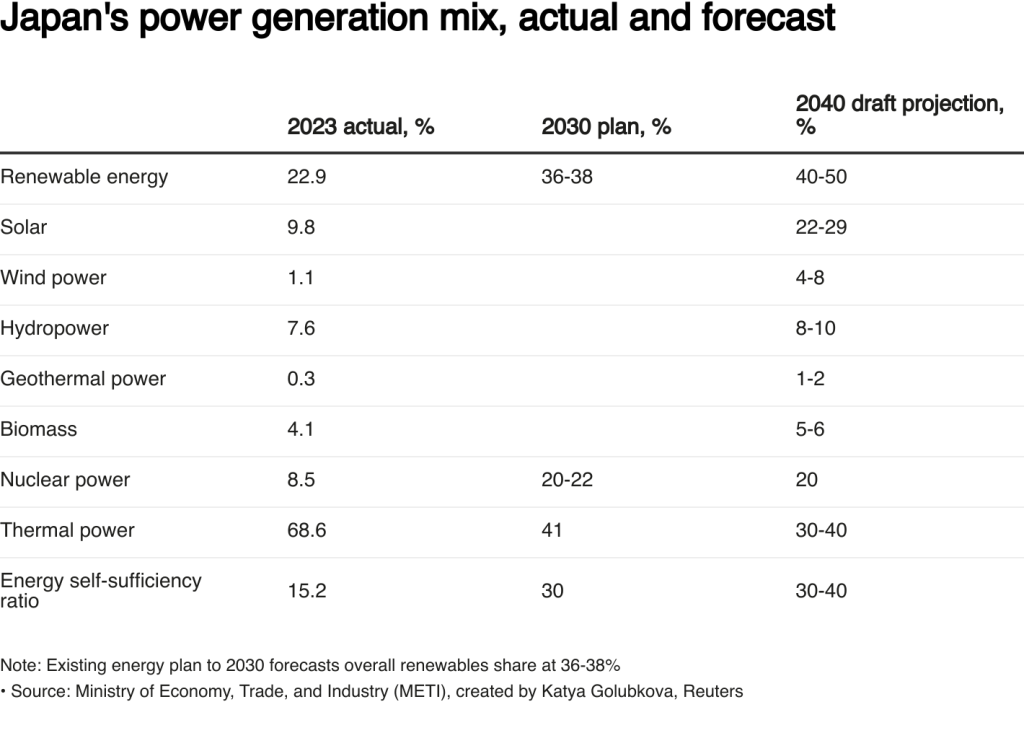
The industry ministry’s policy draft, unveiled on Tuesday, proposes increasing renewables to between 40% and 50% of power supplies in the 2040 fiscal year, roughly doubling the 22.9% share in the 2023 fiscal year and exceeding the 2030 target of between 36% and 38%.
Thermal power usage, particularly from inefficient coal-fired power plants, is set to decrease to between 30% and 40% of the mix by 2040 from 68.6% in 2023, although the draft energy policy does not specify the breakdown of coal, gas and oil.
Advocates for renewable energy have criticised the draft, however, noting the lack of a roadmap for phasing out coal-fired power.
Mika Ohbayashi, a director at the Renewable Energy Institute, also pointed to the small target share for wind power, between 4% and 8%, compared with 20% for nuclear.
That could leave Japan lagging in wind power compared with other markets worldwide.
The draft also called for the government and the private sector to secure long-term LNG contracts to hedge against price hikes and supply disruption risks.
“It is necessary to utilise LNG-fired power as a realistic means of transition,” it said.Japan’s 2040 nuclear power target is in line with the 2030 target of between 20% and 22%, despite the challenges faced by the industry after the 2011 Fukushima disaster.
Nuclear power accounted for 8.5% of the country’s power supply in 2023.
The new energy plan removes the previous target of “reducing reliance on nuclear power as much as possible” and includes plans to build innovative next-generation reactors at nuclear power sites owned by operators who have decided to decommission existing reactors.
The 2040 forecasts assume an increase in electricity demand of between 12% and 22% from 2023 levels, particularly from semiconductor factories and data centres. All targets are provisional.
The new proposed energy plan is more realistic than the existing targets through 2030, some analysts say, indicating that the government wants to attract investments in renewable energy, including storage batteries, and keep LNG as a transition fuel.
International
Japan beer giants raided over alleged price-fixing cartel
Asahi, Kirin and Sapporo all saw their share price fall after news of the investigation broke on Wednesday. Suntory’s beer business is not publicly-listed.

Image credit: BBC| GETTY Images
Japanese officials have raided the country’s biggest beer makers over allegations they worked together to raise the price of their beverages.
Asahi, Sapporo, Kirin and Suntory Spirits confirmed to the BBC that their premises had been searched by the Japan Fair Trade Commission (JFTC), adding that they would fully cooperate with the regulator.
The four firms dominate Japan’s beer market, with their drinks a common sight in supermarkets and convenience stores across the country.
Asahi, Kirin and Sapporo all saw their share price fall after news of the investigation broke on Wednesday. Suntory’s beer business is not publicly-listed.
“I do not deny that an investigation is being conducted today, but I’d like to refrain from commenting on the details as a preliminary review is underway,” JFTC Secretary General Iwanari Hiroo said, according to local media.
International
Belgian Students Protest Over Rising Education Costs
Tuition fees for most students in Belgium’s French-speaking Community, was increased from €835 to €1,194.

Hundreds of students in the Belgian city of Liège took to the streets protesting rising education costs, according to Belga news agency.
Tuition fees for most students in Belgium’s French-speaking Community, was increased from €835 to €1,194.
Local media reported that 107 people had been arrested in recent days, for offences linked to property damage and arson.
The protesters are challenging conditions in Belgium’s French-language education system, citing rising costs, overcrowded classrooms and difficulties accessing study materials.
Students carried placards expressing their frustration, including messages calling for education to be treated as a right rather than a privilege.
International
Ethiopian woman says she hasn’t eaten or drunk water since age 10
Despite claiming not to eat, Ambaw said she enjoys preparing meals for her family and visitors.

•Muluwork Ambaw
An Ethiopian woman, Muluwork Ambaw, has claimed that she has not eaten food or drunk water since she was 10 years old, saying she suddenly lost her appetite as a child.
Ambaw, who is now 26 and lives in Jimma, Ethiopia, said her last meal was lentil stew before she stopped eating and drinking.
Her extraordinary claim gained international attention after travel content creator Drew Binsky visited her in Ethiopia and documented her story and daily life.
According to Ambaw, the change began when her family would ask her to have breakfast before going to school.
Her extraordinary claim gained international attention after travel content creator Drew Binsky visited her in Ethiopia and documented her story and daily life.
According to Ambaw, the change began when her family would ask her to have breakfast before going to school.
“I used to live with my family, and they asked me to eat breakfast and go to school. I said I had eaten, but I was pretending,” she said, according to an account shared by Binsky.
Ambaw said she simply stopped feeling hungry or thirsty and has continued living without consuming food or water.
Despite claiming not to eat, Ambaw said she enjoys preparing meals for her family and visitors.
She reportedly grows vegetables in her garden so she can cook fresh food when her sister or guests visit.
“I cook as much as I want, but I have no appetite,” she said.


Investors Rush For Airtel Money IPO on LSE

JUST IN: NNPC Clarifies Petrol Discount: Relief Initiative, Not Subsidy Restoration

JUST IN: A’Court Stalls SERAP, Oluwadare Defamation Appeals Over Late Briefs

Tech Expert, Zuckerberg trains with UFC champions, Adesanya, Alexander

Organ Trafficking: Ekweremadu bags 10 years in UK prison

SAINT OBI: Between his marriage and his death
-

 News3 days ago
NAF Helicopter Makes Precautionary Landing In Makurdi
-

 Business3 days ago
Naira Today Exchange Rates, Thursday October 8
-

 News1 day ago
Tears, Embraces as Rescued NYSC Members Reunite with Families in Ibadan
-

 Business2 days ago
Naira Exchange Rates Friday, October 9
-

 Business3 days ago
Obi advocates policy support for manufacturers
-

 Business1 day ago
Manufacturers sitting on N40trn untapped opportunities, says report
-

 News1 day ago
Ahmadu Bello University Hikes Fees Across Programme
-

 International3 days ago
Belgian Students Protest Over Rising Education Costs