News
FCT Minister, Nyesom Wike introduces sweeping reforms in FCT land Administration

….says, area council land allocations will be regularised, Mass Housing properties will be titled in favour of Buyers, and allottees must develop lands within two Years.
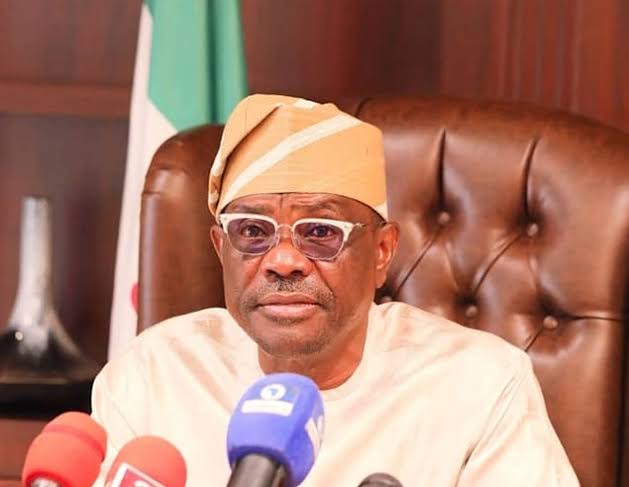
The Minister of the Federal Capital Territory, FCT, Nyesom Wike has introduced sweeping reforms in FCT land Administration.
According to the Minister, area council land allocations will be regularised, Mass Housing properties will be titled in favour of Buyers, and allottees must develop lands within two Years.
Director, Land Administration FCTA, Chijioke Nwankwoeze, said the land reform will become operational from April 21, 2025.
The statement reads: “We are here to intimate you of the broad and comprehensive reforms on land administration in the Federal Capital Territory (FCT), that the Minister, Barrister Ezenwo Nyesom Wike, CON, has approved for implementation.
These reforms, which will become operational from April 21, 2025, cover specific areas like conditions of grant of Statutory Right of Occupancy, contents of the Statutory Right of Occupancy Bill, contents of Letter of Acceptance/Refusal of offer of grant of Right of Occupancy, titling of Mass Housing and sectional interests, as well as regularization of Area Council Land documents.
It should be noted that before now, deadline for payment of bills, rents, fees and charges is not specified in the Statutory Right of Occupancy bill, and no penalty for failure to make payment promptly.
This has caused delay in revenue receivable due to non-collection of Right of Occupancy (R-of-O) and non-payment of bills, slower pace of infrastructural development, sustained land speculation and racketeering while huge expenses have been incurred by the FCT Administration through repeated advertisements and publications notifying the public on the need for collection of R-of-O and timely payment of bills and charges.
Consequently, as against the unspecified period within which to collect the Right of Occupancy (R-of-O) and make full payment of the Statutory Right of Occupancy bills and charges, land allottees now have 21 days from the date of offer, to make full payment of all bills, fees, rents and charges prescribed on offers of Statutory Rights of Occupancy and submit a duly completed Letter of acceptance alongside evidence of payments, or lose the offer.
Also, as against the lengthy period within which to develop allocated lands, the period within which to erect and complete developments on any land granted in the FCT is now two years from the date of the commencement of the R-of-O.
Therefore, any R-of-O bills and any other payments made outside the stipulated 21 days shall be considered invalid while any land granted should be developed within two years.
On lands previously allocated by Area Councils, the law stipulates that all lands in the FCT are urban land.
It therefore becomes necessary that all land documents issued by the Area Councils are considered for regularisation to statutory titles in line with relevant statutes.
It should be noted that in 2006, the Zonal Land, Planning and Survey offices of the six Area Councils were directed to submit all Area Council allocation lists, layouts, files and registers to Abuja Geographic Information System (AGIS)/Lands Department, and this was done by the Area Councils.
However, to date, out of the 261,914 Area Council land documents submitted for regularization, only 8,287 have been vetted, out of which only 2,358 were cleared, validated and regularized to statutory titles.
The 8,287 were vetted from 2006 to 2023 (17 years), and this represents just 3.2% of the total land documents submitted for vetting and regularization as at today, the FCT Administration is still left with 253,627 submissions in its database.
Area Council land documents successfully vetted and confirmed would have statutory titles on such lands issued and the allottees will have sixty days to make full payments of all bills, fees, rents and charges prescribed, failure of which the offers shall become invalid.
On Mass Housing, it should be noted that the Mass Housing Programme was initiated in year 2000 to utilize the Public Private Partnership (PPP) strategy with the objective of providing affordable housing for the residents of FCT.
However, from the inception of the Mass Housing programme in 2000 till date, out of the 445 Mass Housing allocations granted, only two developers have successfully met the terms and conditions.
A new operational framework for titling of Mass Housing and Sectional Interests has been developed to fast-track the exercise efficiently, effectively and diligently, in line with the Minister’s vision to restore confidence in the administration of lands in the FCT.
Currently, the holders/occupiers of properties within the various Mass Housing Estates in the FCT do not pay and bills, rents, fees and charges to the government despite having held and occupied the properties for decades.
In recognition of the urgent need to issue titles to the beneficiaries of Mass Housing and Sectional Interests, all applications for titling are to be made by the Subscribers/Developers to the Department of land Administration for processing.
Processing of titles for Mass Housing and Sectional Interests shall commence on April 21, 2025, in line with the new operational framework.








Former Delta State Governor Dr. Emmanuel Eweta Uduaghan is dead. He passed away on the morning of Monday, October 19, 2026, at the age of 71, after a period of illness.
A family statement announced his death, describing it as a devastating loss. Uduaghan, a medical doctor, served as Delta State Commissioner for Health (1999–2003) and Secretary to the State Government (2003–2007) before becoming governor from 2007 to 2015. He was known for contributions to infrastructure and human capital development in the state.
Delta State Governor Sheriff Oborevwori has expressed deep sadness over the passing. In a condolence message, he described Uduaghan as a detribalised leader whose service left a lasting mark on Delta State.
Oborevwori extended heartfelt condolences to Uduaghan’s wife, Roli, his children, the Uduaghan family, the Itsekiri nation, and the people of Delta State, praying for the peaceful repose of his soul.
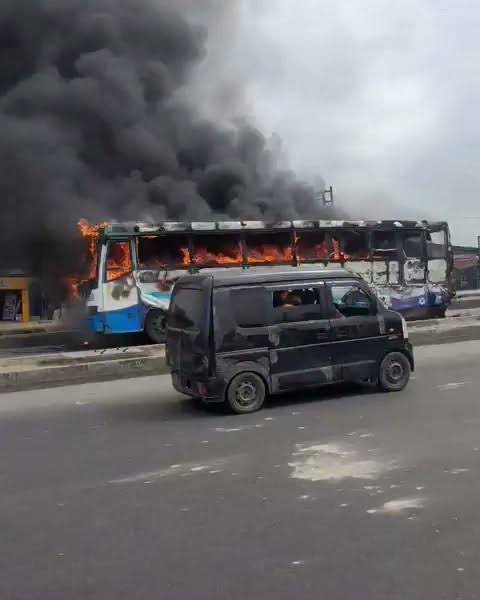
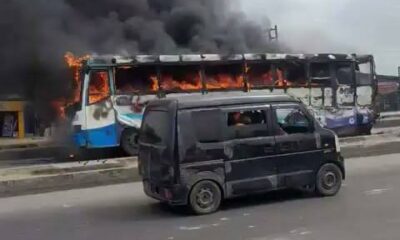
An angry mob has set a Bus Rapid Transit (BRT) bus on fire after it reportedly crushed a commercial motorcyclist to death at Ogolonto Bus Stop along Ikorodu Road in Lagos State.
The incident occurred on Friday, October 16, 2026. Eyewitness accounts and social media reports indicate that the motorcyclist was riding alone along the restricted BRT lane when the collision happened. He died at the scene.
Enraged residents and youths then attacked the bus driver and set the vehicle ablaze. Police officers and officials of the Lagos Neighbourhood Safety Corps (LNSC), who were nearby, intervened promptly and rescued the driver unharmed.
The identity of the deceased motorcyclist and the exact circumstances of the crash had not been officially confirmed at the time of filing this report. It was also unclear whether any arrests had been made in connection with the burning of the bus.
News
ARISE News Wins Seven Honours At Nigerian Broadcasters Merit Awards
The awards recognised the network’s achievements in television journalism and programming, with ARISE News winning the Best TV Channel (Viewer’s Choice) category.


• ARISE News Anchor and host of What’s Trending Ojy Okpe was named Best Newscaster (TV – Female)
ARISE News has emerged as one of the major winners at the just ended Nigerian Broadcasters Merit Awards (NBMA).
ARISE News won seven honours across television broadcasting, news reporting, presentation and production during the ceremony.
The awards recognised the network’s achievements in television journalism and programming, with ARISE News winning the Best TV Channel (Viewer’s Choice) category.
The network’s flagship breakfast programme, The Morning Show, also won the Best TV Talk Show award, further strengthening its recognition in television broadcasting.
ARISE News Anchor and host of What’s Trending Ojy Okpe was named Best Newscaster (TV – Female).
Rufai Oseni was named Nigerian Broadcaster of the Year (Male), while Vimbai Mutinhiri-Ekpeyong received the Nigerian Broadcaster of the Year (Female) award.
The recognition extended to the network’s newsroom, with Ovieteme George winning Best TV News Reporter (Male) for his contributions to television news reporting.
Behind the camera, Sam Adeyemi received the Best Camera Operator/Cinematographer award, recognising his work in television production and visual storytelling.


JUST IN: Ex-Delta Gov Uduaghan Dies at 71, Oborevwori Mourns

JUST IN: Mob Sets BRT Bus Ablaze After Motorcyclist’s Death in Lagos

BREAKING: DSS Arrests Fugitive Maina Son, Hands Him to EFCC

BREAKING: Lagos Govt Declares Today, Thursday Work-Free to Mark 2026 Ìṣẹ̀ṣe Day

Tech Expert, Zuckerberg trains with UFC champions, Adesanya, Alexander