
Politics
Chief Bode George Writes President Tinubu “Protect the democratic space, not shrink it”
Let me state this plainly: Democracy cannot survive where opposition is weakened, ridiculed, or systematically neutralized.

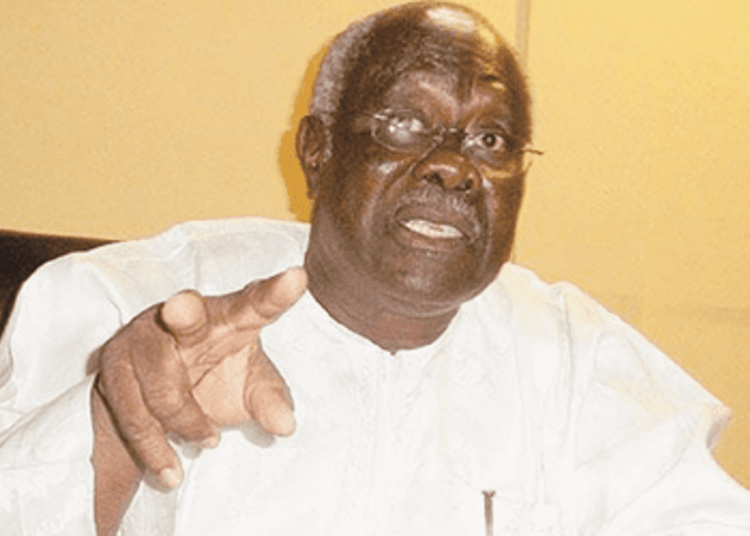
Chief Olabode Ibiyinka George, has written an open letter to President Bola Ahmed Tinubu, counseling him to “Protect Nigeria’s democratic space, not shrink it.”
In the open letter, Chief George tells President Tinubu:
” Mr. President,This is not a routine correspondence; it is a deeply held conviction from my heart.
I write as a man who has given over half a century to the service of Nigeria, a country whose stability, unity, and democratic future are now under visible strain.
I speak out of conviction, experience, and a duty to truth.
My reflections arise not from anger or partisanship, but from a place of sincere patriotism, responsibility, and an abiding faith in Almighty God.
Nigeria is drifting dangerously. What is unfolding within our political space today raises grave concern.
The increasing suppression direct or indirect of opposition voices, the apparent drive toward political dominance without restraint, and the erosion of democratic balance are not merely troubling; they are signals of a system under stress and heading towards potential rupture.
Let me state this plainly: Democracy cannot survive where opposition is weakened, ridiculed, or systematically neutralized.
A country governed without credible dissent is not stable, it is volatile. And volatility, once ignited, respects no office, no title, and no authority.
Mr. President, history is littered with leaders who mistook control for strength.
They surrounded themselves with applause, silenced criticism, and dismissed warnings until reality corrected them, often irreversibly. I request you fervently not to walk that path.
The assumption that power can be consolidated without consequence is a grave miscalculation.
The belief that influence, patronage, or financial leverage can substitute for justice and fairness is equally flawed.
As one of the global economic thinkers Professor Ross Gittins rightly observed societies do not find stability in material appeasement alone.
As material incentives and political patronage do not create lasting satisfaction or loyalty.
Money does not define leadership and cannot buy legitimacy. It cannot command respect, and certainly cannot secure legacy.
What sustains leadership is trust and trust is built on fairness, equity, transparency and justice.
Today, that trust is under pressure. Nigerians are not merely concerned they are watching.
They are burdened by economic hardship, rising costs, and a growing sense of uncertainty. In such a climate, any perception rightly or wrongly of political suppression becomes combustible.
Let me be unequivocal:a nation under economic strain cannot afford political provocation.
This is how instability begins not suddenly, but gradually through decisions that appear strategic in the moment but prove destructive in consequence.
Mr. President, you stand at a decisive crossroad. You can choose to correct course, strengthen democratic institutions, and restore national confidence.
Or you can allow the current trajectory to continue one that risks deepening division and inviting consequences that no administration can fully control.There is also a matter of counsel.
As we approach critical judicial decisions, particularly from the Supreme Court, every action taken by leadership must reinforce not weaken the integrity of our institutions. Anything less sends a dangerous message both within and beyond our borders.
Those who tell you that all is well, those who dismiss legitimate concerns, who encourage aggressive political consolidation, who interpret caution as weakness are not safeguarding your leadership; they are endangering it.
Leadership demands the courage to hear the truth, not just loyalty. Let me remind you: Power is temporary. History is permanent. No leader escapes the judgment of history.
The question is not whether your tenure will end; it will end. The question is how it will be remembered.
Nigeria, once the undisputed Giant of Africa, now faces the risk of diminished relevance.
Nations once considered smaller or less stable are advancing in governance, electoral credibility, and institutional discipline while we struggle with avoidable internal tensions.
This is not acceptable. As we approach critical judicial decisions, particularly from the Supreme Court, every action taken by leadership must reinforce not weaken the integrity of our institutions. Anything less sends a dangerous message both within and beyond our borders.
Mr. President, I say this with all sincerity and urgency. If the current course is not urgently reviewed and corrected, the consequences may be far-reaching.
Nations do not collapse overnight they unravel through a series of ignored warnings.This is one of those warnings, if ignored could be severe.
You have been entrusted by God and by circumstance with leadership at a critical moment in Nigeria’s history.
Use it wisely. Correct course where necessary. Restore confidence where it has been lost. Protect the democratic space, not shrink it. That trust must not be squandered.
Act with courage.
Act with restraint. Act with justice.
Distance yourself from sycophants. Embrace truth and act with courage. Remove those who mislead you.Listen to voices of reason. Protect the democratic space.
Save Nigeria from avoidable crisis.
Protect its democracy. Preserve its unity. Secure its future.
Finally, Mr. President, I must emphasise that the integrity of our electoral process must remain sacrosanct.
There must be no manipulation whatsoever by the Independent National Electoral Commission (INEC) in any form or manner.
The will of the Nigerian people must be respected and allowed to prevail freely, transparently, and without interference.
Anything short of this undermines democracy and risks eroding the very foundation of our nation’s unity and legitimacy.
May God grant you the wisdom to discern truth, the humility to act on it, and the strength to lead rightly,” he signed off.

Politics
Exclusion of candidates from INEC list: CD cautions INEC against manipulation by politicians
The organisation maintained that it was deeply troubling that candidates who emerged through primaries monitored by INEC itself could be so brazenly excluded without immediate explanation.
• Demands untainted integrity ahead of 2027 elections
A leading pro-democracy group in Nigeria, the Campaign for Democracy (CD) has raised concerns over the omission of some political parties’ candidates from the list of candidates to contest in the 2027 general elections, particularly some governorship candidates.
The pro-democracy group warned the Independent National Electoral Commission against manipulation by desperate politicians, saying any threat to what it described as “political pluralism and participatory democracy” would be resisted.
In a strongly worded statement, signed by its President, Comrade Ifeanyi Odili, and released on Wednesday, CD wondered how the candidates’ names were excluded from the final list, without any immediate explanation, and when INEC, in its earlier list made available to the public on August 29, 2026, had cleared and published them.
The statement made particular reference to the Peoples Democratic Party’s governorship candidate in Gombe State, Isa Pantami; the party’s governorship candidate in Ogun State, Ladi Adebutu, and his deputy, Yemi Sowunmi-Kolapo.
The Campaign for Democracy said the development was particularly disturbing in Ogun State, where citizens had witnessed repeated boasts and triumphalism by members of the All Progressives Congress in the state that the PDP governorship candidate would be excluded from the final list.
According to CD, as if to validate that boast, INEC went ahead to publish a list that excluded both the PDP candidate, and his deputy, Hajia Yemi Sowunmi-Kolapo, without stating any reason for their omission.
CD said, “The timing of the omissions was even more disturbing, and this was where we became concerned and alarmed. A particular instance was that of Ogun State where the state’s citizens had witnessed repeated claims and apparent triumphalism by elements within the All Progressives Congress (APC) and their supporters that the PDP governorship candidate would be disqualified from participating in the forthcoming election.
“As if to validate that boast, INEC published a list that excluded both PDP candidates without stating the reason for their omission.”
“This troubling sequence of events raises legitimate questions about the independence and impartiality of the Commission that Nigerians cannot afford to ignore,” the pro-democracy group added.
It said, “Under your leadership, Mr. Chairman, INEC bears an enormous responsibility to demonstrate impartiality, transparency, and strict adherence to the law. Unfortunately, this development has raised serious doubts about the Commission’s preparedness to conduct a credible, transparent, and inclusive election in 2027.
“The clarification by the Commission published late yesterday, three days after the incident was belated.”
The group stated, “To the best of our knowledge, these are candidates that emerged through the primaries conducted by their various political Parties which were monitored by the Independent National Electoral Commission (INEC). Information in the public domain shows clearly that these candidates were on the earlier list published on the 29th of August, 2026.
“Even though the Commission has just published a belated clarification on the incident, we consider this development deeply troubling and a serious blow to public confidence in the electoral process, particularly because the published list provided no immediate explanation for the omissions of the governorship and other candidates.”
CD, which was formed in 1991 and was among the prominent civil society organisations that fought the military for restoration of civil rule in 1999, said it decided to intervene because the omission threatens Nigeria’s democratic credentials, warning INEC Chairman, Joash Amupitan, to avoid orchestrating anything that could set the nation on fire.
The organisation maintained that it was deeply troubling that candidates who emerged through primaries monitored by INEC itself could be so brazenly excluded without immediate explanation.
The group warned that an electoral umpire must not only be independent but must be seen to be independent.
CD said information from the affected states already showed heightened anxiety that could have exploded into intractable violence before the Commission’s belated clarification, describing the delay as inexcusable tardiness.
The pro-democracy body further demanded an immediate investigation into allegations circulating in the public that some candidates’ names were electronically removed after they were duly submitted.
It vowed that as a committed pro-democracy group, it would not hesitate to mobilise citizens and pro-democracy organisations across the nation for lawful mass civic action against any threat to political pluralism and participatory democracy.
“We remind INEC that elections belong to the Nigerian people, not to any political party, individual, or governing interest.
No institution should take actions that create the impression that opposition participation can be determined by administrative discretion without transparent, constitutional justification and due process,” CD stated.
Politics
APC Makes Wike, Soludo, Adeleke State’s Campaign Coordinator
Wike belongs to the Peoples Democratic Party (PDP), Soludo is a member of the All Progressives Grand Alliance (APGA), while Adeleke won re-election as Osun governor in 2026 under the Accord Party.
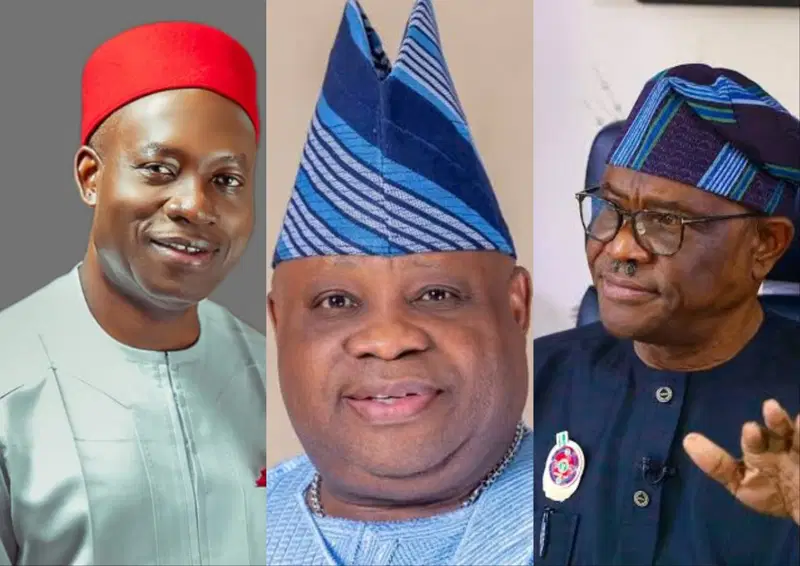
• [L-R] A collage of Soludo, Adeleke and Wike
The All Progressives Congress (APC) has named Nyesom Wike, minister of the Federal Capital Territory (FCT); Ademola Adeleke, Osun governor; and Chukwuma Soludo, Anambra governor, as state campaign coordinators in its expanded presidential campaign council for the 2027 general election.
This is despite their affiliations with other political parties.
Wike belongs to the Peoples Democratic Party (PDP), Soludo is a member of the All Progressives Grand Alliance (APGA), while Adeleke won re-election as Osun governor in 2026 under the Accord Party.
Under the new arrangement, Wike will coordinate the APC campaign in Rivers State and the FCT, Soludo will oversee Anambra, while Adeleke will coordinate the campaign in Osun.
The expanded list is scheduled for inauguration by President Bola Tinubu at the Presidential Villa in Abuja on Wednesday.
The APC initially released its campaign council list on August 22, naming Abdulaziz Yari, former Zamfara governor, as director-general. Senate President Godswill Akpabio, House of Representatives Speaker Tajudeen Abbas and Yobe Governor Mai Mala Buni were appointed deputy director-generals.

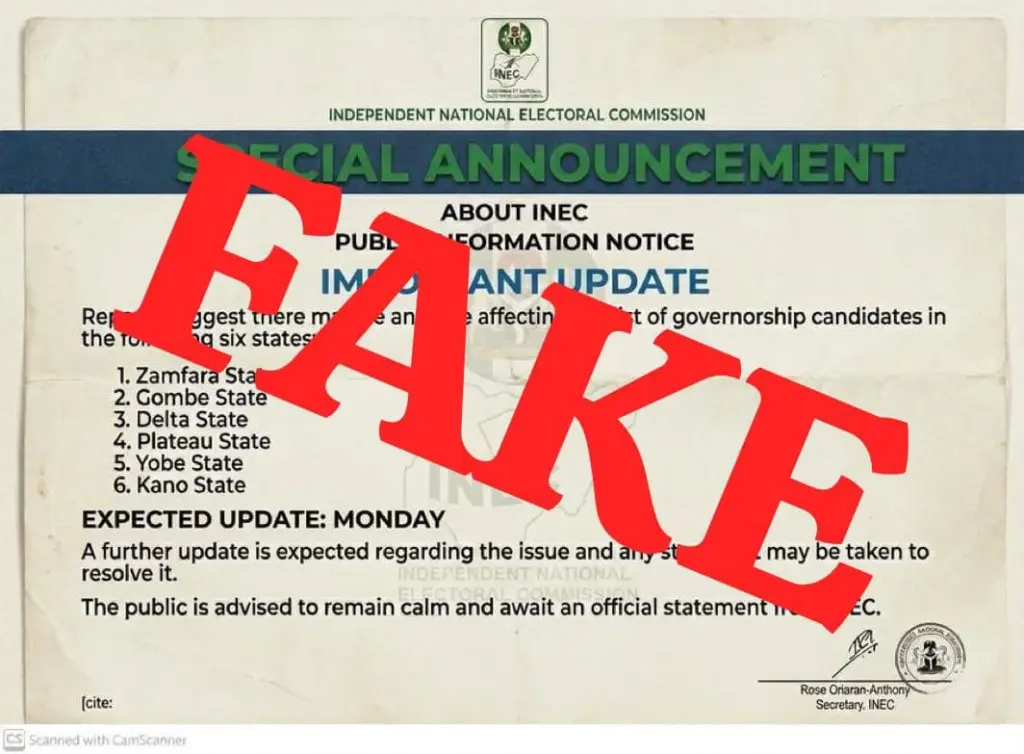
The Independent National Electoral Commission (INEC) has raised the alarm over a fraudulent publication circulating online that claims to be a special announcement about governorship candidates for the 2027 elections.
In a public notice issued on Monday, October 12, 2026, the electoral body described the document as “FAKE” and stressed that it did not originate from the Commission.
The circulating material purports to address issues affecting the list of governorship candidates in six states: Zamfara, Gombe, Delta, Plateau, Yobe, and Kano.
“The Commission wishes to categorically inform the general public that the publication is FAKE and did not originate from INEC. INEC therefore urges members of the public to disregard the fraudulent publication and refrain from sharing it,” the notice stated.
INEC further clarified that any information suggesting it has issued a special announcement concerning governorship candidates in those states is false.
The warning comes just days after the Commission published the final lists of candidates for the February 6, 2027 governorship elections.
The electoral umpire advised Nigerians, political parties, and candidates to rely solely on official notices, press releases, and information released through its verified channels.
These include the INEC website (inecnigeria.org), its Facebook page (INEC Nigeria), X and Instagram handles (@inecnigeria), and the INEC News Portal.
INEC reiterated its commitment to providing accurate electoral information and called on the public to remain vigilant against misleading publications as preparations for the 2027 elections intensify.


JUST IN: Mob Sets BRT Bus Ablaze After Motorcyclist’s Death in Lagos

BREAKING: DSS Arrests Fugitive Maina Son, Hands Him to EFCC

BREAKING: 5 Arrested Over Imo NYSC Abduction

BREAKING: Lagos Govt Declares Today, Thursday Work-Free to Mark 2026 Ìṣẹ̀ṣe Day

Tech Expert, Zuckerberg trains with UFC champions, Adesanya, Alexander

Organ Trafficking: Ekweremadu bags 10 years in UK prison
-

 Business3 days ago
NAFDAC scolds fake manufacturers: “You are killing Nigerians in order to make money”
-
 Business2 days ago
Naira Exchange Rates For Thursday, October 15
-
 Business3 days ago
Oyedele Chairs G-24 Call for Fairer Global Financial System, Affordable Development Financing
-
 Sports2 days ago
CAF Increases Annual Funding for Member Federations to $700,000
-
 Politics3 days ago
Exclusion of candidates from INEC list: CD cautions INEC against manipulation by politicians
-

 News2 days ago
ASCON To Be Rebranded “National School Of Government”
-

 Business1 day ago
Germany plans tax on sugary drinks
-

 News2 days ago
Sanwo-Olu Appoints Olatunbosun Ogunbanwo, 5 Others as Perm Secs