
News
Catholic Bishops in Nigeria calls for nation building, moral regeneration

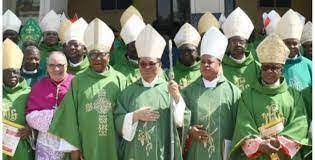
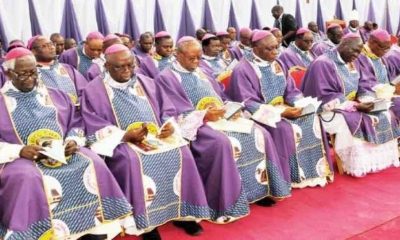
The Catholic Bishops Conference of Nigeria, (CBCN), at its 2023 2nd Plenary in Abuja, has advocated for building of a better nation as it said in a communiqué that moral regeneration of Nigerians is a key factor to building a new Nigeria.
The Bishops decried the escalating insecurity situation in the country, noting that it has remained a persisting problem as insurgents, herdsmen militia, bandits, and the so-called unknown gunmen have continued to unleash terror in different parts of the country.
“Kidnapping for ransom has continued. Some of our communities have been completely taken over by criminals. The result is that many have fled their homes, abandoned their farms, shops, businesses and other sources of livelihood. The throng of internally-displaced persons in our country is ever-growing, with many children out of school, making them easy prey to human traffickers,” CBCN lamented.
Contrary to claims by the Nigerian Military recently that it has ended the sit at home saga in the South East of Nigeria, the body of Bishops said insecurity in Nigeria has been compounded by the incessant sit-at-home orders in the South-East issued by non-state actors.
“Many have lost their lives for failing to adhere to such illegal directives.”
CBCN condemned the killing of the young seminarian, Stephen Na’aman Ngofe Danladi, of Kafanchan Diocese and all the other victims of such violence in all parts of the country as it condoled with all the bereaved and pray for the eternal repose of the dead.
The Bishops called on governments at all levels to stand up to their primary responsibility of safeguarding the lives and property of Nigerians. “The blood of the innocent continues to cry out to God for vengeance like Abel’s (Cf Genesis 4:10),” CBCN said.
While addressing the state of economy of the nation, CBCN noted, “Our failing and worsening economy has continued to make living difficult and hard for our people. Nigerians have been subjected to a life of poverty, hunger, hardship and suffering. The condition has been aggravated by the removal of fuel subsidy which has led to high cost of food items, transportation and meeting up with other essential needs. As if these are not enough, the hike in school fees has made it difficult for the children of the poor to continue their education.”
“Based on past experience, we consider the resort to palliative measures as a treatment of the symptom rather than the cure for the disease. We, therefore, urge government to address the fundamental defective structures that deepened inequality and poverty. We call on governments to provide the enabling environment for the creation of more jobs for our teeming unemployed youths. We equally encourage government to put in place measures that will curb the persistence of theft of oil and other minerals. At the same time, we enjoin the government to radically review programmes aimed at alleviating the suffering of the Youths. We equally advise the youth not to resort to violence and crime as a substitute for hard work,” CBCN added.
CBCN rejected the ever increasing scandalous comfort and remuneration of elected leaders to the detriment of the poor. “We therefore demand that the governments cut the increasing cost of running government in our country and that the money saved be used to provide essential amenities and services,” it said.
In addition, CBCN emphasized the contribution of religion in nation building, noting, “From the beginning of time, Religion has contributed immensely to the building and sustaining of nations and empires. It has done this through socialization processes, both formal and informal, societal integration and social control. Religion, as it were, brings to focus the inalienable place of God in human history. In Nigeria, we have three main religions: Christianity, Islam and African Traditional Religion. These religions have enjoyed mutual co-existence over time and agree on the sacredness of human life, moral uprightness, justice for all, especially for the poor and the vulnerable, respect for elders and those in authority, and many other common values.”
The Bishops, however, acknowledged that religion has had its share of negative impact on some nations, especially in multi-ethnic and diverse cultures, calling on Christians in Nigeria to change the narratives. “We invite all Christians, and indeed all people of good will, to be salt of the earth (Cf. Matthew 5:13-16), in the quest for rebuilding our nation through political participation, contribution to sustainable development, promotion of the common good, social justice, the rule of law, and shunning primordial interests that inhibit peace and development of the society. “
CBCN also advocated moral regeneration in the country, noting that moral integrity of any nation is paramount to its growth and development. “One who has moral integrity does the right thing always, takes responsibility for his or her actions, treats others with respect, and is honest. These qualities are necessary for rebuilding a strong and cohesive society. Unfortunately, our country is in serious deficit of moral rectitude which is demonstrated in increasing corruption, cyber-crime and other forms of criminality, blatant lies, and dishonesty.
“As Bishops, we are concerned that moral education is not given adequate attention in the families, schools, formation programmes and public institutions,” the statement added.



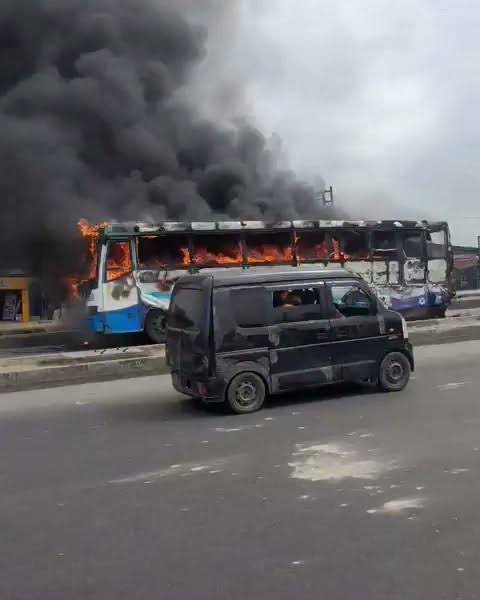
An angry mob has set a Bus Rapid Transit (BRT) bus on fire after it reportedly crushed a commercial motorcyclist to death at Ogolonto Bus Stop along Ikorodu Road in Lagos State.
The incident occurred on Friday, October 16, 2026. Eyewitness accounts and social media reports indicate that the motorcyclist was riding alone along the restricted BRT lane when the collision happened. He died at the scene.
Enraged residents and youths then attacked the bus driver and set the vehicle ablaze. Police officers and officials of the Lagos Neighbourhood Safety Corps (LNSC), who were nearby, intervened promptly and rescued the driver unharmed.
The identity of the deceased motorcyclist and the exact circumstances of the crash had not been officially confirmed at the time of filing this report. It was also unclear whether any arrests had been made in connection with the burning of the bus.
News
ARISE News Wins Seven Honours At Nigerian Broadcasters Merit Awards
The awards recognised the network’s achievements in television journalism and programming, with ARISE News winning the Best TV Channel (Viewer’s Choice) category.


• ARISE News Anchor and host of What’s Trending Ojy Okpe was named Best Newscaster (TV – Female)
ARISE News has emerged as one of the major winners at the just ended Nigerian Broadcasters Merit Awards (NBMA).
ARISE News won seven honours across television broadcasting, news reporting, presentation and production during the ceremony.
The awards recognised the network’s achievements in television journalism and programming, with ARISE News winning the Best TV Channel (Viewer’s Choice) category.
The network’s flagship breakfast programme, The Morning Show, also won the Best TV Talk Show award, further strengthening its recognition in television broadcasting.
ARISE News Anchor and host of What’s Trending Ojy Okpe was named Best Newscaster (TV – Female).
Rufai Oseni was named Nigerian Broadcaster of the Year (Male), while Vimbai Mutinhiri-Ekpeyong received the Nigerian Broadcaster of the Year (Female) award.
The recognition extended to the network’s newsroom, with Ovieteme George winning Best TV News Reporter (Male) for his contributions to television news reporting.
Behind the camera, Sam Adeyemi received the Best Camera Operator/Cinematographer award, recognising his work in television production and visual storytelling.
News
Meta removes 3.7 million accounts in West Africa scam crackdown
The joint operation led to 28 arrests, identified more than 30 suspected scam centres and rescued 117 people allegedly trafficked and forced to work in scam compounds in Ghana.

Meta, the parent company of Facebook and Instagram, has removed more than 3.7 million Facebook and Instagram accounts, pages and groups linked to suspected scam networks operating in West Africa.
The joint operation led to 28 arrests, identified more than 30 suspected scam centres and rescued 117 people allegedly trafficked and forced to work in scam compounds in Ghana.
The company announced the crackdown in a statement on Tuesday, October 13, 2026. It involved 14 technology companies and law enforcement agencies from 10 countries.
The United Kingdom’s National Crime Agency coordinated the operation with the US Department of Justice, the Federal Bureau of Investigation and other agencies. Nigerian authorities were involved.
Other countries included Ghana, Australia, Canada, New Zealand and India.Tech companies that took part included Google, Microsoft, OpenAI, Coinbase, Starlink and Adobe.
Meta said the partnership let participants share intelligence across digital platforms, countries and financial systems to identify criminal networks.


JUST IN: Mob Sets BRT Bus Ablaze After Motorcyclist’s Death in Lagos

BREAKING: DSS Arrests Fugitive Maina Son, Hands Him to EFCC

BREAKING: 5 Arrested Over Imo NYSC Abduction

BREAKING: Lagos Govt Declares Today, Thursday Work-Free to Mark 2026 Ìṣẹ̀ṣe Day

Tech Expert, Zuckerberg trains with UFC champions, Adesanya, Alexander

Organ Trafficking: Ekweremadu bags 10 years in UK prison
-

 Business3 days ago
NAFDAC scolds fake manufacturers: “You are killing Nigerians in order to make money”
-
 Business3 days ago
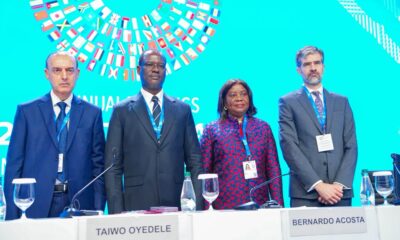
Oyedele Chairs G-24 Call for Fairer Global Financial System, Affordable Development Financing
-
 Business2 days ago
Naira Exchange Rates For Thursday, October 15
-
 Sports2 days ago
CAF Increases Annual Funding for Member Federations to $700,000
-
 Business1 day ago
Germany plans tax on sugary drinks
-
 Politics2 days ago
Exclusion of candidates from INEC list: CD cautions INEC against manipulation by politicians
-
 Business1 day ago
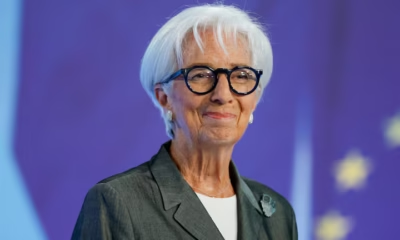
WEF could appoint Lagarde as its next chair, sources say
-
 International1 day ago
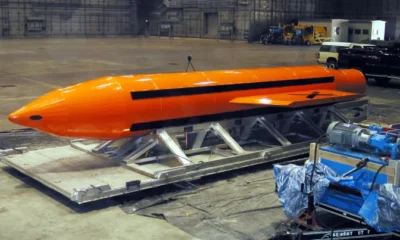
“Mother of all bombs,” Trump Plans To Hit Iran