
Business
Are The Ministers of industry Leaving Manufacturers To Face Challenges?
” Nigeria deserves regulation that safeguards public health while preserving livelihoods, investment, and respect for due process,” said Oyerinde.


By OCHEFA
• Collage: MAN President Francis Meshioye; John Owan Enoh, Minister of State for Industry; and Minister of Industry, Jumoke Oduwole.
This concerns the National Agency for Food and Drug Administration and Control (NAFDAC) ‘s recent ban on spirit drinks in sachets and small bottles under 200ml.
Since the issue arose, industry stakeholders have been negotiating directly with the regulator, without their ministers’ involvement, despite their oversight over policies affecting operators.
Industry groups like MAN, NECA, FOBTOB, and others have engaged with NAFDAC and lawmakers independently, without consulting the sector’s ministerial officials who could have intervened and coordinated with higher authorities, including the Minister of Health.
Currently, there is confusion caused by government officials.
NAFDAC claims its ban is authorised by the Nigerian Senate and supported by the Federal Ministry of Health to protect public health, especially children and young adults.
Conversely, the Office of the Secretary to the Government of the Federation (OSGF), led by Senator George Akume, states that the ban requires their approval as the final authority.
Before the December 25, 2025, ban, NAFDAC Director-General Prof Mojisola Christianah Adeyeye stated that manufacturers had a six-year moratorium to reconfigure their products.

• Different brands of sachets alcohol
In December 2018, NAFDAC, the Federal Ministry of Health, and FCCPC signed a five-year MoU with AFBTE and DIBAN to phase out sachet and small-volume alcohol packaging by January 31, 2024.
The moratorium, initiated in 2021, was extended to December 2025 to allow industry players to clear stock and reconfigure production.
NAFDAC insists that the current Senate resolution aligns with the original agreement and Nigeria’s commitment to the WHO Global Strategy to Reduce Harmful Alcohol Use, which Nigeria has supported since 2010.
NAFDAC recently presented a survey report backing the ban on the production and consumption of alcoholic drinks sold in sachets and Polyethylene Terephthalate bottles among minors and underage persons.
NAFDAC recently made a public presentation of the alcohol consumption survey.
This was in response to the MAN, NECA, FOBTOB, among other industrial stakeholders querying its recent ban on sachet alcohol in packet sizes and PET bottles.
NAFDAC Director-General, Prof. Mojisola Adeyeye, said during the presentation of the survey reports that the study was conducted in collaboration with the Distillers and Blenders Association of Nigeria and carried out by Research and Data Solutions Ltd, Abuja, surveyed 1,788 respondents across six states between June and August 2021.
“Rivers and Lagos State lead in the consumption of alcoholic drinks sold in sachets and Polyethene Terephthalate bottles among minors and underage persons”, she said.
The agency said that the report examined access to alcohol and drinking frequency among minors (below 13 years), underage (13–17 years), and adults (18 years and above).”
Alcohol remains “one of the most widely used substances of abuse among youths” and noted that “the availability and easy access to alcohol have been identified as a contributory factor to the increasing alcohol consumption among minors.”54.3 percent of minors and underage respondents obtained alcohol by themselves.
Nearly half (49.9 per cent) purchased drinks in sachets or PET bottles, with Rivers State recording the highest rates—68.0 percent for sachets and 64.5 percent for PET bottles.
“Meshioye urges the government to prevail on the regulator to suspend the ban, because, “When manufacturing thrives, Nigeria thrives..when manufacturing wins, government wins.”
Lagos followed with 52.3 percent and 47.7 percent, respectively, while Kaduna recorded 38.6 percent sachet and 28.4 percent PET bottle consumption.
“The proportion of drinks procured in sachets was higher among males (51.4 percent) compared to females (41.5 percent), and more in rural (50.1 percent) compared to urban (45.3 percent) locations.”
The report also revealed that minors and underage respondents also accessed alcohol from friends and relatives (49.9 percent), social gatherings (45.9 per cent), and parents’ homes (21.7 percent).
It said that among those who bought alcohol themselves, 47.2 percent of minors and 48.8 percent of underage respondents procured drinks in sachets, while 41.2 percent of minors and 47.2 percent of the PET bottles.
On consumption frequency, 63.2 percent of minors and 54.0 percent of underage persons were occasional drinkers, but 9.3 percent of minors and 25.2 percent of underages respondent reported drinking daily.
Albeit, the OSGF, in a joint statement with the NSA, declared the NAFDAC ban ” Null and Void.”
The leadership of the Manufacturers Association of Nigeria (MAN), however accused the NAFDAC of having misled the Senate to approve the ban on sachet alcohol and PET bottles.
Francis Meshioye, the President of the association, and Segun Ajayi-Kadir, Director -General of MAN, emphasised that NAFDAC didn’t provide the Senate with empirical data showing the negative impacts of alcohol on children.
“Business is based on data and logic. Not sentiment. Data is key. Bring your data. Alcohol is not produced for children.It is clearly written on the sachet that it is for people 18+; the companies producing them have done the campaigns; they have NAFDAC numbers. So NAFDAC should do its job.
They misled the Senate by not giving enough information to the lawmakers,” said Ajayi – Kadir.
Meshioye urges the government to prevail on the regulator to suspend the ban, because, “When manufacturing thrives, Nigeria thrives..when manufacturing wins, government wins.”
Corroborating with MAN, the Nigeria Employers’ Consultative Association (NECA) strongly condemned the ban, calling it a “serious regulatory misstep” that threatens jobs, investments, and Nigeria’s regulatory credibility.
NECA Director General Wale-Smatt Oyerinde, expressed dismay that the enforcement is already disrupting legitimate businesses, jeopardising thousands of jobs across the wines and spirits value chain—including manufacturing, packaging, distribution, retail, and agriculture—and eroding investor confidence amid economic challenges such as high operating costs and currency pressures.
While affirming strong support for protecting minors, removing unsafe products, and advancing public health, NECA argued that the current blanket approach is flawed.
It disproportionately affects compliant, NAFDAC-registered manufacturers whose products underwent rigorous testing, registration, and revalidation processes.
These products comply with international alcohol-by-volume (ABV) standards for spirits, with clear labelling and warnings restricting consumption to adults over 18.
Oyerinde stressed that underage access stems from enforcement gaps at the retail level—such as weak age verification and monitoring—rather than packaging formats.
He advocated for smarter, evidence-based measures, including stricter retailer licensing, compliance checks, public education on responsible drinking, and intensified crackdowns on illicit narcotics and unregistered substances, which pose greater dangers to youth.
“Nigeria deserves regulation that safeguards public health while preserving livelihoods, investment, and respect for due process,” said Oyerinde, emphasising, “Policies ignoring science, economic realities, and regulatory coherence risk causing more harm than good..”


Business
History of Naira Revaluation and Devaluation (1973–2026) (Part 1)
Why was the naira devalued?
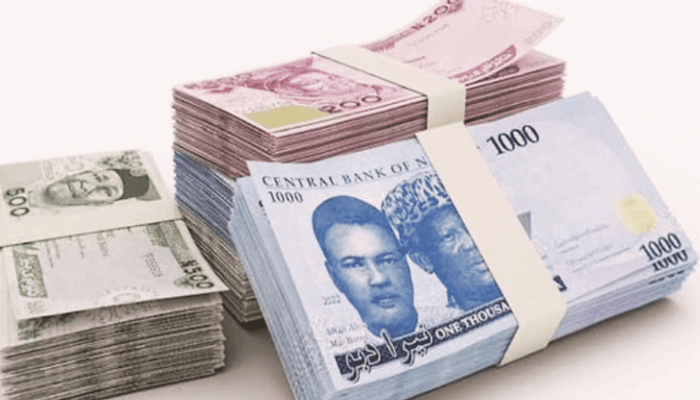
The history of the Nigerian naira is marked by two major developments: periods when the currency gained value or was officially strengthened, and prolonged periods when it lost value against major international currencies, particularly the US dollar.
Since its introduction in 1973, the naira has undergone several exchange-rate policy changes, including fixed exchange rates, currency devaluations, foreign-exchange market liberalisation, attempts to unify exchange rates and market-driven depreciation.
The Central Bank of Nigeria (CBN) has played a central role in managing these changes.
- Introduction of the Naira in 1973
Nigeria introduced the naira on January 1, 1973, replacing the Nigerian pound.
The conversion rate was:
£1 Nigerian pound = ₦2.
₦1 = 10 shillings under the old currency system.
₦1 = 100 kobo.
The new currency was introduced during a period of expanding oil revenues and economic growth.
Nigeria initially maintained a relatively strong, managed exchange rate, supported by foreign-exchange controls and the country’s oil earnings.
The introduction of the naira was a currency change, not a devaluation.- The 1970s: A Relatively Strong Naira
During the 1970s, rising oil revenues strengthened Nigeria’s foreign-exchange position.
The government maintained a controlled exchange-rate system, initially linking the naira to the US dollar before moving to a basket of currencies representing major trading partners in 1978.
The oil boom provided foreign exchange for imports, infrastructure and public expenditure.
However, Nigeria’s dependence on crude oil revenues left the economy vulnerable to fluctuations in international oil prices.
Key development: The naira benefited from a relatively strong external position, although its exchange rate was managed by the authorities rather than determined by an unrestricted market.- The Early 1980s: Mounting Pressure on the Naira
The economic situation deteriorated in the early 1980s as oil revenues weakened and foreign-exchange shortages intensified.
Nigeria faced several economic challenges:
• Declining oil receipts.
• Rising import bills.
• Pressure on foreign reserves.
• Growing external debt and trade arrears.
• Increasing demand for foreign currency.
The government maintained controls on foreign exchange, but the official rate became increasingly disconnected from the rate at which foreign currency could be obtained in the parallel market.
This created pressure for exchange-rate reform.
The crisis set the stage for the introduction of the Structural Adjustment Programme (SAP) in 1986.- 1986: Major Naira Devaluation Under SAP
September 26, 1986, marked a turning point in the history of the naira.
Under the military government of General Ibrahim Babangida, Nigeria introduced the Second-Tier Foreign Exchange Market (SFEM) as part of the Structural Adjustment Programme.
The objective was to allow market forces to play a greater role in determining the naira’s exchange rate.
According to an International Monetary Fund account, the naira’s value was discounted by approximately 66 per cent at the inaugural SFEM auction.
The exchange rate moved from about ₦1.60 per US dollar under the previous administered rate to approximately ₦4.60 per dollar at the initial auction.
Why was the naira devalued?
The policy was intended to:
•Reduce the overvaluation of the naira.
•Improve the allocation of scarce foreign exchange.
•Encourage non-oil exports.
•Improve the competitiveness of Nigerian products.
•Reduce distortions in the foreign-exchange market.
However, the weaker currency also increased the naira cost of imported goods and production inputs.
The 1986 reform began a prolonged period of exchange-rate adjustments.- …To be continued
Business
Obasanjo Accuses Tinubu : “You Made Every Nigerian Poor By 300% Naira Devaluation”
The former President also rejected the argument that Tinubu needed more time to complete his reforms, saying he did not see the economy improving.
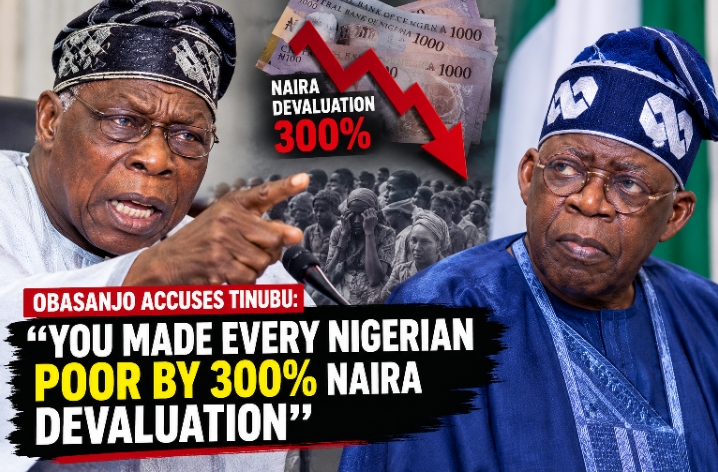
Image: AI generated
Former President Olusegun Obasanjo has accused President Bola Tinubu of making every Nigerian poor by 300 per cent through the devaluation of the naira.
Obasanjo spoke on Wednesday during the Financial Times Africa Summit 2026 in London, United Kingdom.
He said that the naira lost its value overnight due to economic reforms undertaken by the Tinubu administration in 2023.
“We do not live in isolation as a country. We interact with the rest of the world. And overnight, you devalue the currency by 300 per cent. The naira went from N500 to a dollar to N1,500 to a dollar. What that meant was that every Nigerian is made poor by 300 per cent.”
Obasanjo said that had made Nigeria “the poverty capital of the world,” which he said meant the country had the largest number of poor people in the world.
“You cannot say to me that that is good for Nigeria. You cannot say to me that that is good for us in any sense,” he noted.
The former President also rejected the argument that Tinubu needed more time to complete his reforms, saying he did not see the economy improving.
Business
CBN Licences Abbey Bank to Start Full Commercial Banking in November 2026
Adewumi said: “The year 2026 represents a defining moment in the history of Abbey. Our approval to transition to commercial banking is a testament to the work invested in building this institution and the confidence placed in us by our regulators, shareholders, customers and employees.”

The Central Bank of Nigeria (CBN) has approved Abbey Bank Plc to begin operation as a regional commercial bank, effectively from November 2026.
The licence opens retail banking, small and medium-sized enterprise lending, trade finance and corporate banking to the lender.
Abbey Bank had operated as a mortgage bank for more than three decades.
The commercial banking licence was issued in June 2026 after the bank completed its capital-raising process.
Managing Director and Chief Executive Officer Mobolaji Adewumi said the bank began internal discussions on the transition in 2023 and submitted a formal application in 2024.
He said regulatory approval arrived in October 2024.
Adewumi said: “The year 2026 represents a defining moment in the history of Abbey. Our approval to transition to commercial banking is a testament to the work invested in building this institution and the confidence placed in us by our regulators, shareholders, customers and employees.”


JUST IN: Four Pilots Die After Mid-Air Collision of Military Planes in Philippine

JUST IN: Another Nollywood Actor, Dies After Brief Illness

Ebola patient in Abuja showing signs of recovery – FG

BREAKING: Lagos Govt Declares Today, Thursday Work-Free to Mark 2026 Ìṣẹ̀ṣe Day

Tech Expert, Zuckerberg trains with UFC champions, Adesanya, Alexander

Organ Trafficking: Ekweremadu bags 10 years in UK prison
-

 Business2 days ago
Naira To Dollar, Pound, Euro… Today October 23
-

 Health3 days ago
Ebola Outbreak: Don’t Panic, FG Assures Nigerians
-

 Health3 days ago
UPDATE: Identity of Woman Who Flew into Nigeria with Ebola Virus Revealed
-

 Business2 days ago
Obasanjo Accuses Tinubu : “You Made Every Nigerian Poor By 300% Naira Devaluation”
-
Business3 days ago
Dollar to Naira Exchange Rate – Thursday, October 22, 2026
-

 News3 days ago
UNILAG School Teachers Begin Work-to-Rule Over Unpaid Arrears
-

 Entertainment2 days ago
JUST IN: Nollywood Veteran Francis Duru Dies at 57 After Brief Illness
-

 News2 days ago
JUST IN: 1 Dead, 3 Rescued in Fadeyi Building Collapse, Lagos