
International
UK Supreme Court rules definition of ‘woman’ based on sex at birth and not by transgender

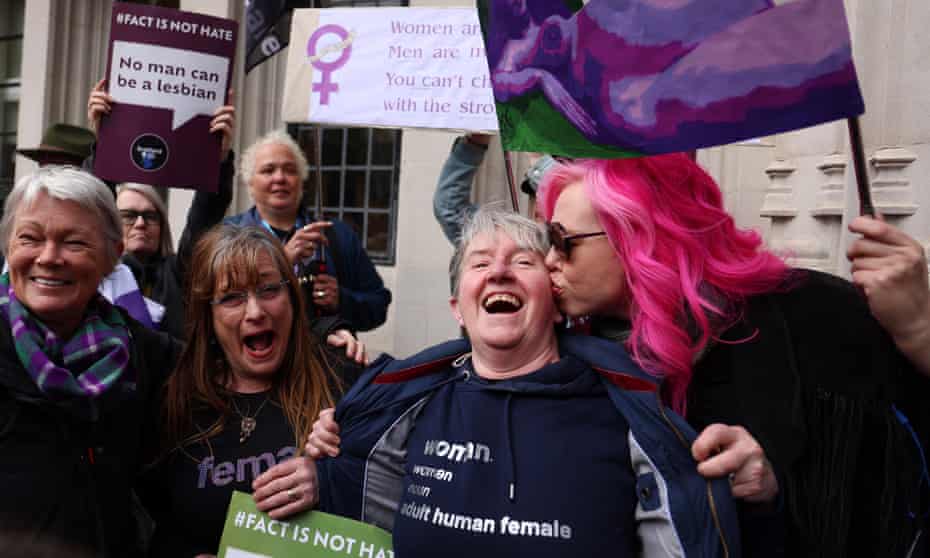
The UK supreme court has ruled that the terms “woman” and “sex” in the Equality Act refer to a biological woman and biological sex, in a victory for gender-critical campaigners.
Five judges from the UK supreme court ruled unanimously that the legal definition of a woman in the Equality Act 2010 did not include transgender women who hold gender recognition certificates (GRCs).
In a significant defeat for the Scottish government, the court decision will mean that transgender women can no longer sit on public boards in places set aside for women.
It could have far wider ramifications by leading to much greater restrictions on the rights of transgender women to use services and spaces reserved for women, and prompt calls for the UK’s laws on gender recognition to be rewritten.
The UK government said the ruling “brings clarity and confidence” for women and those who run hospitals, sports clubs and women’s refuges.
A spokesperson said: “We have always supported the protection of single sex spaces based on biological sex. Single-sex spaces are protected in law and will always be protected by this government.”
John Swinney, Scotland’s first minister, posted on social media: “The Scottish government accepts today’s supreme court judgment. The ruling gives clarity between two relevant pieces of legislation passed at Westminster.
We will now engage on the implications of the ruling. Protecting the rights of all will underpin our actions.”
Lord Hodge told the court the Equality Act (EA) was very clear that its provisions dealt with biological sex at birth, and not with a person’s acquired gender, regardless of whether they held a gender recognition certificate.
That affected policymaking on gender in sports and the armed services, hospitals, as well as women-only charities, and access to changing rooms and women-only spaces, he said.
In a verbal summary of the decision, he said: “Interpreting sex as certificated sex would cut across the definitions of man and woman in the EA and thus the protected characteristic of sex in an incoherent way.
It would create heterogeneous groupings.
“As a matter of ordinary language, the provisions relating to sex discrimination, and especially those relating to pregnancy and maternity and to protection from risks specifically affecting women, can only be interpreted as referring to biological sex.”
Trans rights campaigners urged trans people and their supporters to remain calm about the decision.
The campaign group Scottish Trans said: “We are really shocked by today’s supreme court decision, which reverses 20 years of understanding of how the law recognises trans men and women with gender recognition certificates.
“We will continue working for a world in which trans people can get on with their lives with privacy, dignity and safety. That is something we all deserve.
”Ellie Gomersall, a trans woman in the Scottish Green party, called on the UK government to change the law to entrench full equality for trans people.
Gomersall said: “I’m gutted to see this judgment from the supreme court, which ends 20 years of understanding that transgender people with a gender recognition certificate are able to be, for almost all intents and purposes, recognised legally as our true genders.
“These protections were put in place in 2004 following a ruling by the European court of human rights, meaning today’s ruling undermines the vital human rights of my community to dignity, safety and the right to be respected for who we are.”
The gender critical campaign group For Women Scotland, which is backed financially by JK Rowling, said the Equality Act’s definition of a woman was limited to people born biologically female.
Maya Forstater, a gender critical activist who helped set up the campaign group Sex Matters, which took part in the supreme court case by supporting For Women Scotland, said the decision was correct.
“We are delighted that the supreme court has accepted the arguments of For Women Scotland and rejected the position of the Scottish government.
The court has given us the right answer: the protected characteristic of sex – male and female – refers to reality, not to paperwork.”
Hodge, the deputy president of the court, said it believed the position taken by the Scottish government and the Equality and Human Rights Commission that people with gender recognition certificates did qualify as women, while those without did not, created “two sub-groups”.
This would confuse any organisations they were involved with. A public body could not know whether a trans woman did or did not have that certificate because the information was private and confidential.
And allowing trans women the same legal status as biological women could also affect spaces and services designed specifically for lesbians, who had also suffered historical discrimination and abuse.
In part of the ruling that could have sweeping implications for policymakers in the sports world and sports centres, he said some services and places could “function properly only if sex is interpreted as biological sex”.
“Those provisions include separate spaces and single-sex services, including changing rooms, hostels, medical services, communal accommodation, [and] arise in the operation of provisions relating to single-sex characteristic associations and charities, women’s fair participation in sport, the operation of the public sector equality duty and the armed forces.”
Hodge urged people not to see the decision “as a triumph of one or more groups in our society at the expense of another”.
He said all transgender people had clear legal protections under the 2010 act against discrimination and harassment.
Kishwer Falkner, the chair of the Equality and Human Rights Commission, which had intervened in the case to support the Scottish government’s stance, said it would need time to fully interpret the ruling’s implications.
However, the commission was pleased it had dealt with its concerns about the lack of clarity around single-sex and lesbian-only spaces.
“We are pleased that this judgment addresses several of the difficulties we highlighted in our submission to the court, including the challenges faced by those seeking to maintain single-sex spaces, and the rights of same-sex attracted persons to form associations.”













Four Philippine Air Force pilots died Friday after two SF-260 trainer aircraft collided mid-air during a training flight and crashed at Fernando Air Base in Lipa City, Batangas, south of Manila, the air force confirmed Saturday.
The accident occurred at about 3:51 p.m. local time on October 23, 2026. Both single-propeller planes went down within the base perimeter. No other casualties were reported on the ground.
Philippine Air Force spokesman Colonel Alvin Capinguian (also referred to as Alvin Jay Capinguian) said the aircraft were involved in a training flight. Officials with knowledge of the incident, speaking anonymously, and local reports confirmed the planes collided while flying at low altitude. Some accounts noted they were part of a larger formation or flyby rehearsal, with other aircraft landing safely.
The air force described it as an “aviation accident” and said an investigation is underway to determine the cause. As a precaution, the entire fleet of SF-260 aircraft has been temporarily grounded. The air force is coordinating assistance with the families of the deceased and asked the public to respect their privacy. One of the pilots was later identified in some reports as 1st Lt. Angeleo Adrian Peñaflor.
The SF-260 is a light Italian-designed trainer used by the Philippine Air Force. The incident is the latest fatal crash involving the type; two pilots were killed in a similar SF-260 training accident in Benguet province in May.
International
“Mother of all bombs,” Trump Plans To Hit Iran
The 21,600-pound airburst weapon is designed to affect surface targets over a wide area and has so far not been deployed by the U.S. in previous strikes on targets inside Iran. It was used in Afghanistan in 2017 during the previous Trump administration.


The U.S. military is considering use of the GBU-43/B Massive Ordnance Air Blast (MOAB) bomb if it resumes strikes inside Iran, CNN reported Thursday, citing U.S. officials.
The 21,600-pound airburst weapon is designed to affect surface targets over a wide area and has so far not been deployed by the U.S. in previous strikes on targets inside Iran. It was used in Afghanistan in 2017 during the previous Trump administration.
Trump said Oct. 8 that he would not resume U.S. strikes on Iran before the Nov. 3 midterm elections, while attacks on shipping near the Strait of Hormuz and deadly Houthi strikes in Saudi Arabia have raised regional tensions.
Iranian Parliament Speaker Mohammad Bagher Ghalibaf said Tehran will combine military capabilities and negotiations to press its demands.
International
Child marriage in southern Germany: Over 350 cases recorded, some brides as young as 11
The most recent entries in the overview relate to 2026. They include, among other things, marriages of 16- and 17-year-old girls to adult men.

• Child marriage / UNICEF
In the southwestern German state of Baden-Württemberg, a total of 358 so-called child marriages have been officially recorded since 2012.
Euro News reported that only eight of these forced marriages have so far been legally annulled.
According to authorities, the other 350 cases were brought to an end in other ways.
This alarming finding comes from a response by the Baden-Württemberg state government to a minor inquiry submitted by AfD state parliament members Nikolaos Boutakoglou and Emely Knorr.
The Tübingen regional authority is responsible for recording the data, the answer came from the Ministry of the Interior.
The eight final annulments took place between 2018 and 2024. Among the documented cases was the marriage of an 11-year-old girl from Iraq to a 17-year-old Iraqi, which was annulled in 2020.
As early as 2018, the marriage of a 14-year-old Afghan girl to a 30-year-old man had been ended.
In 2024 two further annulments were added: they concerned a 16-year-old German girl and a 25-year-old Pakistani man and a 16-year-old Syrian girl and a 27-year-old man from the same country.State parliament member Nikolaos Boutakoglou wrote on Facebook that the issue was “really awful” but was being treated as a taboo.
According to its own account, the ministry deals exclusively with such marriages entered into abroad.
Since summer 2017, the Act to Combat Child Marriages has been in force in Germany.
In 2024, the Bundestag adopted new rules to protect minors in marriages concluded abroad.
Hundreds of cases without state intervention
The significantly higher number of cases concluded in other ways raises questions about how these marriages continued.
For the period from 2015 to 2026, the regional authority lists a total of 350 proceedings under the heading “other disposals.”But what became of the other child marriages?
The state government cites, among other things, the death of a spouse, reaching adulthood, a decision not to seek annulment or a new marriage concluded abroad.
In these cases, there was therefore no legally binding annulment.
For 2023, the records include the case of a 12-year-old Afghan girl who was married to a 21-year-old Afghan man. Girls aged 13 and 14 also appear several times in the statistics.
The most recent entries in the overview relate to 2026. They include, among other things, marriages of 16- and 17-year-old girls to adult men.
The statistics record the age of the spouses at the time of marriage and their respective nationalities.


JUST IN: Four Pilots Die After Mid-Air Collision of Military Planes in Philippine

JUST IN: Another Nollywood Actor, Dies After Brief Illness

Ebola patient in Abuja showing signs of recovery – FG

BREAKING: Lagos Govt Declares Today, Thursday Work-Free to Mark 2026 Ìṣẹ̀ṣe Day

Tech Expert, Zuckerberg trains with UFC champions, Adesanya, Alexander

Organ Trafficking: Ekweremadu bags 10 years in UK prison
-

 Business2 days ago
Naira To Dollar, Pound, Euro… Today October 23
-

 Health3 days ago
Ebola Outbreak: Don’t Panic, FG Assures Nigerians
-

 Health2 days ago
UPDATE: Identity of Woman Who Flew into Nigeria with Ebola Virus Revealed
-

 Business2 days ago
Obasanjo Accuses Tinubu : “You Made Every Nigerian Poor By 300% Naira Devaluation”
-
Business3 days ago
Dollar to Naira Exchange Rate – Thursday, October 22, 2026
-

 News3 days ago
UNILAG School Teachers Begin Work-to-Rule Over Unpaid Arrears
-

 Entertainment2 days ago
JUST IN: Nollywood Veteran Francis Duru Dies at 57 After Brief Illness
-

 News2 days ago
JUST IN: 1 Dead, 3 Rescued in Fadeyi Building Collapse, Lagos