
News
Subsidy: Labour Union threatens strike, resumes talks with FG


Ahead of the meeting between the Federal Government and the organised labour scheduled to hold today (Monday), the Nigeria Labour Congress has said the government must meet its demands to cushion the effect of the fuel subsidy removal.
The union threatened that it would not hesitate to call out workers for industrial action, adding that it only suspended its planned strike.
It stated that the high cost of fuel was inflicting unbearable hardship on Nigerians, adding that the government must act fast with respect to providing palliatives, as the NLC said it was expecting an increase in the minimum wage from N30,000 to N150,000.
The Federal Government and labour unions met on June 5, 2023, with a resolution to reconvene on June 19 to agree on the implementation framework of the resolutions reached.
The former Speaker of the House of Representatives and current Chief of Staff to the President, Femi Gbajabiamila, who led the government side, had disclosed this at the end of the meeting between labour and government representatives at the Presidential Villa, Abuja.
According to him, the June 5 meeting agreed on a seven-point resolution to cushion the effect of the subsidy removal on Premium Motor Spirit, popularly called petrol, on Nigerians.
“The Federal Government, the TUC, and the NLC to establish a joint committee to review the proposal for any wage increase or award and establish a framework and timeline for implementation.
“The Federal Government, the TUC and the NLC to review the World Bank Financed Cash transfer scheme and propose the inclusion of low-income earners in the programme.
“The Federal Government, the TUC and the NLC to revive the CNG conversion programme earlier agreed with Labour centres in 2021 and work out detailed implementation and timing,” Gbajabiamila had stated.
Labour warns
But when contacted on Sunday to speak on the expectations of labour from the meeting scheduled to hold today (Monday), the Vice President, NLC, Adewale Adeyanju, said a lot of things had been presented by labour unions, stressing that the government should not act funny.
“There are a lot of things that labour has been putting before the government. The refineries need to be revamped. We cannot continue to import refined petroleum products and be spending on subsidies all the time.
“Labour has its set of demands and by the time we meet with the government tomorrow we will list them out again,” he stated.
Asked to state what action the NLC would take should the government fail to give in to the demands of labour, considering the plight currently faced by Nigerians with respect to the removal of subsidy, Adeyanju replied, “You know we only suspended our strike as a result of the need to meet on this.
“So the government should know that things are becoming difficult and they (the government) should not decide to do anything funny. The strike was only suspended. It was an ultimatum that was given out and it (strike) was suspended.
“So let’s hear what the government has for us and then we will know what to tell our members. It is about the lives of the people. Let’s meet them tomorrow and then labour will come out with its position.”
Adeyanju, however, expressed optimism that the meeting would be fruitful and insisted that the NLC would not want the government to behave funny.
“We hope that the meeting is going to be fruitful. The expectations are very high. The nation is watching and people are looking at how the Nigeria Labour Congress is going to handle the situation.
“And the government too will not like to behave funny because they know the country is battling with the increase in fuel pump price and so many things,” he stated.
On the proposal by oil marketers for the deployment of Compressed Natural Gas at filling stations, the NLC official stated that a technical committee had been set up by the Federal Government to look into the matter.
“The government has set up a technical committee on some of these issues. So I don’t want us to preempt the outcomes that will come out from that meeting tomorrow between labour and the government,” he stated.
Commenting on the need to deploy CNG, the National President of the Independent Petroleum Marketers Association of Nigeria, Chinedu Okonkwo, stated that oil marketers were looking forward to the outcomes of the meeting between the Federal Government and labour before making their moves.
“That meeting tomorrow (Monday) is very crucial, because marketers are ready to deploy CNG, but the outcome of that meeting will tell us whether the government is ready to give the support needed to make this initiative fruitful.
“We are very confident that with the deployment of CNG as a substitute to PMS, the harsh effect caused by petrol price hike would be addressed significantly,” Okonkwo stated on Sunday.
NLC’s benchmark
The NLC also stated on Sunday that it was expecting an increment in minimum wage from N30,000 to between N150,000 and N200,000.
It further urged President Bola Tinubu to ensure that borders were re-opened to ensure smooth importation and exportation of food and farm products.
The National Treasurer, NLC, Hakeem Ambali, made the disclosure in an interview with one of our correspondents in Abuja.
When asked about the expectations of the NLC from today’s meeting, Ambali said, “We are saying that since petrol prices have increased by three folds, we expect minimum wage to be increased to a minimum of between N150,000 to N200,000.”
He said the expectation of the NLC was also that President Bola Tinubu would grant operational licenses for the creation of more modular refineries.
“We want a transparent agency to be set up to oversee these refineries. We don’t have to depend solely on multinationals. Already, we have some Nigerians who refine crude oil locally.
“Also, on the issue of energy, some Nigerians buy fuel for their generators and provide power for themselves, we want a review of the corrupt privatisation of the energy sector that gave generation and sale of energy to private individuals who have not added value to energy consumption in Nigeria,” he stated.
He said it was time for the government to look inward and see that these individuals were discharged for incompetence.
“Alternate power supplies like solar systems should also be put in place. When you travel to other countries like Israel, you see that solar energy is available there and cheaper and this is a clean energy alternative.
“We also want them to look into the transportation sector. We want the President to develop a master plan and provide a metro rail line for all the state capitals across the country. He should also open up the border and allow the free flow of market goods into Nigeria and outside Nigeria.
“The cost of running governance is too high. We also looked at that and we are of the opinion that the high cost of governance and number of appointments be brought down. We also believe that there should be a micro-credit scheme that should be put in place that will give loans to farmers and entrepreneurs at small digit rates,” he stated.
Labour demands palliatives
Amballi called for palliatives for Nigerians, as the price of consumables had skyrocketed.
Also speaking on the subject, the National Deputy President of the Trade Union Congress, Tommy Etim, urged the government to ensure that the requests in the charter of demands presented to the government were met.
“It is expected that the government will look into our positions. Since the removal of subsidies, workers have not been finding it funny, especially on the home front.
“Government must be fast in its actions. It is expected that by tomorrow, we would have reached a concrete agreement even as the negotiations continue,” he stated.
Asked whether the TUC would embark on strike if its demands were not met, replied, “Let us cross the bridge when we get there.”
Ohibaba.com reports that during his inaugural speech at Eagle Square in Abuja, Tinubu said the era of subsidy on fuel had ended, adding that with the 2023 budget making no provision for fuel subsidy, further payment was no longer justifiable.
“Fuel subsidy is gone,” Tinubu had said. He said his government would instead channel funds into infrastructure and other areas to strengthen the economy.
The presidential pronouncement led to an almost instant resurgence of fuel queues across the country as Nigerians rushed to get the product.
Though Tinubu’s decision received backing from the Nigerian National Petroleum Company Limited and the House of Representatives, it has since been resisted by the NLC and TUC.
According to organised labour, the President could not unilaterally take a decision on subsidy removal.
The TUC President, Festus Osifo, had also argued that there was a reason the immediate past administration of Muhammadu Buhari pushed the “sensitive issue” to the new government.
The NLC and the TUC had announced an ultimatum to embark on strike, with the NLC mobilising its members for a nationwide strike.







News
Police must pay transport fares, says AIG
” No police officer has the right to enter your vehicle without paying. We should assist one another willingly, not by force,” he said.

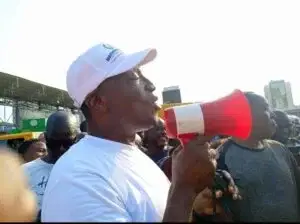
• The Assistant Inspector-General of Police(AIG) in charge of Zone 2 Command, Mr Olohundare Jimoh, speaking with transporters at Obalende garage, Lagos State, on Wednesday.
The Assistant Inspector-General of Police, Zone 2 Command, Mr Olohundare Jimoh, has declared that officers must pay fares before boarding commercial vehicles, warning against abuse of authority.
Jimoh spoke on Wednesday at Obalende garage during a sensitisation meeting with drivers and transport workers marking National Police Day 2026.
He stressed that relations between police and the public must be based on partnership, not coercion, urging both sides to support each other voluntarily.
“No police officer has the right to enter your vehicle without paying. We should assist one another willingly, not by force,” he said.
Jimoh called for stronger cooperation to maintain safety and order on roads, insisting there was no conflict between officers and transport unions.
“I don’t collect money from officers. We don’t arrest people arbitrarily. If you have issues with any officer, report directly to me,” he said.
(Vanguard)
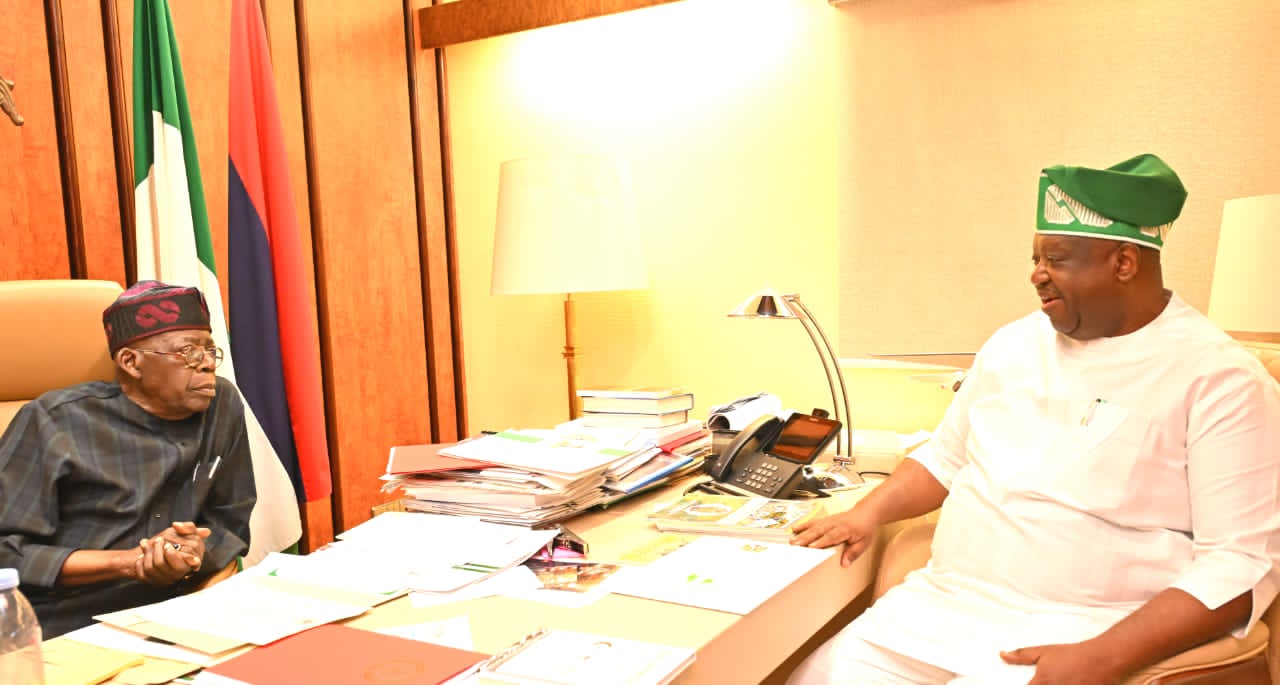
President Bola Ahmed Tinubu will leave for Jos tomorrow to commiserate with the state government and residents over recent deadly gun attacks that lefts dozens dead.
This was following Governor Caleb Mutfwang’s security briefing to the President on the recent violent attack in Angwan Rukuba, Plateau State.
During the meeting on Wednesday at the presidential villa in Abuja, Governor Caleb Mutfwang told Mr President that although security forces have restored calm after fresh disturbances involving looters on Wednesday morning, following the deadly Palm Sunday attack that left more than a dozen dead and many others injured.
He said that investigations are continuing to determine the identities or motives of the attackers who are yet to be apprehended .
Presidency source said that President Tinubu was initially scheduled for a planned trip to Ogun State to flag off operations at the Gateway International Cargo Airport on Thursday.
From Jos, the President will travel to Lagos to observe Good Friday.
On Saturday, April 4, he will visit Ogun State to commission projects including the cargo airport.
He will then return to Lagos during the Easter holiday to commission several state infrastructure projects, including the Ojota/Opebi Link Bridge.
Before heading back to Abuja, the president will visit Bayelsa State on April 10 to commission projects completed under Governor Duoye Diri.
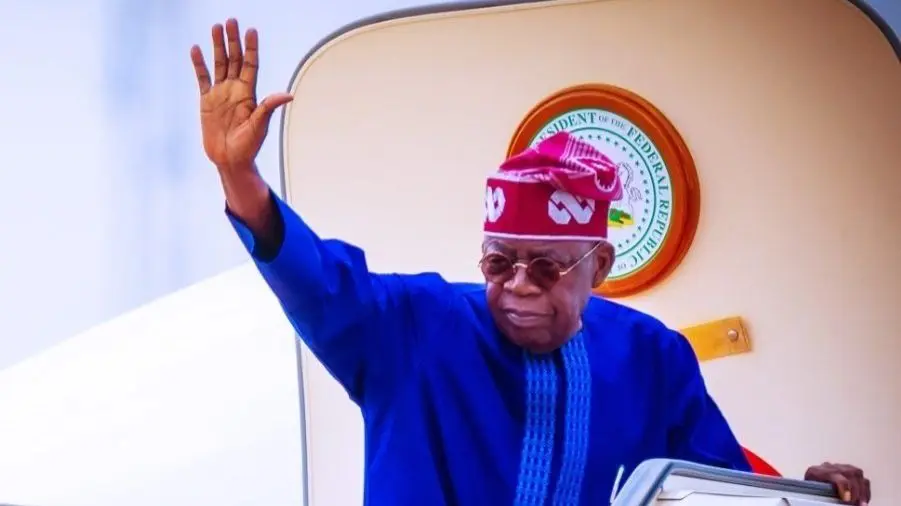
President Bola Ahmed Tinubu will tomorrow embark on a visit to Jos, Plateau State, as the first leg of a five-state tour across the country.
The Presidency announced that the President has postponed his scheduled trip to Ogun State to enable him to commence the series of official visits.
Details of the remaining four states in the tour are expected to be released by the Presidency in due course.
The development comes as President Tinubu continues nationwide engagements aimed at assessing development projects, interacting with stakeholders, and addressing key national issues in the respective states.
Further updates on the itinerary will be communicated as the visits progress.


INEC Dismisses Calls for Chairman’s Removal

Ebonyi: Gunmen Assasinate Another Traditional Ruler

From South Africa to US, ‘Cicada’ COVID-19 variant spreading

Tech Expert, Zuckerberg trains with UFC champions, Adesanya, Alexander

Organ Trafficking: Ekweremadu bags 10 years in UK prison

SAINT OBI: Between his marriage and his death
-
 Business2 days ago
33 Nigerian Banks Beat CBN’s Recapialisation with ₦4.65trn Combined Capital Base
-
 Politics2 days ago
BREAKING: INEC Withdraws Recognition of David Mark’s ADC
-
 Sports2 days ago
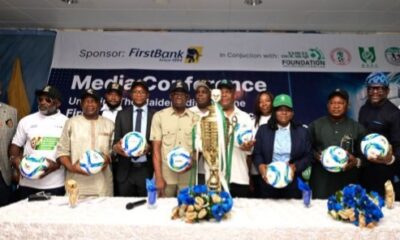
FirstBank Sponsors Samuel Okwaraji U-16 Football Championship 2026
-
 News2 days ago
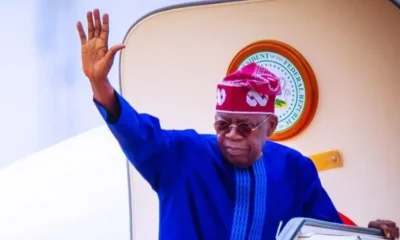
JUST IN: Tinubu Heads to Jos Tomorrow, Postpones Ogun Trip for 5-State Visits
-
 News2 days ago
Easter: FG declares Friday, Monday public holidays
-

 Entertainment2 days ago
Super Eagles Iwobi to launch music album ‘More To Life’
-
 News2 days ago
Gas Leak in Ogun School: 30 Students, Teacher Hospitalised
-
 Politics2 days ago
Arise News Anchor Ikokwu in Political Race for Reps Seat