
Opinions
Propaganda Journalism: Are Image Makers To Blame or The Board ?


By Ichaburu Ochefa
Image credit: The Hoot
“Our refinery not 90% completed – BUA
The management of BUA Refinery and Petrochemicals has denied reports its refinery is 90 percent completed.” (Daily Trust)
“CBN Dismisses Forced Exit Claims, Says 1,000 Staff Exited Voluntary with Full Benefits” (Arise News)
“FCCPC denies claims of halting investigations into Air Peace, other sectors” (The Nation)
” Port Harcourt Refinery begins operation, says NNPC (Premium Times)
“NNPC Ltd Delivers on Refinery Revamp Promise: Warri Plant Resumes Operation with 125,000bpd Capacity in Warri, Delta State.” (Dec 30, Reuters)
Looking at the above headlines clips, what do they have in common?
Managements discredited news reports that emanated from the organizations. Either from the corporate affairs departments duly signed by the company’s image maker or a member of the board of directors of the company.
Also, the information may have been gotten by the reporter or Editor, through an insider ( the CEO himself, a director, driver, cleaner, PRO, etc) in the company.
He hurries to write the story and breaks it as an “exclusive or a scoop”, on his media platform.
However, to promote or project an organization’s image in a positive light to the government, the shareholders, and other stakeholders, some company’s media departments have employed what we call “agitprop” or propaganda journalism, which is coloring falsehood, lies, and misinformation, to look like truth.
It is a powerful tool or weapon to move the crowd to believe what is fake is real and things like that.
Just to sway or pull the crowd to accept that viewpoint.
Advertisers use it often in the marketing of products and services.
Maybe you are familiar with clichés such as these:
“Use this cream and you will look glamorous.”
“Use this toothpaste and…”
“Everybody is drinking this water…” Propaganda journalism or messages are destructive.
It is like you lied to me before, how can I trust you again?
Again, some news sources or makers even employ what is called synecdoche, a figure of speech in English -Literature.
Synecdoche means when you use a part to represent a whole, or a whole for the part.
Therefore, organizations and their image makers had better ensure that the information they are sending out for public consumption is crafted in such a manner that what is written is what is understood, and what is understood is what is meant
That’s what may have played out in the reportage of the NNPCL refineries in Port Harcourt and the Warri Refinery and Petrochemicals.
The NNPCL, in its press releases, made the public believe that they had started working, whereas it was a section of the refineries.
Media reports had it that in November and December 2024, respectively, the NNPCL announced the revamping of the refineries, even if partially, with Port Harcourt at 70 percent level functionality, while the Warri refinery is currently operating at 60 percent.
The announcements led to the government rejoicing, a well-done and for the good works to the NNPCL management, and an encouragement by Mr President to the Corporation’s head to finish the Kaduna refinery and the New Port Harcourt Refinery, too.
However, the praises were soon cut shut, following the outpourings of doubts about the Workability of the refineries.
The doubters include oil, some people in the oil and gas industry, petroleum engineers, as well as Nigeria’s elder statesman, former President Olusegun Obasanjo.
SweetcrudeReports, recently reported: ” Experts, stakeholders and inside sources at the Port Harcourt Refinery are faulting the recent Nigerian National Petroleum Company Limited, NNPC, claims on the return of the 60,000 barrels per day old Port Harcourt refinery to operations.
They described the claims as amounting to national deceit. Investigations at the refinery showed that the plant currently refines only 6,500 barrels of crude oil some days (not even daily), which can only load 10 trucks. Industry experts say this is insignificant when compared to the refinery’s 60,000 barrels per day refining capacity and its loading capacity of 180 to 200 trucks daily.
According to the experts, a refinery of 60,000 per day capacity that is processing only 6,500 barrels cannot be described as working. “As it stands now, it is only the CDU (Crude Distillation Unit) that refines just 6,500 barrels per day and produces nothing more than 10 trucks maximum per day that is working, ”Alex Ogedegbe, a chemical engineer, expert refiner and former Managing Director of the Port Harcourt Refinery and the Warri Refinery, told SweetcrudeReports.
He added: “It is not the full refinery that is functioning. No refiner can claim that with only one unit running, and for that, the Port Harcourt refinery has begun operations and thus issues fake figures to Nigerians.
President Olusegun Obasanjo also expressed reservations over the workability of the Port Harcourt and Warri refineries.
Obasanjo who spoke recently on a national television, likened the declaration by the NNPC that the crude oil refining facilities are now working to a farmer who lied about the volume of his crops during the planting season, insisting that the truth will always be revealed during the harvest season.
“So if anybody tells you now that they (the refineries ) are working, why are they not with Aliko (in the market)? And Aliko will make his refinery work. Not only make it work, he will make it deliver.
“Whether we announce our government refineries are working or not working, look, it is like they say in Yoruba adage, ‘the man who plants 100 heaps of yams and says he has planted 200 heaps, they say after he has harvested 100 heaps of yam, he will also harvest 100 heaps of lies,” he said in response to a question on the oil assets.
What is the point?
Therefore, organizations and their image makers had better ensure that the information they are sending out for public consumption is crafted in such a manner that what is written is what is understood, and what is understood is what is meant; otherwise, the receivers will read different meaning or give a different interpretation to the information.
In the words of Anuk Kumar, any news that does not contain facts and shades of opinion that allow readers to draw their own meaning is inadvertent propaganda.
▪︎Ichaburu Ochefa, a media professional and communicator, wrote this piece in Lagos.
Opinions
IWD: 50 rights female gender should enjoy
Women are individuals with talents, ambitions, and identities.

Every year on March 8, the world pauses to celebrate International Women’s Day (IWD), a global moment to reflect on women’s achievements and the ongoing fight for equality.
Meanwhile, beyond the celebrations, the real conversation centers on something deeper: women’s rights.
Tribune Online, highlights 50 key rights of the female gender, drawn from those principles and global equality frameworks, to mark International Women’s Day and remind society that equality is not a privilege but a right.
The Right to Respect
Every woman deserves respect in all aspects of her life, including society, at home, and in the workplace.
The Right to Be Free from Body Shaming
No woman should be judged or mocked because of her appearance.
The Right to Protection from Sexual Abuse
Sexual violence against women is a violation of basic human rights.
The Right to Protection from Physical Abuse
Women have the right to live without domestic or physical violence.
The Right to Emotional Safety
Psychological and emotional abuse are forms of violence that must be rejected.
The Right to Education
No girl or woman should be denied access to education.
The Right to Equal Treatment
Women should be treated equally to men in all areas of life.
The Right to Equal Pay
Women must receive the same pay as men for the same work.
Globally, the gender pay gap persists, where women are paid roughly 22% less than men on average, according to the Economic Policy Institute.
The Right to Freedom from Discrimination
Gender should never determine opportunities.
The Right to Political Participation
Women should have the opportunity to run for public office.
The Right to Own Property
Women should have the right to own land and assets.
The Right to Healthcare
Access to quality healthcare is a fundamental right.
The Right to Bodily Autonomy
A woman’s body belongs to her, no one else.
The Right to Vote
Women must participate freely in democratic processes.
The Right to Make Personal Decisions
Women should have autonomy over life choices.
The Right to Choose Marriage
No woman should be forced into marriage.
The Right to Decide Family Size
Women should determine the number of children they want.
The Right to Dress Freely
Women should not be shamed for their clothing choices.
The Right to Reproductive Freedom
Women must not be forced into abortion or sterilization.
The Right to Protest
Women have the right to peacefully advocate for their rights.
Women have the right to peacefully advocate for their rights.
The Right to Speak Out
Every woman should be able to express her views openly.
The Right to Privacy
Recording or sharing images of women without consent is unacceptable.
The Right to Protection from Drugging or Assault
Women deserve safety in social spaces.
The Right to Safety in Public and Private Spaces
Women must feel secure everywhere they go.
The Right to Be Seen Beyond Sexual Objectification
Women are individuals with talents, ambitions, and identities.
The Right to Freedom of Movement
Women should travel freely without restrictions.
The Right to Hold a Passport
Travel rights must not be denied based on gender.
The Right to Independence
Women should be encouraged to build financial independence.
The Right to Dignity After Divorce
Divorced women should not face stigma.
The Right to Respect Regardless of Marital Status
Being unmarried should never invite insult.
The Right to Protection from Rape
Sexual violence must never be tolerated
Sexual violence must never be tolerated.
The Right to Freedom from Harmful Cultural Practices
Practices like forced virginity tests must be abolished.
The Right to Freedom from Widowhood Abuse
Widows should not face degrading rituals.
The Right to Freedom from Gender Stereotypes
Women should not be confined to traditional roles.
The Right to Career Ambition
An ambitious woman should be celebrated, not criticized.
The Right to Equal Leadership Opportunities
Women should participate in leadership and decision-making.
The Right to Equal Opportunity in Employment
Career advancement should be based on merit.
The Right to Freedom from Disability Discrimination
Women with disabilities deserve equal respect.
The Right to Gender Equality Policies
Governments must reform laws that discriminate against women.
Right to Empowerment
Education, economic inclusion, and health access empower women globally.
Right to Celebration
Women’s contributions make the world better and deserve recognition.
Opinions
How Akpabio’s Leadership Secured Nigeria’s Electoral Future, by Rt Hon Eseme Eyiboh
For the first time since independence in 1960, electronic viewing of polling unit results is explicitly grounded in statutory authority.
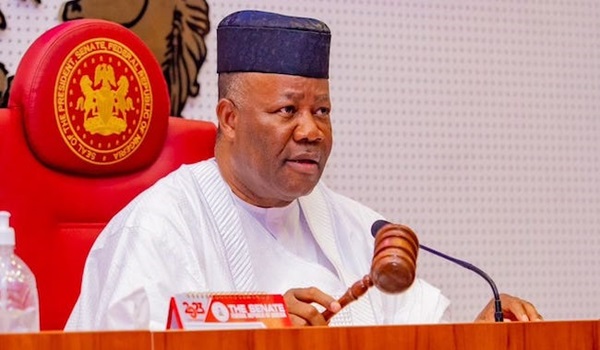
• Senate’s President, Godswill Akpabio
IN the evolving story of Nigeria’s democratic consolidation, few issues have provoked as much intensity as electoral reform.
The signing into law of the Electoral Act (Repeal and Re-enactment) Bill 2026 by President Bola Ahmed Tinubu marked another chapter in this journey, drawing applause, skepticism, and fierce debate in equal measure.
At the centre of this moment stands Godswill Akpabio, President of the Senate, who has consistently articulated a position that blends institutional caution with reformist intent.
His assertion that the National Assembly met “the aspirations of Nigerians, not a few people who make noise” reflects not merely rhetorical flourish, but a deeper philosophy of lawmaking anchored in constitutionalism, legislative procedure, and national peculiarities.
To understand Akpabio’s positioning, one must situate the reform within Nigeria’s broader democratic trajectory. Since the country’s return to civilian rule in 1999, electoral reforms have often oscillated between technological optimism and structural reality.
The 2026 re-enactment does not discard innovation; rather, it recalibrates it.
In defending the new Act, Akpabio emphasised that the National Assembly undertook a “painstaking” and “thorough” process, mindful of the country’s infrastructural limitations, judicial precedents, and the ultimate objective of preventing disenfranchisement.
A key flashpoint in the debate was the question of electronic transmission of results. For many reform advocates, real-time electronic transmission became symbolic of transparency.
Yet Akpabio’s argument was not against technology; it was against rigidity detached from capacity.
He consistently maintained that technology must serve democracy, not endanger it.
In a country where broadband penetration is uneven, where insecurity disrupts network infrastructure across multiple states, and where power supply remains inconsistent, embedding inflexible “real-time” mandates into statute could, in his view, expose elections to avoidable litigations and invalidation.
This perspective aligns with the constitutional role of the legislature.
The Senate does not conduct elections; it makes laws.
The responsibility for operational modalities rests with the Independent National Electoral Commission (INEC), which applies the law within its administrative and technical capacity.
By leaving room for INEC to determine timing and modalities of transmission, the Act reflects a respect for institutional boundaries.
Whether history ultimately vindicates every provision of the 2026 Act will depend on future elections. But as of its enactment, the legislative record reflects a deliberate attempt to harmonize innovation with stability.
Akpabio’s defense of this approach underscores his insistence that Parliament legislate for posterity, not for transient political advantage.
At the State House signing ceremony, President Tinubu reinforced this institutional clarity.
He observed that Nigeria’s elections remain “essentially manual.”
Ballots are cast manually, counted manually, and declared by human beings.
While electronic viewing enhances transparency, the core process remains human-centered.
Tinubu’s caution about broadband readiness and cyber vulnerabilities echoes Akpabio’s reasoning.
Together, their statements project a governance philosophy that privileges clarity and feasibility over performative reform.
Perhaps the most celebrated innovation in the new Act is the formal legal recognition of the Bimodal Voter Accreditation System (BVAS) result viewer, commonly referred to as IReV. This recognition represents a significant milestone.
For the first time since independence in 1960, electronic viewing of polling unit results is explicitly grounded in statutory authority.
Under the amended framework, results transmitted electronically—even if delayed due to connectivity issues—must ultimately reflect on the IReV portal once network is restored. This creates a verifiable digital trail that citizens, observers, and parties can scrutinize and interrogate.
Akpabio described this as a landmark safeguard against a historic problem: tampering between polling units and collation centres.
By ensuring that Form EC8A—the primary polling unit result form signed by presiding officers and party agents—feeds into a publicly accessible portal, the law strengthens accountability without discarding manual collation procedures validated by courts.
The Supreme Court’s pronouncements in post-2023 election litigation had clarified that IReV, as previously configured, was not the definitive legal record of results.
Rather than ignore this judicial interpretation, the legislature responded by integrating electronic viewing into statutory text while preserving the evidentiary primacy of signed result forms.
This harmonization of law and jurisprudence illustrates legislative maturity.Critics, including the opposition parties, alleged that the Act’s signing reflected partisan fear.
Civil society voices such as Yiaga Africa described the reform as incremental where transformation was needed. Yet even among critics, a pragmatic thread emerged.
The Civil Society Legislative Advocacy Centre and the Transition Monitoring Group urged acceptance of the law while focusing attention on demanding credible conduct from INEC.
This convergence suggests that while disagreements persist about optimal reform design, there is recognition that institutional strengthening is iterative.
Akpabio’s stance during earlier debates further illuminates his approach.
On February 8, at a public presentation of Senator Effiong Bob’s book in Abuja, he cautioned against hasty conclusions about an amendment process still underway.
His insistence that commentators wait until Votes and Proceedings were finalized before passing judgment reflects a proceduralist ethos. Legislative drafting is iterative.
Clauses are debated, amended, harmonised between chambers, and only then crystallised into final text.
By defending this process against what he termed premature media trials, Akpabio positioned himself as a guardian of institutional integrity.His critique of “retreat politics” is equally telling.
Consultative retreats, he argued, are valuable but not binding.
Final authority rests on the Senate floor, where clauses are debated and voted upon. This distinction reinforces parliamentary sovereignty within Nigeria’s constitutional framework.
It also shows a deeper democratic principle: advocacy informs lawmaking, but elected representatives deliberate and decide.
Another noteworthy provision in the amended Act concerns internal party democracy.
By empowering party members to vote directly for candidates during primaries, the law dilutes the dominance of small delegate blocs.
In theory, this broadens participation, reduces transactional politics, and enhances legitimacy.
Akpabio’s highlighting of this reform signals an understanding that electoral integrity begins within parties, not merely at polling units.
The Act also addresses scenarios where leading candidates are disqualified by courts. Mandating fresh elections in such circumstances, it prevents outcomes where significantly lower-polling candidates assume office by default.
This provision closes a loophole that had generated controversy in past cycles. In doing so, the legislature strengthens the moral authority of electoral outcomes.
The reduction of statutory notice for elections from 360 days to 300 days, may appear technical but carries practical implications.
It allows scheduling flexibility, including the possibility of avoiding sensitive religious periods such as Ramadan and Lent.
This demonstrates legislative sensitivity to socio-cultural realities—a recurring theme in Akpabio’s rhetoric about Nigeria’s peculiarities.
Opposition criticisms deserve engagement.
The PDP characterized the signing as hurried and partisan.
Yet the legislative timeline reflects deliberation across chambers, conference committee harmonisation, and eventual executive assent.
Moreover, the principle of legislative-executive cooperation is intrinsic to constitutional governance. The swift assent by President Tinubu can be interpreted not as haste but as responsiveness to parliamentary consensus.
Support from figures like Nyesom Wike reinforces the perception that the reform commands cross-sectional backing within the governing architecture.
Wike’s description of democracy as a “work-in-progress” aligns with Akpabio’s incrementalist philosophy. Reform, in this view, is evolutionary rather than revolutionary.
Central to Akpabio’s defense is the rejection of absolutism.
Mandating real-time electronic transmission in a context of infrastructural fragility could render entire states’ results vulnerable to nullification due to network outages.
He invoked comparative examples, including electoral disputes in advanced democracies, to illustrate that even technologically sophisticated systems encounter anomalies.
The lesson he draws is humility: laws must anticipate worst-case scenarios.
This caution is not synonymous with conservatism. By embedding IReV recognition in statute, the Act advances transparency beyond previous frameworks.
It creates a hybrid model—manual voting and collation complemented by electronic visibility. Such hybridity may represent a uniquely Nigerian pathway, blending global best practices with domestic constraints.
Akpabio’s rhetorical framing—distinguishing “noise” from lawmaking—has attracted attention.
While critics may interpret it as dismissive, it also speaks to a tension in contemporary democracies: the amplification of vocal minorities through media ecosystems. Legislative legitimacy, however, derives from electoral mandate and constitutional procedure.
By emphasizing the “generality of Nigerians,” Akpabio situates himself within a majoritarian democratic theory tempered by rule of law.The question of disenfranchisement further illuminates his position.
If technological failure in insecure or rural areas invalidated results, marginalized communities could bear disproportionate impact.
By allowing delayed electronic uploads once connectivity is restored, the Act seeks to reconcile inclusivity with transparency.
This compromise reflects distributive sensitivity.
In evaluating Akpabio’s stewardship, one must also consider his broader legislative philosophy.
He repeatedly asserts that laws must outlast individuals. This intergenerational perspective discourages tailoring statutes to immediate partisan contests.
Whether one agrees with every clause, the emphasis on durability highlights a statesmanlike orientation.The reactions from civil society, though critical, implicitly acknowledge the dynamic nature of reform.
Calls to continue advocating improvements indicate that the 2026 Act is part of an ongoing process. Akpabio himself has stated that doors remain open. This openness suggests confidence rather than defensiveness.
Ultimately, the measure of electoral reform lies not only in statutory text but in implementation.
INEC’s capacity, political party behaviour, judicial adjudication, and citizen vigilance will shape outcomes. Yet legislation provides the framework within which these actors operate.
By integrating electronic viewing, clarifying collation hierarchies, strengthening internal party democracy, and closing disqualification loopholes, the National Assembly has recalibrated that framework.
In positioning Akpabio in a favourable light, it is important to avoid hagiography. Democratic leadership entails contestation.
However, his consistent themes—respect for process, infrastructural realism, institutional boundaries, and posterity—form a coherent narrative. Rather than capitulate to populist maximalism or resist reform altogether, he charted a middle course.
Nigeria’s democracy, like many across the globe, navigates between aspiration and capacity.
Technological for determinism offers seductive simplicity; constitutional prudence demands complexity.
In the crucible of electoral reform, Akpabio has presented himself as a custodian of that prudence.
Whether history ultimately vindicates every provision of the 2026 Act will depend on future elections. But as of its enactment, the legislative record reflects a deliberate attempt to harmonise innovation with stability.
The broader democratic project requires precisely this balance.
Transparency without feasibility breeds litigation. Feasibility without transparency breeds distrust.
By embedding electronic visibility within a manual backbone, the Act seeks equilibrium. In championing this architecture, Akpabio aligns himself with a vision of reform that is incremental yet substantive, cautious yet forward-moving.
As Nigeria approaches future electoral cycles, the real test will be whether citizens experience greater confidence, fewer disputes, and clearer outcomes.
Should that occur, the painstaking deliberations defended by the Senate President may be remembered not as noise, but as necessary groundwork.
In that sense, Akpabio’s insistence that lawmaking differ from clamor may prove less a rebuke than a reminder: democracy flourishes not only through passion, but through patient construction of rules capable of enduring the storms of politics.
Nigeria’s Electoral Future shall have Senator Godswill Akpabio positively mentioned in its repository.
• Rt Hon Eseme Eyiboh is the Special Adviser on Media/Publicity and official Spokesperson to the President of the Senate.

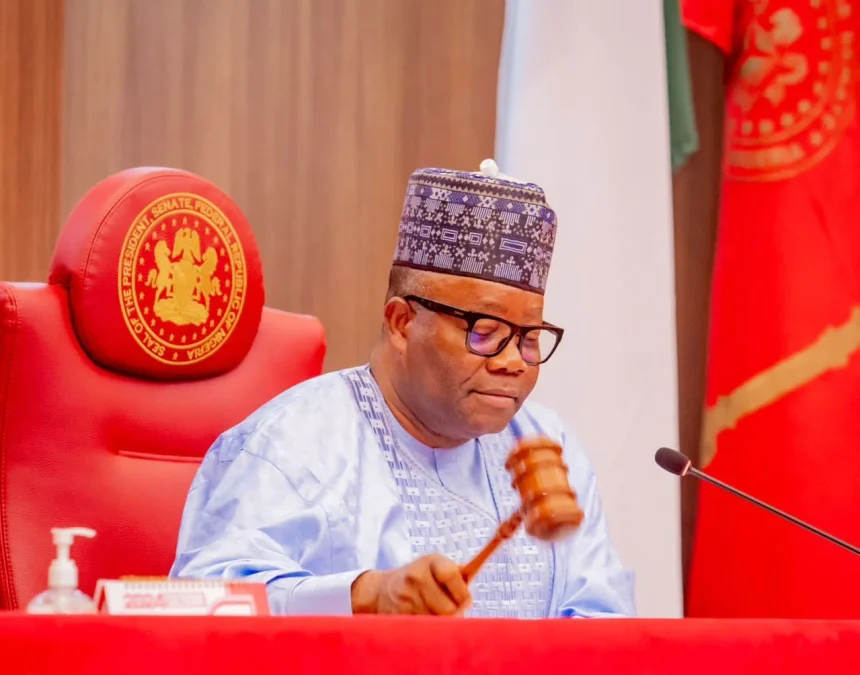
By Rt. Hon. Eseme Eyiboh, mnipr
Nigerian politics is not for the faint-hearted. It is noisy, dramatic, and often unforgiving. In a space where rumours travel faster than facts and headlines are written before the full story is known, substance can easily be drowned out. Real governance — the slow, patient work of building consensus, following procedure, and making tough decisions — rarely makes for exciting news.
The tenure of Senate President Godswill Akpabio has unfolded in that same charged atmosphere. It has drawn criticism, sparked debate, and generated its share of controversy — some sincere and rooted in genuine concern, some exaggerated for effect. That is the terrain of public life in Nigeria: intense, watchful, and rarely quiet.
Yet to evaluate this leadership solely through the prism of passing storms is to overlook the structure rising beneath the scaffolding. It is to confuse the weather with the architecture. Akpabio’s defining legacy will not be found in the daily churn of sensationalism, but in something far more consequential and far less clamorous: the deliberate stabilization of the legislature and its purposeful alignment with the executive in service of national progress.
Perhaps the most critical — and least celebrated — achievement of the current Senate is the restoration of constructive collaboration between the arms of government. After years in which legislative-executive friction often stalled governance in cycles of ego and brinkmanship, Akpabio has presided over a quiet but decisive shift.
What has emerged is a more mature, problem-solving partnership anchored in the understanding that Nigeria’s challenges transcend partisan divides. Under his stewardship, the 10th Senate has fostered an atmosphere in which policymaking rises above inherited animosities, enabling a focused pursuit of national interest.
Stability has been the oxygen of this Senate. It explains the timely consideration of executive communications, the passage of complex reform bills, and ministerial screenings that have been firm without being obstructionist.
From the presiding officer’s chair, this coherence has given government a more unified voice. In a federation as intricate and delicately balanced as Nigeria, coherence is not optional; it is essential. By prioritizing unity of purpose, Akpabio has repositioned the Senate from a potential arena of paralysis to a functioning engine of reform.
The most visible dividend of this stabilized framework is legislative output. The figures speak for themselves. In two years, the Senate has introduced over 844 bills, passed more than 90, and seen over 58 receive presidential assent under President Bola Ahmed Tinubu.
This pace — noticeably faster than that of recent assemblies — reflects what many observers describe as Akpabio’s leadership style: one that values efficiency, transparency, and measurable results over political theatrics.
Consider the Minimum Wage Act, a reform with a distinctly human impact. The law more than doubled the national minimum wage from ₦30,000 to ₦70,000 and exempted minimum wage earners from personal income tax. This was not an abstract fiscal adjustment; it was direct relief for millions of households navigating economic pressure.
Complementing this reform is a suite of tax legislation, including the Nigeria Tax Bill and the Nigeria Tax Administration Bill. Together, they represent a structural recalibration of Nigeria’s fiscal framework. By streamlining administration, responsibly broadening the tax base, and introducing targeted relief measures, these reforms have encouraged healthier fiscal competition among states and strengthened revenue generation. Nigeria’s GDP expansion from ₦314.02 trillion in 2023 to ₦372.8 trillion in 2024 stands as one indicator — among many complex factors — of renewed economic momentum supported by legislative-executive synergy.
Beyond macroeconomic indicators, Akpabio’s legislative vision reflects a keen appreciation of Nigeria’s geopolitical realities. His focus has not been confined to national aggregates. Under his leadership, the Senate has established five Regional Development Commissions covering the South East, South West, South South, North West, and North Central zones. These commissions are designed to reduce bureaucratic bottlenecks and accelerate infrastructure and social investment in regions long accustomed to delay.
This is development with strategic intent. It signals inclusion and reassures every zone that it is not peripheral to the national project.
Equally significant is the Local Government Financial Autonomy Act, which strengthens local councils’ control over their resources. By decentralizing both power and accountability — from Kaura Namoda to Urue Offong/Oruko — the law reduces dependency and narrows the space in which petty corruption thrives.
In the sphere of human capital development, the Students Loans Act stands out. Through the Nigerian Education Loan Fund, it provides zero-interest loans to students, directly addressing one of the most persistent barriers to social mobility. It is an investment in Nigeria’s most renewable asset: the intellect and ambition of its youth.
Akpabio’s influence has also extended beyond national borders. His leadership roles in international parliamentary forums have contributed to strengthening Nigeria’s voice in global conversations on climate resilience, migration, and development. At home, he has confronted controversy with openness rather than evasion. Allegations of budget padding were addressed in plenary debate, reinforcing institutional credibility.
His support for the removal of fuel subsidies — politically risky yet economically consequential — further demonstrates a willingness to endure short-term discomfort in pursuit of long-term stability. It reflects political courage anchored in conviction.
This posture is consistent with a career marked more by continuity than reinvention. From Governor transforming infrastructure in Akwa Ibom, to Minister of Niger Delta Affairs prioritizing regional development, to Senate President stabilizing the national legislature, the thread is unmistakable. It is this consistency that has led many to regard him as among the most effective Senate President in Nigeria’s political history. The claim is not one of perfection, but of performance — an operational legislature that works, visibly and persistently.
When history eventually asks what Senator Godswill Akpabio will be remembered for, the answer may not lie in the headlines of his era. It will lie in structure. His enduring contribution is the consolidation of legislative stability — transforming the Senate from a potential theatre of obstruction into a nucleus of collaborative policymaking.
That achievement is the platform upon which all else rests. It explains why bills move, why reforms gain traction, and why noise can gradually be shaped into governance. In a polity often pulled apart by centrifugal pressures, Akpabio has chosen to function as a centripetal force — holding the center not through coercion, but through deliberate and strategic harmony
And in doing so, he has supplied what a nation in transition requires most: stability — the firm foundation upon which a more secure future can be built.
Rt. Hon. Eseme Eyiboh, mnipr, is the Special Adviser, Media/Publicity, and official Spokesperson to the President of the Senate.


INEC Dismisses Calls for Chairman’s Removal

Ebonyi: Gunmen Assasinate Another Traditional Ruler

From South Africa to US, ‘Cicada’ COVID-19 variant spreading

Tech Expert, Zuckerberg trains with UFC champions, Adesanya, Alexander

Organ Trafficking: Ekweremadu bags 10 years in UK prison

SAINT OBI: Between his marriage and his death
-

 Business3 days ago
BUA Foods Plc Reports Strong 2025 Performance with ₦1.77 Trillion Revenue, Proposes Record ₦28 Dividend per Share
-

 News3 days ago
NELFUND Debunks Claims of ₦25,000 Student Upkeep Allowance
-
 Business2 days ago
33 Nigerian Banks Beat CBN’s Recapialisation with ₦4.65trn Combined Capital Base
-
 News3 days ago
Tinubu Appoints CAC, NPC, Officials, Names Adviser on Political Economy
-
 Sports3 days ago
Sportsville Awards: Olopade Leads NSC Delegation to Honour Dikko with Transformative Impact Award
-

 News3 days ago
Nigeria Welcomes African Games Bid Evaluation Committee
-
 Politics2 days ago
BREAKING: INEC Withdraws Recognition of David Mark’s ADC
-
 News3 days ago
El-Rufai Appear in State High Court, after Mother’s death, as Trial Continues