Politics
Presidency To Lamido: You Falsely Accuse Tinubu In June 12 Roles
It is important to remind Nigerians that Alhaji Lamido, as secretary of the Social Democratic Party (SDP)—the party whose candidate, MKO Abiola, won the June 12 election—was among those who failed to oppose the military’s injustice.

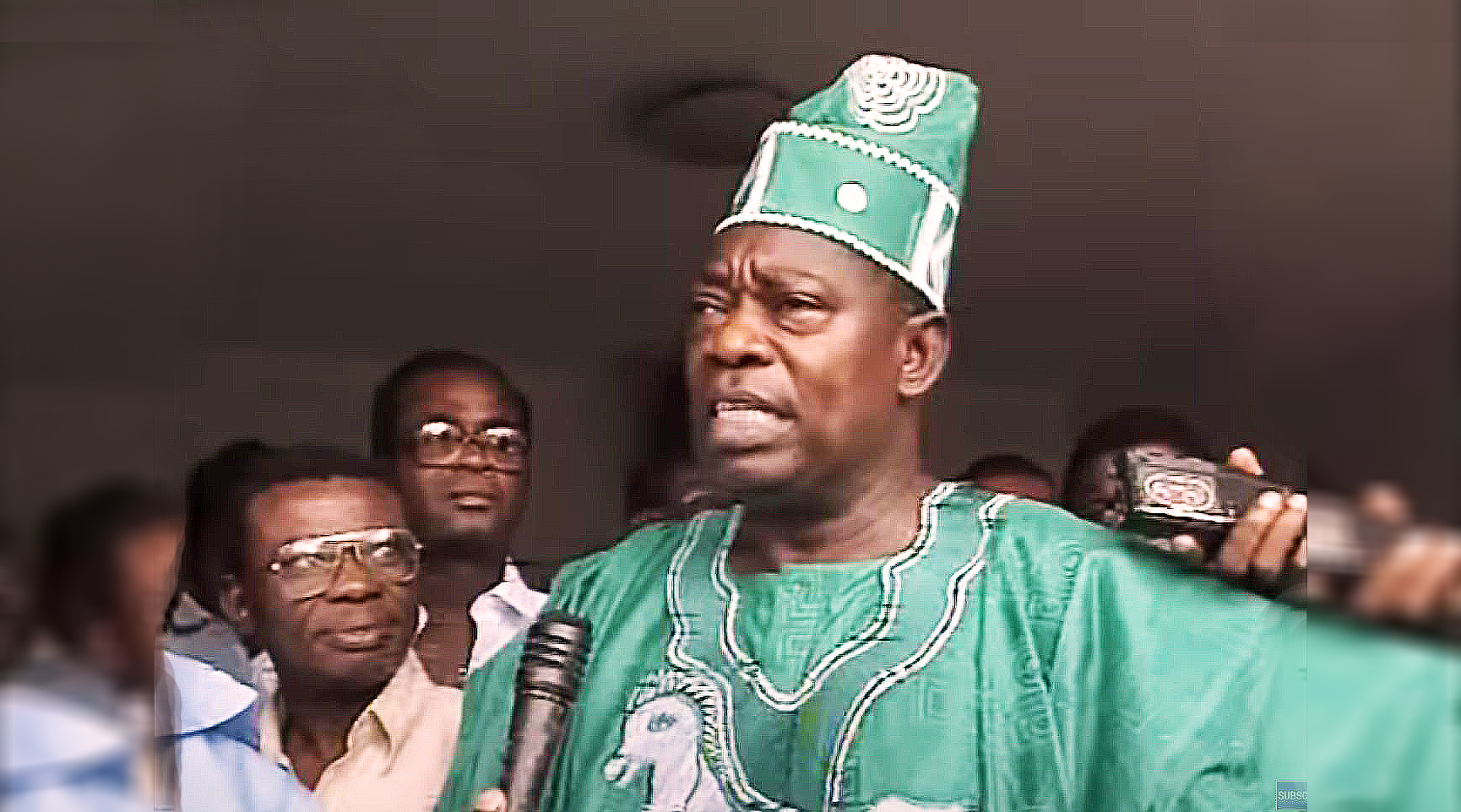
Photographs exist today, showing Tinubu behind Abiola and Abacha.
The attention of the Presidency has been drawn to recent comments made by Alhaji Sule Lamido, former Governor of Jigawa State, on live television, in which he falsely accused President Bola Tinubu of supporting the annulment of the June 12, 1993, presidential election.
Alhaji Lamido’s claims represent a distortion of history and a regrettable attempt at revisionism.
He alleged that President Tinubu only rose to prominence after the formation of NADECO and claimed that Tinubu’s mother, Alhaja Abibatu Mogaji, mobilised market women to back the annulment.
These allegations are patently false. Let us set the record straight: Alhaja Mogaji never mobilised market women to support the unjust annulment.
Had she done so, she would have lost her position as market leader in Lagos. While she once had a personal relationship with then-President Babangida, this was before the annulment crisis.
It is important to remind Nigerians that Alhaji Lamido, as secretary of the Social Democratic Party (SDP)—the party whose candidate, MKO Abiola, won the June 12 election—was among those who failed to oppose the military’s injustice.
The SDP leadership, including Lamido and chairman Tony Anenih, wrote their names in the book of infamy by surrendering the people’s mandate without resistance.
To their eternal shame, Lamido and Anenih teamed up with the defeated National Republican Convention to deny Abiola his mandate.
In sharp contrast, Senator Bola Tinubu stood firm even before General Abacha dissolved the political parties and all democratic institutions, including the National Assembly, on November 17, 1993, following his coup.
Days after General Babangida addressed the Senate and announced his decision to step aside on August 27, 1993, the setting up of an interim government to replace him, Senators debated the speech.
On the Senate floor on August 19, 1993, Tinubu unequivocally condemned the annulment, describing it as another coup d’état and urging Nigerians to reject injustice and lawlessness.
The records captured his contribution, showing that he supported upholding the June 12 election, not against it, as Lamido claimed.
“We have a situation that suggests that the abortion of the June 12 election is another coup d’etat,” Senator Tinubu said.
“My question is, when are we going to stop tolerating injustices, coup d’etat and abuse by the people on whom we invested so much resources—the public funds of this country?… Yes, it is true that we have a crisis, but for every action, there must be a reaction.
This is a self-inflicted crisis because, without the abortion or annulment of the June 12 election, there would be no crisis like this. We have a government that made the law and abused its law.
Therefore, the present military administration, by virtue of abrogation and violation of its own decree, has committed a crime,” the Senator from Lagos West told his colleagues.
The election winner, Abiola, was out of the country when the legislators debated Babangida’s offer to step aside for an interim government. He returned in September 1993.
And who followed him to the Abacha military group, then openly planning a coup against the Ernest Shonekan-led ING? It was Tinubu.
Photographs exist today, showing Tinubu behind Abiola and Abacha.
Abacha took over on November 17, 1993, and dissolved all democratic institutions, including governors, the National Assembly, and the state legislature.
Tinubu and a group of senators reconvened in Lagos, defying the junta. Tinubu, Ameh Ebute, Abu Ibrahim, and others were arrested and kept at Alagbon.
The police took them to court and fabricated a case against them.
While in police detention, Tinubu continued to fund pro-June 12 protests in Lagos, including the blockade of the Third Mainland Bridge.
Weeks after Abacha supplanted the ING, it quickly became clear to Abiola and Tinubu that Abacha would not be a soldier of democracy as he reneged on allowing Abiola to reclaim his mandate.
Enter the National Democratic Coalition (NADECO).
It was born on May 15, 1994. Comprising a broad coalition of Nigerian democrats, it called on the military government of Sani Abacha to step down in favour of the winner of the June 12, 1993, election, MKO Abiola. On the first anniversary of his election, Abiola made a declaration at Epetedo in Lagos, announcing himself as the duly elected president.
Ten days after, on June 22, he was arrested, following which many pro-democracy activists also escaped from Nigeria, including Bola Tinubu.
Tinubu lived in exile for nearly five years while Lamido and his ilk made deals with Abacha.
While Tinubu was away, agents of the junta bombed his home in Balarabe Musa Crescent, Victoria Island. Thankfully, Lamido admitted that Tinubu played a significant role in NADECO. Indeed, Tinubu did more.
He also backed Professor Wole Soyinka’s NALICON, offering material resources to fuel the struggle.
It is well-known that Tinubu played a leading role in the agitation against the June 12 annulment.
Many NADECO leaders and journalists in exile and at home openly admitted that Tinubu sustained them and provided them with funds for the struggle.
With his narrative, Lamido appeared confused about the role of NADECO.
It was an offshoot of the June 12 crisis. NADECO provided a platform to channel the struggle.
Hitherto, all the resistance was left to civil rights groups, journalists, and a section of labour, such as NUPENG.
It is thus disappointing that Alhaji Lamido, despite acknowledging Tinubu’s NADECO role, would attempt to rewrite history for political reasons and being a member of the Coalition of the Disgruntled.
We advise Lamido to check his facts before going on television to spread falsehoods.
It does not help his image, and the coalition he belongs to engages in revisionism.
Revisionism does not serve the cause of truth or our nation’s interests. We do not want to believe that Alhaji Lamido suffers from what psychologists call tall poppy syndrome.
However, the conclusion is inevitable as it appears that Lamido is envious of Tinubu’s democratic credentials.
The facts remain clear: President Tinubu was—and remains—a steadfast advocate for democracy, in contrast to the record of Lamido and others who capitulated in the face of military oppression and intimidation.

Politics
Exclusion of candidates from INEC list: CD cautions INEC against manipulation by politicians
The organisation maintained that it was deeply troubling that candidates who emerged through primaries monitored by INEC itself could be so brazenly excluded without immediate explanation.

• Demands untainted integrity ahead of 2027 elections
A leading pro-democracy group in Nigeria, the Campaign for Democracy (CD) has raised concerns over the omission of some political parties’ candidates from the list of candidates to contest in the 2027 general elections, particularly some governorship candidates.
The pro-democracy group warned the Independent National Electoral Commission against manipulation by desperate politicians, saying any threat to what it described as “political pluralism and participatory democracy” would be resisted.
In a strongly worded statement, signed by its President, Comrade Ifeanyi Odili, and released on Wednesday, CD wondered how the candidates’ names were excluded from the final list, without any immediate explanation, and when INEC, in its earlier list made available to the public on August 29, 2026, had cleared and published them.
The statement made particular reference to the Peoples Democratic Party’s governorship candidate in Gombe State, Isa Pantami; the party’s governorship candidate in Ogun State, Ladi Adebutu, and his deputy, Yemi Sowunmi-Kolapo.
The Campaign for Democracy said the development was particularly disturbing in Ogun State, where citizens had witnessed repeated boasts and triumphalism by members of the All Progressives Congress in the state that the PDP governorship candidate would be excluded from the final list.
According to CD, as if to validate that boast, INEC went ahead to publish a list that excluded both the PDP candidate, and his deputy, Hajia Yemi Sowunmi-Kolapo, without stating any reason for their omission.
CD said, “The timing of the omissions was even more disturbing, and this was where we became concerned and alarmed. A particular instance was that of Ogun State where the state’s citizens had witnessed repeated claims and apparent triumphalism by elements within the All Progressives Congress (APC) and their supporters that the PDP governorship candidate would be disqualified from participating in the forthcoming election.
“As if to validate that boast, INEC published a list that excluded both PDP candidates without stating the reason for their omission.”
“This troubling sequence of events raises legitimate questions about the independence and impartiality of the Commission that Nigerians cannot afford to ignore,” the pro-democracy group added.
It said, “Under your leadership, Mr. Chairman, INEC bears an enormous responsibility to demonstrate impartiality, transparency, and strict adherence to the law. Unfortunately, this development has raised serious doubts about the Commission’s preparedness to conduct a credible, transparent, and inclusive election in 2027.
“The clarification by the Commission published late yesterday, three days after the incident was belated.”
The group stated, “To the best of our knowledge, these are candidates that emerged through the primaries conducted by their various political Parties which were monitored by the Independent National Electoral Commission (INEC). Information in the public domain shows clearly that these candidates were on the earlier list published on the 29th of August, 2026.
“Even though the Commission has just published a belated clarification on the incident, we consider this development deeply troubling and a serious blow to public confidence in the electoral process, particularly because the published list provided no immediate explanation for the omissions of the governorship and other candidates.”
CD, which was formed in 1991 and was among the prominent civil society organisations that fought the military for restoration of civil rule in 1999, said it decided to intervene because the omission threatens Nigeria’s democratic credentials, warning INEC Chairman, Joash Amupitan, to avoid orchestrating anything that could set the nation on fire.
The organisation maintained that it was deeply troubling that candidates who emerged through primaries monitored by INEC itself could be so brazenly excluded without immediate explanation.
The group warned that an electoral umpire must not only be independent but must be seen to be independent.
CD said information from the affected states already showed heightened anxiety that could have exploded into intractable violence before the Commission’s belated clarification, describing the delay as inexcusable tardiness.
The pro-democracy body further demanded an immediate investigation into allegations circulating in the public that some candidates’ names were electronically removed after they were duly submitted.
It vowed that as a committed pro-democracy group, it would not hesitate to mobilise citizens and pro-democracy organisations across the nation for lawful mass civic action against any threat to political pluralism and participatory democracy.
“We remind INEC that elections belong to the Nigerian people, not to any political party, individual, or governing interest.
No institution should take actions that create the impression that opposition participation can be determined by administrative discretion without transparent, constitutional justification and due process,” CD stated.
Politics
APC Makes Wike, Soludo, Adeleke State’s Campaign Coordinator
Wike belongs to the Peoples Democratic Party (PDP), Soludo is a member of the All Progressives Grand Alliance (APGA), while Adeleke won re-election as Osun governor in 2026 under the Accord Party.
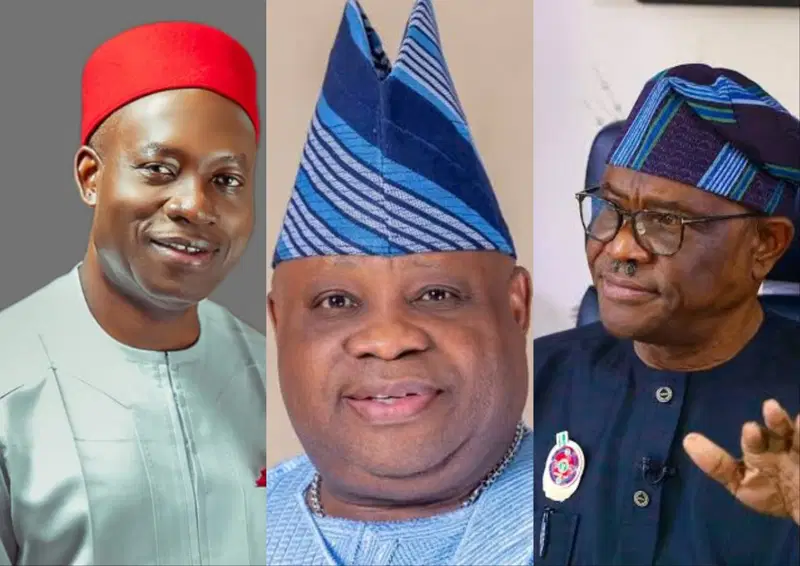
• [L-R] A collage of Soludo, Adeleke and Wike
The All Progressives Congress (APC) has named Nyesom Wike, minister of the Federal Capital Territory (FCT); Ademola Adeleke, Osun governor; and Chukwuma Soludo, Anambra governor, as state campaign coordinators in its expanded presidential campaign council for the 2027 general election.
This is despite their affiliations with other political parties.
Wike belongs to the Peoples Democratic Party (PDP), Soludo is a member of the All Progressives Grand Alliance (APGA), while Adeleke won re-election as Osun governor in 2026 under the Accord Party.
Under the new arrangement, Wike will coordinate the APC campaign in Rivers State and the FCT, Soludo will oversee Anambra, while Adeleke will coordinate the campaign in Osun.
The expanded list is scheduled for inauguration by President Bola Tinubu at the Presidential Villa in Abuja on Wednesday.
The APC initially released its campaign council list on August 22, naming Abdulaziz Yari, former Zamfara governor, as director-general. Senate President Godswill Akpabio, House of Representatives Speaker Tajudeen Abbas and Yobe Governor Mai Mala Buni were appointed deputy director-generals.

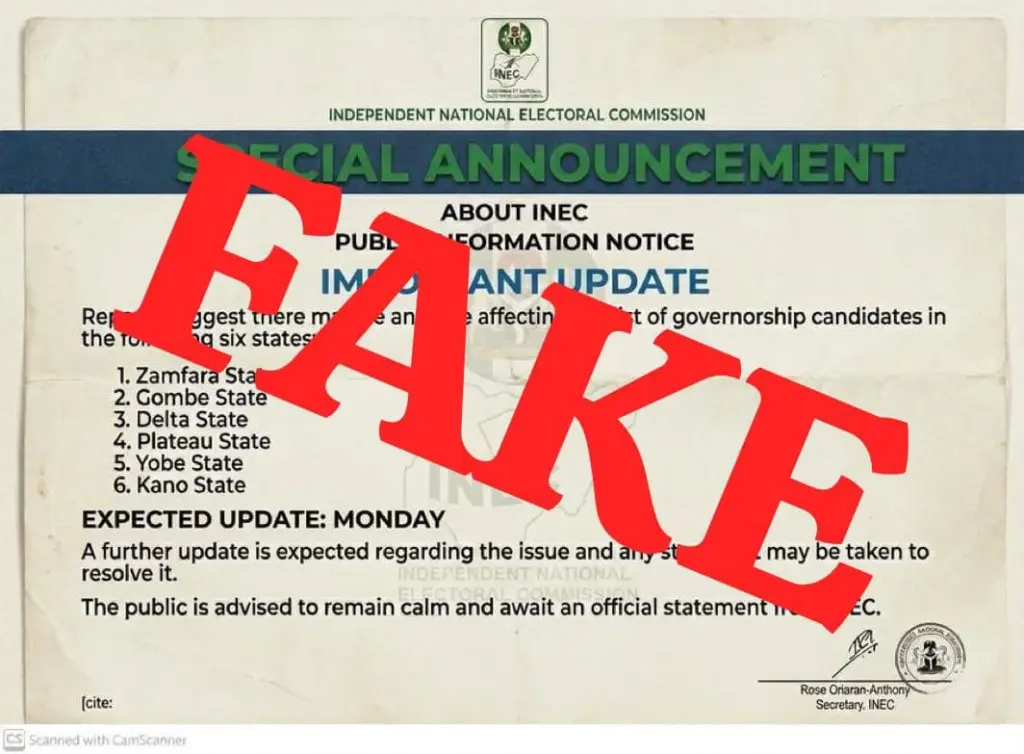
The Independent National Electoral Commission (INEC) has raised the alarm over a fraudulent publication circulating online that claims to be a special announcement about governorship candidates for the 2027 elections.
In a public notice issued on Monday, October 12, 2026, the electoral body described the document as “FAKE” and stressed that it did not originate from the Commission.
The circulating material purports to address issues affecting the list of governorship candidates in six states: Zamfara, Gombe, Delta, Plateau, Yobe, and Kano.
“The Commission wishes to categorically inform the general public that the publication is FAKE and did not originate from INEC. INEC therefore urges members of the public to disregard the fraudulent publication and refrain from sharing it,” the notice stated.
INEC further clarified that any information suggesting it has issued a special announcement concerning governorship candidates in those states is false.
The warning comes just days after the Commission published the final lists of candidates for the February 6, 2027 governorship elections.
The electoral umpire advised Nigerians, political parties, and candidates to rely solely on official notices, press releases, and information released through its verified channels.
These include the INEC website (inecnigeria.org), its Facebook page (INEC Nigeria), X and Instagram handles (@inecnigeria), and the INEC News Portal.
INEC reiterated its commitment to providing accurate electoral information and called on the public to remain vigilant against misleading publications as preparations for the 2027 elections intensify.


BREAKING: Nigeria Confirms First Ebola Case

Mbappé wins Onze d’Or award for 2025/26 season

Ronaldo Gets 30-Day Suspension For Portugal Camp Walkout

BREAKING: Lagos Govt Declares Today, Thursday Work-Free to Mark 2026 Ìṣẹ̀ṣe Day

Tech Expert, Zuckerberg trains with UFC champions, Adesanya, Alexander