
Politics
Osun Records Political Killings Ahead Saturday’s LG poll
Osun State Governor Ademola Adeleke has directed all Osun residents, including politicians across all political divides, to stay away from the local government secretariats to protect public properties and avoid further bloodshed.

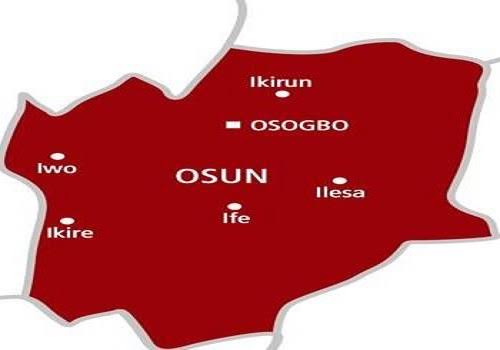
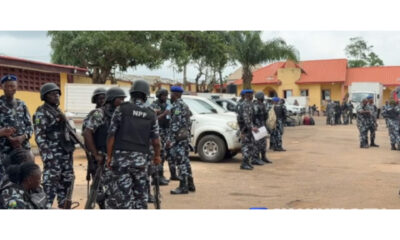
No fewer than two persons have been killed after suspected political thugs wielding machetes and other dangerous weapons invaded Local Government Secretariats in Osun State.
The incident occurred on Monday, February 17, 2025.
This is coming barely a few days to Saturday’s local government election in Osun State.
It was gathered that the incident was not unconnected with the violence that trailed an attempt by members of the All Progressives Congress (APC) to take over the secretariat.
The move was, however, resisted. Confirming the incident, the Osun State Police Public Relations Officer, CSP Yemisi Opalola, said police operatives had been deployed to local government secretariats across the state to maintain law and order.
Meanwhile, Osun State Governor Ademola Adeleke has directed all Osun residents, including politicians across all political divides, to stay away from the local government secretariats to protect public properties and avoid further bloodshed.
Adeleke gave the directive via a statement on Monday.
The governor stated: “This has become necessary, especially as the council secretariats are expected to be under lock and key, due to the withdrawal of service, announced by workers of the Nigerian Union of Local Government Employees (NULGE) across the state. “I equally condole families of victims of the APC illegal takeover bid and chaos unleashed across the state by the APC and their hired thugs.
“The Peoples Democratic Party (PDP), lost five members with several others wounded. Two of those members are from Iragbiji, Boripe local government.
Another two were killed at Ola Oluwa Local government. Another one was lost at Ikire. We must stop further bloodshed.
“I have directed security agencies to take charge of all local government secretariats and I hereby assure residents of Osun of their safety and protection of lives and properties.”




Politics
Benue Politician,Terhemba Shija Vows To Bring Back Home Over 900,000 in IDP Camps
Shija, while describing IDP camps as ranching human beings, said, ” First of all, I have to rescue them from this situation. They have to go back to their land. They have to resume their farming. They have to resume their normal life.
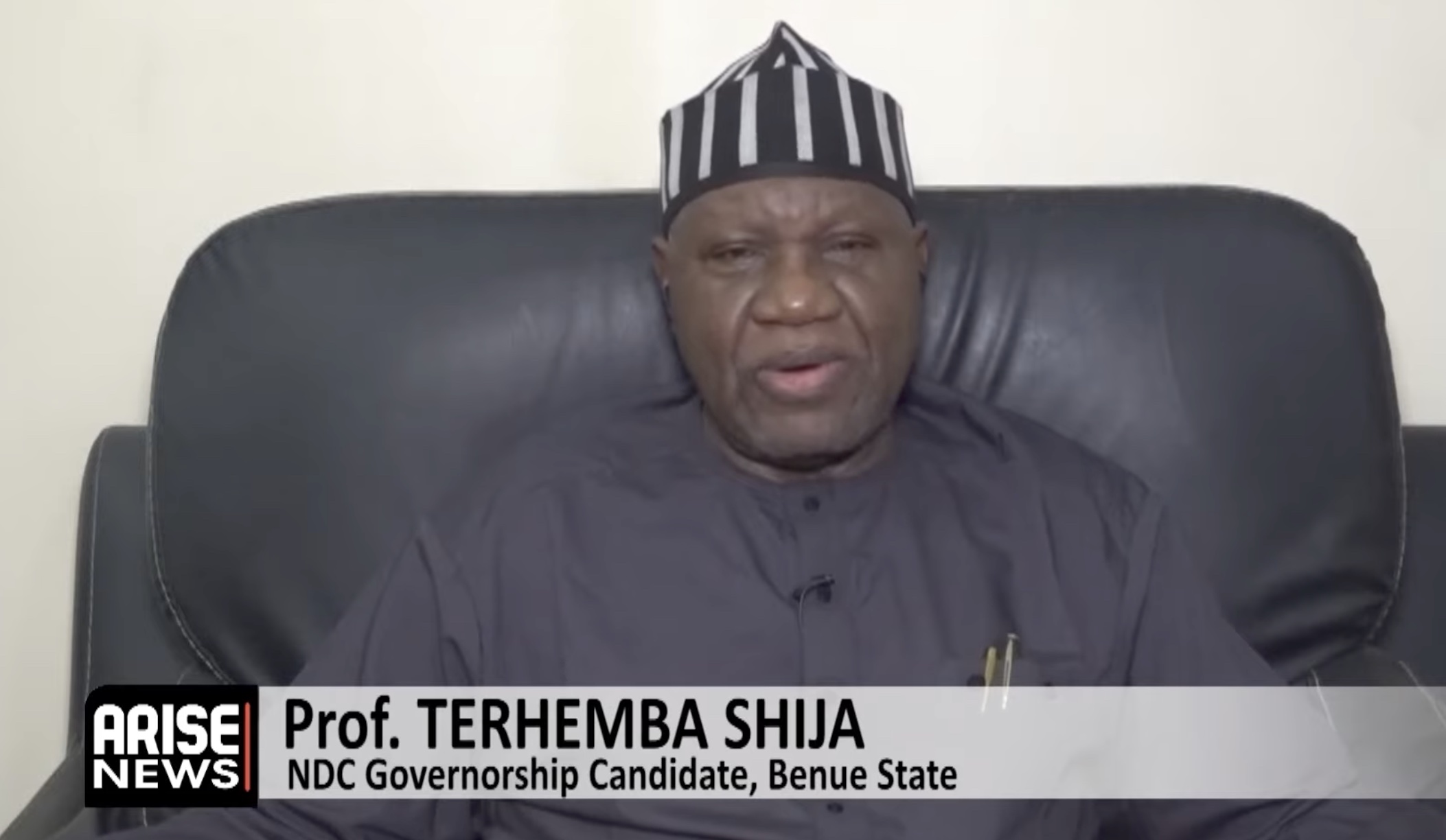
The governorship candidate of the Nigeria Democratic Congress (NDC) in Benue State, Prof. Terhemba Shija, promises to reset the state if he wins the 2027 governorship election.
Shija gave the assurance during an appearance on ARISE News on Wednesday, declaring unacceptable – 900,000 people in Benue State currently living in Internally Displaced Persons (IDP) camps in the state.
Benue State has an official census population of 4,253,641 from 2006, with recent projections estimating the population to be over 6 million people.
Shija, while describing IDP camps as ranching human beings, said “First of all, I have to rescue them from this situation. They have to go back to their land. They have to resume their farming. They have to resume their normal life. We can’t continue normalising what is happening. And once you rescue them, then you set a programme for restructuring. You make sure that Benue is reset afresh.”
“As it is now, this state is in a state of disrepair. The state is no longer in the hands of the owners of the states. Most of over 900,000 people are living in IDP camps. You should know that Benue state is an agrarian state,”he said.
He emphasised “70% of the people of Benue are farmers. They can’t farm. Their land has been taken over by invaders.
Shija, blames the situation on “Herdsmen have taken over Benue land. And these people are living in IDP camps. Now the government has intended to introduce ranching. They have ended up ranching human beings. Human beings are now in IDP camps. And they are at the mercy of people in government.”
Politics
INEC fixes Sept 19 for by-elections in 4 states
The by-elections will take place at Gombe/Kwami/Funakaye Federal Constituency in Gombe, while the state constituencies shall take place at Disina and Sakwa State Constituencies in Bauchi State; Udu and Dawakin Kudu in Delta and Kano State Constituencies respectively.

The Independent National Electoral Commission (INEC) has fixed September 19 for the conduct of five by-elections in four states; Gombe, Kano, Bauchi and Delta.
The Chief Press Secretary to the INEC chairman, Mr Tunde Oketola, disclosed this in an interview with the News Agency of Nigeria (NAN) on Tuesday in Abuja.
Oketola said that the by-elections comprised one federal and four state constituencies.
According to Oketola, the by-elections will take place at Gombe/Kwami/Funakaye Federal Constituency in Gombe, while the state constituencies shall take place at Disina and Sakwa State Constituencies in Bauchi State; Udu and Dawakin Kudu in Delta and Kano State Constituencies respectively.((NAN)
Politics
2027: Tompolo flags – off campaign for Tinubu with 34 Campaign Vehicles
The founder and convener of the movement said Katsina was chosen as the first state in northern Nigeria for the unveiling of the initiative.

The Chief Executive Officer of Tantita Security Services Nigeria Limited, High Chief Government Ekpemupolo, popularly known as Tompolo, has donated 34 campaign vehicles to a support movement mobilising for President Bola Tinubu’s re-election in Katsina State.
Tompolo made the donation during the official unveiling of the PBAT Door-to-Door Movement in Katsina, describing the initiative as part of efforts to build grassroots support for Tinubu ahead of the 2027 presidential election.
The founder and convener of the movement said Katsina was chosen as the first state in northern Nigeria for the unveiling of the initiative.
As part of the launch, 34 local government coordinators were inaugurated and presented with campaign vehicles at the People’s Square in Katsina.
Represented at the flag-off and inauguration by High Chief Kestin Ebimorbowei Pondi, Tompolo said the relationship between Tinubu and Katsina was founded on trust, confidence and inclusion.


Lagos Confirms 6 Diphtheria Cases, Says no Outbreak

Rema to release new single ‘Oh No’ Friday

Police arrest 46 for obstruction of Obi’s convoy in Benue

Tech Expert, Zuckerberg trains with UFC champions, Adesanya, Alexander

Organ Trafficking: Ekweremadu bags 10 years in UK prison

SAINT OBI: Between his marriage and his death
-

 Business2 days ago
NAFDAC Goes After Chinese Logistics Firms Over Products Counterfeiting
-
 International2 days ago
Kenya gives foreign workers 90 days to formalise status or leave
-

 News3 days ago
JUST IN: Traffic Chaos Expected on Lagos-Ibadan Expressway From Tuesday
-

 Sports2 days ago
Falconets lose World Cup opener to Spain
-

 Business3 days ago
Dangote woos ordinary Nigerians to own shares in oil refinery as IPO opens September 14
-

 Entertainment2 days ago
Ikenga becomes highest-grossing Igbo film of all time
-

 Politics2 days ago
2027: Tompolo flags – off campaign for Tinubu with 34 Campaign Vehicles
-
 Business2 days ago
After South Africa, Kenya Cracks Down on Foreign Traders, Retailers