
News
Oguta Community in Imo Abolishes Long-Standing Osu/Ohu Outcast System in Landmark Move

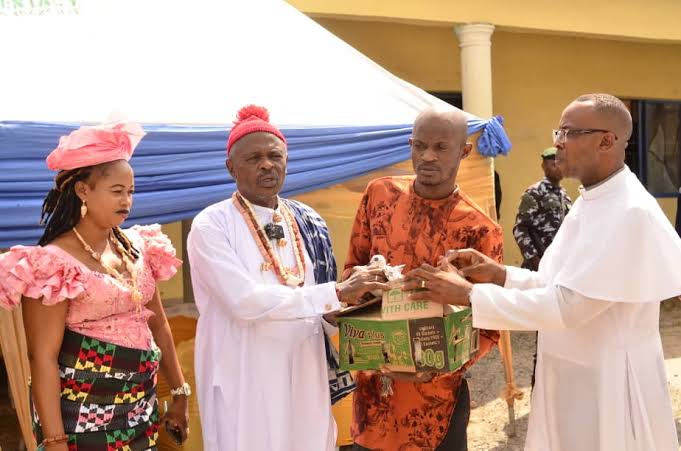
In a significant step against entrenched social discrimination, traditional leaders in Oguta, Oguta Local Government Area of Imo State, have formally abolished the age-long Osu (also referred to as Ohu) outcast system, a cultural practice that has marginalised generations of people through stigma and exclusion.
The abolition was proclaimed on November 3, 2025 (with some reports noting the public declaration on November 2), at the Oguta Civic Centre. Chief Nduka Oduenyi, the Ogana (spokesman/assistant) to the traditional ruler of Oguta, Eze Nnani Eze-Eyiche, made the announcement on behalf of the community’s leaders, elders, youths, and women who gathered for the event.
“This is a historic moment of renewal and unity for the Oguta community,” Oduenyi stated. “The long-standing Ohu caste system — a practice widely regarded as discriminatory and inconsistent with human dignity — no longer exists in Oguta going forward.
”The Osu/Ohu system, deeply rooted in parts of Igbo culture, has historically designated certain individuals and their descendants as outcasts, limiting their social interactions, marriages, and opportunities despite previous legislative efforts at state and regional levels to end it.
The development comes nearly four years after investigative journalist and author Ejiro Umukoro drew fresh national attention to the issue through her novel *Distortion*.
The book, which weaves together themes of mental health, infertility, grief, and systemic discrimination including the Osu caste system, sparked widespread conversations across Nigeria.
Umukoro’s advocacy went beyond the pages of the novel. Through a seven-month nationwide book tour featuring television appearances, radio interviews, and community outreach, she consistently highlighted the lived experiences of those affected by the system, helping to revive dormant discussions on the topic.
This community-led abolition in Oguta is seen by many as a concrete outcome of renewed advocacy efforts, including those by Umukoro and other human rights voices, building on earlier calls for reform. It marks one of the more visible public renunciations of the practice in recent years.
The move has been welcomed by observers as a positive step toward greater social inclusion and equality in the region, though broader eradication across Igbo land would require continued efforts by traditional institutions, government, and civil society.




An independent panel has begun its investigation today into the deaths of 37 people who died while in the custody of the Nigeria Security and Civil Defence Corps (NSCDC) in Niger State.
The Federal Government constituted the 10-member committee last week following the deaths, which occurred on Thursday, September 17, 2026. The victims, described as suspected illegal miners, had been arrested during enforcement operations against artisanal mining activities in the state days earlier.
Minister of Interior Olubunmi Tunji-Ojo announced the panel’s formation, stating it would examine the circumstances surrounding the arrests, detention and deaths. The committee, chaired by retired DSS Deputy Director-General Jonathan Kure, has been given two weeks to submit its report. It is also mandated to determine any negligence or misconduct, recommend accountability measures and propose steps to prevent a recurrence.
Twenty NSCDC officers, including the Niger State Commandant, have been suspended pending the outcome of the probe. Authorities have stressed that any attempt to interfere with the investigation or destroy evidence will be treated as a serious offence.
The incident has drawn widespread attention, with reports of overcrowding and poor ventilation in the detention facility cited among possible factors. Officials have confirmed that medical and forensic examinations are under way to establish the precise causes of death.
News
UK court jails Nigerian man for masturbating in front of a woman
British Transport Police said Odutola approached a woman on the train, looked her up and down and became aggressive when she refused to engage with him. He then exposed himself while sitting in a wheelchair and began masturbating while staring at the woman and telling her to “come over”


•A Nigerian man and registered sex offender, Babatunde Odutola
A Nigerian man and registered sex offender, Babatunde Odutola has been jailed in the UK after exposing himself and masturbating in front of a woman on a train travelling towards Manchester.
Odutola, 36, of no fixed address, was sentenced to 44 weeks in prison at Manchester Magistrates’ Court on Monday, September 14, after pleading guilty to outraging public decency and breaching a suspended sentence order.
The incident occurred around 7pm on Friday, September 11, on a train travelling through Cheshire towards Manchester Piccadilly railway station.
British Transport Police said Odutola approached a woman on the train, looked her up and down and became aggressive when she refused to engage with him. He then exposed himself while sitting in a wheelchair and began masturbating while staring at the woman and telling her to “come over”.
A fellow passenger intervened and escorted the distressed woman from the carriage.
According to police, CCTV footage showed Odutola continued masturbating as other passengers walked through the carriage.
British Transport Police officers arrested him after the train arrived at Manchester Piccadilly. He was subsequently prosecuted and jailed within 72 hours of the incident
News
Digital Economy Minister Says NDPC Now Properly Functional With New HQ
” An asset recovered on behalf of the Nigerian people has now been returned to productive use for the Nigerian people. That is reform made tangible,” he said .


Abuja| NDPC new headquarters commission , Tuesday, 15 September,2026.
An EFCC-recovered property allocated to the Ministry of Communications, Innovation & Digital Economy, has been transformed to the new headquarters of the Nigeria Data Protection Commission (NDPC) in Abuja, as its headquarters.
Speaking during the commissioned ceremony of the building, the Honourable Minister incharge of the ministry, Dr. ‘Bosun Tijani, described the facility as a tangible demonstration of the visionary leadership of President Bola Ahmed Tinubu, and his commitment to building strong institutions that can support Nigeria’s growing digital economy.
The Minister emphasised that said the occasion represented more than the opening of a new office, but a reflection of the administration’s commitment to strengthening the institutions required to protect Nigerians and build trust in the country’s digital economy.
Dr. Tijani said, “Shortly after assuming office in 2023, President Tinubu signed the Nigeria Data Protection Act into law, giving the NDPC the appropriate legal foundation and authority to protect the data and privacy rights of Nigerians.
The President also directed Ministries, Departments and Agencies of the Federal Government to comply with established data protection laws and frameworks, demonstrating that government must lead by example in upholding the standards it expects from citizens and businesses.”
He added, “In the early days of the Commission, it was difficult to ask an institution to protect the data of over 200 million Nigerians and support one of Africa’s largest digital economies without the institutional resources to do so.
President Tinubu recognised this challenge and moved to solve it, approving the resources required for the NDPC to become properly operational and functional, while building towards becoming a sustainable institution in its own right.
He also directed that an EFCC-recovered property be allocated to the Commission as its headquarters.
“An asset recovered on behalf of the Nigerian people has now been returned to productive use for the Nigerian people. That is reform made tangible,” he said .


Gov Mbah Appoints Nollywood’s Eucharia Anunobi, Rachael Okonkwo aides

CBN reduces interest rate to 23% on market stability

BREAKING: Lassa fever kills 259, infects 1,086 in 24 Nigerian states — NCDC

Tech Expert, Zuckerberg trains with UFC champions, Adesanya, Alexander

Organ Trafficking: Ekweremadu bags 10 years in UK prison

SAINT OBI: Between his marriage and his death
-
 Business1 day ago
CBN, MOF sign pact to align monetary, fiscal policies
-

 Business20 hours ago
Dangote Whets Investors Appetite Ahead 2028 Fertiliser IPO
-

 Business19 hours ago
Gambia Orders Nigerian Banks To Replace Foreign Staff by December 2026
-

 International18 hours ago
Trump launches ‘Trump TV’ as US networks halt White House coverage
-

 News18 hours ago
Independent Panel Begins Probe into 37 Deaths in Civil Defence Custody
-

 Sports16 hours ago
Mbappé Leaves Nike To Promote Swiss Sportswear Brand On
-

 Health20 hours ago
Nigerian hospital successfully performs kidney cancer surgery via tele-robotic
-

 Business19 hours ago
Naira To Dollar, Pound, Euro…Rate Today, September 22