
News
LAWMA defends ₦40,000 salary for street sweepers, says It’s minimum wage compliant

In response to a viral video that sparked outrage on social media, the Lagos Waste Management Authority has clarified the wage structure of street sweepers.
The video, which featured a LAWMA worker claiming that sweepers were underpaid and had not received the promised minimum wage of ₦85,000, quickly gained traction and led to widespread public criticism.
The worker claimed that the sweepers were consistently receiving only ₦30,000, which was recently increased to ₦40,000 in February.
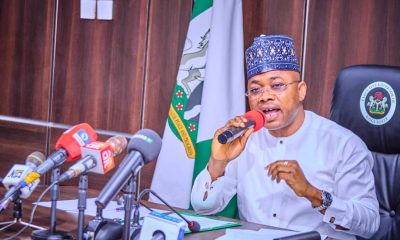
LAWMA, through a statement shared by a Special Assistant to Governor Babajide Sanwo-Olu on Social Media, Jibril Gawat, defended the street sweepers salaries and emphasised its commitment to the welfare of its workers.
The statement explained that the street sweeping programme is managed by LAWMA through private companies that engage sweepers under clearly defined contracts.
It added that the private firms are responsible for paying the workers directly, and as per the new minimum wage review, street sweepers are now earning ₦40,000 per month, while supervisors earn ₦50,000 which it said is proportionate to the four-hour daily shifts worked by the sweepers.
The statement partly read, “Street sweepers are engaged through private companies under structured contracts, with their responsibilities and entitlements clearly defined.
These private companies are responsible for directly paying their engaged sweepers.
“Following a recent wage review, sweeper salaries have been adjusted to align with the national minimum wage and are proportionate to their work schedule, which consists of four-hour daily shifts. Under this structure: Sweepers earn ₦40,000 per month. Supervisors earn ₦50,000 per month.”
LAWMA added that the wage increase was part of a broader effort to provide workers with financial stability while allowing flexibility for them to engage in other economic activities outside their assigned shifts.
The statement further outlined LAWMA’s commitment to improving the welfare of its workers, detailing several initiatives which included regular health and safety training, reclassification of sweeping routes for greater worker security, accident and emergency insurance coverage, and the provision of uniforms and work implements to maintain dignity and efficiency.
In the statement, the agency reaffirmed its commitment to ensuring they receive fair treatment in line with agreed standards and assured the public that any discrepancies in salary payments or violations of contractual agreements would be promptly investigated and rectified.
The agency also emphasised that the success of the street sweeping programme relies heavily on the dedication of the workers, and it remains committed to ensuring fair treatment and improved working conditions.




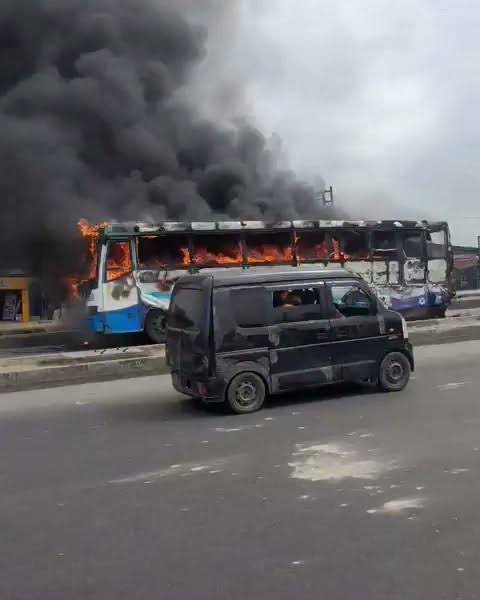
An angry mob has set a Bus Rapid Transit (BRT) bus on fire after it reportedly crushed a commercial motorcyclist to death at Ogolonto Bus Stop along Ikorodu Road in Lagos State.
The incident occurred on Friday, October 16, 2026. Eyewitness accounts and social media reports indicate that the motorcyclist was riding alone along the restricted BRT lane when the collision happened. He died at the scene.
Enraged residents and youths then attacked the bus driver and set the vehicle ablaze. Police officers and officials of the Lagos Neighbourhood Safety Corps (LNSC), who were nearby, intervened promptly and rescued the driver unharmed.
The identity of the deceased motorcyclist and the exact circumstances of the crash had not been officially confirmed at the time of filing this report. It was also unclear whether any arrests had been made in connection with the burning of the bus.
News
ARISE News Wins Seven Honours At Nigerian Broadcasters Merit Awards
The awards recognised the network’s achievements in television journalism and programming, with ARISE News winning the Best TV Channel (Viewer’s Choice) category.

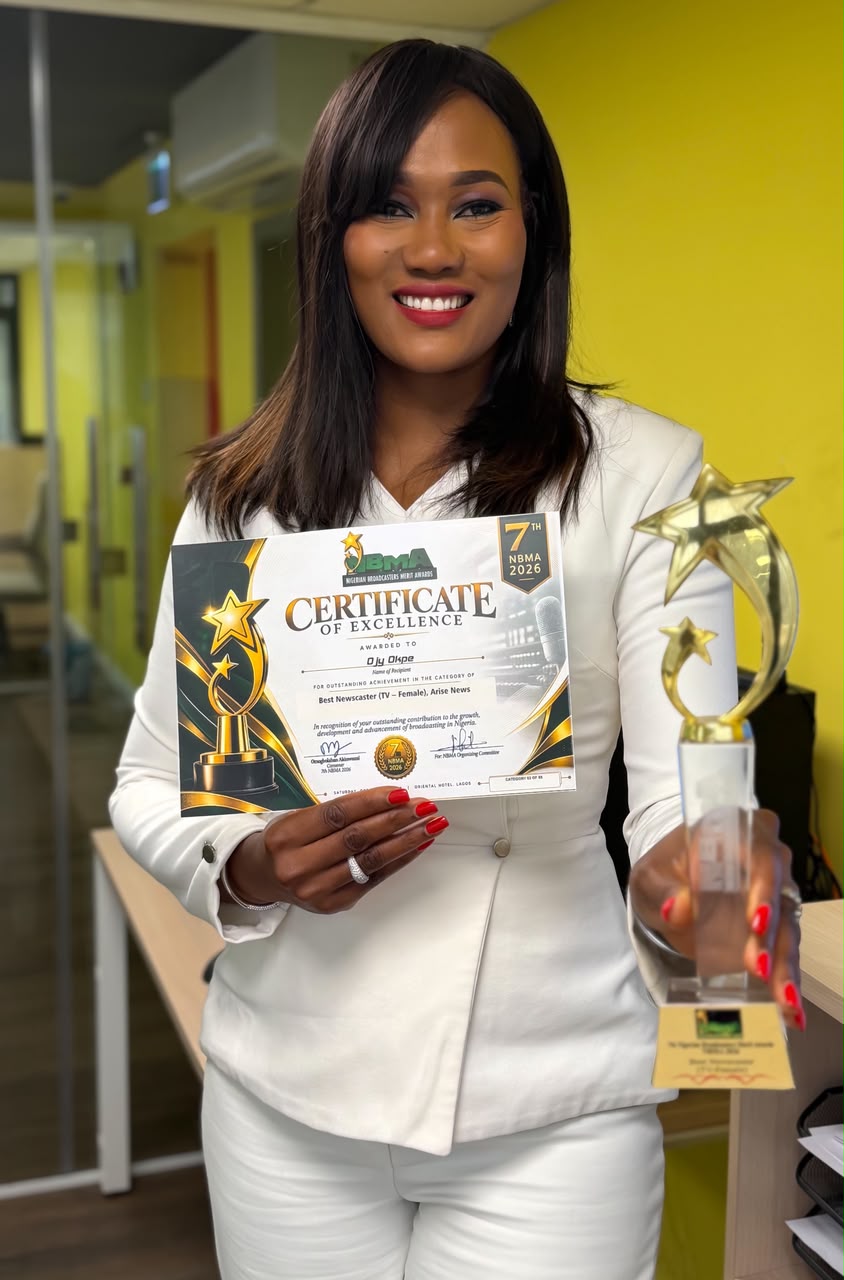
• ARISE News Anchor and host of What’s Trending Ojy Okpe was named Best Newscaster (TV – Female)
ARISE News has emerged as one of the major winners at the just ended Nigerian Broadcasters Merit Awards (NBMA).
ARISE News won seven honours across television broadcasting, news reporting, presentation and production during the ceremony.
The awards recognised the network’s achievements in television journalism and programming, with ARISE News winning the Best TV Channel (Viewer’s Choice) category.
The network’s flagship breakfast programme, The Morning Show, also won the Best TV Talk Show award, further strengthening its recognition in television broadcasting.
ARISE News Anchor and host of What’s Trending Ojy Okpe was named Best Newscaster (TV – Female).
Rufai Oseni was named Nigerian Broadcaster of the Year (Male), while Vimbai Mutinhiri-Ekpeyong received the Nigerian Broadcaster of the Year (Female) award.
The recognition extended to the network’s newsroom, with Ovieteme George winning Best TV News Reporter (Male) for his contributions to television news reporting.
Behind the camera, Sam Adeyemi received the Best Camera Operator/Cinematographer award, recognising his work in television production and visual storytelling.
News
Meta removes 3.7 million accounts in West Africa scam crackdown
The joint operation led to 28 arrests, identified more than 30 suspected scam centres and rescued 117 people allegedly trafficked and forced to work in scam compounds in Ghana.
Meta, the parent company of Facebook and Instagram, has removed more than 3.7 million Facebook and Instagram accounts, pages and groups linked to suspected scam networks operating in West Africa.
The joint operation led to 28 arrests, identified more than 30 suspected scam centres and rescued 117 people allegedly trafficked and forced to work in scam compounds in Ghana.
The company announced the crackdown in a statement on Tuesday, October 13, 2026. It involved 14 technology companies and law enforcement agencies from 10 countries.
The United Kingdom’s National Crime Agency coordinated the operation with the US Department of Justice, the Federal Bureau of Investigation and other agencies. Nigerian authorities were involved.
Other countries included Ghana, Australia, Canada, New Zealand and India.Tech companies that took part included Google, Microsoft, OpenAI, Coinbase, Starlink and Adobe.
Meta said the partnership let participants share intelligence across digital platforms, countries and financial systems to identify criminal networks.


JUST IN: Mob Sets BRT Bus Ablaze After Motorcyclist’s Death in Lagos

BREAKING: DSS Arrests Fugitive Maina Son, Hands Him to EFCC

BREAKING: 5 Arrested Over Imo NYSC Abduction

BREAKING: Lagos Govt Declares Today, Thursday Work-Free to Mark 2026 Ìṣẹ̀ṣe Day

Tech Expert, Zuckerberg trains with UFC champions, Adesanya, Alexander

Organ Trafficking: Ekweremadu bags 10 years in UK prison
-
 News3 days ago
ASCON To Be Rebranded “National School Of Government”
-
 Business3 days ago
Germany plans tax on sugary drinks
-
 Business3 days ago
WEF could appoint Lagarde as its next chair, sources say
-
 International3 days ago
“Mother of all bombs,” Trump Plans To Hit Iran
-
 Business2 days ago
Naira Exchange Rates Friday, October 16
-
 Crime2 days ago
BREAKING: 5 Arrested Over Imo NYSC Abduction
-
 News2 days ago
Meta removes 3.7 million accounts in West Africa scam crackdown
-

 News2 days ago
ARISE News Wins Seven Honours At Nigerian Broadcasters Merit Awards