
Health
JUST IN: Suspected measles outbreak kills 10 children in FCT

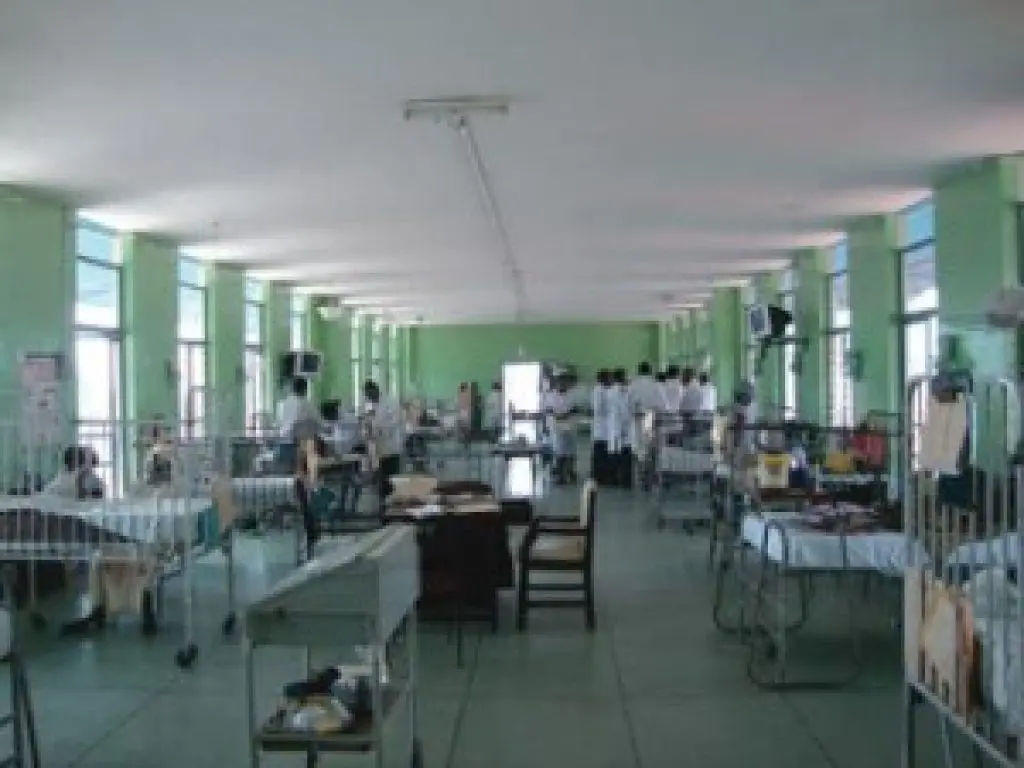
No fewer than ten children have died due to suspected measles outbreak in Damangaza community, Lokogoma District, Federal Capital Territory, FCT, Abuja.
Head of the Damangaza community, Mr James Budebo, disclosed this during a one-day outreach programme on Friday in Abuja.
The programme was organized by Primary Health Care, Damangaza and the Vaccine Network for Disease Control (VNDC), a grassroots organisation dedicated to health interventions in underserved communities.
Suspected measles outbreak kills 10 children in FCTPublished on July 13, 2024By Matthew Atungwu.
No fewer than ten children have died due to suspected measles outbreak in Damangaza community, Lokogoma District, Federal Capital Territory, FCT, Abuja.
Head of the Damangaza community, Mr James Budebo, disclosed this during a one-day outreach programme on Friday in Abuja.
The programme was organized by Primary Health Care, Damangaza and the Vaccine Network for Disease Control (VNDC), a grassroots organisation dedicated to health interventions in underserved communities.
Measles is a highly contagious viral infection characterized by fever, cough, runny nose, red eyes, and a distinctive rash.
It can lead to serious complications such as pneumonia and encephalitis, especially in young children and those with weak immune systems.
Budebo said vaccination was important in preventing measles and its complications, hence the need for widespread immunisation to protect the community.
He said the recent deaths were due to the suspected measles outbreak, adding that there have been challenges to vaccine acceptance within the community.
Mrs Chika Offor, CEO of VNDC, said the one-day outreach programme was a crucial . to the health crisis in Damangaza.
She said it was aimed at providing immediate assistance and laying the groundwork for long-term community resilience.
Offor said efforts were on to promote vaccine accessibility and provide clear, accurate information to address community concerns and misconceptions.
She said the deaths due to measles were preventable, adding that the organisation was committed to supporting community dialogue on vaccination and public health measures.
Ms Longtang Shawen, a Health Worker at PHC, Damangaza, said the outbreak exacerbated the community’s ongoing challenges with limited healthcare access.
She said education was important in empowering the community about vaccine-preventable diseases, sanitation and hygiene.
Shawen said vaccination was critical in preventing measles outbreaks, protecting individuals and ensuring community-wide immunity.
She urged the residents of the community to accept vaccination to guard against such preventable diseases and protect the vulnerable populations.
Chief Bello Musa, the Head of Damangaza Hausawa, said that the Public Health Department, FCT, had been notified of the situation, with previous visits made two weeks ago.Responding, Dr Teresa Nwachukwu, FCT Epidemiologist, said in an interview that she would investigate the current situation.
NAN recalls that data from the Nigeria Centre for Disease Control and Prevention (NCDC) revealed that Abia, Anambra, Jigawa, Edo, Lagos and Bauchi accounted for a significant portion of reported measles cases by December 2023.
As of December 2023, specific states such as Abia (46), Anambra (23), Jigawa (21), Edo (18), Lagos (17), and Bauchi (14) collectively accounted for 64.6% of the 215 suspected measles cases reported.
Among these, 33 cases (15.4%) were confirmed, with no clinically compatible cases, while 43 cases (20%) were discarded and 139 cases (64.6%) were pending classification.
During the period from January to December 2023, major contributors to the 19,470 suspected measles cases included Borno (7,635), Yobe (1,325), Ogun (611), and Zamfara (601), with Lagos also significant at 563 cases, making up 52.2 per cent of the total.Of these suspected cases, 11,433 (58.72%) were confirmed, comprising 1,861 lab-confirmed, 3,120 epi-linked, and 6,452 clinically compatible cases.
The age group 9 – 59 months accounted for 7,317 (64%) of all confirmed cases.
A total of 89 deaths (CFR = 1.1%) were reported among confirmed cases, with 8,380 (73%) of these cases being individuals who had not received any measles vaccine (‘zero dose’).
By December 31, 2023, outbreaks were reported in 8 LGAs across 7 states, bringing the cumulative number of affected LGAs to 184 across 35 states for the year, with only FCT and Osun States not reporting any confirmed measles outbreaks,” it stated.
NAN also reports that NCDC data underscore the need for vaccination campaigns and public health interventions to curb measles outbreaks across Nigeria.








Health
Fire Razes Ebonyi Ministry of Health Section
” Different vaccines like BCG, penta, HPV vaccine etc that were all stored in that cold room were burnt”.

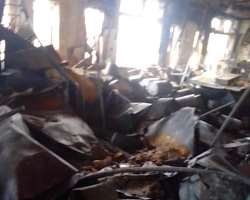
A section of the Ebonyi State Ministry of Health, weekend , was gutted by fire with property worth hundreds of millions of naira destroyed.
The inferno destroyed the cold store housing immunisation and solar units which contained vaccines, vaccine carriers, cold chain boxes, laptops, documents, five refrigerators, two solar refrigerators, 45 solar batteries, inverters, including hospitals beds and foams received from the National Primary Health Care Development Authority (NPHCDA), Abuja, for distribution to local government areas across the state, among others.
The State Commissioner for Health, Dr Moses Ekuma, lamented the disaster and thanked God that no life was lost. He thanked the Commissioner for Power and Energy, the fire service personnel, and the security men who alerted him on time for their prompt response, which made the fire not spread to other parts of the building.
He said, “Different vaccines like BCG, penta, HPV vaccine etc that were all stored in that cold room were burnt”.
Health
Health Workers Protest Against Regulatory Bill
They maintain that all health professions have their regulatory bodies, and that the new bill was seeking to make other health professionals second-class to medical doctors.

Health workers under the Joint Health Sector Unions and the Assembly of Healthcare Professional Associations are protesting against the proposed health sector regulatory bill, which is before the National Assembly.
They said that if allowed to pass, the law would subject every medical profession to the regulation of the Medical and Dental Council of Nigeria.
They maintain that all health professions have their regulatory bodies, and that the new bill was seeking to make other health professionals second-class to medical doctors.
The protesters plan to also go to the National Assembly, where they hope to present their case to lawmakers.
Health
UNIZIK nursing school to review fee hike after students protest
” As for the school fees, yes, there was an increment. We just had a new board and it decided to review the tuition to enable the institution provide the best for the students. They proposed N580,000 to us and we approved it, but there is still room to take another look at it and harmonise things.”

The management of the School of Nursing at the Nnamdi Azikiwe University Teaching Hospital, Nnewi, Anambra State, has pledged to engage the governing board and student leaders to address concerns over the recent increase in tuition fees.
The assurance followed a protest on Tuesday by students of the institution who decried what they described as an astronomical hike in their fees from N90,000 to N580,000.
The PUNCH, reported that the protesting students marched within the school premises carrying placards and chanting solidarity songs, including, “We no go gree, reduce the school fees, we no go gree,” to express their displeasure over the increase.
The fee increment reportedly followed an internal memo issued on January 23 by O.I. Ezejiofor, the Chairman of the Board and Chief Medical Advisory Committee of the NAUTH College of Nursing, announcing an upward review of tuition to facilitate improvements in the institution.
The Chief Medical Director of NAUTH, Prof. Joseph Ugboaja, said that he had been informed about the protest and promised that the management would meet with the relevant stakeholders to resolve the issue.
“I will return to the institution and we will sit with members of the board who proposed the new tuition and also with the students union leadership to sort things out,” Ugboaja said.
“As for the school fees, yes, there was an increment. We just had a new board and it decided to review the tuition to enable the institution provide the best for the students. They proposed N580,000 to us and we approved it, but there is still room to take another look at it and harmonise things.”


El-Rufai Appear in State High Court, after Mother’s death, as Trial Continues

Nigeria Welcomes African Games Bid Evaluation Committee

NELFUND Debunks Claims of ₦25,000 Student Upkeep Allowance

Tech Expert, Zuckerberg trains with UFC champions, Adesanya, Alexander

Organ Trafficking: Ekweremadu bags 10 years in UK prison

SAINT OBI: Between his marriage and his death
-

 Business2 days ago
Governor Otti Commissions Ultimum Manufacturing Plant in Aba
-

 Sports2 days ago
CAF appoints Nigeria’s Samson Adamu as acting secretary general
-

 News1 day ago
President Tinubu at 74, Donates Salaries to Armed Forces Welfare Fund
-

 Politics2 days ago
JUST IN: Kwankwaso Set to Join ADC on Monday
-

 Politics1 day ago
PDP will contest 2027 polls, says Wike
-

 Business1 day ago
OPay launches new office in Jos
-

 Politics1 day ago
PDP Leadership Crisis: Faction Heads to Supreme Court as Tussle Deepens
-

 News1 day ago
Lagos High Court Embraces Full Digital Transformation with Mandatory E-Filing