
News
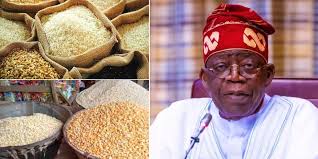
JUST IN: Nigerian govt to suspend tariff, import duty on staple foods, pharmaceuticals, others


The Nigerian government has unveiled a plan to bring down inflation in the country through tariff and import duty suspension for food, raw materials for production, pharmaceuticals, inputs for agriculture production and other fiscal measures.
The Minister of Finance, Wale Edun disclosed this in a recent presentation of the proposed Accelerated Stabilisation and Advancement Plan, ASAP.
Edun stated that the plan, recently presented to President Bola Ahmed Tinubu, was designed to end Nigeria’s economic hardship.
The Nigerian government has unveiled a plan to bring down inflation in the country through tariff and import duty suspension for food, raw materials for production, pharmaceuticals, inputs for agriculture production and other fiscal measures.
The Minister of Finance, Wale Edun disclosed this in a recent presentation of the proposed Accelerated Stabilisation and Advancement Plan, ASAP.
Edun stated that the plan, recently presented to President Bola Ahmed Tinubu, was designed to end Nigeria’s economic hardship.
This comes as Nigeria’s headline and food inflation increased to 33.69 percent and 40.53 percent, respectively.
The inflation portends unbearable hardship for Nigerians as purchasing power continues to shrink upon rising prices while remaining unchanged.
As a solution, Edun explained that the fiscal measures, when implemented, will take Nigeria out of the woods.
He said the order upon implementation will bring about the suspension of import duty and tariff for staple food items, raw materials and other direct inputs used for manufacturing, inputs for agriculture production, including fertilizers, seedlings, chemicals, pharmaceutical products, poultry feeds, flour and grains.
Similarly, it will authorise millers to import paddy rice at zero duty and Value Added Tax for 6 months.
“The import duty and other tariffs on the following items are hereby suspended for six months: staple food items, raw materials and other direct inputs used for manufacturing, inputs for agriculture production including fertilizers, seedlings, chemicals, pharmaceutical products, poultry feeds, flour and grains.
“Value Added Tax, where applicable, is hereby suspended on the following items for the rest of the year 2024: Basic food items and semi-processed, staple food items such as noodles and raw material inputs for the manufacturing
of food items, electricity and public transportation, agricultural inputs and produce, and pharmaceutical products”, the document partly reads.
Relaxation of import duty will calm raging inflation in Nigeria – CPPE
Reacting to the proposal, Muda Yusuf, the Director of the Centre for the Promotion of
Private Enterprise said the relaxation of import duty as contained in the ASAP would calm raging inflation in Nigeria.
Muda noted that the plan will address many of the burning economic issues bothering real sector investors.
He urged Tinubu’s government to expedite action in implementing the plan for the progress of Nigeria’s economy.
“The proposed Accelerated Stabilisation and Advancement Plan is a laudable proposition coming from the Finance Minister. It addresses many of the burning economic issues bothering real sector investors.
“The plan contains robust and comprehensive fiscal policy measures that stakeholders in the real economy had clamored for over the past year. It addresses the concerns of investors on high interest rates, high cost of cargo clearance at the ports, and high import duty regimes.
“The relaxation of import duties on critical raw materials for manufacturers would calm the raging inflationary pressures in the economy, especially food inflation.
“The fiscal measures reflect the responsiveness of the administration to the concerns of investors in the real economy. We urge for expeditious implementation of the plan, once approved by the president,” he said.
Minimum wage negotiation
The government economic proposal, known as ASAP, comes amid the new minimum wage discussion that has taken center stage in Nigeria in recent times.
On Monday, the Organised Labour shut down the Nigerian economy because the government failed to implement a new Minimum wage.
However, the strike was suspended on Tuesday after the workers secured a commitment from the government to pay a minimum wage higher than N60,000.
Meanwhile, the Nigeria Labour Congress and the Trade Union Congress had earlier proposed N494,000 as a new minimum wage.
It was learnt that the Government and the Organised labour has resumed negotiation on the new minimum wage.
Meanwhile, Senator Orji Uzor Kalu at Tuesday’s plenary proposed between N75,000 and 90,000 as the new minimum wage.
Earlier, Paul Alaje, Chief Economist and Partner at SPM said the minimum wage should be at least N100,000.






News
Jega loses wife, Hajiya Hadiza
Hajia Hadiza passed on yesterday and was buried according to Islamic rites.

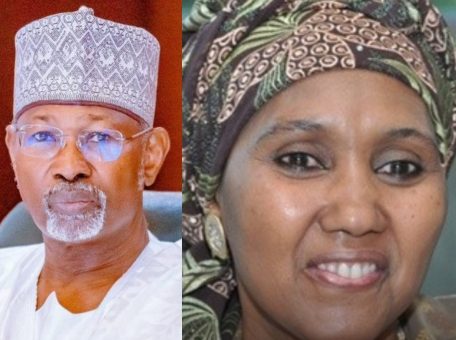
The Special Adviser to the President on Livestock Development, Prof. Attahiru Jega, has lost his wife, Hajiya Hadiza Jega.
Hajia Hadiza passed on yesterday and was buried according to Islamic rites.
Vice President Kashim Shettima, who represented the President at the janazah (Islamic funeral rites) yesterday at the National Mosque in Abuja, conveyed the President’s heartfelt sympathy to the bereaved family.
President Tinubu described the late Hajiya Hadiza as a woman of uncommon grace and strength, noting that she played a pivotal role as a steady support system to her husband throughout his years of public service, including his tenure as chairman of the Independent National Electoral Commission.
A statement in Abuja by his Special Adviser on Information and Strategy, Bayo Onanuga, said that the President also applauded her contributions to education and community development, highlighting her quiet but impactful influence in advancing social causes.
News
Atiku hires US lobbying firm for $1.2m to boost image – Report
One of the objectives of the engagement is to “counterbalance” the Nigerian government’s “lobbying narratives” in the United States, while also working to “advance understanding” of Atiku’s “leadership posture and policy vision” among policymakers.

Ex-Vice-President Atiku Abubakar has hired a Washington-based lobbying firm, Von Batten-Montague-York, L.C., to strengthen his reputational standing in the United States.
The PUNCH reported that the details of the deal are contained in documents filed with the U.S. Department of Justice, which show that the agreement was signed on March 9 and 10, 2026, by the firm’s managing partner, Karl Von Batten, and Nigerian politician Fabiyi Oladimeji on behalf of the former vice president.
According to the filing sighted on the Department of Justice ’s website on Sunday, the contract is aimed at shaping perceptions of Atiku within U.S. policy circles and countering narratives linked to the Nigerian government.
One of the objectives of the engagement is to “counterbalance” the Nigerian government’s “lobbying narratives” in the United States, while also working to “advance understanding” of Atiku’s “leadership posture and policy vision” among policymakers.
Under the arrangement, the firm is expected to facilitate meetings between the former vice-president and U.S. government officials, including members of Congress, as well as provide advisory services on policy positioning and engagement strategy.
“These activities include lobbying and government affairs engagement with Members of Congress, congressional staff, and executive branch officials concerning issues related to democratic governance, regional stability, economic development, and U.S. engagement with Nigeria and the broader West African region,” part of the contract reads.
The firm will also undertake “promotion, perception management, and public relations activities designed to enhance understanding among U.S. policymakers and relevant stakeholders” of Atiku’s positions.
News
Kaduna Mando Garage Explosion Not Bomb- Police
The command’s Public Relations Officer, DSP Mansir Hassan, said in a statement that the incident occurred at about 3:00a.m. on Sunday at the premises of Silver Luxury Travel, a bus company operating at Mando Garage, Kaduna.

The Kaduna State Police Command has confirmed that an explosion at the Lagos Garage Terminus in Mando area of Kaduna State today wasn’t a bomb explosion, but a CNG-powered luxury bus that ruptured after its gas tank was overfilled.
The incident occurred during the early hours of Sunday with the loud blast drawing attention from commuters, traders, and nearby residents, prompting a swift response from emergency services.
The command’s Public Relations Officer, DSP Mansir Hassan, said in a statement that the incident occurred at about 3:00a.m. on Sunday at the premises of Silver Luxury Travel, a bus company operating at Mando Garage, Kaduna.
He said detectives were immediately deployed to the scene after a loud sound was reported, and that the vehicle has been safely evacuated, while normal business activities have since resumed at the motor park.
He noted that no casualties or loss of property were recorded, and normal activities had since resumed in the area.


Seven Eritrean players fail to return home after AFCON qualifier

CAF confirms 16 teams for U-17 AFCON 2026

Trump orders Iran to open Strait of Hormuz by Tuesday or face ‘hell’

Tech Expert, Zuckerberg trains with UFC champions, Adesanya, Alexander

Organ Trafficking: Ekweremadu bags 10 years in UK prison

SAINT OBI: Between his marriage and his death
-

 Crime2 days ago
Three Killed, One Injured in Fresh Jos Attack (Video)
-

 Politics3 days ago
Onyejeocha resigns as Minister of State for Labour
-
 Politics3 days ago
No force can defeat Tinubu in 2027 –Umahi
-

 News2 days ago
Nigerian Army Debunks Claims of Attack on Bishop Matthew Kukah’s Residence and Sokoto Catholic Cathedral
-

 News1 day ago
Kaduna Mando Garage Explosion Not Bomb- Police
-
 Politics3 days ago
Labour Party to hold presidential primary April 28
-

 News2 days ago
JUST IN: Lagos Fire Service Successfully Contains Two Overnight Fire Incidents iin Lagos
-
 News1 day ago
Atiku hires US lobbying firm for $1.2m to boost image – Report