
News
Emefiele loses bid to stop $4.5bn, N2.8bn fraud trial

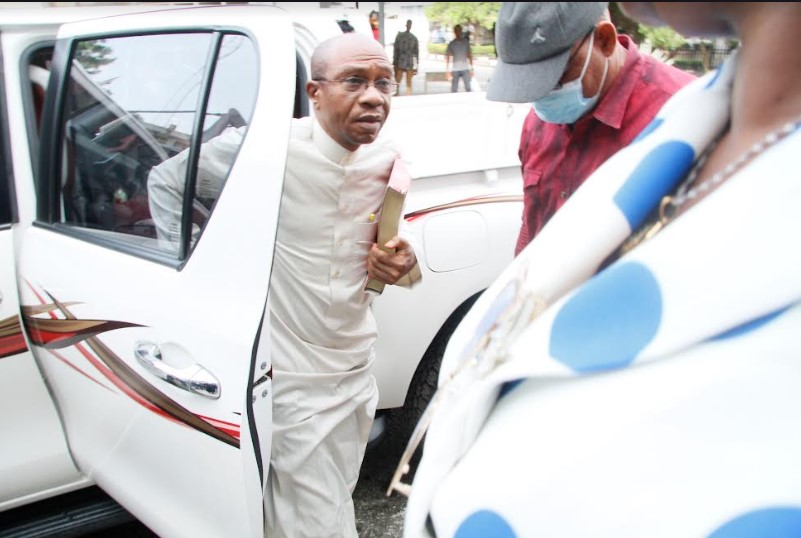
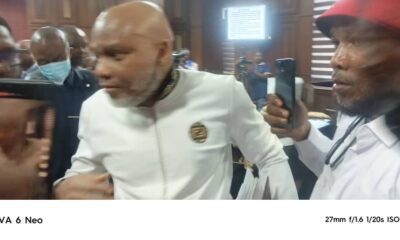
Former governor of the Central Bank of Nigeria, Godwin Emefiele has lost the chance to stop the $4.5bn, N2.8bn fraud trial after the Lagos State Special Offences Court, on Wednesday, dismissed an application filed by the former governor, challenging the court’s jurisdiction to entertain the fraud charges brought against him by the Economic and Financial Crimes Commission.
Justice Rahman Oshodi, in his ruling, held that the court had the jurisdiction to try Emefiele and his co-defendant, Henry Omoile.
The judge, however, struck out four of the 26 counts filed by the EFCC against the defendants for lack of jurisdiction.
Justice Oshodi explained: “Allocation of foreign exchange without reason is not defined as an offence under any written law. The objection to counts one to four succeeds and is hereby struck out.
“The objection challenging the court’s territorial jurisdiction over counts eight to 26 fails and is hereby dismissed.
“The prosecution has established sufficient territorial nexus in this case.
”The judge subsequently adjourned the case for trial continuation on February 24, 2025.
The EFCC had arraigned Emefiele on 26 charges, bordering on abuse of office and illegal allocation of $4.5bn and N2.8bn.
At the last adjourned date on December 12, 2024, Emefiele’s counsel, Mr. Olalekan Ojo (SAN), argued that the court lacked jurisdiction to hear the case in Lagos.Ojo contended that the alleged offences, including abuse of office, fell outside the territorial reach of the Lagos Special Offences Court.
He also argued that the charges violated Section 36(12) of the Nigerian constitution, asserting that the alleged offences were not legally recognised under Nigerian law.
Furthermore, Ojo emphasised that since the Lagos State House of Assembly does not have legislative authority over matters on the Exclusive Legislative List, Section 73 of the Criminal Law of Lagos State (2011), under which counts one to four were filed, cannot apply extraterritorially to the alleged abuse of office by Emefiele.
Ojo added that a court’s territorial jurisdiction is limited to the geographical area within which its authority can be exercised and urged the court to strike out counts one to four of the amended charges filed by the EFCC on April 4, 2024.
In response, EFCC counsel, Mr. Rotimi Oyedepo (SAN), argued that the court had the authority to hear the case.
Oyedepo contended that the alleged crimes were economic and financial in nature, falling within the EFCC’s jurisdiction.
He also maintained that substantial evidence supported Lagos as the appropriate venue for the trial.
According to Oyedepo, the subject matter of the charges clearly fell within the court’s jurisdiction since the offences were committed within its territorial reach.
He noted that evidence and witness testimonies pointed to Lagos as the proper location for the trial and argued that the objections raised by Emefiele’s legal team lacked factual or evidential support.
Following the arguments, Justice Oshodi initially adjourned the case to January 7, 2025, for a ruling on the application challenging the court’s jurisdiction.
However, the ruling was not ready on that date, prompting an adjournment to Wednesday, January 8, 2025.
The case has now been adjourned to February 24 and 26, 2025, for the continuation of trial.








News
NUPENG Braces Up for Leaderships Change
Former National Chair of PTD-NUPENG and National Trustees of the union, Salimon Oladiti will be elected as president of NUPENG in Lagos.


The Nigeria Union of Petroleum and Natural Gas Workers (NUPENG) will, on April 24, elect a new president.
Incumbent President, Williams Akporeha, announced his exit date at the weekend during the Quarterly National Executive Council meeting of Petroleum Tanker Drivers Branch, PTD-NUPENG in Warri, Delta State.
Former National Chair of PTD-NUPENG and National Trustees of the union, Salimon Oladiti will be elected as president of NUPENG in Lagos.
The election of Oladiti will mark the first time in NUPENG a member of the PTD branch will be president.
During the meeting, Zonal Chair of PTD-NUPENG in Port Harcourt, Joseph Okafor, moved the motion for unanimous ratification of Oladiti for president, seconded by Adekunle Akinlaja of Lagos zone.
News
FG Unmasks 60 Persons and Corporates Behind Terrorism Financing, Order Banks To Freeze Their Accounts
The updated sanctions list is part of a crackdown on financial networks supporting extremist groups, particularly following investigations into Bureau De Change (BDC) operators and other entities.
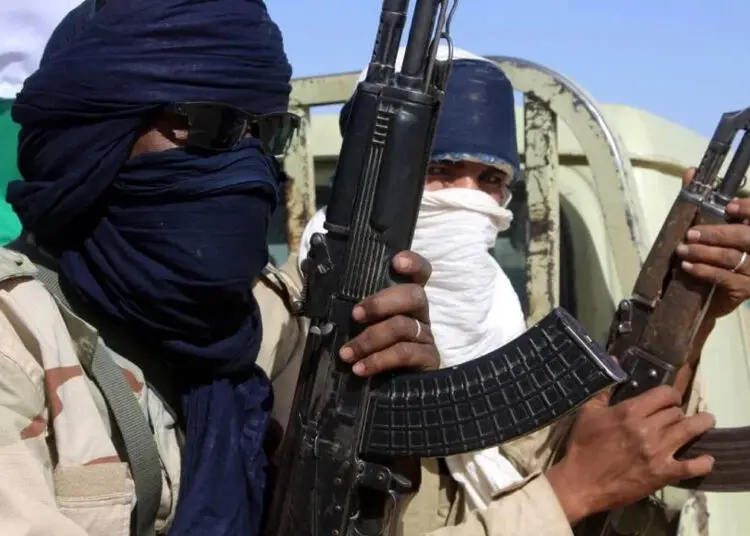
The Federal Government on Saturday released a list of 48 individuals and 12 corporate entities allegedly linked to terrorism financing in Nigeria, as part of ongoing efforts to curb the funding of extremist activities.
The Federal Government also directed financial institutions to freeze all accounts and assets associated with these individuals and firms.
The list, published on the website of the Nigeria Sanctions Committee (NIGSAC), disclosed the nationalities of those named, their specific roles, and the terrorist groups they were allegedly connected to.
The Nigeria Sanctions Committee (NIGSAC) operates under the authority of the Office of the National Security Adviser (ONSA), which coordinates its activities within the national security framework.
Its core mandates include the implementation of United Nations sanctions—particularly those targeting terrorism financing—ensuring compliance with international obligations, and facilitating coordination among agencies such as financial intelligence, defense, and foreign affairs.
Those named in the latest released include Abdulsamat Ohida, Mohammed Sani, Abdurrahman Abdurrahman, Fatima Ishaq, Tukur Mamu, Yusuf Ghazali, Muhammad Sani, Abubakar Muhammad, Sallamudeen Hassan, Adamu Ishak, Hassana Isah, Abdulkarim Musa, Umar Abdullahi, Abdurrahman Ado, Bashir Yusuf, Ibrahim Alhassan, Muhammad Isah, Salihu Adamu, Surajo
Mohammad, Fannami Bukar, Muhammed Musa, Sahabi Ismail, Mohammed Buba, Jama’atu Wal-Jihad, Ansarul Sudan (ANSARU), Islamic State West Africa Province (ISWAP), Indigenous People of Biafra (IPOB), Yan Group, Yan Group NLBDG, Adamu Hassan, Hassan Mohammed, Usman Abubakar, Kubara Salawu, Rabiu Suleiman, Simon Njoku, Godstime Iyare, Francis Mmadubuchi, John Onwumere, Chikwuka Eze, Edwin Chukwuedo, Chiwendu Owoh, Ginika Orji, Awo Uchechukwu, Mercy Ali, Ohagwu Juliana, Eze Okpoto, Nwaobi Chimezie, and Ogumu Kewe.
The entities listed include West and East Africa General Trading Co. Ltd, Settings Bureau De Change Ltd, G. Side General Enterprises, Desert Exchange Ventures Limited, Eagle Square General Trading Co. Ltd, Alfa Exchange BDC, Alin Yar Yaya General Enterprises, K. Are Nigeria Limited, Suhailah Bashir General Enterprises, Igwe Ka Ala Enterprises, Seficuvi Global Company, and Lakurawa Sect.
News
Breaking: INEC postpones voter revalidation exercise till after 2027 elections
The decision was announced in a statement issued and signed by Mohammed Haruna, the commission’s national commissioner and chairman of its information and voter education committee.
The Independent National Electoral Commission (INEC) on Friday postponed its planned nationwide voter revalidation exercise until after the 2027 general elections.
The decision was announced in a statement issued and signed by Mohammed Haruna, the commission’s national commissioner and chairman of its information and voter education committee.
Haruna said that the postponement followed deliberations at a meeting between the commission and resident electoral commissioners (RECs).
“Following deliberations, the commission resolved to postpone the exercise until after the 2027 General Election,” the statement read.
(VANGUARD)


Hayatu-Deen joins ADC Party

NUPENG Braces Up for Leaderships Change

Tuface, Laolu Gbenjo, others set to electrify Vanguard Personality of the Year Award

Tech Expert, Zuckerberg trains with UFC champions, Adesanya, Alexander

Organ Trafficking: Ekweremadu bags 10 years in UK prison

SAINT OBI: Between his marriage and his death
-

 News3 days ago
CBN Debunks Viral Fake News of ₦5,000 Banknote Featuring President Tinubu’s Image
-
 Politics3 days ago
2027: Bode George warns INEC, Judiciary Drifting Nigeria Towards ” One Party Rule”
-
 Business3 days ago
DR Congo Central Bank Announces Ban on Foreign Currency Cash Transactions from 2027
-
 Politics3 days ago
NBA Cautions Lawyers Against Involvement in Political Party Disputes
-

 Business2 days ago
Supreme Court Overturns Appellate’s Ruling on $2bn Debt Recovery Battles Nestoil /Neconde Energy vs FBNQuest Merchant Bank
-
 News2 days ago
Plateau Community Laments ‘ No Security To Repel Attackers’
-

 Crime2 days ago
Ex-senatorial candidate jailed 10 yrs for selling petrol to Boko Haram
-
 News2 days ago
Breaking: INEC postpones voter revalidation exercise till after 2027 elections