
News
Edo REC Denies Complicity In BVAS Allegation, Invites PDP For Inspection

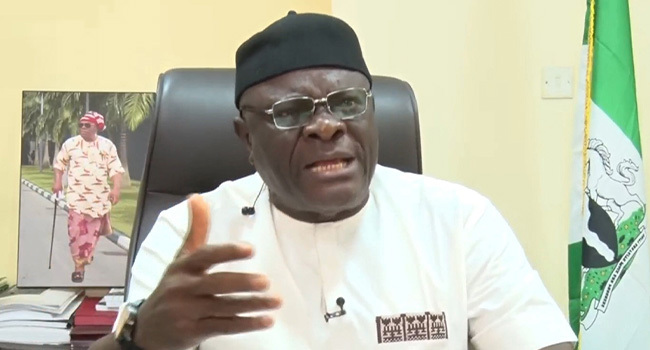
The Edo State Independent National Electoral Commission’s Resident Electoral Commissioner (INEC REC) Anubgum Onuoha, has denied complicity in the allegation against him by the Peoples Democratic Party (PDP), that he resisted request to gain access to the Bimodal Voter Accreditation System (BVAS) inspection before the just-concluded gubernatorial elections in the state.
A statement issued by Onuoha on Tuesday described the PDP allegation as “baseless, misleading and devoid of the truth”.
Onuoha said he never denied any political party, agents or representatives access to the BVAS ahead of the contestation in courts to inspect the BVAS.
He acknowledged that it is the duty of INEC to grant such access anytime the political parties ask for it.
The PDP had accused the INEC in Edo State of refusing to to grant the party and its candidate, Asue Ighodalo, access to the BVAS machines and other materials used in the September 21, 2024, Edo State governorship election against the order of court.
The allegation was made by the National Publicity Secretary, PDP, Debo Ologunagba.
“Our Party also alerts the public of how compromised INEC officials used the ploy of waiting for “directives from above” to allegedly allow thugs recruited by the All Progressives Congress (APC) and some unscrupulous police operatives to invade the INEC office in Edo State so as to cause confusion and frustrate the PDP from accessing these sensitive materials.”
“INEC’s refusal to release the materials is in brazen affront of the Order of the Edo State Governorship Election Petition Tribunal Holden at Benin City, dated 29th day of September, 2024 which ordered the Commission to grant our Party and candidate “unfettered access to and open up for inspection all electoral documents or any document in the custody of the National Chief Electoral Commissioner or any officer of the Commission/1st Respondent, particularly the Voter Registers, Ballot papers, the BVAS machines, Forms EC25B, EC25B(i) Forms EC40A and Forms EC40C which were utilized for the conduct of the Edo State Governorship election held on the 21st September 2024”.
In response, however, Onuaha said political parties interested in challenging the results of the election are free to do so, as the move has already been addressed by the law.
He also invited all political parties, including the PDP to inspect the BVAS on Wednesday.
He said; “The attention of the Independent National Electoral Commission (INEC) and my office as the Resident Electoral Commission (REC) for Edo State has been drawn to certain unfounded allegations suggesting that I have refused political parties and their representatives access to inspect the Biomodal Voter Accreditation System (BVAS) devices and other election materials used during the recent elections.
“I used to categorically state that these allegations are baseless, misleading and completely devoid of truth. INEC under my leadership in Edo State, remains committed to upholding the highest standards of transparency, fairness and integrity in all electoral processes.
The inspection of election materials“The attention of the Independent National Electoral Commission (INEC) and my office as the Resident Electoral Commissioner (REC) for Edo State has been drawn to certain unfounded allegations suggesting that I have refused political parties and their representatives access to inspect the Bimodal Voter Accreditation System (BVAS) devices and other election materials used during the recent elections.
“I wish to categorically state that these allegations are baseless, misleading, and completely devoid of truth. INEC, under my leadership in Edo State, remains committed to upholding the highest standards of transparency, fairness, and integrity in all electoral processes.
The inspection of election materials is a fundamental right of all parties involved in election petitions, and it is a process that we are mandated by law to facilitate.
“At no time have I or any official in my office obstructed or denied any political party or their representatives access to inspect the materials used in the last elections.
INEC is fully aware of the legal implications of such actions, and we are dedicated to supporting the lawful processes that enable parties to seek redress in the courts.
“In furtherance of this commitment, I wish to inform the public that the inspection of the election materials, including the BVAS devices, has been formally scheduled to take place tomorrow, October 9, 2024, at 10:00 AM at the INEC Headquarters in Edo State.
All political parties and their representatives are invited to participate in this exercise, as per the legal procedures, to ensure transparency and adherence to the rule of law.
“Any political party or candidate seeking to inspect these materials has been and will continue to be granted access, provided they follow the proper procedures as outlined by the Election Tribunal and relevant legal frameworks.
“It is, therefore, unfortunate that these baseless accusations have been circulated without any evidence or proper engagement with my office.
“I urge all stakeholders and the general public to disregard such misinformation. As a Commission, our loyalty remains to the Nigerian people, the Constitution, and the rule of law.
“INEC, as an institution, stands for transparency, and we are fully committed to ensuring that the electoral process is free, fair, and accountable.
“Any party wishing to engage with my office regarding the inspection of materials is encouraged to do so through the appropriate legal channels, and I assure them of our full cooperation.”





News
Nigerian Army Debunks Claims of Attack on Bishop Matthew Kukah’s Residence and Sokoto Catholic Cathedral
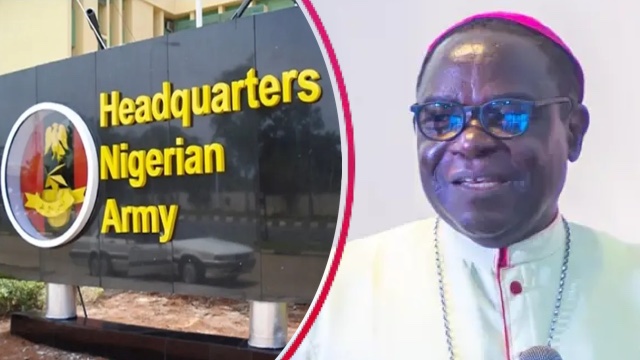
The Nigerian Army has categorically dismissed as false and misleading a viral social media post alleging an armed attack on the residence of Bishop Matthew Kukah, the Catholic Bishop of the Sokoto Diocese, and the Sokoto Catholic Cathedral.
In an official statement issued on Saturday by the 8 Division Nigerian Army and Sector 2 of Operation FANSAN YAMMA, the military said no such incident occurred in Sokoto State. The claim, which circulated on Facebook, was described as unfounded and fabricated.
“The safety and security of Bishop Matthew Kukah and the Sokoto Catholic Cathedral remain intact,” the statement read. It added that the Bishop is currently carrying out his Easter duties without any disruption.
The Army noted that it had taken note of the misleading report and, in collaboration with other security agencies, confirmed there was no attack anywhere in the state.
The Division reaffirmed its commitment to the safety of all residents in Sokoto State and its area of responsibility. “Robust security measures are in place to guarantee a peaceful and secure Easter celebration,” it said.
The statement was signed by Lieutenant Colonel Olaniyi Osoba, Acting Deputy Director, Army Public Relations, 8 Division Nigerian Army / Sector 2 Operation FANSAN YAMMA.
Similar clarifications have also been issued by the Catholic Diocese of Sokoto, which described circulating videos and reports as attempts to cause panic and destabilise peace in the area. Both the Bishop’s residence, the Cathedral, and related facilities remain safe and operational.
Authorities urged the public to disregard the false information and rely on verified sources during the Easter period.
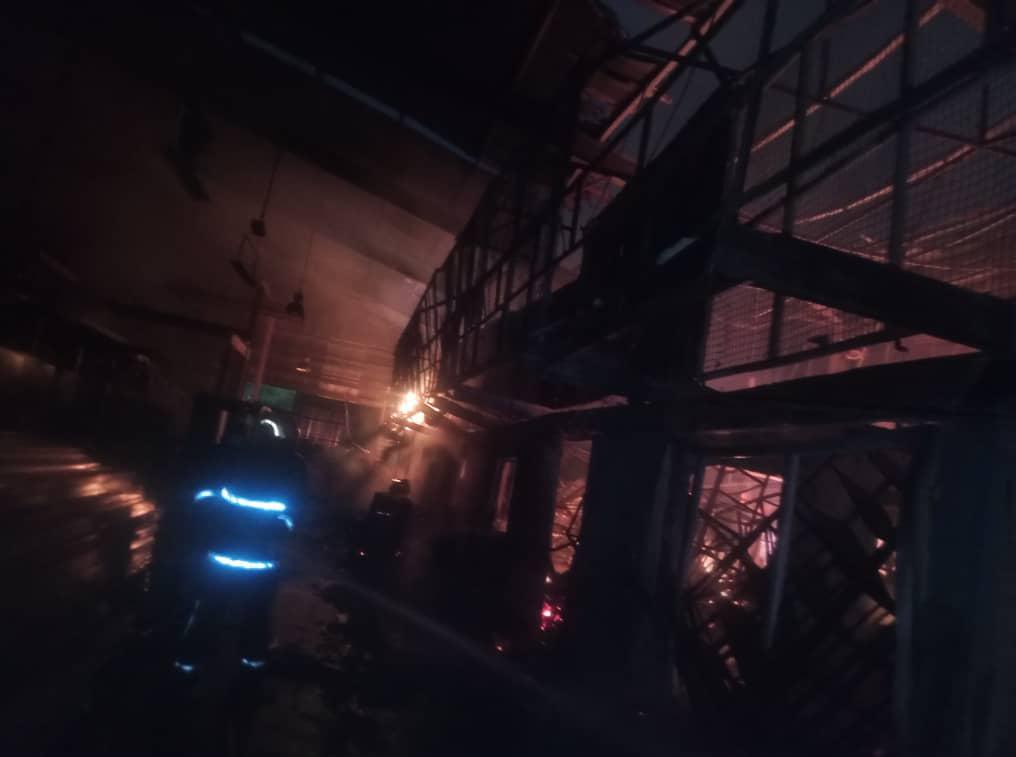
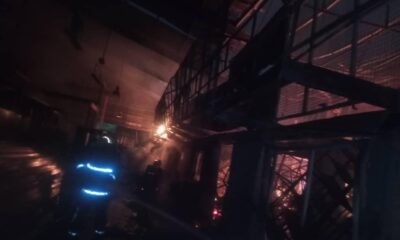
The Lagos State Fire and Rescue Service has confirmed the successful containment of two separate fire incidents that occurred overnight in different parts of the state.
The first incident was reported at 22:46 hours on Saturday at Tower Aluminum Village, along Abeokuta Expressway, Dopemu, Agege.
Fire crews from Ikeja and Agege stations responded promptly to the emergency, effectively dousing the fire which affected multiple offices and stores of varying sizes.
The structures, situated on a land area of approximately 2,592 square meters within a premises spanning about four acres, suffered significant damage to affected sections and their contents.
The second incident occurred in the early hours of Sunday at about 03:15 hours at a three-storey commercial building located on Oyabiyi Street, opposite the NLC Office, Tejuosho, Yaba. The building, which housed shops and stores containing stacked textile materials, was engulfed by fire.
Firefighters from Somolu, Ilupeju, and Sari Iganmu Fire Stations were swiftly mobilized to the scene and successfully contained the blaze, preventing further spread to adjoining properties.
In both incidents, the Lagos State Fire and Rescue Service demonstrated professionalism and rapid response, ensuring that the fires were brought under control without escalation and casualty.
The Controller General of Lagos state fire and rescue reiterates the importance of fire safety precautions and urges members of the public to remain vigilant, especially in commercial areas where flammable materials are stored.
Further investigations into the causes of the fires are ongoing to unravel their causes.
News
Police must pay transport fares, says AIG
” No police officer has the right to enter your vehicle without paying. We should assist one another willingly, not by force,” he said.

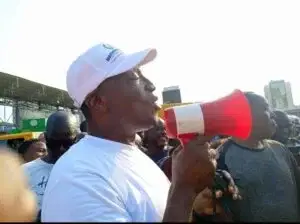
• The Assistant Inspector-General of Police(AIG) in charge of Zone 2 Command, Mr Olohundare Jimoh, speaking with transporters at Obalende garage, Lagos State, on Wednesday.
The Assistant Inspector-General of Police, Zone 2 Command, Mr Olohundare Jimoh, has declared that officers must pay fares before boarding commercial vehicles, warning against abuse of authority.
Jimoh spoke on Wednesday at Obalende garage during a sensitisation meeting with drivers and transport workers marking National Police Day 2026.
He stressed that relations between police and the public must be based on partnership, not coercion, urging both sides to support each other voluntarily.
“No police officer has the right to enter your vehicle without paying. We should assist one another willingly, not by force,” he said.
Jimoh called for stronger cooperation to maintain safety and order on roads, insisting there was no conflict between officers and transport unions.
“I don’t collect money from officers. We don’t arrest people arbitrarily. If you have issues with any officer, report directly to me,” he said.
(Vanguard)


Nigerian Army Debunks Claims of Attack on Bishop Matthew Kukah’s Residence and Sokoto Catholic Cathedral

JUST IN: Lagos Fire Service Successfully Contains Two Overnight Fire Incidents iin Lagos

Three Killed, One Injured in Fresh Jos Attack (Video)

Tech Expert, Zuckerberg trains with UFC champions, Adesanya, Alexander

Organ Trafficking: Ekweremadu bags 10 years in UK prison

SAINT OBI: Between his marriage and his death
-

 Health3 days ago
From South Africa to US, ‘Cicada’ COVID-19 variant spreading
-
 Crime2 days ago
Ebonyi: Gunmen Assasinate Another Traditional Ruler
-
 Politics2 days ago
INEC Dismisses Calls for Chairman’s Removal
-
 Crime15 hours ago
Three Killed, One Injured in Fresh Jos Attack (Video)
-

 Politics22 hours ago
Onyejeocha resigns as Minister of State for Labour
-
 Politics23 hours ago
Labour Party to hold presidential primary April 28
-
 Politics23 hours ago
No force can defeat Tinubu in 2027 –Umahi
-
 News12 hours ago
JUST IN: Lagos Fire Service Successfully Contains Two Overnight Fire Incidents iin Lagos