
News
PDP Slams Tinubu’s Ambassadorial List as ‘Scandalous,’ Demands Withdrawal


The Peoples Democratic Party (PDP) has strongly condemned President Bola Tinubu’s recently submitted list of ambassadorial nominees, describing it as “scandalous” and a direct reflection of the administration’s values.
In a press release signed by National Publicity Secretary Comrade Ini Ememobong, the PDP criticized the inclusion of “disgraced propagandists, characterless politicians, and public officials” with “integrity deficits” and histories of “anti-democratic activities.”
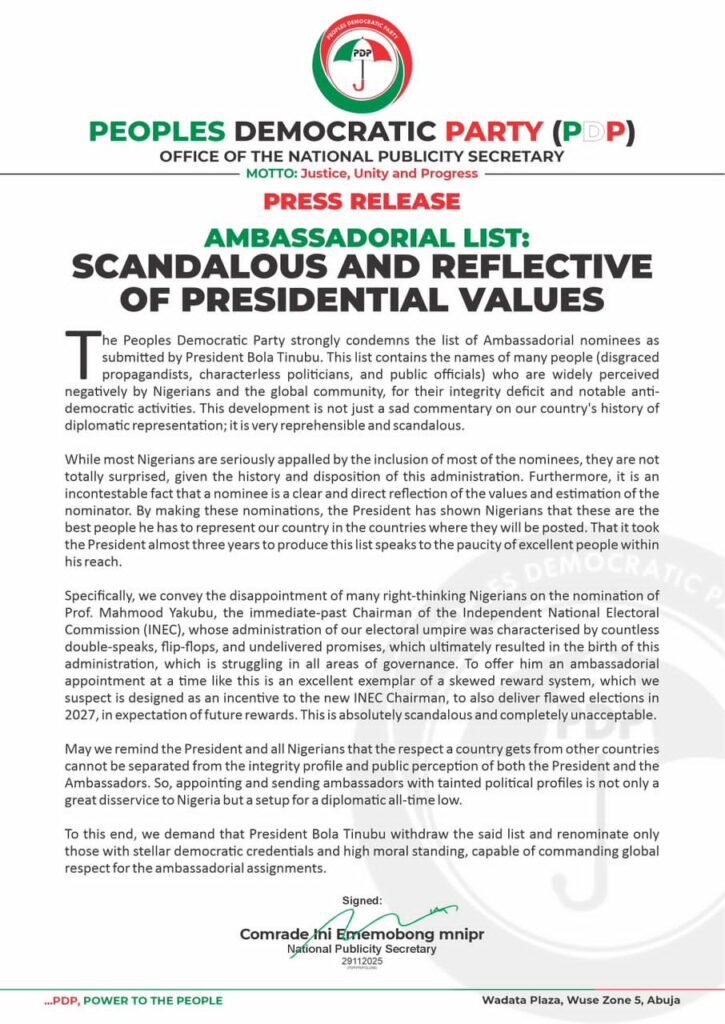
The party called the nominations a “sad commentary” on Nigeria’s diplomatic representation, arguing they undermine the country’s global standing.
The PDP expressed particular outrage over the nomination of Prof. Mahmood Yakubu, the immediate-past Chairman of the Independent National Electoral Commission (INEC).
The party accused Yakubu’s tenure of being marred by “double-speaks, flip-flops, and undelivered promises,” which they claim facilitated the current administration’s rise. Offering him an ambassadorial post now, the PDP alleged, is a “skewed reward system” intended to incentivize the new INEC Chairman to deliver “flawed elections” in 2027.
“A nominee is a clear and direct reflection of the values and estimation of the nominator,” the statement read, asserting that the list—submitted nearly three years into Tinubu’s term—reveals a “paucity of excellent people” within the President’s circle.
The opposition party warned that appointing ambassadors with “tainted political profiles” would lead to a “diplomatic all-time low,” as a nation’s international respect hinges on the integrity of its representatives.
The PDP demanded that President Tinubu immediately withdraw the list and renominate candidates with “stellar democratic credentials and high moral standing” capable of commanding global respect.
The controversy erupts as the National Assembly prepares to screen the 32 additional nominees announced earlier this week, intensifying political tensions ahead of the 2027 elections. The Presidency has yet to respond to the PDP’s allegations.








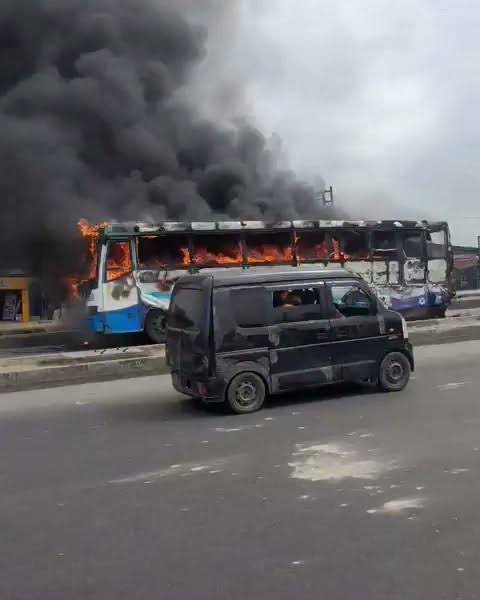
An angry mob has set a Bus Rapid Transit (BRT) bus on fire after it reportedly crushed a commercial motorcyclist to death at Ogolonto Bus Stop along Ikorodu Road in Lagos State.
The incident occurred on Friday, October 16, 2026. Eyewitness accounts and social media reports indicate that the motorcyclist was riding alone along the restricted BRT lane when the collision happened. He died at the scene.
Enraged residents and youths then attacked the bus driver and set the vehicle ablaze. Police officers and officials of the Lagos Neighbourhood Safety Corps (LNSC), who were nearby, intervened promptly and rescued the driver unharmed.
The identity of the deceased motorcyclist and the exact circumstances of the crash had not been officially confirmed at the time of filing this report. It was also unclear whether any arrests had been made in connection with the burning of the bus.
News
ARISE News Wins Seven Honours At Nigerian Broadcasters Merit Awards
The awards recognised the network’s achievements in television journalism and programming, with ARISE News winning the Best TV Channel (Viewer’s Choice) category.


• ARISE News Anchor and host of What’s Trending Ojy Okpe was named Best Newscaster (TV – Female)
ARISE News has emerged as one of the major winners at the just ended Nigerian Broadcasters Merit Awards (NBMA).
ARISE News won seven honours across television broadcasting, news reporting, presentation and production during the ceremony.
The awards recognised the network’s achievements in television journalism and programming, with ARISE News winning the Best TV Channel (Viewer’s Choice) category.
The network’s flagship breakfast programme, The Morning Show, also won the Best TV Talk Show award, further strengthening its recognition in television broadcasting.
ARISE News Anchor and host of What’s Trending Ojy Okpe was named Best Newscaster (TV – Female).
Rufai Oseni was named Nigerian Broadcaster of the Year (Male), while Vimbai Mutinhiri-Ekpeyong received the Nigerian Broadcaster of the Year (Female) award.
The recognition extended to the network’s newsroom, with Ovieteme George winning Best TV News Reporter (Male) for his contributions to television news reporting.
Behind the camera, Sam Adeyemi received the Best Camera Operator/Cinematographer award, recognising his work in television production and visual storytelling.
News
Meta removes 3.7 million accounts in West Africa scam crackdown
The joint operation led to 28 arrests, identified more than 30 suspected scam centres and rescued 117 people allegedly trafficked and forced to work in scam compounds in Ghana.

Meta, the parent company of Facebook and Instagram, has removed more than 3.7 million Facebook and Instagram accounts, pages and groups linked to suspected scam networks operating in West Africa.
The joint operation led to 28 arrests, identified more than 30 suspected scam centres and rescued 117 people allegedly trafficked and forced to work in scam compounds in Ghana.
The company announced the crackdown in a statement on Tuesday, October 13, 2026. It involved 14 technology companies and law enforcement agencies from 10 countries.
The United Kingdom’s National Crime Agency coordinated the operation with the US Department of Justice, the Federal Bureau of Investigation and other agencies. Nigerian authorities were involved.
Other countries included Ghana, Australia, Canada, New Zealand and India.Tech companies that took part included Google, Microsoft, OpenAI, Coinbase, Starlink and Adobe.
Meta said the partnership let participants share intelligence across digital platforms, countries and financial systems to identify criminal networks.


JUST IN: Mob Sets BRT Bus Ablaze After Motorcyclist’s Death in Lagos

BREAKING: DSS Arrests Fugitive Maina Son, Hands Him to EFCC

BREAKING: 5 Arrested Over Imo NYSC Abduction

BREAKING: Lagos Govt Declares Today, Thursday Work-Free to Mark 2026 Ìṣẹ̀ṣe Day

Tech Expert, Zuckerberg trains with UFC champions, Adesanya, Alexander

Organ Trafficking: Ekweremadu bags 10 years in UK prison
-

 Business3 days ago
Naira Exchange Rates Friday, October 16
-
 Crime2 days ago
BREAKING: 5 Arrested Over Imo NYSC Abduction
-

 News3 days ago
Meta removes 3.7 million accounts in West Africa scam crackdown
-

 News3 days ago
ARISE News Wins Seven Honours At Nigerian Broadcasters Merit Awards
-
 Crime2 days ago
BREAKING: DSS Arrests Fugitive Maina Son, Hands Him to EFCC
-
 News2 days ago
JUST IN: Mob Sets BRT Bus Ablaze After Motorcyclist’s Death in Lagos