
International
BREAKING: Trump Expands Travel Restrictions, Adding Partial Limits on Nigeria and 14 Other Countries


President Donald J. Trump on Tuesday signed a new presidential proclamation expanding U.S. entry restrictions on foreign nationals from multiple countries, citing persistent deficiencies in screening, vetting, and information-sharing that pose risks to national security and public safety.
The move builds on an earlier proclamation from June 2025 (Proclamation 10949), which imposed full restrictions on 12 high-risk countries: Afghanistan, Burma, Chad, Republic of the Congo, Equatorial Guinea, Eritrea, Haiti, Iran, Libya, Somalia, Sudan, and Yemen.
The updated proclamation maintains those full bans while adding:-
**Full restrictions** on five additional countries: Burkina Faso, Mali, Niger, South Sudan, and Syria.-
**Full restrictions** on individuals holding Palestinian Authority-issued travel documents.- Upgrades to
**full restrictions** for Laos and Sierra Leone, previously under partial limits.Partial restrictions—primarily affecting immigrant visas, business/tourist (B-1/B-2), and student/exchange (F, M, J) visas—now apply to 15 new countries, including:
– Angola
– Antigua and Barbuda
– Benin
– Côte d’Ivoire
– Dominica- Gabon
– The Gambia
– Malawi- Mauritania
– Nigeria
– Senegal
– Tanzania
– Tonga
– Zambia
– ZimbabwePartial restrictions remain in place for Burundi, Cuba, Togo, and Venezuela.
In a White House fact sheet, the administration described the action as “strengthening national security through common sense restrictions based on data.”
It emphasized challenges such as widespread corruption, unreliable civil documents, nonexistent birth-registration systems, refusal to share law-enforcement data, high visa overstay rates, and the presence of terrorist or extremist activity in affected countries.
President Trump was quoted in the fact sheet:
“It is the President’s duty to take action to ensure that those seeking to enter our country will not harm the American people.
”The proclamation includes exceptions for lawful permanent residents, existing visa holders, certain categories (e.g., athletes and diplomats), and cases where entry serves U.S. national interests.
Family-based immigrant visa exemptions with high fraud risks have been narrowed, though case-by-case waivers are still available.
The White House framed the policy as fulfilling Trump’s campaign promises to restore and expand travel restrictions, referencing a prior Supreme Court ruling that upheld similar measures as within presidential authority and premised on legitimate purposes—preventing entry of inadequately vetted individuals and encouraging foreign governments to improve cooperation.
Notably, Turkmenistan saw partial relief: nonimmigrant visa restrictions were lifted due to improved cooperation, though immigrant entry suspensions remain.
Nigeria’s inclusion follows Trump’s earlier designation of the country as a “Country of Particular Concern” in October 2025 over allegations of severe religious freedom violations and persecution of Christians, though Nigerian officials have disputed characterizations of the violence as targeted genocide.
The new restrictions are tailored to encourage cooperation from affected nations, with ongoing assessments based on Executive Order 14161 issued in January 2025.

Reaffirming Nigeria-France Ties
French President Emmanuel Macron received Nigerian President Bola Ahmed Tinubu for a private dinner at the Élysée Palace in Paris on Thursday night, in a high-level engagement underscoring the enduring bilateral relationship between the two countries.

The dinner, held on September 17, 2026, was disclosed on Friday by Bayo Onanuga, Special Adviser to the President on Information and Strategy. In a post on X, Onanuga stated that the meeting reflected “the enduring relationship between Nigeria and France and their shared commitment to strengthening bilateral cooperation.” Photographs released from the evening showed Tinubu with Macron and France’s First Lady, Brigitte Macron, in a cordial setting at the presidential palace.

President Tinubu is currently in Europe on a three-week annual leave. He departed Abuja on August 30, 2026, first spending time in London before proceeding to Paris. The private dinner took place during the Paris leg of his vacation and marks another personal interaction between the two leaders.
In related comments, Tinubu described the evening as a pleasure and said the conversation reaffirmed the strong friendship between Nigeria and France as well as their shared commitment to deepening cooperation and building a mutually beneficial partnership. He thanked Macron for his warm hospitality and friendship.

Nigeria and France have maintained active diplomatic and economic engagement in recent years, covering areas such as trade, investment, energy, security cooperation, infrastructure, and critical minerals. The private dinner continues a pattern of direct leader-level contacts that both sides have used to advance practical cooperation beyond formal state visits.
No detailed official readout of specific discussion topics or new agreements was immediately released by either the Élysée Palace or the Nigerian presidency. Such informal encounters have previously helped lay groundwork for subsequent formal engagements between Abuja and Paris.
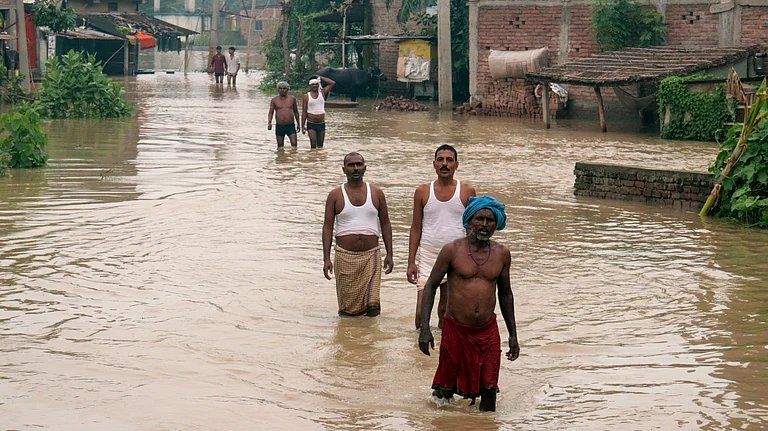
Nearly five million people have been affected by severe flooding in the eastern Indian state of Bihar, where swollen rivers including the Ganga and its tributaries have inundated vast areas following heavy monsoon rains and inflows from Nepal.
As of mid-September 2026, Bihar’s Disaster Management Department reported that around 49 to 50 lakh (4.9 to 5 million) people across 15 districts— including Patna, Bhagalpur, Saran, Vaishali, Begusarai, and others—were impacted in hundreds of gram panchayats. Several major rivers remained above danger levels at multiple gauge stations, with agricultural land submerged and villages cut off.
Authorities have distributed food packets, polythene sheets, fodder for livestock, and medical supplies, while operating community kitchens, relief camps, and nearly 1,800 boats for evacuations and transport. Local officials described ongoing challenges in accessing clean water, food, and milk for children in the worst-hit areas. Some reports noted at least a handful of drowning deaths earlier in the crisis, though the full toll continued to be assessed.
Flooding has also hit other states. In West Bengal, the death toll from recent floods climbed toward 100 even as water levels began receding in some areas, with hundreds of thousands affected and large tracts of farmland under water. Uttar Pradesh reported hundreds of thousands impacted across more than two dozen districts, with thousands evacuated and relief camps established.
The India Meteorological Department has warned of continued rain and thunderstorms in northern and central regions, keeping flood risks elevated. State governments and central agencies are coordinating large-scale relief and monitoring river levels as the monsoon remains active.

A Kenmore Air seaplane carrying 11 people crashed and burst into flames during an emergency landing near Sucia Island in Washington state’s San Juan Islands on Tuesday evening, September 15, 2026. All occupants survived.
The de Havilland DHC-3 Otter, operating as Flight 140, took off from Lake Union in Seattle around 4:30 p.m. bound for Roche Harbor on San Juan Island. About 45 minutes later, at approximately 5:15 p.m., the single-engine floatplane made an emergency landing in Shallow Bay off Sucia Island after the pilot adjusted course due to weather.
The aircraft struck the water, hit rocks along the shore, and then caught fire, with flames and black smoke engulfing much of the wreckage.
Videos from nearby boats captured the plane tilting and bouncing on the water before coming to rest against the rocky coastline. Passengers and the pilot escaped the aircraft before it was fully consumed by fire. Nearby recreational boaters reached the scene first and assisted in the rescue, followed by a multi-agency response involving the U.S. Coast Guard, U.S. Navy, Canadian Coast Guard, local fire and rescue teams, and the San Juan County Sheriff’s Office.
All 11 people on board—10 passengers and one pilot—were accounted for and transported for medical care. Injuries included head trauma, broken bones, and lacerations. One person was initially reported in critical condition; by the following day, three remained hospitalized in satisfactory condition, while the pilot and others had been released or discharged.
The National Transportation Safety Board and Federal Aviation Administration are investigating the incident. Preliminary information indicates the pilot reported bad weather that prevented a landing at the intended destination, though the exact cause remains under review. Kenmore Air canceled flights the next day to support those involved and is cooperating with authorities.
Sucia Island, a popular state park north of Orcas Island near the U.S.-Canada border, saw a swift response that officials credited with helping ensure everyone survived the fiery crash.


Macron Hosts Tinubu for Private Dinner at Élysée Palace (Photos)

Madonna Returns To MTV Video Music Awards, After 23 years

Emir Sanusi mobilises Kano People “Buy Dangote Refinery’s Shares Now”

Tech Expert, Zuckerberg trains with UFC champions, Adesanya, Alexander

Organ Trafficking: Ekweremadu bags 10 years in UK prison

SAINT OBI: Between his marriage and his death
-

 Health3 days ago
Ondo ‘Monkey Tail’ herbal drink kills 49
-

 Business3 days ago
Nigerians Speak As Petrol sells N1,500/litre
-
 Business2 days ago
Emir Sanusi mobilises Kano People “Buy Dangote Refinery’s Shares Now”
-

 News2 days ago
Digital Economy Minister Says NDPC Now Properly Functional With New HQ
-

 News2 days ago
UK court jails Nigerian man for masturbating in front of a woman
-
 Entertainment2 days ago
Madonna Returns To MTV Video Music Awards, After 23 years
-
 International2 days ago
Macron Hosts Tinubu for Private Dinner at Élysée Palace (Photos)