
Health
Brain drain: Stakeholders demand immediate action


Following the 2020 COVID-19 pandemic, the World Health Organisation, WHO, and the International Council of Nurses, ICN, issued an alert warning on the global depletion of health personnel.
They reported that over 180,000 medical employees were killed by the COVID-19 virus, and a large number of health workers have quit their jobs due to exhaustion and frustration from multiple tragedies that occurred throughout the pandemic.
ICN further stressed that there was a global nursing shortage of 5.6 million nurses, with Africa one of the continents in dire need for qualified nurses. It also stated the European region also needs medical workers to meet their current and future needs.
But while several nations are rising to the call by taking fast measures to cover their shortfall of health workers, in Nigeria it is a different scenario, as the government seems unperturbed.
Losing Our Best Hands:
With the failure of the government to effectively respond to unending complaints of poor salary and welfare packages, Nigeria’s medical talents leave in droves to countries luring health workers with bumper pay structures and advanced hospital facilities, to come in and fill their depleted workforce.
Countries such as Canada, the United States, the United Kingdom, Saudi Arabia, and the United Arab Emirates are actively seeking to hire medical professionals to address the severe shortage caused by COVID-19.
To facilitate the hiring process, these countries have implemented special immigration programs and accelerated the recognition of foreign qualifications.
For example, the UK introduced the ‘health and care visa’ program in 2020, while Canada has relaxed language requirements and streamlined the qualification recognition process for foreign-trained nurses. In a recent development, Germany has expressed its goal of recruiting 500,000 African nurses to address staffing shortages in its healthcare system.
According to statistics obtained from the UK General Medical Council, the government body that maintains the official register of medical practitioners, there are currently over 11,000 Nigerian-trained doctors in the UK.
Nigeria has the third highest number of foreign doctors working in the UK after India, and Pakistan. Also, a report revealed that between December 2021 and May 2022 alone, 727 Nigerian medical doctors migrated to the UK.
In January, the National President of Nigerian Association of Resident Doctors (NARD), Dr Innocent Orji revealed that Nigeria has lost about 2800 resident doctors over a period of two years.
According to Dr Orji, the number does not include medical consultants and other specialist doctors that have left the country.
Also, the president of the Nigerian Medical Association (NMA), Uche Rowland added that 74 per cent of health practitioners in Nigeria intend to migrate to seek greener pastures abroad.
This brain drain in the health sector is rising to a crisis level, and it has become hard for Nigeria to retain its skilled medical workers, and build a functional healthcare system.
According to WHO, Nigeria is among the countries struggling with a serious shortage of health workers, citing that the country has one of the lowest physician-to-patient ratios in the world, with only 4 physicians to 10, 000 patients.
The implication of this shortage can make it difficult for patients to receive the medical treatment they need, especially in rural areas where access to healthcare services is limited.
Tedros Ghebreyesus, the WHO director-general, stressed that health workers are the backbone of every health system, and yet some of the world’s fragile health systems do not have enough and many are losing their health workers to international migration.
Desperate Measures:
The alarming depletion of the country’s skilled medical workers has severe consequences for Nigeria’s healthcare system and its citizens’ access to quality care.
The shortage of doctors and nurses exacerbates the already overwhelmed healthcare infrastructure, leading to longer waiting times, reduced patient care, and ultimately, poorer health outcomes. This brain drain not only undermines the progress made in medical education and training but also stalls the development of sustainable healthcare programs in Nigeria.
And in a bid to stem the exodus of medical workers, the former President Muhammadu Buhari administration made moves to control the migration of the health workers by getting some years of mandatory service in Nigeria before they could go for other employment opportunities abroad.
The government’s move came open in December 2021, when the ex-minister of Labour and Employment, Chris Ngige, while speaking to the House of Representatives about the brain drain in the health sector, proposed that health workers trained by the Nigerian government should sign a bond to work in the country for nine years.
Ngige argued that medical personnel should not be allowed to leave the country for free at public expense, especially after their training in Nigeria.
“Medical education in Nigeria is almost free. Where else in the world is it free? The Presidential Committee on Health should come up with a proposal for bonding doctors, nurses, medical laboratory scientists and other health workers so that they don’t just carry their bags and walk out of their country at will when they were trained at no cost.
“In London, it is 45,000 pounds a session for medical education in cheap universities. If you go to Edinburgh or Oxford, you pay 80,000 dollars. If you go to the USA you pay 45,000 dollars but if you go to the Ivy League, you pay 90,000 dollars for only tuition, excluding lodging. You do it for six years. So, people in America take loans. We can make provisions for loans and you pay back. If the government will train you for free, we should bond you. You serve the country for nine years before you go anywhere,” he said.
Most Nigerians were quick to dismiss Ngige’s suggestion with a mere wave of hand.
However, fast-forward to April 6th, 2023, when the news circulated that a bill to mandate fresh Nigerian-trained doctors to work for five years in the country had passed the second reading.
Nigerians and stakeholders in the health sector were outraged as they roundly condemned the bill, saying it grossly violates their rights to dignity and personal liberty.
Like Ngige, the lawmaker sponsoring the bill, Ganiyu Johnson, argued that doctors are trained with taxpayers’ money and need to give back to their country, an argument medical practitioners have faulted as ‘weak’, describing it as an enslavement ploy by the government.
In the counterargument, the medical workers said that the idea that Nigerian medical doctors are trained for free is a fallacy. They insisted that tuition paid by medical students is usually higher than that of nonmedical students in most universities. Also, every employed graduate pays back the government subsidies by earning salaries far lower than their peers in developed countries.
Prescribing Change:
However, proffering solutions on how to escape the doldrums of medical workers’ shortage, health workers during a chat with newsmen urged the government of President Bola Tinubu to avoid mistakes made by his predecessors. Tinubu was charged to make concerted efforts at tackling the root causes fueling the migration of doctors, rather than using a bill to force doctors to stay back in Nigeria.
According to NARD, improved welfare for healthcare workers remains the panacea to curb brain drain in the health sector.
“I always say, as politicians are playing politics, they should also pay attention to governance.
“The reason doctors are leaving is not only for remuneration, they need housing schemes, car loan schemes and other things that even the government does not necessarily need to spend its money on, what it needs to do is just to midwife the process and get in private investors who would fund that.
“Another reason doctors are leaving is because of poor infrastructure. It is very disheartening that as a doctor, you know what to do to save the life of your patient and you end up losing the patient because of lack of infrastructure.
“If it happens over time, you run into depression, this is not a joke, and the next thing you have to do is to move away and go to a better system,” Orji said.
Another medical worker, Dr Albert Iseli of Springs Dental Centre urged the Tinubu administration to ensure better funding for the health sector.
“The reasons doctors leave the country are a web of multiple factors. These reasons take root in the government’s poor investments in health systems. The fruit is the brain drain.
“Governments at all levels, including policymakers, must understand the situation’s complexity and be willing to act accordingly to fix it. A fire-brigade approach that stifles freedom will not solve the problem. Instead, it will worsen the situation,” he said.
Also, Dr Ejim Egba Clement, a 600-level medical student of the University of Jos, and President of the Nigeria Medical Students Association (NiMSA) supported the calls for better emolument for medical workers.
He said, “Brain drain cannot be addressed by forcing fresh medical graduates to stay back. That would even promote more exodus.
“We have continually made lots of suggestions to the government on what needs to be done to make medical students stay back and practice here in Nigeria.
“One such suggestion is the need to improve the remunerations of medical practitioners. Our take-home pay is not commiserating with the amount of service they render on the work.
“Also the amount of energy and time and resources they put into training themselves in the system. An average medical student spends at least eight years in school, after which they earn a paltry N180, 000 or N200, 000, which is nothing compared to what our counterparts in other countries earn after staying barely four years in medical school.
“Secondly, the work environment in hospitals is nothing to write home about. Most times doctors watch helplessly as patients die because of the poor or lack of needed medical facilities at our hospitals to treat ailments.
“And this situation affects the psyche of medical doctors. Many general hospitals and PHCs don’t have consumables like syringes, face masks, etc, for medical workers to use”, he said.





Health
Millions of bedbugs crawl out of mattresses and walls in huge outbreak
Bedbugs can enter homes on clothes, luggage, or second hand furniture – and “hide” in mattresses or walls, according to the NHS.


Millions of bedbugs were crawling out of mattresses in what a pest controller said was the worst outbreak he had seen in 38 years.
They were even in the walls and under the wallpaper, with the mattresses and bed frames needing to be incinerated.
Cardiff pest controller Gareth Davies had to wear full protection as his team tackled the problem in the Canton area of the city, using a specialist vacuum cleaner to collect millions of the bugs.
It came after they had tackled a large cockroach outbreak last month in a scene he likened to a horror movie.
“This house was just horrific,” he told BBC Radio Wales Breakfast.
“Hundreds of thousands of them when you lifted the mattresses up.
“They were coming out of the wallpaper, it was horrendous.”
Bedbugs can enter homes on clothes, luggage, or second hand furniture – and “hide” in mattresses or walls, according to the NHS.
Credit: BBC
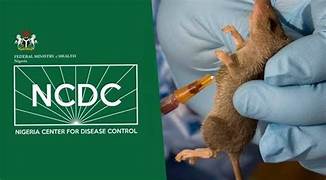
The Nigeria Centre for Disease Control and Prevention (NCDC) has confirmed that Lassa fever has claimed 259 lives and infected 1,086 people across 24 states and 118 local government areas so far in 2026.
In its latest Lassa Fever Situation Report for epidemiological week 36 (August 31 to September 6), the agency said the figures represent a case fatality rate of 23.9 percent — significantly higher than the 18.6 percent recorded during the same period in 2025.
Twelve new confirmed cases were recorded in week 36, a decline from the 18 cases reported the previous week. The fresh infections were detected in Ondo, Edo and Kogi states.
Five states continue to bear the heaviest burden, accounting for 87 percent of all confirmed cases this year: Bauchi, Ondo, Taraba, Benue and Edo. People aged 21 to 30 remain the most affected age group.
The NCDC noted that no new infections among healthcare workers were recorded during the latest reporting week. The agency continues to urge the public to maintain hygiene, avoid contact with rodents and their droppings, and seek early medical care if symptoms appear.
Health
Nigerian hospital successfully performs kidney cancer surgery via tele-robotic
The development could reduce the need for Nigerians to travel abroad for specialised medical treatment, thereby reducing expenditure on international travel, accommodation and medical services.
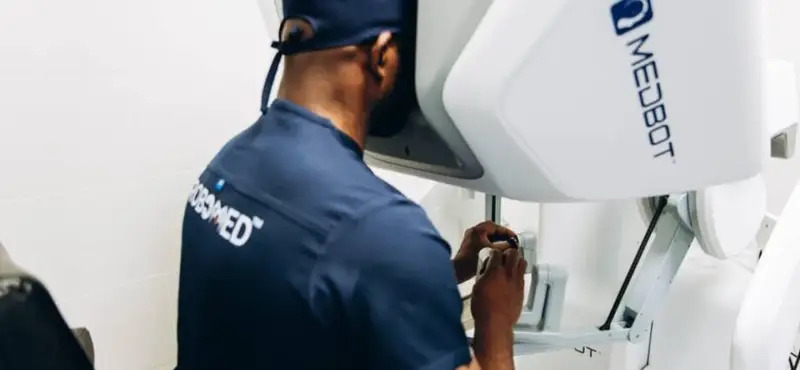
• A surgeon performing tele-robotic surgery.
Nisa Premier Hospital, Abuja, has partnered with RoboMed Global and The Redeemer’s Health Village (RHV) to successfully perform what the hospital described as the first tele-robotic surgery in Nigeria and West Africa.
The landmark kidney cancer surgery was performed on a patient at Nisa Premier Hospital, Abuja, while the surgeon, Professor Obi Ekwenna-Davis, remotely controlled the robotic surgical platform from Redeemer’s Health Village in Lagos.
The procedure, which lasted approximately three hours, was performed to remove a kidney affected by a cancerous tumour.
The hospital said the patient had been discharged following the successful procedure, although details about the patient’s identity and condition were withheld for privacy reasons.
Speaking during an event to mark the milestone, the Chief Executive Officer of Nisa Premier Hospital, Dr Ibrahim Wada, said the development demonstrated the potential of tele-robotic surgery to connect specialist surgical expertise with patients across Nigeria.
Wada said the procedure was carried out using the MicroPort robotic surgical platform installed at Nisa Premier Hospital, with the remote surgeon controlling the system from Lagos.
He said the development could reduce the need for Nigerians to travel abroad for specialised medical treatment, thereby reducing expenditure on international travel, accommodation and medical services.
According to him, the technology also creates an opportunity for Nigerians to access specialised expertise from doctors located in other parts of the world without requiring the doctors to travel physically to Nigeria.
Source: Daily Trust


JUST IN: Mob Sets BRT Bus Ablaze After Motorcyclist’s Death in Lagos

BREAKING: DSS Arrests Fugitive Maina Son, Hands Him to EFCC

BREAKING: 5 Arrested Over Imo NYSC Abduction

BREAKING: Lagos Govt Declares Today, Thursday Work-Free to Mark 2026 Ìṣẹ̀ṣe Day

Tech Expert, Zuckerberg trains with UFC champions, Adesanya, Alexander

Organ Trafficking: Ekweremadu bags 10 years in UK prison
-

 Business2 days ago
NAFDAC scolds fake manufacturers: “You are killing Nigerians in order to make money”
-

 Business2 days ago
Oyedele Chairs G-24 Call for Fairer Global Financial System, Affordable Development Financing
-
 Business2 days ago
Naira Exchange Rates For Thursday, October 15
-

 Business3 days ago
BREAKING: Shell to Exit Nigeria’s Domestic Gas Distribution Business
-
 Politics2 days ago
Exclusion of candidates from INEC list: CD cautions INEC against manipulation by politicians
-
 Sports2 days ago
CAF Increases Annual Funding for Member Federations to $700,000
-

 Business1 day ago
Germany plans tax on sugary drinks
-

 News2 days ago
Sanwo-Olu Appoints Olatunbosun Ogunbanwo, 5 Others as Perm Secs