
News
Understanding Property Titles and Documents in Nigeria by Dennis Isong


Being a property owner in Nigeria is a big accomplishment and a wise investment.
But managing the complexity of property ownership necessitates a thorough comprehension of papers and property titles. These records are vital for preserving property rights since they act as official proof of ownership.
This article explores the several kinds of property titles and documents that are available in Nigeria, their significance, and the ways in which they support safe real estate transactions.
1. Certificate of Occupancy (C of O):
A Certificate of Occupancy is perhaps the most crucial document when it comes to land ownership in Nigeria.
It is issued by the state government and serves as proof of ownership and the right to use the land for a specific purpose.
The process of obtaining a C of O involves the applicant submitting an application to the state government, which then conducts due diligence to verify the legitimacy of the claim to the land. Once issued, the C of O grants the holder exclusive rights to use and develop the land.
2. Deed of Assignment:
A Deed of Assignment is a legal document that transfers ownership of property from one party to another.
It typically outlines the details of the transfer, including the names of the parties involved, a description of the property, and any conditions or considerations attached to the transfer. This document is crucial for formalizing the sale or transfer of property rights and should be duly executed and registered with the appropriate government authority to ensure its validity.
3. Deed of Conveyance:
Similar to a Deed of Assignment, a Deed of Conveyance is used to transfer ownership of property. However, unlike the Deed of Assignment, which is commonly used for the transfer of leasehold interests, the Deed of Conveyance is used for the transfer of freehold interests.
It is typically executed between the seller (grantor) and the buyer (grantee) and includes details such as the purchase price, description of the property, and any covenants or warranties.
4. Survey Plan:
A Survey Plan is a document that shows the accurate boundaries and measurements of a piece of land. It is prepared by a licensed surveyor and is essential for verifying the exact location and dimensions of a property.
A Survey Plan is often required during the process of obtaining a C of O or when transferring property ownership to ensure that there are no boundary disputes or encroachments.
5. Power of Attorney:
A Power of Attorney is a legal document that grants someone else the authority to act on behalf of the property owner. It is commonly used in situations where the property owner is unable to handle their affairs due to illness, absence, or other reasons.
A Power of Attorney can be limited or general in scope, depending on the specific powers granted to the attorney-in-fact.
The Significance of Property Titles: Safeguarding Your InvestmentLegal Ownership:
Property titles serve as incontrovertible evidence of legal ownership.
They establish the rightful owner of the property and delineate the boundaries of their ownership rights. Without a valid title, one cannot claim ownership of a property, leaving them vulnerable to disputes and challenges regarding ownership.
Protection of Property Rights:
Property titles provide protection against encroachments and unauthorized claims to the property.
They offer a legal shield against potential disputes, ensuring that the owner’s rights are recognized and respected by others.
With a clear title, property owners can confidently assert their ownership rights and defend against any attempts to infringe upon them.
Without a valid title, one cannot claim ownership of a property, leaving them vulnerable to disputes and challenges regarding ownership.
Facilitation of Transactions:
Clear and valid property titles facilitate smooth and efficient real estate transactions. When buying or selling property, a clean title provides assurance to both parties that the transaction is legitimate and free from any encumbrances or defects. It instills confidence in buyers and lenders, making it easier to secure financing and close the deal.
Legal Certainty:
Property titles provide legal certainty by establishing a chain of ownership that can be traced back through time. They document the history of the property, including previous transfers of ownership, mortgages, liens, and other encumbrances.
This historical record ensures transparency and clarity regarding the property’s status, enabling informed decision-making by prospective buyers and lenders.Access to Legal Remedies:In the event of a dispute or legal challenge regarding property ownership, a valid title provides the basis for seeking legal remedies and resolution.
Property owners with clear titles can avail themselves of legal avenues to defend their rights and rectify any discrepancies or irregularities affecting their ownership.
This access to legal recourse is essential for protecting investments and preserving property rights.Peace of Mind: Perhaps most importantly, property titles offer peace of mind to owners, knowing that their investment is secure and their ownership rights are legally recognized.
With a clear title in hand, property owners can confidently enjoy the benefits of homeownership, such as occupancy, development, and transferability, without fear of adverse claims or challenges.
The Implications of Not Acquiring Property Titles in Nigeria: Risks and Consequences
● Lack of Legal Ownership:
One of the most significant implications of not acquiring property titles is the lack of legal ownership. Without proper documentation, individuals cannot assert their ownership rights over the property, leaving them vulnerable to claims by other parties. This lack of legal ownership can lead to disputes, litigation, and the loss of investment in the property.
● Insecurity of Tenure:
Property titles provide security of tenure, guaranteeing the owner’s right to occupy and use the property without fear of eviction or interference. Without proper titles, individuals face uncertainty regarding their tenure, making them susceptible to arbitrary eviction or displacement by third parties claiming ownership rights. This insecurity of tenure can disrupt lives, businesses, and communities, leading to social and economic instability.
● Difficulty in Transacting:
Acquiring property titles is essential for facilitating real estate transactions, such as buying, selling, or leasing property. Without clear titles, individuals encounter difficulties in transacting, as potential buyers or lenders may be reluctant to engage in deals involving properties with uncertain ownership status. This can impede economic development and hinder investment in the real estate sector.
● Limited Access to Credit:
Property titles serve as collateral for obtaining loans and credit from financial institutions. Without proper titles, individuals have limited access to credit, as lenders are unwilling to accept properties with unclear ownership as collateral. This lack of access to credit hampers economic growth and development, as it constrains individuals’ ability to invest in property development and other productive ventures.
● Vulnerability to Fraud and Exploitation:
In the absence of property titles, individuals are vulnerable to fraud and exploitation by unscrupulous actors seeking to exploit their lack of legal protection. Fraudulent schemes such as land grabbing, forgery of documents, and illegal sales thrive in environments where property titles are not properly established. This exposes unsuspecting individuals to financial loss and legal entanglements.
● Legal and Regulatory Risks:
Failure to acquire property titles exposes individuals to legal and regulatory risks, as they may be in violation of laws and regulations governing property ownership and transactions. Government authorities may take enforcement actions against individuals occupying or developing property without proper titles, leading to fines, penalties, or even demolition of structures.
▪︎Dennis Isong is a TOP REALTOR IN LAGOS.
He Helps Nigerians in Diaspora to Own Property In Lagos Nigeria STRESS-FREE.
For Questions WhatsApp/Call 2348164741041
News
A Review of Akwa Ibom State Government’s July Delivery Meeting
Stakeholders at the meeting delivered goodwill messages, commending Governor Umo Eno for institutionalising the Delivery Meeting as a platform for transparency, accountability, and inclusive governance.

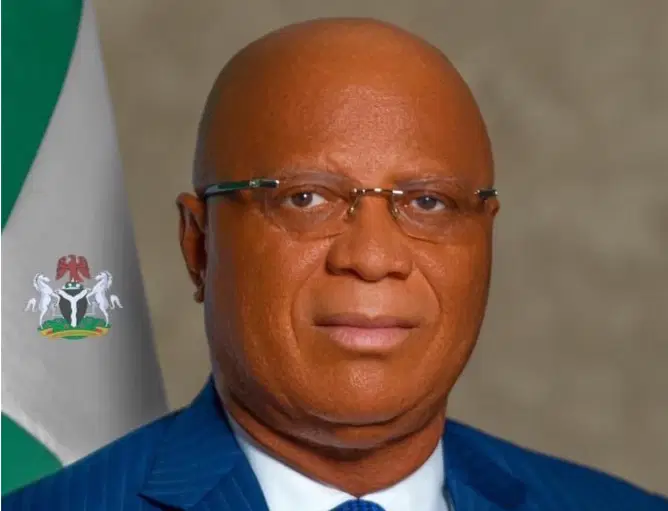
Image: Governor Umo Eno
- The Akwa Ibom State Government’s Monthly Delivery Meeting concluded its two-day July session, with Governor Umo Eno presiding over an extensive review of the administration’s strategic projects across key sectors.
- Hon. Aniekan UmanahCommissioner for Information, reported that the meeting forms part of ongoing efforts to monitor implementation, evaluate progress, and ensure the timely delivery of projects under the ARISE Agenda.
- In his opening remarks on Day Two, Governor Eno reiterated that the Delivery Meeting has become a vital accountability mechanism for tracking the performance of government projects and ensuring that every initiative delivers measurable value to the people of the State.
- He stressed that the sessions provide an opportunity for honest appraisal, collective problem-solving, and improved coordination among implementing agencies as the administration continues to deliver on its commitments under the ARISE Agenda. Quoting the Greek philosopher Socrates, the Governor said, “An unexamined life is not worth living.”
- Before the commencement of the Day Two session, Governor Eno paid an unscheduled visit to the ARISE Palm Resort, an audacious tourism project built on a 73-hectare gully reclamation site, to verify claims made during the previous day’s presentations and assess firsthand the level of progress on the facility, which is scheduled for commissioning later in the year.
- The meeting received comprehensive presentations on key projects across multiple sectors of the state’s development programme, including agriculture, trade and investment, maritime and transportation, health, internal security, housing, tourism, local government administration, direct labour projects, and other flagship initiatives.
- Under the agricultural sector, presentations were made on the Ibom Model Farm, Agric Equipment Leasing Company, Distribution of Oil Palm Seedlings Programme, Dakkada Global Oil Palm Project, and the Akwa Ibom Agricultural Development Programme (AKADEP), with emphasis on mechanised farming, food security, and job creation.
- The Ministry of Trade and Investment presented updates on the International Market, Ikot Ekpene, highlighting its role in boosting commerce, attracting investment, and strengthening regional trade.
- The meeting noted the significant progress recorded on the project and urged the contractors to sustain the pace of work.
- In the maritime and transport sector, updates were presented on the Oron Maritime Infrastructure Project, which is aimed at improving maritime transportation, boosting commerce, and stimulating economic growth as part of the administration’s broader Blue Economy development initiatives.
- The health sector presentation covered the Ibom International Hospital, General Hospitals in Ukanafun, Ibiono Ibom, Ikot Ekpene, Iquita-Oron, Ikot Ekpene Udo, and other State of Emergency Health Projects, reinforcing the government’s commitment to providing accessible, affordable, and quality healthcare services.
- The Ministry of Internal Security and Waterways presented progress on the Counter Terrorism Unit Base, aimed at strengthening security infrastructure and enhancing public safety across the state.
- The Ministry of Housing provided updates on the Doctors’ Residence and the Executive and Legislative Quarters, projects aimed at providing decent accommodation while supporting urban renewal and improving living standards.
- In the tourism sector, progress on the Ibom International Hotel at the Convention Arena was reviewed, with emphasis on repositioning the facility to boost tourism, hospitality, and investment opportunities.
- Updates from the Ministry of Local Government and Chieftaincy Affairs covered the Chairmen’s Lodges, with an assurance that all 31 lodges will be completed by December 2026 to strengthen administrative efficiency at the grassroots level.
- The Direct Labour Committee reported progress on the Youth Development Centres, the One Project Per Local Government Area (Phase II), the Judiciary Village, and the House of Assembly Complex, all aimed at strengthening governance infrastructure and promoting youth development.
- Other strategic projects reviewed included the ARISE Shopping City, ARISE Park Beach Villas, AKBC Project, Model Secondary School, Senior Citizens Centre, and the Nigeria Formr Women Project, reflecting the administration’s broad development agenda across multiple sectors.
- Stakeholders at the meeting delivered goodwill messages, commending Governor Umo Eno for institutionalising the Delivery Meeting as a platform for transparency, accountability, and inclusive governance.
- Senator Effiong Bob commended the Governor for consistently engaging stakeholders in the governance process, noting that the ARISE Agenda is making measurable progress while praising the administration’s openness and transparency. Senior Advocate of Nigeria, Assam Assam, described the meeting as the most impactful yet, citing visible progress across sectors, particularly in healthcare infrastructure and service delivery.
- The Speaker of the Akwa Ibom State House of Assembly, Rt. Hon. Udeme Otong, lauded the Governor’s leadership and assured him of the continued support and collaboration of the State House of Assembly.
- The Oku Ibom Ibibio and President-General of the Supreme Council of Traditional Rulers, His Eminence, Ntenyin Dr. Solomon Etuk, JP, expressed pride in the administration’s developmental strides and commended Governor Eno’s inclusive approach to governance.
- In his closing remarks, Governor Umo Eno appreciated all participants, Heads of Ministries, Departments and Agencies (MDAs), Delivery Advisors, stakeholders, and contractors for their contributions to the two-day review exercise, noting that the sessions were rigorous but necessary in strengthening governance and ensuring accountability.
- The Governor stated that the administration is entering its “harvest season” as it gradually winds down its first term, adding that observations from the meeting would be used to further improve service delivery and implementation efficiency.
- He reaffirmed the government’s commitment to completing all ongoing projects within set timelines and urged implementing agencies to sustain the momentum and maintain high standards in project execution for the benefit of the people of Akwa Ibom State.
- At the conclusion of the Delivery Meeting, Governor Eno led stakeholders on an inspection visit to the Ibom Convention Arena to assess ongoing work on the 200-bed Ibom International Hotel project, which is billed for commissioning later in the year.
News
Explosion rocks Apapa tank farm; NPA, NIMASA move to curtail spread
Following the outbreak the fire service departments of both the Nigerian Ports Authority (NPA) and the Nigerian Maritime Administration and Safety Agency (NIMASA) moved in to curtail the spread of the inferno.

Panic erupted at the Lagos tank farm cluster at Ibafon, Apapa, on Friday morning after a fire broke out at the Bono Tank Farm, located within the Best Energy Tank Farm complex.
The inferno sent residents and workers in the area fleeing for safety as emergency responders moved in to contain the blaze.
Following the outbreak the fire service departments of both the Nigerian Ports Authority (NPA) and the Nigerian Maritime Administration and Safety Agency (NIMASA) moved in to curtail the spread of the inferno.
Efforts to obtain comments from the management of Bono Tank Farm and Best Energy Tank Farm were unsuccessful, as phone calls and text messages sent to their representatives were neither answered nor acknowledged.
News
FG slams 8-count charges on Adeyemi over fake agency ” I’m not a criminal”, he defends
It was learned that the alleged ‘‘fake’’ Presidential Economic Advisory Council/Presidential Foreign Intervention Promotion Council was allocated N1.302 billion in the 2026 Budget of the Federal Government.
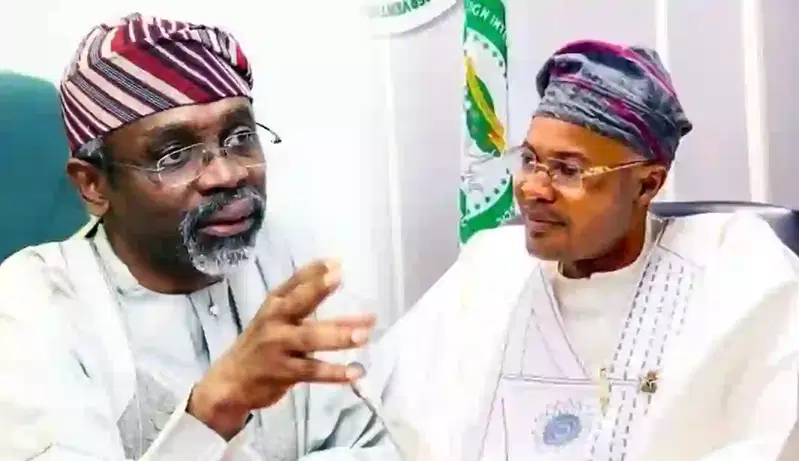
Photo: Gbajabiamila, and Adeyemi
The Federal Government has filed an 8-count charges against Adeniyi Adeyemi, convener of a purported Presidential Foreign Intervention Promotion Council, PFIPC, over the controversy trailing the agency.
Adeyemi, however, fought back claiming that he was given an appointment letter.
Adeyemi, during an appearance on Channels Television claimed that the Chief of Staff to the President, Mr. Femi Gbajabiamila gave him an appointment letter, insisting that he is not a criminal.
However, it was learned that the alleged ‘‘fake’’ Presidential Economic Advisory Council/Presidential Foreign Intervention Promotion Council was allocated N1.302 billion in the 2026 Budget of the Federal Government.
In a statement on Wednesday, Bayo Onanuga, presidential spokesperson, said the charges were filed by the Police on November 27, 2025, against Adeyemi and two accomplices at the Federal High Court in Abuja.
Onanuga said Adeyemi is expected to appear in court on July 27, 2026.


A Review of Akwa Ibom State Government’s July Delivery Meeting

Explosion rocks Apapa tank farm; NPA, NIMASA move to curtail spread

FG slams 8-count charges on Adeyemi over fake agency ” I’m not a criminal”, he defends

Tech Expert, Zuckerberg trains with UFC champions, Adesanya, Alexander

Organ Trafficking: Ekweremadu bags 10 years in UK prison

SAINT OBI: Between his marriage and his death
-

 Sports3 days ago
Cape Verde faces defending world cup champions , Argentina today
-

 International3 days ago
General Hydrocarbons Floors FBN as S’Court Sets Aside Appeal Court Ruling
-

 Business3 days ago
Naira Exchange Rates Friday, 3 July 2026
-

 News3 days ago
US ends military operations in Nigeria, withdraws 200 soldiers
-
 News3 days ago
NDC calls for Gbajabiamila sack over fake agency scandal
-
 News3 days ago
FG slams 8-count charges on Adeyemi over fake agency ” I’m not a criminal”, he defends
-
 News2 days ago
Explosion rocks Apapa tank farm; NPA, NIMASA move to curtail spread
-
 News2 days ago
A Review of Akwa Ibom State Government’s July Delivery Meeting