
News
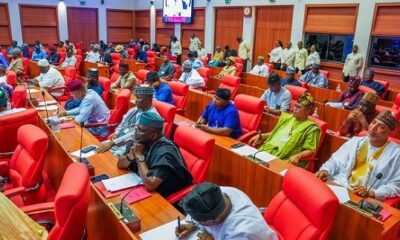
Senate Passes Controversial State Police Bill

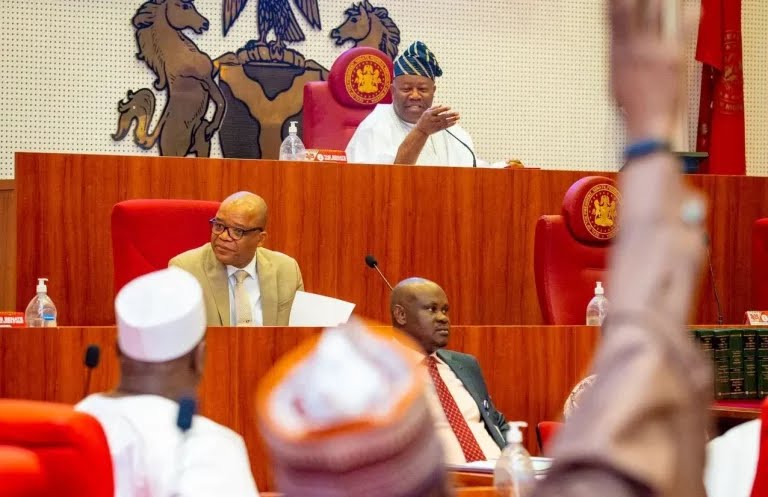
In a landmark decision that could reshape the nation’s security architecture, the Nigerian Senate on Wednesday passed a bill establishing state police forces across the country.
The bill, which seeks to amend the 1999 Constitution to allow states to create and manage their own police services, was approved after hours of debate and multiple amendments. Lawmakers voted overwhelmingly in favor, marking a significant victory for proponents who argue that decentralized policing is essential to tackling rising insecurity, banditry, and kidnapping.
Senate President Godswill Akpabio described the passage as “a bold step towards true federalism and enhanced security governance.” He noted that the bill includes stringent safeguards, including oversight mechanisms by the federal police authorities and human rights protections to prevent abuse.
The development comes amid growing pressure from state governors, particularly in the southern and north-central regions, who have long complained that the centralized Nigeria Police Force is overstretched and ill-equipped to respond swiftly to local threats. Supporters believe state police will enable quicker response times, better intelligence gathering, and community-oriented law enforcement.
However, critics expressed concerns during the debate over potential risks, including the politicization of security forces, possible human rights violations, and the capacity of poorer states to fund and equip their own police. Some senators warned that without robust funding frameworks and training standards, the reform could exacerbate existing inequalities between states.
The bill now proceeds to the House of Representatives for concurrence. If passed by the lower chamber and signed by President Bola Tinubu, it will represent one of the most sweeping constitutional changes in Nigeria’s Fourth Republic.
Public reactions have been mixed, with civil society groups calling for transparency in the implementation process and adequate training for new recruits. Security analysts say the success of state police will ultimately depend on proper funding, accountability, and coordination with federal forces.
This legislative move is seen as part of broader efforts to address Nigeria’s multifaceted security challenges as the country grapples with economic pressures and persistent violence in various regions.







News
President Tinubu Performing Umrah
The President is expected to return to Nigeria next week after completing the religious exercise.

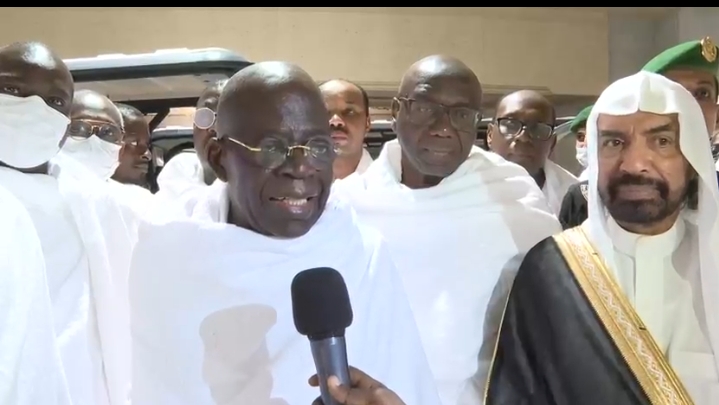
Photo: President Tinubu I Makkah
President Bola Tinubu on Friday commenced performing Umrah at Makkah in Saudi Arabia, praying for the nation and for every Nigerian to live in peace and harmony.
Tinubu on Thursday evening arrived in Saudi Arabia, landing at the King Abdulaziz International Airport in Jeddah.
He was received by Nigeria’s ambassador to Saudi Arabia, Yakubu Gambo, and the Saudi head of royal protocol Ahmad bin Thafir.
Thursday’s trip marks the second time Tinubu has travelled to Makkah to perform Umrah since assuming office on May 29, 2023.
President Tinubu visited the holy city in November 2023, shortly after attending the Saudi-African Summit in Riyadh, where he also prayed for divine guidance in leading Nigeria.
The latest trip is part of a series of foreign engagements undertaken by Tinubu since becoming president. He has visited more than 30 countries in over 50 unique and recurring trips.
The President is expected to return to Nigeria next week after completing the religious exercise.
News
State police ready by December — Senate Leader
Highlighting the historic milestone, Bamidele explained that the 30 state approvals comfortably satisfy the two-thirds concurrency requirement mandated by Section 9(2) of the 1999 Constitution (as amended).
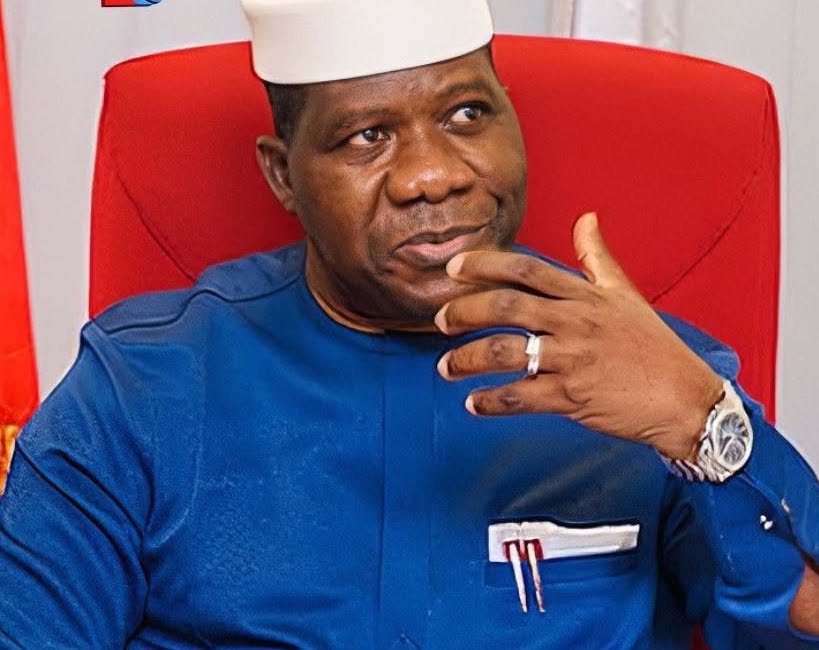
Senate Leader Opeyemi Bamidele has expressed conviction that the proposed state police will be ready on or before December 2026, given that 30 State Houses of Assembly have officially approved the State Police Constitution Alteration Bill, 2026.
Speaking on the Bill on Thursday, the Leader of the Senate declared that multi-tier policing in Nigeria has moved from a recurring political promise into an actionable constitutional reality.
Bamidele, who also serves as the Vice Chairman of the Senate Committee on the Review of the 1999 Constitution, made the disclosure while delivering a paper at the National Institute for Policy and Strategic Studies (NIPSS), Kuru, Plateau State.
He addressed participants of the Senior Executive Course (SEC) 48 on the topic, “Improving the Efficiency and Effectiveness of Governance through Proactive Lawmaking.”
Highlighting the historic milestone, Bamidele explained that the 30 state approvals comfortably satisfy the two-thirds concurrency requirement mandated by Section 9(2) of the 1999 Constitution (as amended).
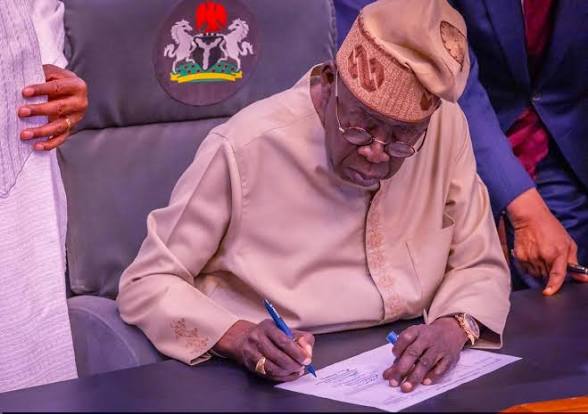
President Bola Tinubu’s request for approval to borrow $20.52 billion and €1.045 billion has intensified debate over Nigeria’s rising debt burden and its long-term implications.
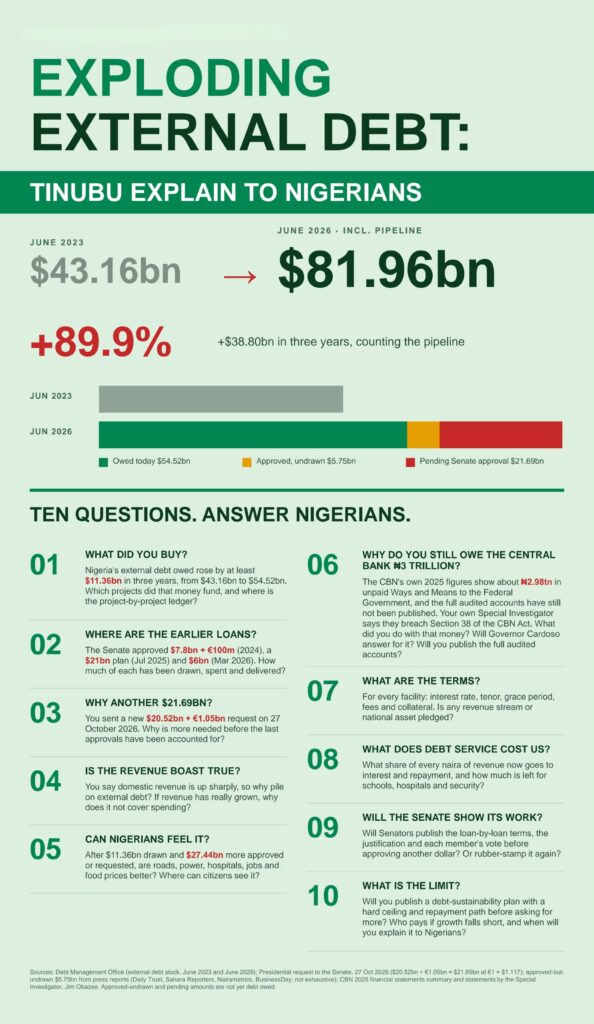
Nigeria’s external debt climbed from $43.16 billion in June 2023 to $54.52 billion in June 2026 — an increase of $11.36 billion, or 26.3%. Over the same period, total public debt rose from ₦87.38 trillion to ₦166.79 trillion, a jump of roughly 90.9%.
When the latest loan request is combined with previously approved but undrawn financing, potential external debt exposure could reach about $81.96 billion if all facilities are fully drawn and there is no overlap. Officials stress this remains an illustrative figure rather than current outstanding debt.
The government says the new borrowing will finance critical development projects. Critics, however, are demanding greater transparency. They want clear evidence of what earlier loans have delivered — completed roads, functional hospitals, power projects that have increased electricity supply, and measurable gains for businesses and households facing high living costs.
Questions are also being raised about the scale of new borrowing at a time when government revenues are reported to be rising, and amid concerns from lawmakers about inadequate capital releases to ministries under previous budgets.
Opposition voices and civil society groups are calling for the National Assembly to insist on full disclosure before approving further loans. They want a project-by-project register of external loans since May 2023, showing amounts borrowed and disbursed, loan terms, project locations, implementation status and independently verified results. They also seek a clear assessment of future debt-service obligations and the risks from exchange-rate movements.
Borrowing can support development when investments produce measurable returns and repayment remains sustainable. The central issue, observers say, is not only how much more debt Nigeria can carry, but what citizens receive in return.
The National Assembly is expected to subject the requests to rigorous scrutiny.


Nigeria Is Practically Comatose – ADC, Tasks NASS, Onanuga

Tinubu Built Nothing but Solar Farm for Aso Rock While Nigerians Suffer — ADC-PCC
NDC Tasks INEC to Remove Names of Deceased Nigerians From Voters’ Register

BREAKING: Lagos Govt Declares Today, Thursday Work-Free to Mark 2026 Ìṣẹ̀ṣe Day

Tech Expert, Zuckerberg trains with UFC champions, Adesanya, Alexander

Organ Trafficking: Ekweremadu bags 10 years in UK prison
-

 Business2 days ago
Exchange Rates Thursday October 29 2026
-

 Entertainment3 days ago
Davido, Kirk Franklin, to hit airwaves with new song ‘Hope In You’
-
 Entertainment3 days ago
Sultan of Sokoto to Honour Peter Igho as Kakakin Daular Usmaniyya
-

 Business3 days ago
Investors from 120 countries participate in Dangote Refinery’s IPO
-

 Sports3 days ago
Team Nigeria Braces For Historic Dakar 2026 Youth Olympic Games
-

 Sports3 days ago
Nigeria Thrash New Caledonia 7-0 In FIFA U15 World Cup Festival
-

 News3 days ago
MultiChoice Says Subscribers To Now Choose From Four DStv, GOtv Packages
-

 International3 days ago
Luxury cruise passengers stranded in Cambodia due to soaring fuel costs