
Opinions
Reframing Nigeria’s Banditry Crisis: From Emotional Narratives to Strategic Clarity
My work took me repeatedly into frontline areas: Birnin Gwari and its adjoining corridors; the forests and flashpoints of Zamfara, Katsina, and Niger States; and into out-of-reach locations in Chikun, Igabi, Giwa, Kajuru, Kachia, Kagarko, Kauru, Kubau, and other high-risk zones across the state and beyond.
My submission is, essentially, a summary of the practical knowledge from my involvement.

By Samuel Aruwan
PROLOGUE
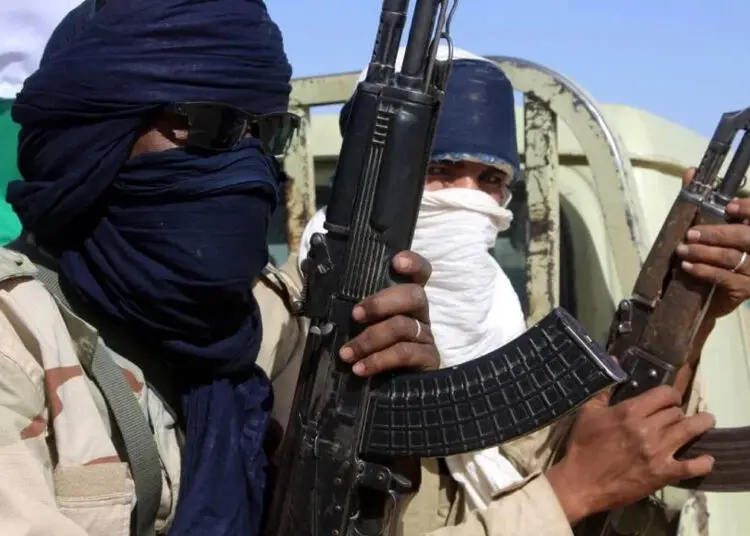
Nigeria is once again trapped in a familiar and dangerous cycle: confronting a grave national security threat through emotionally charged narratives, partisan framings, and poorly differentiated solutions that blur the line between grievance and criminality.
The armed banditry plaguing Northern Nigeria—particularly across the North-West and parts of the North-Central—has generated an avalanche of commentary for and against dialogue with bandits. While supporters of dialogue are often cast as well-intentioned, their opponents frequently argue that such a stance is insensitive to the victims of banditry.
This essay intervenes in that conversation. Its purpose is not to provoke a sterile debate between advocates of ‘dialogue’ and proponents of ‘kinetic action,’ nor to dismiss non-kinetic tools wholesale.
Rather, it seeks to interrogate the assumptions, misdiagnoses, and conceptual errors that increasingly shape public discourse on banditry, often in ways that undermine Nigeria’s national security rather than strengthen it.
What is urgently required is clarity of threat, precision of categorisation, and discipline in policy response.
Banditry in Northern Nigeria is neither monolithic nor reducible to a single narrative of grievance.
Treating it as such—through emotional understanding, ethnic profiling, or indiscriminate calls for amnesty—risks legitimising violent criminal enterprises, emboldening perpetrators, and eroding the state’s monopoly over the use of force.
Author’s Background
I write neither as a passive observer nor as a theorist detached from the theatre of violence.
Before entering public service, I spent over a decade as a journalist covering conflict and insecurity in Northern Nigeria.
I later served as Spokesperson to the Government of Kaduna State and pioneer Commissioner of Internal Security and Home Affairs.
For nearly a decade, I was a member—and later Secretary—of the State Security Council, actively involved in security operations, liaison between the Government of Kaduna State and security forces, coordination of intelligence gathering and internal security, among other responsibilities.
Bandits Frontline Areas
My work took me repeatedly into frontline areas: Birnin Gwari and its adjoining corridors; the forests and flashpoints of Zamfara, Katsina, and Niger States; and into out-of-reach locations in Chikun, Igabi, Giwa, Kajuru, Kachia, Kagarko, Kauru, Kubau, and other high-risk zones across the state and beyond. My submission is, essentially, a summary of the practical knowledge from my involvement.
Banditry in Northern Nigeria today is not primarily a grievance-based phenomenon seeking political redress.
It is a violent, profit-driven criminal ecosystem that has evolved into a quasi-corporate enterprise, with diversified revenue streams, transnational arms supply chains, and entrenched leadership structures.
To treat it otherwise is to misread the threat.
Banditry is not new to Northern Nigeria. Historical accounts trace cattle rustling and armed robbery as far back as 1891 around Dansadau, where some traditional rulers were accused of colluding with bandits.
From Cross -Border to Rural criminality
Cross-border criminality involving some Tuareg, Fulani, Gobirawa, and Asebenawa actors existed during the colonial period, but these activities were limited in scale and lethality, constrained by the absence of widespread small arms proliferation.
The contemporary mutation of banditry emerged gradually but decisively in the post-2011 period.
What began as rural criminality—cattle rustling, highway robbery, and communal disputes—metastasised into mass kidnapping, village annihilation, sexual violence, arms and drug trafficking, territorial control, and many other challenges.
The turning point was not merely grievance but weaponisation: the transition from sticks and swords to pump-action rifles and, eventually, AK-47s and other high-calibre weapons.
First modern bandit gang
Scholarly work, including that of Dr. Murtala Rufai, identifies Alhaji Kundu and Buhari Tsoho (Buharin Daji) as architects of the first modern bandit gang.
Their operations expanded rapidly across Zamfara and neighbouring states, eventually spawning over 120 gangs by 2021.
Between 2011 and 2021 alone, these groups reportedly killed over 12,000 people, displaced tens of thousands, destroyed entire villages, and stole hundreds of thousands of livestock.
Crucially, the early victims of modern banditry were Fulani herders whose cattle were rustled en masse by bandits of the same Fulani extraction.
Eventually, these legitimate cattle owners resorted to self-help by also acquiring low-calibre weapons to protect their livestock from being rustled by the bandits, as police and traditional rulers’ interventions failed and the authorities turned a blind eye—not seeing the dangers ahead and just perceiving the development as usual intra-Fulani herders feud. In return, because of their contacts and resources, the bandits started acquiring automatic weapons and overpowered these legitimate cattle owners and massively rustled their cattle.
It also got to a stage where bandits were kidnapping these cattle owners and demanding herds of cattle or its equivalent in cash as ransom.
Many cattle owners who had no herds of cattle to present nor money to pay as ransom were killed, and some of their daughters and wives were forcibly taken as sex slaves.
This trend impoverished these owners, driving many of their kin to join banditry to recover stolen cattle.
Others joined gangs like the ‘Kungiyar Gayu’ to demand pastoral unity and justice in response to cattle rustling, extortions, allegations of injustices by local traditional rulers, police partialities, politicians, local court corruption, and other abnormal practices that exposed them to extreme poverty without a source of livelihood.
Some were also brainwashed by bandits to join banditry in the name of resisting a perceived agenda against their ethnicity in view of social discrimination and stereotyping.
The Kundu and Tsoho’s gang
As I have previously argued, the first main targets of Kundu and Tsoho’s gang were the legitimate Fulani cattle owners.
Once they were finished with them, they turned to rustling the farming cattle (Shanun Huda) of Hausa farmers, alongside killings, kidnappings, gender-based violence of the Hausa women, confiscation of properties, and the destruction of farms.
In response, Hausa farming communities formed volunteer groups, commonly referred to as ‘Yan-Sakai’ or ‘Yan-Banga’.
The excesses of these volunteers—generalising and categorising all Fulani, including herders who were also victims, as complicit—drew a dangerous ethnic battle line.
The rural Fulani herders could no longer access towns and markets, while Hausa farming communities could not access their farms deep in the forest.
Markets became inaccessible. Farms were abandoned. Forests became battlefields.
This development set in motion killings and counter-killings, even as cattle rustling intensified.
Kidnapping for ransom
In the midst of this, kidnapping for ransom emerged, with bandits carrying out abductions and the ‘Yan-Sakai’ organizing counter attacks—excesses that affect the innocent based on shared ethnicity.
This dynamic further compounds the crisis, as aggrieved innocents seek vengeance, since there is no justice system to dispense justice, while the bandits and ‘Yan-Sakai’ pursue their own, parallel cycles of retribution.
The ‘Yan-Sakai’ killing of a Fulani leader, Alhaji Isshe of Chilin village in Maru Local Government Area of Zamfara State—an event recorded as occurring on 16th August 2012—marked a decisive escalation.
As Rufai noted in his thesis, they carried out the public murder on the accusation that he was harboring criminals and rustlers. Reprisal followed reprisal.
What began as criminality hardened into an ethnicised cycle of violence, even as bandit gangs expanded operations against all communities regardless of identity.
By the time the government acted, the criminality had become entrenched across several centres of gravity in Zamfara State and neighbouring corridors. Kidnapping and attacks intensified around 2013 and resurged in 2016 across Zamfara, Kaduna, Katsina, Kebbi, Sokoto, Niger, Plateau, and Benue.
A major obstacle to an effective response has been the tendency of some media sections to fracture the banditry narrative along ethnic and religious lines: one story for Zamfara and Katsina, another for non-Hausa communities in Plateau and Benue.
The Tiv and The Fulani
The criminality perpetrated by the bandits—for instance, in Benue and Plateau states—further ignited the long-standing farmers-herders, land-grabbing, and indigene-settler tensions and crises, which usually take on religious and ethnic dimensions because the farmers are largely non-Fulani Christians while the herders are Fulani Muslims.
This escalation occurred despite a positive history of Fulani-Tiv and Fulani-Berom relations built on complementary farming and pastoralism over time.
The good side of Tiv and Fulani brotherhood was well captured by Akiga Sai (1898-1959) in his book ‘History of the Tiv’.
The exact passage is: “Besieged with animosity from their neighbours, the Tiv pulled out from their neighbors, the Tiv pulled out from their midst and migrated north-east, if one uses a modern compass, until they met with another alien group called Fulani and mingled with them. The Fulani never troubled them by interfering with their way of life.
They formed close bonds with each other. In case of any attack by another group, the Fulani would easily repel such an attack.
The Tiv marvelled at the dexterity with which the Fulani fought and defeated aggressor ethnic groups and nicknamed the Fulani pul, meaning ‘conqueror’ in the Tiv language.”
Akiga Sai was a man of historic firsts.
He was the first Tiv man to declare himself a Christian in 1912 and was among the first group of four to be baptised in 1917.
He became the first Tiv to read and write, edited the first Tiv newsletter (Mwanger u Tiv) published by the Gaskiya Corporation, served as the first Tiv elected politician in the Northern House of Assembly, was one of the delegates sent to the London constitutional conference in 1953, and authored the first book ever written by a Tiv person.
He completed the Tiv language manuscript for his book, ‘History of the Tiv’, in 1935. An edited English translation by Rupert East was first published by the International African Institute in 1939 under the title ‘Akiga’s Story: the Tiv tribe as seen by one of its members.’
Ethnic Conflicts in Plateau State
In a separate 2016 article on Nigerian linguistics, the scholar Farooq Kperogi notes: “Again, although the Fulani and the Berom of Plateau State see themselves as belonging to the furthest poles of northern Nigeria’s political and cultural divide, especially in light of the recent internecine ethnic conflict in Plateau State, they not only belong to the larger Niger Congo language family (to which many languages in central and southern Nigeria belong); they actually belong to the same Atlantic Congo subfamily of the Niger Congo family.”
These historical and linguistic ties underscore how the contemporary framing of conflict along rigid ethnic lines is dangerous, one that bandits and partisan narratives exploit.
Much as there’s a problem, the better part of the past can be used in reframing narratives to halt bloodshed and exploit the strengths of diversities and the ubiquitous of all humans.
Furthermore, the fact that banditry is perpetrated by criminals whose ethnic identity is traceable to Fulani has exacerbated the problem.
I have argued elsewhere that, despite the symbiotic nature of banditry and farmers-herders conflicts, there is a fundamental difference between the two; and all parties (farmers and herders communities) are ultimately victims of the banditry perpetrated by these criminals and their collaborators who are driven by economics and terror.
The book ‘The Root Cause of Farmers-Herders Crisis in North Central Nigeria’ by Plangshak Musa Suchi and Sallek Yaks Musa explores this problematic nexus in greater detail.
Media Reportage
The media’s selective framing fuels polarization and obscures the underlying criminal logic that drives the violence. Banditry is not tribal or identity-based violence but a form of terrorism and criminality perpetrated by criminal elements who must be viewed and treated as such.
Ethnic profiling weakens the collective battle against crime, complicates counter-banditry campaigns, and strengthens the bandits’ emotional narratives.
At its core, contemporary banditry is sustained by money.
What began as cattle rustling evolved into a sophisticated criminal economy with multiple income streams: ransom payments, cattle sales, arms trafficking, illegal mining, protection levies, forced taxation, mercenary killings, drug peddling, and collaboration with transnational criminal networks across borders.
Some kingpins transitioned from field operations into full-time arms dealing, supplying weapons not only to their own gangs but to other criminal actors. In certain forest corridors, weapons became easier to obtain than food.
Bandits Shadow Goverance
The accumulation of wealth allowed bandits to establish shadow governance structures in ungoverned spaces and thrive in their lucrative enterprise of crime.
Faced with mass casualties and public pressure, several state governments in the past turned to dialogue and peace accords.
Early attempts at negotiation were documented, such as a reported meeting with the bandit leader Buharin Daji at Gobirawa Chali village in December 2016.
Zamfara, Katsina, and others experimented repeatedly with negotiations, arms surrender ceremonies, and promises of reintegration.
Key events include a peace agreement in Katsina on 15th January 2017, a major surrender ceremony in Zamfara on 16th December 2019, and another peace accord enacted by the Zamfara state government in 2019.
Each time, violence temporarily subsided—only to return with greater ferocity.
Former Governor Aminu Bello Masari’s frustration was telling: peace accords rarely lasted beyond a few months. Bandits regrouped, rearmed, and resumed operations.
In Kaduna State, an attempt to suggest dialogue was rebuffed, and the state maintained an outright rejection of negotiation—a stance hardened by major attacks in 2021 and 2022.
This position stemmed from a hard-earned assessment: financially incentivised criminals have little reason to abandon lucrative violence. Dialogue is not inherently wrong. Its error lies in misapplication.
A central failure in Nigeria’s discourse is the refusal to distinguish between categories of armed actors involved in the banditry cycle.
There exists a group of low-risk non-state actors: individuals who armed themselves defensively after suffering attacks from bandits or vigilantes, as earlier discussed.
They do not engage in predatory kidnapping but in violence associated with the repercussions of attacks and criminality perpetrated by bandits.
These actors and communities can be engaged through dialogue, disarmament, and state protection, alongside an emphasis on recourse to the law and the avoidance of stereotyping that creates chains of serial attacks and counter-attacks resulting in killings and displacement while banditry flourishes.
But there is a second group: heavily armed, profit-driven bandit networks responsible for mass killings as hired mercenaries; serial kidnappings of students, citizens and expatriates; cattle rustling; attacks on schools and hospitals to cripple education and healthcare service delivery; attacks and killings of worshippers at mosques and churches, as well as at markets, farms, and rivers during fishing; the burning of communities and territorial control; the displacement of communities; the enslavement of community members to run errands and service their logistical needs for petrol and food; and the conscription of others from these enslaved communities into armed banditry and other related crimes.
They impose protection levies on communities and levies for the clearing of farms, farming, and harvesting.
They engage in armed robbery, maintain informant networks that aid targeted kidnappings, and coerce communities to place their wards on routine sentry duty to report security force movements while forbidding them from volunteering information or responding to official inquiries—a directive enforced by the threat of execution.
They are also involved in illegal mining, procuring and trafficking in arms and drugs, carrying out joint operations and fusing with ideologically based terror groups, attacks on critical national infrastructure, and gender-based violence, including the impunity with which they make minors and married women into sex slaves, and attacks on security forces—carting away arms and committing other forms of violent attacks for monetary gain and objectives that undermine national security and Nigeria’s sovereignty.
These actors operate criminal franchises.
Kid-glove approaches
Appeasement or kid-glove approaches only strengthen them, as practical study shows they rush to embrace truces when weakened by the coercive power of the state, buying time to restock and rebalance their armoury.
Within this category are those they conscripted; if these individuals surrender voluntarily and give up their arms, it should be honoured while they are profiled, further disarmed, and processed as guaranteed by law and protocols.
Advocates of dialogue
Advocates of dialogue often underestimate the intelligence advantage held by security agencies.
Lawful interception, human intelligence networks, and post-operation verification provide a far clearer picture of bandit intentions than any forest-level engagement.
For those familiar with security management trends, these capabilities provide intelligence agencies with crucial advantages.
They enable the collection of real-time details and background intelligence on armed groups, putting strategic communications, tactics, and decoys at the agencies’ fingertips—all without the knowledge of the groups themselves or of the commenting public.
Bandits stage theatrical performances for emissaries: choreographed displays of arms, rehearsed grievances, emotional appeals.
These are psychological operations designed to conceal their real motive, which is fundamentally criminal and nothing more.
What emissaries hear is not truth—it is an emotional narrative, as many advocates do not engage in post-intelligence verification that security agencies conduct and from which they glean actionable intelligence.
From Maitatsine, Boko Haram, and now banditry
Nigeria has paid dearly for ignoring early warning signs: Maitatsine, Boko Haram, and now banditry.
Each followed the same trajectory—dismissal, appeasement, escalation, catastrophe. Recent statistics underline the cost.
Banditry Statistics
According to a report issued by the National Bureau of Statistics (NBS) in December 2024, which calls for deeper reflection on the economy of banditry, between May 2023 and April 2024, the nation recorded more than 600,000 deaths from insecurity, with 614,937 citizens killed nationwide.
The North-West had the highest figure with 206,030, followed by the North-East with 188,992, while the least was recorded in the South-West at 15,693.
The Bureau, in the said report which has not been countered, added that 2,235,954 Nigerians were kidnapped and a total of ₦2,231,772,563,507 (approximately $1,438,040,707) was paid in ransom.
The report stated that the North-West remained dominant in Nigeria’s kidnap-for-ransom landscape, recording 425 incidents, or 42.6 per cent of total cases nationwide.
The region also accounted for 2,938 victims, representing 62.2 per cent of all abducted persons.
This report and the recent one issued by SBM Intelligence in December 2025 are worrisome, presenting a clear scenario and a sign that the nation must tread with caution.
Banditry in Northern Nigeria is not a misunderstanding to be resolved through sentiment and politicking.
It is a national security threat that demands conceptual clarity, differentiated responses, and state resolve.
Dialogue has a place—but only where actors are willing to genuinely disengage.
Criminal enterprises masquerading as aggrieved must be confronted with lawful, proportionate, and decisive force. Nigeria’s future security depends not on emotional understanding, but on strategic honesty.
To move forward, Nigeria must formally abandon the tendency to treat “bandits” as a single category.
A National Threat Differentiation Doctrine
A national threat differentiation doctrine should be adopted across federal and state security architecture, clearly distinguishing between low-risk armed non-state actors, who are defensive and grievance-driven, and high-risk entrepreneurial bandit networks, which are profit-driven, transnationally connected, and heavily armed criminal franchises.
This distinction should guide who may be engaged, who must be disarmed, and who must be confronted with the might of the state.
If emotional narratives continue to override intelligence, law, and experience, the country risks repeating the very mistakes that produced its gravest security catastrophes
Without this clarity, dialogue and force will continue to be applied blindly, with counterproductive results.
Dialogue, reconciliation, and reintegration
Consequently, dialogue, reconciliation, and reintegration must be surgically applied, not morally universalised. Engagement should be limited to individuals who do not engage in kidnapping for ransom, do not command armed groups, have no history of mass killings or sexual violence, and are willing to submit to biometric registration, vetting, and monitoring.
Such processes must be embedded within formal Demobilisation, Disarmament and Reintegration (DDR) frameworks, not ad hoc political expediency arrangements. Any negotiation with high-value bandit leaders constitutes strategic appeasement and should be reconsidered.
Bandit Economy
The bandit economy survives on cash flow.
Therefore, payments by communities for “peace,” protection, access to farms, mining, or ceasefires must be officially discouraged because they are indirect terror financing and a source of oxygen for the crisis.
Community Protections
Communities must be protected so that survival payments and ransom do not become their only option, and networks in communities involved in ceasefire payments or facilitation ought to be dismantled.
Ending violence requires cutting revenue, and no line enabling or sustaining a revenue source should be taken lightly.
For entrenched, profit-driven bandit groups, force must be lawful, precise, relentless, and intelligence-led. Operations should prioritise command nodes, arms supply chains, logistics corridors, financial intermediaries, and forest-based staging areas.
This is not collective punishment; it is targeted state enforcement of the monopoly of violence.
The Kaduna-bound train attack of 2022 and similar incidents demonstrate a dangerous convergence between bandit networks and ideological terrorist elements.
Nigeria must treat this convergence as an early-stage insurgency risk, disrupt funding overlaps, shared training, and weapons transfers, and prevent bandit networks from evolving into full-spectrum terrorist organisations, as happened with Boko Haram.
History shows the cost of ignoring this phase is catastrophic.
Bandits thrive where the state is absent. Security operations must be followed immediately by permanent security presence, the reopening of schools and health facilities, the restoration of markets and rural livelihoods, and the reinstatement of administrative control through courts and civil authority. Clearing operations without holding and governing will only recycle violence.
Furthermore, the state must lead a deliberate narrative reset.
Official communication should describe banditry as criminal violence—a threat to the common good that must be addressed.
Wrong Media Profiling
Media framing that profiles entire communities must be actively discouraged, and law enforcement actions must be visibly even-handed. While community self-defence emerged from necessity, its excesses escalated violence.
The security outfits being established by some states must be regulated and trained in human rights and rules of engagement, placed under clear legal authority, and held accountable for abuses. Unregulated activities compound the crisis and fuel cycles of attacks.
Nigeria’s history—Maitatsine, Boko Haram, now banditry—reveals a pattern of ignored warnings. Intelligence assessments must translate into early action, not delayed consensus.
Political hesitations
Political hesitation in the face of clear threat indicators must be treated as a national security failure. Prevention is always cheaper—in lives, legitimacy, and resources—than containment.
Conclusion
Finally, Nigeria must stop debating banditry primarily as a sociological misunderstanding.
It is a violent criminal economy, and a threat to national security and all the negative consequences earlier discussed.
The central lesson from the foregoing is simple: If emotional narratives continue to override intelligence, law, and experience, the country risks repeating the very mistakes that produced its gravest security catastrophes.
• Aruwan is a postgraduate student at Ahmadu Bello University, Zaria.
aruwansamuel@aol.com
Opinions
Am I A Thief?
Sometimes, we think being a thief is only about taking what is not ours in obvious ways.

One of our Sudanese brothers once shared a deeply touching story titled “Am I a Thief?”—and honestly, it’s not just a story… it’s a mirror to the soul.
He spoke of two moments that seemed small on the surface, yet carried profound weight.
He had traveled to Ireland for a medical exam. The fee was £309, but without change, he paid £310. It felt insignificant—just £1 extra. He completed his exams and eventually returned to Sudan, probably never thinking about it again.
But then… a letter arrived.
Inside was a check for £1, with a message that pierced deeper than the money itself:
“You made a mistake when paying your exam fees. The fee was £309, but you paid £310. This is your £1… we do not take more than what is rightfully ours.”
Pause for a moment and let that sink in…
The envelope, the stamp, the process—it all costs more than £1. Yet, integrity was not measured by cost, but by principle.
It wasn’t about the money. It was about doing what is right… even when no one is watching, even when it doesn’t “make sense.”
The second moment:
On his daily route between college and home, he would stop by a small grocery shop run by a woman and buy chocolate for 18 pence.
One day, he noticed something different. The same chocolate—same size, same quality—but now there were two prices: 18 pence and 20 pence.
Curious, he asked why.
She calmly explained:
“There were issues in Nigeria, where we get cocoa. Prices have gone up. The new stock is 20 pence, but the old one remains 18.”
He thought logically, like many of us would:
“Then people will only buy the 18 until it finishes, before moving to 20.”
She nodded, “Yes, I know.”
So he suggested what seemed like a “smart” solution:
“Why not mix them together and sell everything at 20? No one will know the difference.”
She leaned closer… lowered her voice… and asked a question that struck like lightning:
“Are you a thief??”
He was stunned. Speechless.
He walked away—but that question followed him… echoed within him… refused to let him go:
“Am I a thief??!!”
Sometimes, we think being a thief is only about taking what is not ours in obvious ways.
But this story challenges something deeper.
It asks:
What do we do with the little things?
The unnoticed moments?
The quiet opportunities to bend the truth… just a little?
Because integrity is not proven in grand gestures.
It is revealed in the smallest decisions—when profit is possible, when shortcuts are easy, when no one would ever know.
And perhaps the real question is not what others call us…but what our conscience whispers when we are alone.

As Nigerians commemorate Democracy Day, the Peoples Democratic Party (PDP) has declared that three decades after the historic June 12, 1993 presidential election, democracy remains under severe threat in the country.
In a strongly worded press statement issued on Thursday, the PDP paid tribute to the freest and fairest election in Nigeria’s history and the sacrifices made by citizens who defended the people’s mandate.
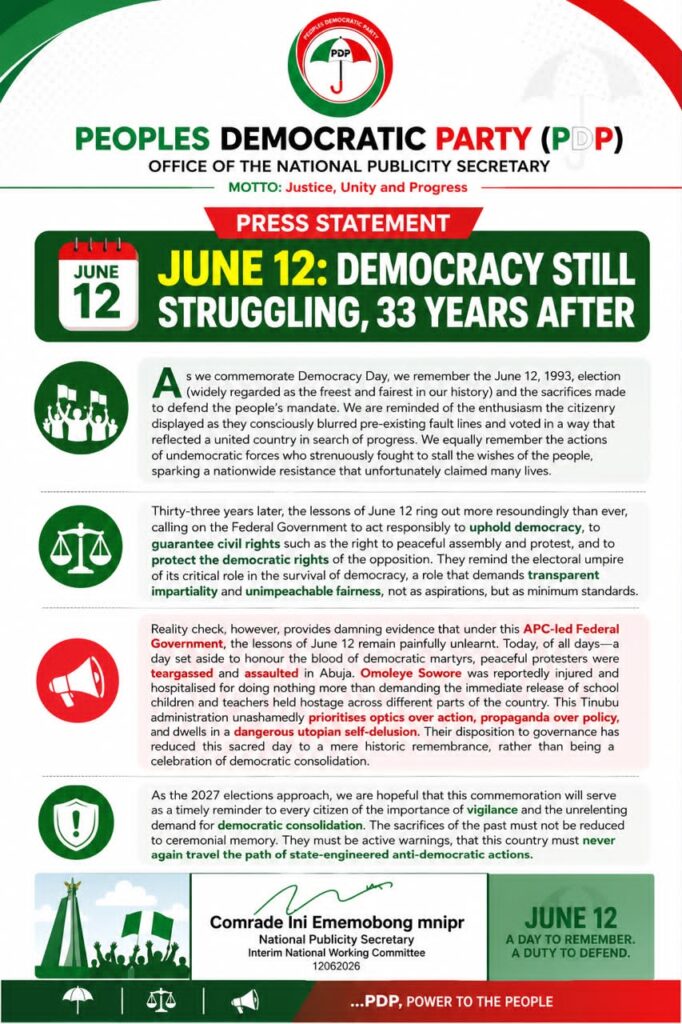
The party recalled the remarkable enthusiasm displayed by Nigerians during the 1993 polls, when citizens transcended ethnic and religious fault lines to vote for national progress.
The statement, signed by Comrade Ini Ememobong, National Publicity Secretary of the PDP Interim National Working Committee, noted that undemocratic forces aborted the popular will, triggering a prolonged resistance that claimed many lives.
“Thirty-three years later, the lessons of June 12 ring out more resoundingly than ever,” the PDP said, urging the Federal Government to uphold democratic principles, guarantee civil rights including the right to peaceful assembly and protest, and protect the rights of the opposition.
The party also reminded the Independent National Electoral Commission (INEC) of its sacred duty to conduct elections with “transparent impartiality and unimpeachable fairness,” describing these as minimum standards rather than mere aspirations.
However, the PDP expressed deep disappointment over what it described as the current administration’s failure to learn from history.
“Reality check, however, provides damning evidence that under this APC-led Federal Government, the lessons of June 12 remain painfully unlearnt,” the statement read. “Today, of all days — a day set aside to honour the blood of democratic martyrs — peaceful protesters were teargassed and assaulted in Abuja.”
The party highlighted the case of activist Omoleye Sowore, who was reportedly injured and hospitalised while demanding the immediate release of schoolchildren and teachers held hostage in different parts of the country.
The PDP accused the Tinubu administration of prioritising “optics over action, propaganda over policy,” and living in “a dangerous utopian self-delusion,” thereby reducing Democracy Day to a mere historic remembrance instead of a celebration of democratic consolidation.
Looking ahead to the 2027 general elections, the opposition party called on all citizens to remain vigilant and unrelenting in their demand for genuine democratic consolidation.
“The sacrifices of the past must not be reduced to ceremonial memory. They must be active warnings that this country must never again travel the path of state-engineered anti-democratic actions,” the PDP warned.
Comrade Ini Ememobong, mnipr is the National Publicity Secretary, Interim National Working Committee of the Peoples Democratic Party.
Opinions
Nigeria Cannot Build Flood Resilience While Destroying Its Wetlands
The next 10 to 20 years are likely to bring even more dangerous combinations of intense rainfall, river flooding, urban flooding, and coastal flooding/erosion.
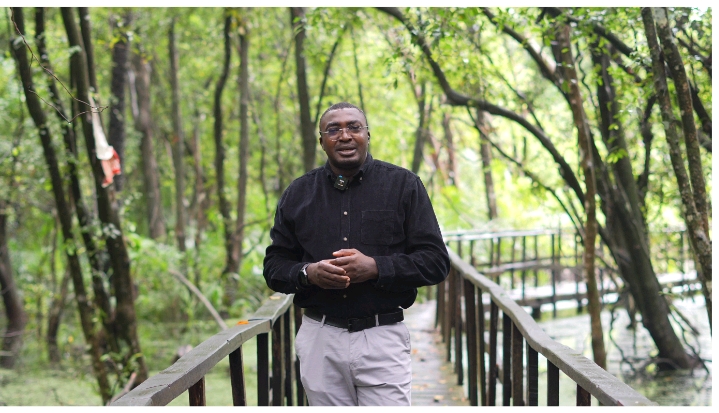
By DrJoseph Onoja
Every rainy season in Nigeria now arrives with a familiar sense of anxiety. Roads disappear beneath floodwaters, homes are submerged, businesses are disrupted, and lives are displaced.
What was once considered a seasonal inconvenience has become a recurring national emergency.
But Nigeria’s flooding crisis is no longer simply about rain.It is the result of a dangerous collision between climate change, environmental degradation, and weak urban planning.
Climate change is intensifying rainfall patterns across Africa, but human activities like deforestation, wetland destruction, poor drainage systems, and uncontrolled development on floodplains are multiplying the scale of destruction.
The uncomfortable truth is this: flooding in Nigeria is becoming structural.
Climate change may trigger the rainfall, but environmental degradation determines whether rain becomes disaster.
Climate Change Is Intensifying the Risk
Scientific evidence continues to show that extreme rainfall events are becoming more intense across Africa.
According to the Intergovernmental Panel on Climate Change (IPCC), both the frequency and intensity of heavy precipitation events are projected to increase as global warming accelerates.
In cities like Lagos, the impacts are already visible. Urban flooding has become more widespread, with both short-duration high-intensity rainfall and prolonged rainfall events increasing flood risks.
However, climate change alone does not explain the scale of devastation we are witnessing.
Ordinarily, heavy rainfall should not automatically become a disaster.
Healthy wetlands, functional drainage systems, protected floodplains, and well-planned urban infrastructure are designed to absorb and manage excess water.
” In Lagos, this issue is particularly critical. Water bodies, lagoons, creeks, and wetlands cover more than 62% of the state’s land area, while another significant portion remains seasonally flood prone.”
But when these natural and engineered systems fail or are deliberately compromised, communities become increasingly vulnerable.Nigeria’s flood challenge is therefore not only a climate issue. It is also a planning and governance issue.
Nigeria Is Destroying Its Natural Flood Defences
One of the most overlooked aspects of flood resilience in Nigeria is the role of nature itself.
Forests, wetlands, mangroves, and floodplains act as natural flood buffers. They absorb excess water, slow runoff, reduce erosion, and minimize flood peaks.
In many ways, they function as invisible infrastructure protecting communities from disaster.
Yet across Nigeria, these ecosystems are being degraded at alarming rates.
Deforestation reduces the soil’s ability to absorb water, increasing surface runoff and erosion. Sediments washed into drainage systems reduce their capacity and worsen urban flooding.
At the same time, wetlands and floodplains are increasingly being sandfilled and converted for construction and urban expansion.
The irony is embedded in the name itself: floodplains exist to absorb floods.
In Lagos, this issue is particularly critical. Water bodies, lagoons, creeks, and wetlands cover more than 62% of the state’s land area, while another significant portion remains seasonally flood prone.
When these ecosystems are filled, degraded, or built over, floodwater has fewer places to disperse safely. Instead, it ends up in homes, roads, and communities.
Wetlands are not vacant land waiting for development; they are natural infrastructure protecting cities from collapse.
The implications are enormous. Sensitive ecological areas such as the Lekki Conservation Centre continue to serve as natural buffers by receiving, retaining, and absorbing water from surrounding environments.
If such ecological buffers are lost to uncontrolled development, entire communities become significantly more exposed to flooding risks with attendant consequences for human health, livelihoods, wellbeing, infrastructure, and property.
Nigeria’s Adaptation Gap Is Growing
Nigeria is not standing completely still. There are signs of progress.
The Lagos Climate Adaptation and Resilience Plan identify dozens of adaptation projects and estimates financing needs between US$9 billion and US$16 billion by 2035.
This reflects increasing recognition that climate resilience must become a development priority.
But adaptation efforts are still not keeping pace with the speed of urban growth and climate risk.
Rapid urbanization, inadequate drainage systems, weak urban governance, and insufficient climate-resilient infrastructure continue to increase exposure across many Nigerian cities.
The next 10 to 20 years are likely to bring even more dangerous combinations of intense rainfall, river flooding, urban flooding, and coastal flooding/erosion.
Sea level rise will further worsen risks in low-lying coastal cities, especially Lagos.
Without urgent intervention, the economic, social, and environmental costs will continue to rise.
The cost of protecting ecosystems today is far lower than the cost of rebuilding cities tomorrow.
Nature-Based Solutions Must Become National Policy
Nigeria cannot engineer its way out of this crisis through concrete alone. Flood resilience requires a combination of infrastructure investment and ecological protection.
Nature-based solutions must become central to national and subnational climate adaptation strategies.
This means:
- • Protecting and restoring forests, wetlands, mangroves, and floodplains
• Strengthening drainage and storm water systems
• Enforcing risk-sensitive urban planning regulations
• Preventing development on ecologically sensitive areas
• Improving solid waste management to prevent blocked drainage systems
• Investing in low-carbon and climate-resilient growth pathways.
These actions are not optional environmental luxuries. They are essential investments in public safety, economic stability, and national resilience.
The future of flood resilience in Nigeria will depend as much on ecological protection as on engineering.
A Defining Choice for Nigeria
Floods are no longer isolated disasters. They are warning signs. They reveal the growing consequences of ignoring environmental limits while cities expand faster than resilience systems can keep pace.
They expose the cost of treating ecosystems as expendable rather than essential.
Nigeria still has a choice. We can continue reacting to flood disasters after they occur, or we can invest in prevention, resilience, and nature-based infrastructure before the next crisis arrives.
Protecting Forests, wetlands, restoring degraded ecosystems, and strengthening climate adaptation systems are not simply environmental priorities.
They are national development imperatives.The future resilience of Nigeria’s cities may well depend on how seriously we take them today.
• Dr Joseph Onoja , a conservation scientist, is the Director – General of the Nigerian Conservation Foundation (NCF).


FG Inaugurates Nigeria Anti-Doping Centres Board

Team Nigeria Targets 20 Golds at Commonwealth Games

Burna Boy Overtakes Tyla as Africa’s Most Streamed Artist on Spotify

Tech Expert, Zuckerberg trains with UFC champions, Adesanya, Alexander

Organ Trafficking: Ekweremadu bags 10 years in UK prison

SAINT OBI: Between his marriage and his death
-

 Business3 days ago
BUA Group Denies Reports of Bid to Acquire Stake in Kano Pillars Football Club
-

 Business3 days ago
Naira Exchange Rates Tuesday, 30 June 2026
-

 Business3 days ago
Nigeria’s oil minister orders marketers to reduce fuel price
-
 News3 days ago
Insecurity: NSCIA fumes “Enough is Enough” over attacks on Islam and Muslims in Nigeria
-

 Business2 days ago
BOI names Kuramo Capital Fund Manager for $170.6m iDICE
-

 News2 days ago
Nigeria’s data centers worth $2bn
-

 News3 days ago
FG Supports Tomato, Pepper Sellers Too, Not Just ‘Akara’ — Remi Tinubu
-

 News3 days ago
NYSC to be headed by civilians under new reforms