
News
Tribunal Strikes out PDP, Adebutu’s reply on Vote Buying Allegation Against Dapo Abiodun


The Governorship Election Petition Tribunal sitting in Abeokuta, Ogun State, on Monday struck out the vote buying allegation, levelled against Governor Dapo Abiodun and the All Progressives Congress (APC) by the Peoples Democratic Party (PDP) and its governorship candidate, Ladi Adebutu.
Adebutu had dragged Governor Abiodun and the APC to the tribunal challenging their declaration as the winner of the 18, March 2023 governorship election in the state.
But the governor’s lawyers, led by Chief Wole Olanipekun (SAN), in their defence to the petition, made weighty allegations backed up with police report, establishing that Adebutu and the PDP engaged in vote buying during the elections.
On 22 May, 2023, Adebutu and the PDP filed a reply to the defence by Governor Abiodun and the APC, also levelling vote buying allegation against the ruling party.
The Governor’s lawyers, represented by Prof. Taiwo Osipitan (SAN), however, filed an application asking the Tribunal to strike out the Reply in its entirety or in the alternative, to strike out offending paragraphs from that Reply.
Osipitan argued that the Reply filed by Adebutu and PDP contravenes paragraph 16(1) (a & b) of the Electoral Act and the rules of court pleadings.
While ruling on the matter, the Chairman of the Tribunal, Justice H.N. Kunaza, agreed with the submissions by Prof. Osipitan
In the ruling, supported by the other two members; Hon. Justice J.B. Egele and Hon. Justice Sannusi Shehu, the Tribunal overruled Adebutu’s lawyers, led by Chief Goddy Uche (SAN), saying that the application filed by the Governor’s lawyers was not the kind of application that the Constitution requires to be determined at the end of proceedings in judgment.
Relying on relevant provisions of the Constitution, the Tribunal held that only applications that challenge the tribunal’s jurisdiction or the competence of a petition will be deferred till judgment whereas the application filed by Governor Abiodun’s lawyers was not that kind of application.
The Tribunal also held that the Reply by Adebutu and PDP was incompetent for multiple reasons.
The Tribunal identified some paragraphs which contained unnecessary and repetitive allegations, others, which contained arguments and legal conclusions (which are not allowed in replies), and some paragraphs which were an improper expansion of the petition earlier filed.
The Tribunal noted that in their petition, Adebutu and PDP alleged that Governor Abiodun and APC committed corrupt practices during the gubernatorial elections. The Tribunal further noted that vote buying is a specie of corruption and that if PDP and Adebutu truly believed that APC engaged in vote buying, the petitioner ought to have included those allegations in their petition from the start, which they did not do.
The Tribunal noted that if the Reply filed by Adebutu and PDP was permitted, there was a risk to prejudice, surprise, or even shut out Governor Abiodun and APC on the issues raised in that Reply.
The Tribunal denounced Adebutu and the PDP for coming up with the vote-buying allegation only after APC and Governor Abiodun had done same against them.
With this backdrop, the Tribunal unanimously concluded that Governor Abiodun and APC would be prejudiced if the Reply filed by Adebutu and PDP is allowed.
The Tribunal held that when Governor Abiodun and APC filed their defence, they joined issues with Adebutu and PDP; that by joining issues, the parties fixed the dispute; and that it was improper to go outside those issues in the Reply.
The Tribunal also found that it was unnecessary to file a Reply in the circumstance, as held in several decisions of the Supreme Court and the Appeal Court.
The Reply was accordingly struck out.
With this ruling, only the allegation of vote buying made by Governor Abiodun and APC against Adebutu and the PDP would be entertained by the tribunal.
Jelili Owonikoko (SAN), represented INEC, while the APC team was led by Chief Onyeazu Ikpeazu (SAN).
It would be recalled that Adebutu and PDP leaders in Ogun State have been charged for the offence of vote buying by the Federal Government, a situation that has led to Adebutu being a fugitive to the law.





News
IGP Disu Launches Nigeria Police Force Vigilant App, for Tracking Crimes
” The police cannot be everywhere at the same time, but through technology and partnership with the citizens, we can significantly expand our capability to prevent and respond to crimes,” he noted.


The Inspector-General of Police, IGP Olatunji Disu, has launched the Nigeria Police Force Vigilant App as part of efforts to strengthen public engagement, internal communication and the fight against increasingly sophisticated crimes.
Disu also unveiled MTN Closed User Group (CUG) Network for strengthening communication among police commands, formations, divisions and specialised units nationwide.
Speaking during the launch ceremony in Abuja, IGP Disu said that the changing nature of crime and the speed at which information travels have made it necessary for the police to embrace technology.
The policing environment is changing rapidly. Crime is becoming more sophisticated. Information moves faster, and citizens increasingly expect public institutions to be accessible and respond to technology,”said Disu.
He explained that the Vigilant App was designed to improve communication between the police and members of the public by enhancing information sharing and citizen engagement.
The IGP urged Nigerians to use the platform responsibly to report suspicious activities, provide useful information and seek assistance when necessary .
Disu also charged officers managing the platform to operate with professionalism and integrity, stressing that information received through the system must be handled responsibly, investigated diligently and protected appropriately.
“The police cannot be everywhere at the same time, but through technology and partnership with the citizens, we can significantly expand our capability to prevent and respond to crimes,” he noted.
Disu observed that effective communication often determines the success of operations, emergency responses and investigations.
“In policing, information delayed can be information lost,” the IGP declared.
News
Edo Influential Politician, Daniel Orbih, dies at 64 •Obaseki mourns
Obaseki said Orbih’s contributions to Nigerian politics and the PDP remained significant, particularly during his years of service in Edo.

•Chief Daniel Osi Orbih
Chief Daniel Osi Orbih, a chieftain of the Peoples Democratic Party (PDP) is dead, aged 64.
Orbih, known by his traditional title, the Kulukulu 1 of Ogoni Land and Oduma of Uzairue, reportedly died on Monday, 31st August 2026.
His death was confirmed in a statement issued by his family and signed by Francis Udukhomoi Orbih, Esq., on behalf of the Orbih family.
Orbih was born on the 27th of October, 1961, to Chief and Mrs M.C.K. Orbih of Ogbona in Etsako Central Local Government.
He ventured into politics in 1999, and was the deputy governorship candidate of the All Peoples Party (APP) in Edo State, describing Orbih as a prominent figure and influential voice in Edo politics.
Condolences
Former governor of Edo, Godwin Obaseki, lamented that Orbih ‘s death represents a significant loss to Edo.
Obaseki said Orbih’s contributions to Nigerian politics and the PDP remained significant, particularly during his years of service in Edo.
“For many years, he provided leadership to the Peoples’ Democratic Party (PDP) in Edo State as its State Chairman and subsequently served as the PDP National Vice Chairman, South-South.
“Through these roles, he contributed significantly to the development of the party in the Edo State and Nigeria, ” he said.
He emphasised that the former PDP chairman’s death represented a significant loss to Edo State and Nigeria, while commiserating with his family, friends and political associates.
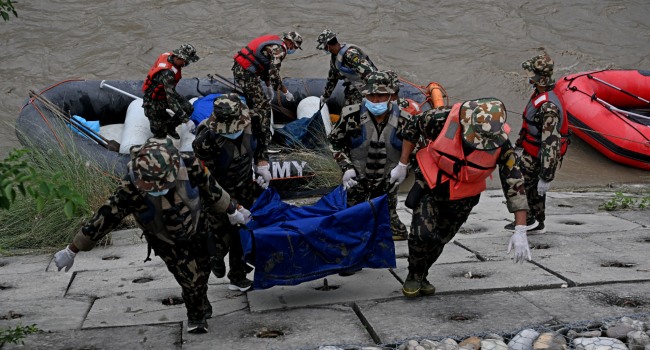
The death toll from catastrophic flash floods along the Nepal-China border has surged past 1,000, authorities said Tuesday, as rescue teams continued searching through mud, debris and damaged hydropower tunnels nearly a week after the disaster.
Nepal’s National Disaster Risk Reduction and Management Authority reported 987 deaths in the country, with Chinese state media confirming 16 fatalities in Tibet, bringing the combined toll to more than 1,000. Around 3,900 people remain missing in Nepal, including 583 foreign nationals, while China has reported 546 missing.
The floods were triggered on August 26 by a glacial collapse near the border that sent a massive surge of water, ice, rock and debris racing down the Trishuli and Bhotekoshi river systems. Entire settlements were wiped out, roads and bridges destroyed, and multiple hydropower projects heavily damaged.
Hundreds of workers are still feared trapped in mud-filled tunnels at hydropower sites. Joint teams of Nepalese, Chinese, Indian and other international rescuers have so far pulled out more than 270 people from those sites, while overall more than 11,800 people have been rescued across the affected districts.
Chitwan district has recorded the highest number of recovered bodies, followed by Nawalparasi. Many victims remain unidentified, and authorities have begun mass burials while collecting DNA samples to help families identify the dead. Fresh flood alerts were also issued in several districts amid ongoing intermittent rain.


Nollywood actress Atinuke Kareem dies of breast cancer

IGP Disu Launches Nigeria Police Force Vigilant App, for Tracking Crimes

Edo Influential Politician, Daniel Orbih, dies at 64 •Obaseki mourns

Tech Expert, Zuckerberg trains with UFC champions, Adesanya, Alexander

Organ Trafficking: Ekweremadu bags 10 years in UK prison

SAINT OBI: Between his marriage and his death
-

 Business1 day ago
Naira Exchange Rates Today, Monday August 31
-

 Business2 days ago
PZ Cussons Reports N45.2bn PAT, Proposes N2.50 Dividend
-

 News1 day ago
JAMB introducing facial scan to catch UTME impersonators
-

 Business1 day ago
Emzor Pharma raises N26.7bn bond to boost local drug manufacturing
-

 Business12 hours ago
Commercial Banks Borrowing From CBN Drops By 89% in August
-

 Entertainment1 day ago
Dolly Parton Buried By Husband’s Grave In Private Cemetry
-

 Business1 day ago
Nigeria’s GDP grew 4.43% in Q2 2026, says NBS
-

 Politics1 day ago
G100 Opposition Summit Proposes Single 4-year Term