
Business
BUA Foods reports 24% revenue growth as Q1 profit hits N125bn

BUA Foods Plc has announced its unaudited financial results for the first quarter of 2025, demonstrating robust growth across key financial indicators.
The company recorded a revenue growth of 24 per cent to N442.1bn in Q1 2025, up from N356.9bn in the corresponding period of 2024.
The performance was driven by increases in revenue from Flour, which soared 145 per cent to N176.2bn, Pasta rose 12 per cent to N41.5bn, and Rice recorded a 1617 per cent to N13.02bn.
Sugar revenue, however, saw a slight 11 per cent quarter-on-quarter decrease to N211.3bn (Q1 2024: N238.2 billion).
BUA Foods, in a statement on Thursday, said it also reported a gross profit of N160.91bn in Q1 2025, a 39 per cent increase compared to N115.42bn in Q1 2024.
This growth led to an improved gross profit margin of 36.4 per cent, a 406 basis point increase from 32.3 per cent in the prior quarter.
Total operating expenses for the period increased by 56 per cent to N22.39bn (Q1 2024: N14.37 billion), due to increases in selling and distribution expenses, which rose 13 per cent to N11.08bn driven by logistics costs, and administrative expenses up 147% to N11.32bn.
Despite the increase in operating expenses, BUA Foods achieved a 124% in profit after tax to N125.28bn in Q1 2025, compared to N55.82bn in Q1 2024.
Consequently, Earnings per Share also saw a significant increase of 125% to N6.96 from N3.10 in the corresponding period.
The company’s total equities stood strong at N554.34bn as of Q1 2025, representing a 29.2% increase from N429.06bn in FY 2024.
This growth was mainly driven by a 30 per cent increase in retained earnings.
Commenting on the results, the Managing Director, BUA Foods, Dr Ayodele Abioye, said, “We are pleased to begin 2025 on a strong note, as our business continued to demonstrate resilience and adaptability amidst a still-evolving macroeconomic landscape.
Despite operating in a high-cost environment, our proactive supply chain measures and improved internal efficiencies enabled us to sustain strong operational momentum.”
“Revenue increased by 24%, while Net Profit leaped by 124% to N125Billion further re-affirming our position as a leading food business on the Nigerian Exchange Limited.
Our ongoing investments in production capacity, product/package innovation and route-to-market development continue to impact our results positively, enabling fulfilment of customer and consumer demand.”
“As we look ahead, we remain focused on deepening our market penetration and accelerating innovation to meet changing consumer needs.
With a stabilizing economy and growing emphasis on food security, we are confident that our unique and integrated business model, strong financial position, and robust execution will continue to enhance our strategic growth and create lasting value for all stakeholders throughout 2025.”




Business
Dangote, NMDPRA Clash Over Refinery’s Free Zone Status
The case has been adjourned until September 9, 2026, when the court is expected to hear the motion on notice.

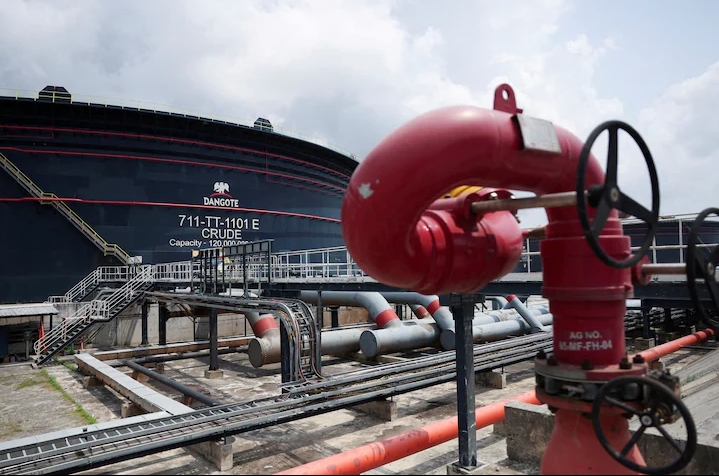
A fresh regulatory battle between Dangote Petroleum Refinery and the Nigerian Midstream and Downstream Petroleum Regulatory Authority (NMDPRA) has erupted into a major legal confrontation over the extent of government’s regulatory powers within Nigeria’s free zones.
A Federal High Court in Lagos yesterday restrained NMDPRA from enforcing its directive suspending the loading and truck-out of petroleum products from the Dangote Refinery, effectively stopping the regulator from taking enforcement action against the facility pending the determination of the substantive application.
Justice Akintayo Aluko, in an interim ruling, also barred NMDPRA, its officers, agents and representatives from entering, sealing, shutting down, restricting access to, obstructing, suspending, disrupting, inspecting, supervising, sanctioning or otherwise interfering with the refinery’s operations at the Lekki Free Zone.
The order followed an ex-parte application filed by Dangote Petroleum Refinery and Petrochemicals FZE in Suit No. FHC/L/CS/1174/2026.
At the heart of the dispute is NMDPRA’s August 24, 2026 directive suspending the loading and truck-out of petroleum products from the refinery.
But the case is rapidly assuming significance beyond the immediate dispute over product evacuation.
It raises a fundamental question about the jurisdiction of Nigeria’s petroleum regulator over businesses operating within designated free zones.
Who Regulates the Refinery?
Dangote is challenging NMDPRA’s action on the ground that the regulator lacks the authority to exercise regulatory or oversight powers over operations within free zones, including the Dangote Industrial Free Zone.
Justice Aluko said the documents placed before the court raised “serious issues” requiring determination, particularly whether NMDPRA possesses the regulatory or oversight powers it sought to exercise over the refinery.
The judge also referred to a March 2, 2026 letter from the Attorney-General of the Federation which, according to the court, “clearly stated” that NMDPRA was not entitled to exercise regulatory powers or oversight functions over operations within free zones.The apparent conflict between that position and NMDPRA’s August 24 directive now forms one of the central issues before the court.
Justice Aluko said the critical question was whether NMDPRA should be allowed to exercise the disputed regulatory authority while the substantive issues remained unresolved.
High Stakes for Downstream Market
The dispute comes at a sensitive time for Nigeria’s downstream petroleum industry, where the Dangote Refinery has become a major source of locally refined petroleum products.
Any regulatory action capable of restricting the refinery’s ability to load and evacuate products has potential implications for petroleum distribution and supply across the country.
For Dangote, the legal battle is also about protecting the operational autonomy and investment framework of a refinery established within a free-zone environment.
For NMDPRA, the issue goes to the core of its mandate as the statutory regulator of Nigeria’s midstream and downstream petroleum sector.
The eventual substantive ruling could therefore have consequences well beyond the two parties.
It could establish a judicial precedent on how far petroleum-sector regulators can go in supervising or enforcing their mandates against businesses operating within free zones.
The case has been adjourned until September 9, 2026, when the court is expected to hear the motion on notice.
Business
Commercial Banks Borrowing From CBN Drops By 89% in August
The CBN has two short term lending windows for banks: the Standing Lending Facility (SLF) and Repo lending.

Commercial banks borrowing from the Central Bank of Nigeria’s (CBN) declined by 89 percent to N126 billion in August 2026 from N1.19 trillion in July 2026.
This means higher liquidity in the banking system.
The CBN has two short term lending windows for banks: the Standing Lending Facility (SLF) and Repo lending.
The apex bank lends money to banks through the SLF at interest rate of 500 bases points (bps) above the Monetary Policy Rate (MPR).
It also lends money to banks through Repurchase (Repo) arrangement, which involves the purchase of banks’ securities with the agreement to sell back at a specific date and usually for a higher price.
Source: Vanguard
Business
Naira Exchange Rates Tuesday September 1
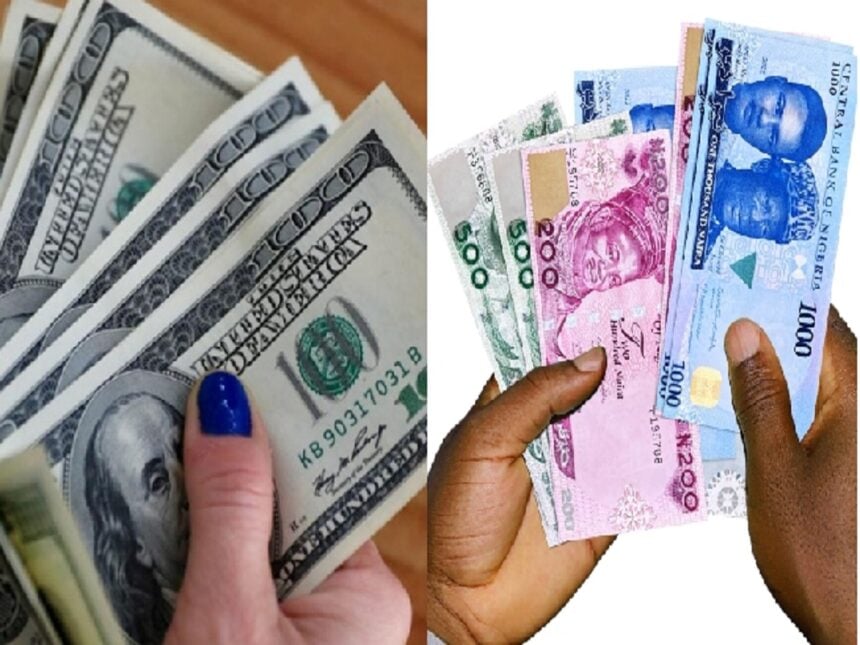
Today, the Naira Black Market exchange rate for 1 US Dollar is 1398 Naira, British Pound is1890 Naira
While EURO is 1595 Naira.
BLACK MARKET EXCHANGE RATES
Today, the Naira Black Market exchange rate for 1 US Dollar is 1398 Naira.
Great British Pound (GBP) is 1890 Naira.
Euro (EUR) is 1595 Naira.
Canadian Dollar (CAD) is 1020 Naira.
Chinese Yuan is 190 Naira.
Ghanaian Cedi is 95 Naira.
South African Rand (ZAR) is 75 Naira.
UAE Dirham is 350 Naira.
CFA Franc (XOF) is 2300 Naira.
CFA Franc (XAF) is 2150 Naira.
Australian Dollar (AUD) is 800 Naira.
CBN EXCHANGE RATES
DOLLAR (USD) ₦1332.94
POUND (GBP) ₦1805.60
EURO (EUR) ₦1545.81
SWISS FRANC (CHF) ₦1647.84
CFA FRANC (XOF) ₦2.37
WEST AFRICAN UNIT OF ACCOUNT (WAUA) ₦1833.11
CHINESE YUAN (CNY) ₦198.36
SAUDI RIYAL (SAR) ₦355.01
SOUTH AFRICAN RAND (ZAR) ₦82.50


Death Toll in Nepal Floods Exceed 1,000

Dangote, NMDPRA Clash Over Refinery’s Free Zone Status

Olukoyede Sacks 40 EFCC Staff Over Corruption

Tech Expert, Zuckerberg trains with UFC champions, Adesanya, Alexander

Organ Trafficking: Ekweremadu bags 10 years in UK prison

SAINT OBI: Between his marriage and his death
-
 Business1 day ago
Naira Exchange Rates Today, Monday August 31
-

 Business1 day ago
PZ Cussons Reports N45.2bn PAT, Proposes N2.50 Dividend
-

 News1 day ago
JAMB introducing facial scan to catch UTME impersonators
-
 Business1 day ago
Emzor Pharma raises N26.7bn bond to boost local drug manufacturing
-

 Politics24 hours ago
G100 Opposition Summit Proposes Single 4-year Term
-

 Entertainment1 day ago
Dolly Parton Buried By Husband’s Grave In Private Cemetry
-

 Business20 hours ago
Nigeria’s GDP grew 4.43% in Q2 2026, says NBS
-
 Business5 hours ago
Commercial Banks Borrowing From CBN Drops By 89% in August