
Politics
Tribunal throws out petition challenging Gov Okpebholo’s election victory in Edo

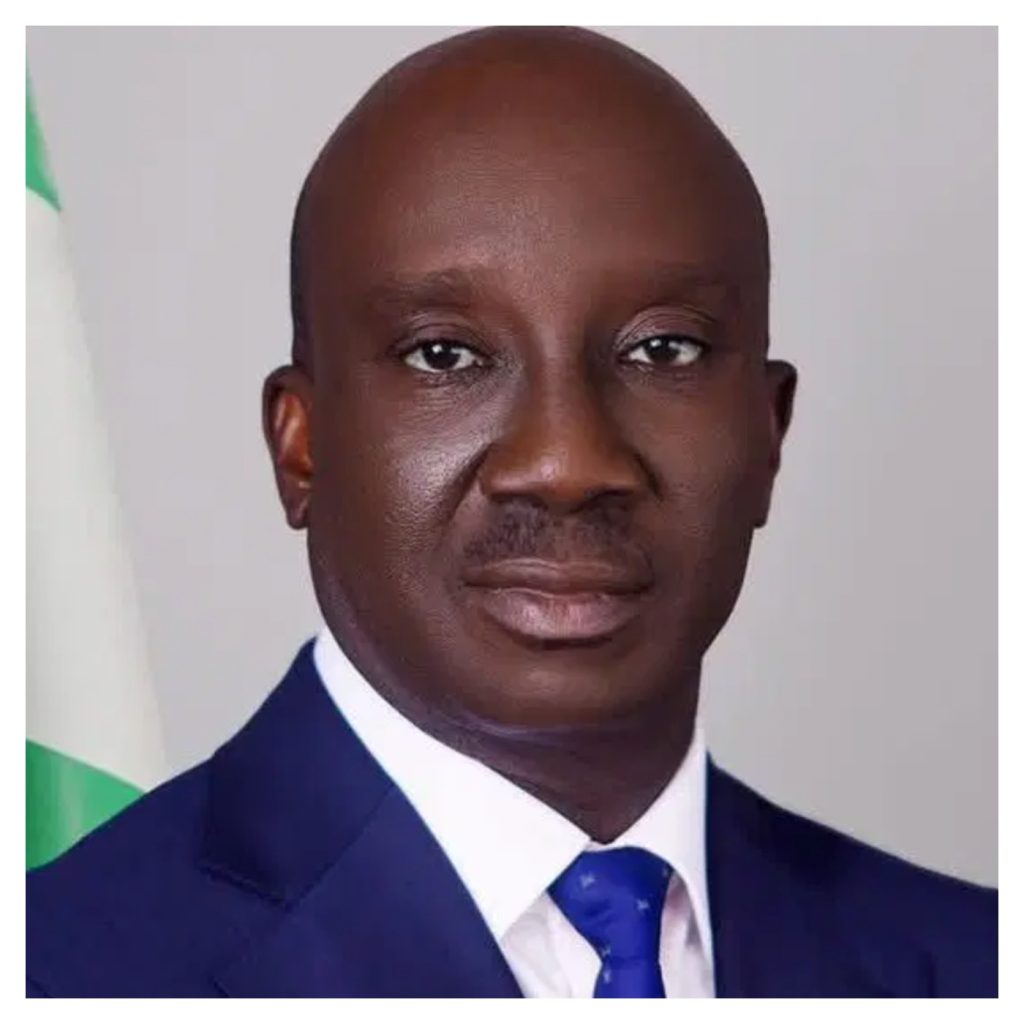
Governor Monday Okpebholo and the All Progressives Congress, APC, have won round one in the series of petitions challenging their declaration as winners of the September 21, 2024, governorship election in Edo State.
A petition instituted against them by the Action Alliance (AA) and one Adekunle Rufai Omoaje was thrown out by the Edo State Governorship Election Petition Tribunal for lacking merit and being frivolous.
In the first judgment of the Tribunal on Wednesday, it was held that Adekunle Rufai Omoaje, who filed the joint petition, had no locus standi to institute the case, as his petition was not based on election-related matters.
Among other points, the Tribunal held that Omoaje did not participate in the governorship election and, as such, had no power to question the validity of the election.
The Tribunal also held that Omoaje’s grievance against the election was that he was not recognized as the National Chairman of the Action Alliance for the purpose of nominating candidates for the poll. However, it was held that his claims had no basis in the Electoral Act of 2022.
Omoaje had, in the petition, asked the Tribunal to declare the declaration of Okpebholo and APC as winners of the election by the Independent National Electoral Commission (INEC) as illegal, unlawful, unconditional, and null and void due to non-compliance with the Electoral Act.
He also alleged corruption and that Okpebholo and APC did not win the majority of lawful votes in the election.
Omoaje further alleged that AA was not allowed to nominate a lawful governorship candidate for the election, having not signed the nomination form as the National Chairman of the party.
INEC had declared Okpebholo of the APC as the winner with 291,667 votes, defeating his closest rival, Asue Ighodalo of the Peoples Democratic Party (PDP), who polled 247,655 votes in the election.
Details later….


Politics
APC Makes Wike, Soludo, Adeleke State’s Campaign Coordinator
Wike belongs to the Peoples Democratic Party (PDP), Soludo is a member of the All Progressives Grand Alliance (APGA), while Adeleke won re-election as Osun governor in 2026 under the Accord Party.

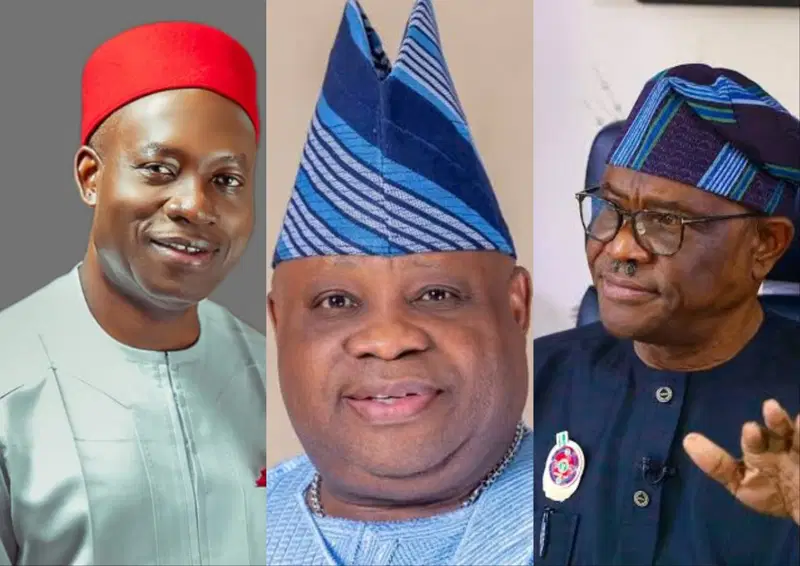
• [L-R] A collage of Soludo, Adeleke and Wike
The All Progressives Congress (APC) has named Nyesom Wike, minister of the Federal Capital Territory (FCT); Ademola Adeleke, Osun governor; and Chukwuma Soludo, Anambra governor, as state campaign coordinators in its expanded presidential campaign council for the 2027 general election.
This is despite their affiliations with other political parties.
Wike belongs to the Peoples Democratic Party (PDP), Soludo is a member of the All Progressives Grand Alliance (APGA), while Adeleke won re-election as Osun governor in 2026 under the Accord Party.
Under the new arrangement, Wike will coordinate the APC campaign in Rivers State and the FCT, Soludo will oversee Anambra, while Adeleke will coordinate the campaign in Osun.
The expanded list is scheduled for inauguration by President Bola Tinubu at the Presidential Villa in Abuja on Wednesday.
The APC initially released its campaign council list on August 22, naming Abdulaziz Yari, former Zamfara governor, as director-general. Senate President Godswill Akpabio, House of Representatives Speaker Tajudeen Abbas and Yobe Governor Mai Mala Buni were appointed deputy director-generals.
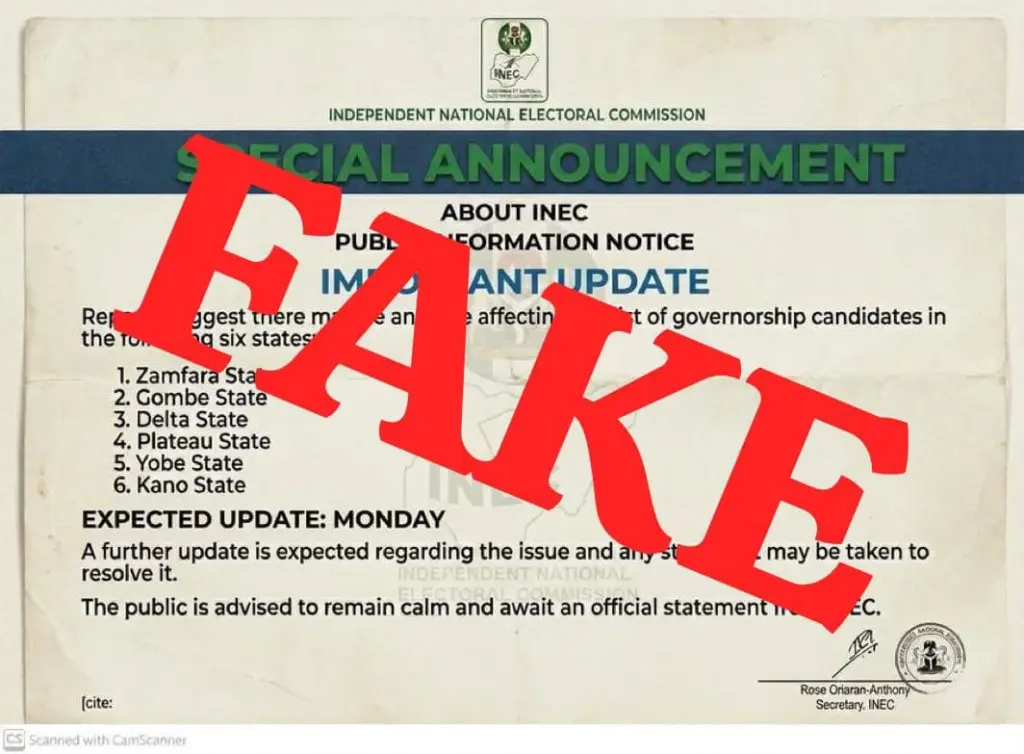
The Independent National Electoral Commission (INEC) has raised the alarm over a fraudulent publication circulating online that claims to be a special announcement about governorship candidates for the 2027 elections.
In a public notice issued on Monday, October 12, 2026, the electoral body described the document as “FAKE” and stressed that it did not originate from the Commission.
The circulating material purports to address issues affecting the list of governorship candidates in six states: Zamfara, Gombe, Delta, Plateau, Yobe, and Kano.
“The Commission wishes to categorically inform the general public that the publication is FAKE and did not originate from INEC. INEC therefore urges members of the public to disregard the fraudulent publication and refrain from sharing it,” the notice stated.
INEC further clarified that any information suggesting it has issued a special announcement concerning governorship candidates in those states is false.
The warning comes just days after the Commission published the final lists of candidates for the February 6, 2027 governorship elections.
The electoral umpire advised Nigerians, political parties, and candidates to rely solely on official notices, press releases, and information released through its verified channels.
These include the INEC website (inecnigeria.org), its Facebook page (INEC Nigeria), X and Instagram handles (@inecnigeria), and the INEC News Portal.
INEC reiterated its commitment to providing accurate electoral information and called on the public to remain vigilant against misleading publications as preparations for the 2027 elections intensify.
Politics
2027: 119 Women Jostle For State’s Governors
States with female governorship candidates are Akwa Ibom (five candidates), Ebonyi (three) Cross River, Adamawa, Delta, Lagos (two each), while Plateau, Abia, Bauchi, Benue, Kaduna, Kano, Kwara, Ogun and Rivers have one female candidate each.
Twenty one political parties are fielding 119 women for governorship elections in next year’s poll, data from the INEC reveals
However, 936 governorship candidates and running mates are on the ballot for the February 6, 2027 poll across 28 states.
Also, out of 10,020 candidates for the House of Assembly, 1,016 are women.
The Nigeria Democratic Congress (NDC) candidate in Adamawa state, Senator Aishatu Dahiru Binani, is the highest ranking woman on the list.
According to the list, 25 women are contesting for governor in 15 states, while there is no female candidates in 13 states.
The statistics show that 94 women across 26 states are running mates.
But there is no female governorship and deputy governorship candidate in Jigawa and Katsina states.
States with female governorship candidates are Akwa Ibom (five candidates), Ebonyi (three) Cross River, Adamawa, Delta, Lagos (two each), while Plateau, Abia, Bauchi, Benue, Kaduna, Kano, Kwara, Ogun and Rivers have one female candidate each.
Ogun State takes the lead with 10 deputy governorship candidates, followed by Plateau and Lagos with nine women, Akwa Ibom; eight Rivers; six, Oyo, Kaduna, Enugu with five each; Abia, Adamawa, Ebonyi, Taraba; four each, Niger and Delta; three each, Gombe, Kebbi, Sokoto and Zamfara; two each, while Bauchi, Benue, Borno, Kano, Kwara, Nasarawa and Yobe have one each.
The women governorship candidates are Doris Uzumma Umezurike (AAC, Abia), Chigbe Chioma Vivian -NRM and Joelyne Ita Hogan Bassey – ADP (Cross River); Bingel Hurung Philomina- ADP (Plateau); Aishatu Dahiru Binani-NDC and Samuel Faith Monday-NRM (Adamawa); Achibong Inimbom Nsikak-ADP, Jimmy Stella Monday-APGA, Emem Umoh-APP, Effiong Asuomo Rosemary-SDP and Umo Blessing Okon-ZLP (Akwa Ibom) and Babageidam Lami- ZLP (Bauchi).
Others are Ujah Mercy Engole-APP (Benue); Mohammed Jemila-YPP (Kaduna); Ahmed Furera-BP (Kano); Jayeola Monturayo-APM (Kwara); Adeyemi Abiola-APP and Peter Helen Ojoyule-ZLP (Lagos), Layi Labode Halima-APP (Ogun); West Ivy-AAC (Rivers); James Esther-LP and Iyovwaye Chris-NDC (Delta); Nwodum Lucy Chinwe-APGA, Nwankwo Martha Ebere-APP and Nwinyinya Juliet-ZLP (Ebonyi).


Oyedele Chairs G-24 Call for Fairer Global Financial System, Affordable Development Financing

NAFDAC scolds fake manufacturers: “You are killing Nigerians in order to make money”

BREAKING: Shell to Exit Nigeria’s Domestic Gas Distribution Business

Tech Expert, Zuckerberg trains with UFC champions, Adesanya, Alexander

BREAKING: Lagos Govt Declares Today, Thursday Work-Free to Mark 2026 Ìṣẹ̀ṣe Day

Organ Trafficking: Ekweremadu bags 10 years in UK prison
-

 Business2 days ago
Nigeria’s ₦33bn Fruit Import Bill Exposes Missed Opportunities in Jos
-

 Business2 days ago
Naira To Dollar, Pound ,Euro …Rates For Monday, October 12
-

 International3 days ago
‘Up to our people’ to pick leader, Zelenskyy responds to Trump’s pledge for new elections in Ukraine
-

 Politics2 days ago
2027: 119 Women Jostle For State’s Governors
-
 Politics2 days ago
BEWARE: Fake 2027 Gov’ Candidates List Circulating Online — INEC Raises Alarm
-

 News2 days ago
Forbes Scores GTBank Best Employers 2026
-

 Opinions2 days ago
Human Capital Africa Statement For International Day of the Girl Child 2026
-

 Business1 day ago
Dangote Refinery IPO Attracts N8.61trn in Subscriptions, Four Times Offer