
Business
Global smartphone shipments fall 20% in Q3 2026, lowest in 14 years
“Consumers are holding on to their devices longer than estimated, increasingly considering refurbished devices and prioritizing higher-value devices,” said Shilpi Jain, a senior analyst at Counterpoint Research.


Counterpoint Research has reported drops in global smartphone shipments by 20% year on year in the third quarter of 2026, hitting the lowest level for the period in 14 years, or since 2012.
The report published on Monday showed that persistent memory shortages and rising component costs disrupted supply and pushed retail prices up.
Smartphone retail prices have increased by 20% so far in 2026 as manufacturers pass higher memory costs on to consumers.
Counterpoint said rising prices for DRAM and NAND memory components inflated bill of materials (BOM) costs, deepened supply shortages and disrupted shipments.
Manufacturers were forced to adjust shipment plans, raise prices and prioritise profitability over sales volumes.
The pressure is changing consumer behaviour. Buyers are holding on to their devices longer and considering alternatives.
“Consumers are holding on to their devices longer than estimated, increasingly considering refurbished devices and prioritizing higher-value devices,” said Shilpi Jain, a senior analyst at Counterpoint Research.
According to the report, Samsung and Apple gain market share during the period under review.
Samsung retained its position as the world’s largest smartphone manufacturer in the third quarter, accounting for 23% of global shipments despite a 3% year on year decline in shipment volume.
Counterpoint attributed Samsung’s performance to demand for its Galaxy Z Fold8 series and stable component supplies for its mid-range devices.
Apple’s market share reached 22%, crossing 20% for the first time in a third quarter, despite a year on year decline in shipments.
The absence of a base iPhone 18 model resulted in a smaller launch-month channel fill than the full iPhone 17 lineup a year earlier.
Counterpoint said the iPhone 18 Pro models recorded a stronger launch than their predecessors, particularly in China and India, while continued momentum from the iPhone 17 series helped offset the shipment decline.


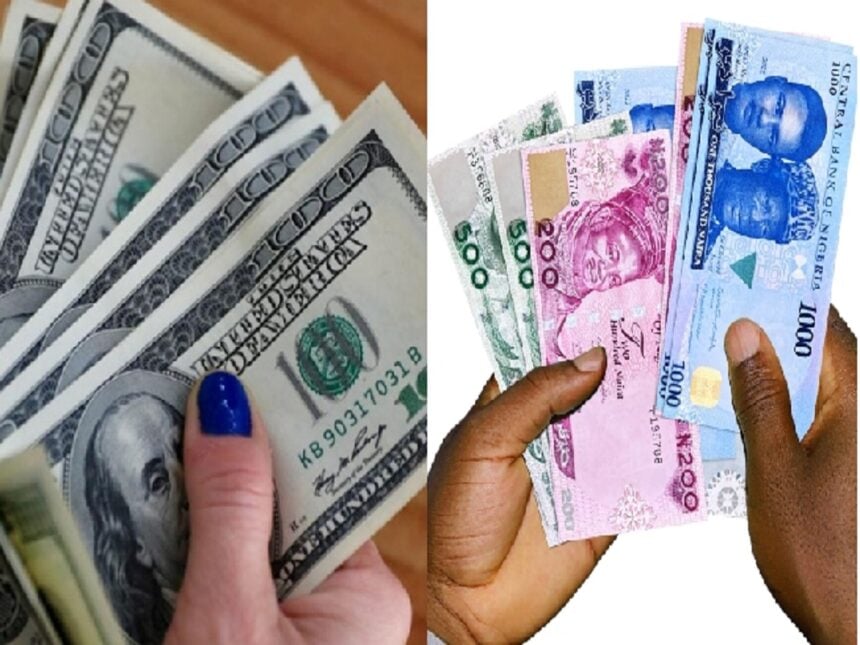
Black Market Rates
1365 DOLLAR (USD)
₦1820 POUND (GBP)
₦1525 EURO (EUR)
₦970 DOLLAR (CAD)
₦65 RAND (ZAR)
₦350 DIRHAM (AED)
₦190 YUAN (CNY)
₦100 G.CEDI (GHS)
₦2300CFA F.(XOF)
₦2200 CFA F.(XAF)
₦850 AUSSIE (AUD)
OFFICIAL CBN EXCHANGE RATES
DOLLAR (USD)₦1332.10
POUND (GBP)₦1762.63
EURO (EUR)₦1489.15
SWISS FRANC (CHF)₦1598.58
JAPANESE YEN (JPN)₦8.40
CFA FRANC (XOF)₦2.27
WEST AFRICAN UNIT OF ACCOUNT (WAUA)₦1800.76
CHINESE YUAN (CNY)₦199.03
SAUDI RIYAL (SAR)₦354.67
SOUTH AFRICAN RAND (ZAR)₦80.58
Business
Top 10 Highest-Paid CEOs in Nigeria
The ranking, published in 2026, is based on estimated annual remuneration and should not be interpreted as basic salary or the amount of cash actually received during the year. Executive remuneration can include salary, bonuses, allowances and other compensation.
By Ochefa
Chief executives of some of Nigeria’s biggest companies are commanding annual remuneration running into billions of naira, with oil and gas, telecommunications, cement, banking and consumer goods executives dominating the latest ranking.
A 2026 ranking puts former Seplat Energy Chief Executive Officer, Roger Thompson Brown, at the top with estimated annual remuneration of ₦3.90 billion, followed by MTN Nigeria CEO Karl Toriola with ₦3.14 billion.
The ranking, published in 2026, is based on estimated annual remuneration and should not be interpreted as basic salary or the amount of cash actually received during the year. Executive remuneration can include salary, bonuses, allowances and other compensation.
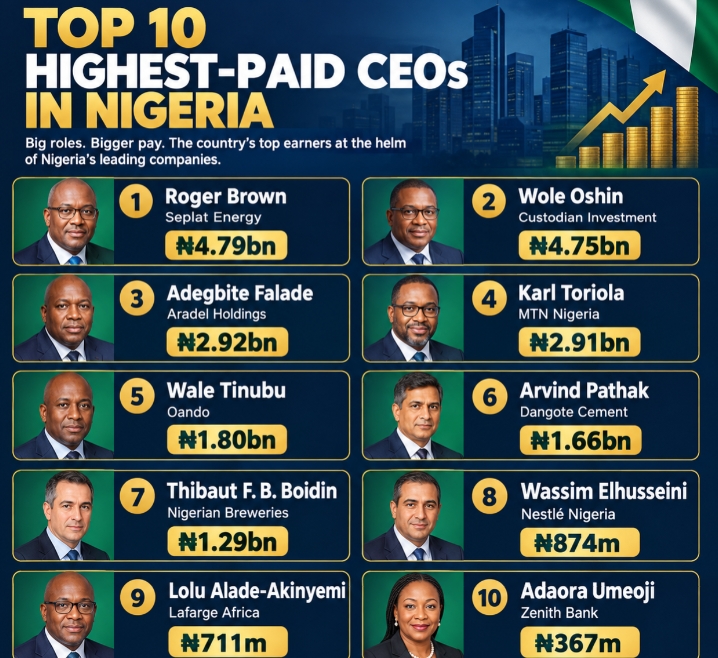
Image generated by AI
1. Roger Thompson Brown — Seplat Energy — ₦3.90bn
Brown topped the ranking with estimated remuneration of ₦3.90 billion.
He joined Seplat in 2013 as Chief Financial Officer and Executive Director before becoming CEO in 2020.
During his tenure, he oversaw Seplat’s $1.28 billion acquisition of ExxonMobil’s Nigerian shallow-water business, a transaction that significantly expanded the company’s domestic oil production portfolio.
However, Brown is no longer Seplat’s CEO. He retired from the company and left its board on July 31, 2026, after six years as CEO.
2. Karl Toriola — MTN Nigeria — ₦3.14bn
MTN Nigeria CEO Karl Toriola ranked second with estimated annual remuneration of ₦3.14 billion.
Toriola joined the MTN Group in 2006 and has held senior positions across its African operations, including CEO of MTN Cameroon and Chief Technology Officer of MTN Nigeria. He became CEO of MTN Nigeria in March 2021.
3. Adegbite Falade — Aradel Holdings — ₦2.44bn
Adegbite Falade, Managing Director and CEO of Aradel Holdings, ranked third with estimated remuneration of ₦2.44 billion.
Falade heads the indigenous integrated energy company with interests spanning oil, gas and power.
He has more than two decades of experience in the energy industry and holds a first-class degree in Electrical and Electronics Engineering from the University of Ibadan and an MBA from Warwick Business School.
4. Wale Tinubu — Oando — ₦1.80bn
Oando Group Chief Executive, Jubril Adewale “Wale” Tinubu, occupied fourth position with estimated remuneration of ₦1.80 billion.
A lawyer by training, Tinubu has spent decades in Nigeria’s oil and gas industry. Under his leadership, Oando expanded through major acquisitions, including Unipetrol and Agip Nigeria.
5. Arvind Pathak — Dangote Cement — ₦1.58bn
Dangote Cement Group Managing Director and CEO, Arvind Pathak, ranked fifth with estimated remuneration of ₦1.58 billion.
Pathak became CEO of Dangote Cement in March 2023 after a long career in the Indian cement industry, including leadership positions at Birla Corporation and other major cement companies.
6. Samba Seye — TotalEnergies Nigeria — ₦1.06bn
Dr Samba Seye, Managing Director of TotalEnergies Marketing Nigeria, ranked sixth with estimated remuneration of ₦1.06 billion.
An engineer with a doctorate from the University of Sciences and Techniques of Lille in France, Seye has worked across the energy industry, including senior positions at Shell and TotalEnergies. He became Managing Director of Total Nigeria in September 2021.
7. Adaora Umeoji — Zenith Bank — ₦874m
Zenith Bank Group Managing Director and CEO, Adaora Umeoji, was the only woman among the 10 executives, ranking seventh with estimated remuneration of ₦874 million.
Umeoji became Zenith Bank’s GMD/CEO in June 2024 after more than two decades with the bank, becoming its first female chief executive.
Separate analysis of audited 2025 accounts shows Zenith’s highest-paid director received ₦367 million in 2025, illustrating why rankings based on different definitions of remuneration can produce substantially different figures.
Proshare, for example, defines total compensation to include basic salary, benefits and dividends from shareholdings.
8. Wassim Elhusseini — Nestlé Nigeria — ₦831m
Nestlé Nigeria Managing Director and CEO, Wassim Elhusseini, ranked eighth with estimated remuneration of ₦831 million.
Elhusseini joined Nestlé in 2002 and held senior sales and business-development positions across the Middle East before becoming Managing Director/CEO of Nestlé Nigeria in September 2020.
9. Adebayo Alli — Guinness Nigeria — ₦756m
Guinness Nigeria Managing Director and CEO, Adebayo Alli, ranked ninth with estimated remuneration of ₦756 million.
Alli became CEO in January 2024, taking responsibility for the Nigerian operations of Guinness Nigeria, part of global drinks company Diageo.
10. Segun Agbaje — GTCO — ₦471m
GTCO Group Chief Executive Officer, Segun Agbaje, completed the top 10 with estimated remuneration of ₦471 million.
Agbaje became Managing Director and CEO of Guaranty Trust Bank in 2011 and later assumed the group CEO role following the creation of GTCO’s holding-company structure.Energy and telecoms dominate.
The ranking highlights the concentration of Nigeria’s highest executive remuneration in capital-intensive sectors.
Oil and gas executives occupy three of the first four positions, while telecommunications, cement, banking and consumer goods also feature prominently.
Proshare’s separate analysis of FY2025 audited accounts found that the 10 highest-paid CEOs had combined total compensation of ₦30.04 billion, up 42 per cent from ₦21.17 billion in 2024. Its methodology included basic salary, benefits and dividends linked to CEOs’ shareholdings.
Business
Dangote Refinery IPO Attracts N8.61trn in Subscriptions, Four Times Offer
The IPO is going very well. We will extend the closing date because we want more of our African brothers and sisters to participate…

Strong investors demand for Dangote Petroleum Refinery’s public offer has prompted two-week extension of share offer to October 27 as the company seeks wider participation across Africa.
In a statement by the Dangote Group on Monday, Dangote was quoted as saying that the company originally targeted to raise N2.15 trillion but the offer had been over subscribed to about N8.61trillion.
The N8.61 trillion figure represents an estimate based on reported subscriptions of roughly four times the IPO’s N2.15 trillion offer value.
The company has not officially confirmed the exact subscription amount.
He said that the two weeks extension was not driven by a need to raise more money but by the company’s desire to give more Africans an opportunity to own shares in the business.
The IPO comprises 4.1 billion ordinary shares priced at N525 each, giving the offer a total value of N2.1525tn if all the shares are subscribed.
“The IPO is going very well. We will extend the closing date because we want more of our African brothers and sisters to participate.
Following our discussions with the Nairobi Stock Exchange, we have identified what we believe is the best way to facilitate participation. We are now trying to replicate that arrangement with other African exchanges to ensure wider participation,” he said.


Global smartphone shipments fall 20% in Q3 2026, lowest in 14 years

Naira Exchange Rates To Dollar , Pound ,Euro, … Tuesday, October 13
Top 10 Highest-Paid CEOs in Nigeria

Tech Expert, Zuckerberg trains with UFC champions, Adesanya, Alexander

Organ Trafficking: Ekweremadu bags 10 years in UK prison

SAINT OBI: Between his marriage and his death
-
 Business1 day ago
Naira To Dollar, Pound ,Euro …Rates For Monday, October 12
-
 Business1 day ago
Nigeria’s ₦33bn Fruit Import Bill Exposes Missed Opportunities in Jos
-

 International2 days ago
‘Up to our people’ to pick leader, Zelenskyy responds to Trump’s pledge for new elections in Ukraine
-

 Opinions1 day ago
Human Capital Africa Statement For International Day of the Girl Child 2026
-
 News1 day ago
Forbes Scores GTBank Best Employers 2026
-

 Politics1 day ago
2027: 119 Women Jostle For State’s Governors
-

 Politics20 hours ago
BEWARE: Fake 2027 Gov’ Candidates List Circulating Online — INEC Raises Alarm
-

 International2 days ago
Time for Ukraine to get a new president’, says Trump