
News
Supreme Court Fixes October 22 to Hear 16 State Govts’ Suit Challenging EFCC Establishment


The Supreme Court, on Tuesday, fixed October 22 for the hearing of a suit filed by no sixteen state governments challenging the constitutionality of the laws that established the Economic and Financial Crimes Commission (EFCC), and two others.
A seven-man panel of justice, led by Justice Uwani Abba-Aji, fixed the date after the states were joined as co-plaintiffs and leave granted for consolidation of the case in the suit originally filed by the Kogi State Government through its Attorney General (AG).
The states that joined in the suit marked: SC/CV/178/2023 include Ondo, Edo, Oyo, Ogun, Nassarawa, Kebbi, Katsina, Sokoto, Jigawa, Enugu, Benue, Anambra, Plateau, Cross-River and Niger.
The 16 states are relying on the fact that the Constitution is the supreme law and any law that is inconsistent with it is a nullity.
The Supreme Court, in Dr. Joseph Nwobike Vs Federal Republic of Nigeria, had held that it was a UN Convention against corruption that was reduced into the EFCC Establishment Act and that in enacting this law in 2004, the provision of Section 12 of the 1999 Constitution, as amended, was not followed.
The argument was that, in bringing a convention into Nigerian law, the provision of Section 12 must be complied with.
The States that joined in the suit marked: SC/CV/178/2023 include Ondo, Edo, Oyo, Ogun, Nassarawa, Kebbi, Katsina, Sokoto, Jigawa, Enugu, Benue, Anambra, Plateau, Cross-River and Niger
The 16 state governors argued that the provision of the Constitution necessitated the majority of the States’ Houses of Assembly agreeing to bringing the convention in before passing the EFCC Act and others, which was allegedly never done.
The argument of the states in their present suit, which had reportedly been corroborated by the Supreme Court in the previous case mentioned, is that the law, as enacted, could not be applied to states that never approved of it, in accordance with the provisions of the Nigerian constitution.
Hence, they argued that any institution so formed should be regarded as an illegal institution.
When the case was called on Tuesday, lawyers, who represented the states, made their submissions.
While majority sought to be joined as co-plaintiffs, two of the states prayed for an order for consolidation of the case.
Kogi State AG’s counsel, Abdulwahab Mohammed, informed the court that there were states that indicated interest in consolidation of the case and those seeking to be joined as co-plaintiffs.
“It is for this honourable court to tell us how to proceed my lord. “Out of about 15 states, there are about 13 of them that have indicated interest to be co-plaintiffs and only two want consolidation.
“To make the task of the court easier, those who want to be be joined as co-plaintiff should be joined and abide by the processes already filed and those who sought consolidation should be asked to file within seven days,” Mohammed said.
After the lawyers’ submissions, Justice Abba-Aji granted their prayers. She adjourned the matter until Oct. 22 for hearing.
The Kogi State AG had initially, in the suit number: SC/CV/178/2023 sued the Attorney-General of the Federation (AGF) as sole defendant. In the originating summons filed by a team of lawyers led by Prof.Musa Yakubu, the state raised six questions for determination and sought nine reliefs.
Among the reliefs being sought are “A declaration that the Federal Government of Nigeria through the Nigerian Financial Intelligence Unit (NFIU) or any agency of the Federal Government lacks the power to issue any directive, guideline, advisory or any instrument howsoever called for the administration and management of funds belonging to Kogi State of Nigeria or any Local Government Area of Kogt State.
“A declaration that the Economic and Financial Crimes Commission (EFCC), the Nigerian Financial Intelligence Unit (NFIU) or any agency of the Federal Government of Nigeria cannot investigate, requisition documents, invite and or arrest anyone with respect to offences arising from or touching on the administration and management of funds belonging to Kogi State of Nigeria or any Local Government Area of Kogi State.”






News
Jega loses wife, Hajiya Hadiza
Hajia Hadiza passed on yesterday and was buried according to Islamic rites.
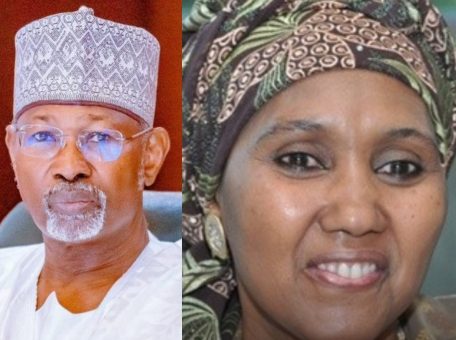
The Special Adviser to the President on Livestock Development, Prof. Attahiru Jega, has lost his wife, Hajiya Hadiza Jega.
Hajia Hadiza passed on yesterday and was buried according to Islamic rites.
Vice President Kashim Shettima, who represented the President at the janazah (Islamic funeral rites) yesterday at the National Mosque in Abuja, conveyed the President’s heartfelt sympathy to the bereaved family.
President Tinubu described the late Hajiya Hadiza as a woman of uncommon grace and strength, noting that she played a pivotal role as a steady support system to her husband throughout his years of public service, including his tenure as chairman of the Independent National Electoral Commission.
A statement in Abuja by his Special Adviser on Information and Strategy, Bayo Onanuga, said that the President also applauded her contributions to education and community development, highlighting her quiet but impactful influence in advancing social causes.
News
Atiku hires US lobbying firm for $1.2m to boost image – Report
One of the objectives of the engagement is to “counterbalance” the Nigerian government’s “lobbying narratives” in the United States, while also working to “advance understanding” of Atiku’s “leadership posture and policy vision” among policymakers.

Ex-Vice-President Atiku Abubakar has hired a Washington-based lobbying firm, Von Batten-Montague-York, L.C., to strengthen his reputational standing in the United States.
The PUNCH reported that the details of the deal are contained in documents filed with the U.S. Department of Justice, which show that the agreement was signed on March 9 and 10, 2026, by the firm’s managing partner, Karl Von Batten, and Nigerian politician Fabiyi Oladimeji on behalf of the former vice president.
According to the filing sighted on the Department of Justice ’s website on Sunday, the contract is aimed at shaping perceptions of Atiku within U.S. policy circles and countering narratives linked to the Nigerian government.
One of the objectives of the engagement is to “counterbalance” the Nigerian government’s “lobbying narratives” in the United States, while also working to “advance understanding” of Atiku’s “leadership posture and policy vision” among policymakers.
Under the arrangement, the firm is expected to facilitate meetings between the former vice-president and U.S. government officials, including members of Congress, as well as provide advisory services on policy positioning and engagement strategy.
“These activities include lobbying and government affairs engagement with Members of Congress, congressional staff, and executive branch officials concerning issues related to democratic governance, regional stability, economic development, and U.S. engagement with Nigeria and the broader West African region,” part of the contract reads.
The firm will also undertake “promotion, perception management, and public relations activities designed to enhance understanding among U.S. policymakers and relevant stakeholders” of Atiku’s positions.
News
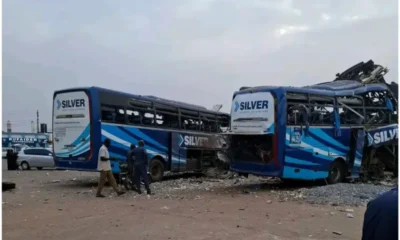
Kaduna Mando Garage Explosion Not Bomb- Police
The command’s Public Relations Officer, DSP Mansir Hassan, said in a statement that the incident occurred at about 3:00a.m. on Sunday at the premises of Silver Luxury Travel, a bus company operating at Mando Garage, Kaduna.
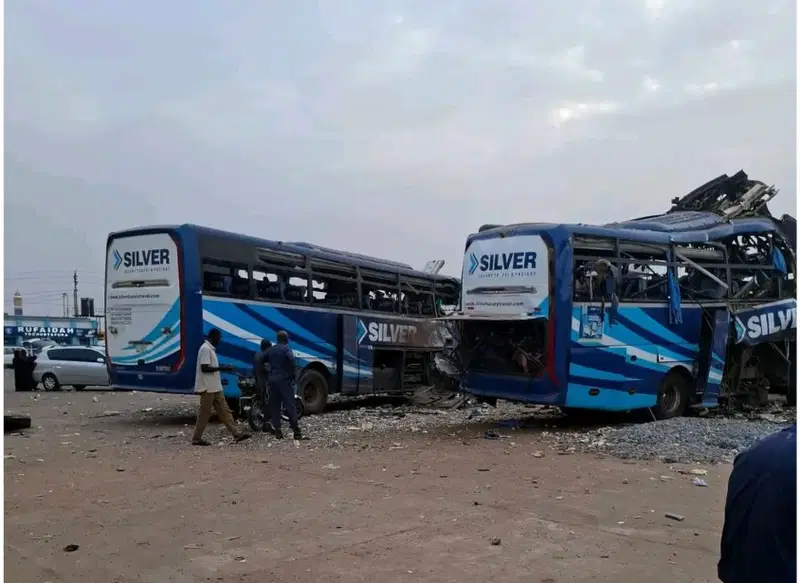
The Kaduna State Police Command has confirmed that an explosion at the Lagos Garage Terminus in Mando area of Kaduna State today wasn’t a bomb explosion, but a CNG-powered luxury bus that ruptured after its gas tank was overfilled.
The incident occurred during the early hours of Sunday with the loud blast drawing attention from commuters, traders, and nearby residents, prompting a swift response from emergency services.
The command’s Public Relations Officer, DSP Mansir Hassan, said in a statement that the incident occurred at about 3:00a.m. on Sunday at the premises of Silver Luxury Travel, a bus company operating at Mando Garage, Kaduna.
He said detectives were immediately deployed to the scene after a loud sound was reported, and that the vehicle has been safely evacuated, while normal business activities have since resumed at the motor park.
He noted that no casualties or loss of property were recorded, and normal activities had since resumed in the area.


Trump orders Iran to open Strait of Hormuz by Tuesday or face ‘hell’

Women giving birth on their backs or squatting – Which is Better?

2027: Atiku Vows To Support Whoever Emerges ADC Presidential Candidate

Tech Expert, Zuckerberg trains with UFC champions, Adesanya, Alexander

Organ Trafficking: Ekweremadu bags 10 years in UK prison

SAINT OBI: Between his marriage and his death
-

 Crime2 days ago
Three Killed, One Injured in Fresh Jos Attack (Video)
-
 Politics3 days ago
Onyejeocha resigns as Minister of State for Labour
-
 News1 day ago
Kaduna Mando Garage Explosion Not Bomb- Police
-
 Politics3 days ago
Labour Party to hold presidential primary April 28
-
 Politics3 days ago
No force can defeat Tinubu in 2027 –Umahi
-
 News1 day ago
Atiku hires US lobbying firm for $1.2m to boost image – Report
-

 News2 days ago
JUST IN: Lagos Fire Service Successfully Contains Two Overnight Fire Incidents iin Lagos
-
 News2 days ago
Nigerian Army Debunks Claims of Attack on Bishop Matthew Kukah’s Residence and Sokoto Catholic Cathedral