
Entertainment
Seyi Tinubu Appoints Obi Cubana as South-East Regional Director of City Boy Movement

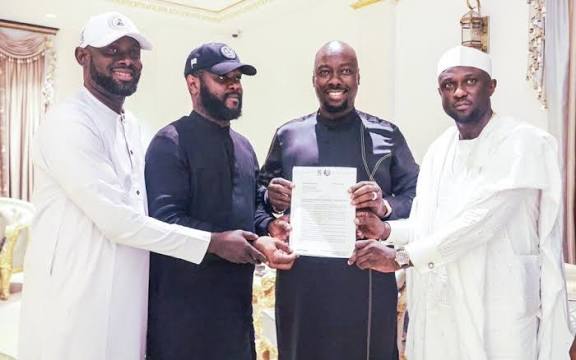
Seyi Tinubu, son of President Bola Ahmed Tinubu and patron of the City Boy Movement (CBM), has officially appointed prominent Nigerian businessman and socialite Obinna Iyiegbu, popularly known as Obi Cubana, as the South-East Regional Director of the youth-focused pro-government group.
The appointment was formalized during a visit by Seyi Tinubu to Obi Cubana’s residence in Abuja on Monday night, February 2, 2026, where he personally presented the letter of recognition and appointment. The ceremony, captured in videos circulating on social media, featured supporters singing President Tinubu’s campaign anthem, “On Your Mandate We Shall Stand,” amid cheers and expressions of loyalty to the Renewed Hope Agenda.
The City Boy Movement is a youth-oriented platform aligned with President Bola Tinubu’s administration, aimed at mobilizing support, promoting youth empowerment, innovation, and regional cooperation ahead of the 2027 general elections.
In a post on his Instagram page on Tuesday, February 3, 2026, Obi Cubana shared details of the event and addressed mixed public reactions to his new role. He reaffirmed his commitment to integrity, community development, and inclusive growth, stating, “I am a City Boy through and through, inside and out,” while emphasizing that meaningful change requires active engagement rather than withdrawal.
The appointment has sparked widespread discussions online, with some praising it as a strategic move to strengthen ties in the South-East region, while others have expressed criticism or skepticism. Obi Cubana urged detractors to respect differing perspectives and focus on shared national progress.
This development comes as part of broader efforts by the City Boy Movement to expand its influence and grassroots support across Nigeria in preparation for future political engagements.






Entertainment
BBNaija season 11: “And The Winner is Temi Nkem”
The finalists were Temi Nkem, Barry, Tram, Oyin, Flora, Sheba, Aikou, Ricky and Bluethopia.


Temi Nkem has emerged as the winner of BBNaija Season 11, bringing the reality show’s latest edition to an end.
The finalists were Temi Nkem, Barry, Tram, Oyin, Flora, Sheba, Aikou, Ricky and Bluethopia.
Temi Nkem was crowned winner during the grand finale on Sunday night after weeks of competition, evictions and intense drama among the housemates.
The victory sees Temi Nkem take home the ₦160 million prize package awarded to the winner of the season.
The season began with 24 housemates before the competition was gradually narrowed down to the finalists.
Entertainment
President Tinubu, Other Political Leaders Watch MKO Documentary
The documentary, MKO, directed by Nigerian-American filmmaker Ose Oyamendan, chronicles the life, political journey and legacy of the late Chief Moshood Kashimawo Olawale Abiola, with particular focus on the June 12, 1993 presidential election, its annulment, subsequent detention and the pro-democracy struggle that followed.
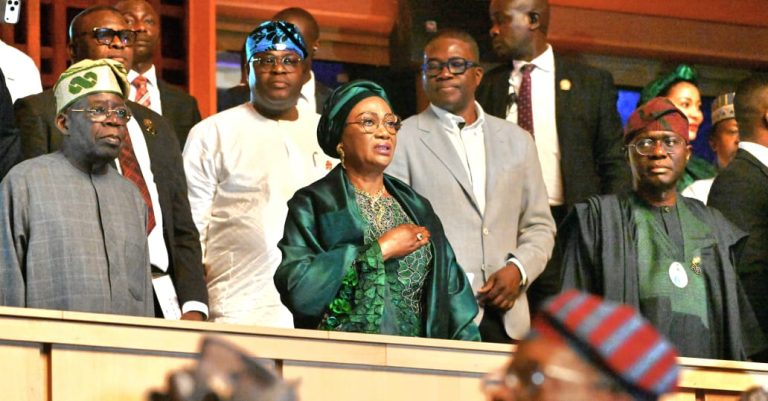
President Bola Tinubu on Thursday attended the official launch and premiere of MKO at the Wole Soyinka Centre for Culture and the Creative Arts in Lagos, ahead of the film’s nationwide cinema release from October 2.
Chief MKO Abiola occupies a prominent place in Nigeria’s democratic history as the winner of the June 12, 1993 presidential election, which was annulled by the then military government.
The President was joined at the Wole Soyinka Centre for Culture and the Creative Arts in Lagos by First Lady Senator Oluremi Tinubu, Senate President Godswill Akpabio, Lagos State Governor Babajide Sanwo-Olu, Ogun State Governor Dapo Abiodun and Kwara State Governor AbdulRahman AbdulRazaq.
Others present included Deputy Senate President Jibrin Barau, Deputy Speaker of the House of Representatives Benjamin Kalu, Chief of Staff to the President Femi Gbajabiamila, Minister of Art, Culture, Tourism and the Creative Economy Hannatu Musawa, former Ogun State Governor Segun Osoba and other dignitaries.
The documentary, MKO, directed by Nigerian-American filmmaker Ose Oyamendan, chronicles the life, political journey and legacy of the late Chief Moshood Kashimawo Olawale Abiola, with particular focus on the June 12, 1993 presidential election, its annulment, subsequent detention and the pro-democracy struggle that followed.
The film, which had its international premiere at the Sheffield International Documentary Festival in the United Kingdom in June 2026, features archival materials and first-hand accounts from key personalities connected to the period.
Entertainment
Nollywood actor Cjay Nwokafor dies
Cjay, who began his acting career in 2021, featured in several Nollywood productions, including Larry Cold, Mum Overnight and A Day to My Wedding.

•Nollywood actor Cjay Nwokafor
The death of Nollywood actor Chijioke “Cjay” Nwokafor has been announced.
Cjay, an indigene of Anambra, who began his acting career in 2021, featured in several Nollywood productions, including Larry Cold, Mum Overnight and A Day to My Wedding.
His colleague, actress Nkechi Blessing, announced his death on Instagram on Wednesday, sharing videos of herself with the late actor.
Blessing did not disclose the cause of his death but said she had cancelled the release of her movie, Egusi Ogbono, in his honour. Cjay featured in the film.
The actress had initially scheduled the movie for release at 5pm on Wednesday but withdrew it after a hospital confirmed the actor’s death.
Blessing said she spoke with Cjay at about 8am on Wednesday, only to receive news of his death a few hours later.
“Cjay Nwoke Oma, so this is really the end? Omo we had plans. I spoke to you at 8 a.m. today and a few hours later you are no more with us.


UPDATE: Identity of Woman Who Flew into Nigeria with Ebola Virus Revealed

UNILAG School Teachers Begin Work-to-Rule Over Unpaid Arrears

Dollar to Naira Exchange Rate – Thursday, October 22, 2026

BREAKING: Lagos Govt Declares Today, Thursday Work-Free to Mark 2026 Ìṣẹ̀ṣe Day

Tech Expert, Zuckerberg trains with UFC champions, Adesanya, Alexander

Organ Trafficking: Ekweremadu bags 10 years in UK prison
-
 Business2 days ago
Naira Exchange Rates Wednesday, October 21, 2026
-
 Business2 days ago
Currency Words You Should Know
-

 Business2 days ago
NCC, CBN To Warn Companies By Flagging Fraudulent Phone Numbers
-
 Business2 days ago
JPMorgan Eyeing Entry Into Nigeria’s Banking Industry
-

 Business2 days ago
RMRDC Taking 2027 Africa Raw Materials Summit To Kenya
-
 Health2 days ago
BREAKING: Nigeria Confirms First Ebola Case
-
 Politics2 days ago
NDC Plans Fresh Congresses To Replace Defector Members
-
 Health2 days ago
Ebola In Nigeria: Symptoms, Spread and How To Protect Yourself