
International
Saudi restricts Riyadh Landlords to increase rents for five years
In June, Saudi Minister of Municipal Rural Affairs and Housing Majed bin Abdullah Al-Hogail pointed to the high demand for housing, saying “a city like Riyadh needs between 120,000 and 130,000 housing units annually to enter the market”.


Saudi authorities announced on Thursday a five-year freeze on rent for residential and commercial properties in Riyadh, where demand for housing has soared as the kingdom’s ambitious megaprojects draw workers to the city.
Riyadh, the capital of the Middle East’s largest economy, is home to more than 8.6 million people, nearly half of them foreigners.
Many have converged on the city to work on multi-billion dollar projects as part of the Vision 2030 plan launched by Saudi Crown Prince Mohammed bin Salman, seeking to diversify the country’s economy away from oil.
The General Authority for Statistics reported in August a 7.6 percent year-on-year increase in residential rent prices.
The official Saudi Press Agency (SPA) said the crown prince had issued orders “in response to the challenges the capital has witnessed in recent years regarding rising residential and commercial rents”.
The ensuing cabinet decision and royal decree suspended “the annual increase in the total rent value in residential and commercial property leases… located within the urban area of Riyadh for a period of five years”.
“The landlord may not increase the total rent value of the property agreed upon in existing or new contracts” as of Thursday, it added.
Low-rise buildings and villas make up the majority of housing units in Riyadh, where construction has boomed.
In June, Saudi Minister of Municipal Rural Affairs and Housing Majed bin Abdullah Al-Hogail pointed to the high demand for housing, saying “a city like Riyadh needs between 120,000 and 130,000 housing units annually to enter the market”.
In April, Saudi authorities increased annual fees on undeveloped land in Riyadh to 10 percent of the property’s value, in a bid to encourage residential construction.
International
Trump warns Entire Iran could be ‘taken out’ Tuesday night
” The entire country could be taken out in one night, and that night might be Tuesday night,” he said.

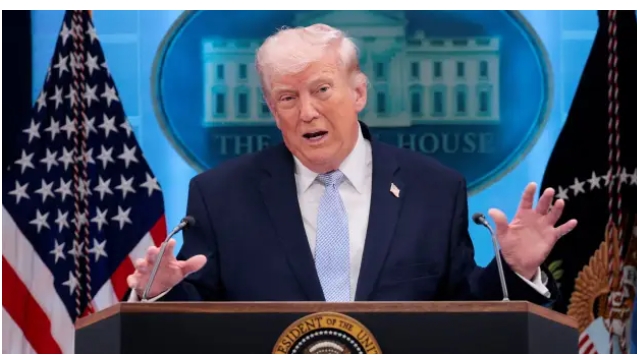
US President Donald Trump says Iran could be “taken out” in one night as the deadline set for the country to open the Strait of Hormuz to shipping traffic approaches.
On Saturday, Trump gave Iran 48 hours to comply or risk facing “hell”.
He later threatened that the US would blow up Iran’s power plants and bridges if Tehran failed to adhere to his warning.
The US president said Iran had until Tuesday at 8 p.m. ET (1 am WAT) to make a deal.
In a press conference on Monday, Trump reiterated and intensified his threats.
“The entire country could be taken out in one night, and that night might be Tuesday night,” he said.
International
Trump orders Iran to open Strait of Hormuz by Tuesday or face ‘hell’
The president threatened to bomb the country’s power plants and bridges.Trump subsequently posted “Tuesday, 8:00 P.M. Eastern Time!” without further explanation.

President Donald Trump gave Iran until Tuesday to open the Strait of Hormuz or face attacks on its power plants.
Consequently, U.S. crude oil futures for May pared earlier gains to rise 0.5% at $112.08 per barrel at 9:28 p.m. ET. International benchmark Brent prices for June delivery also scaled back to 1.3%, trading at $110.47 per barrel.
Trump gave the warning on Sunday in an expletive-filled social media post that Iran would be “living in Hell” if they do not open the Strait.
The president threatened to bomb the country’s power plants and bridges.Trump subsequently posted “Tuesday, 8:00 P.M. Eastern Time!” without further explanation.
Iran has effectively kept the Strait closed through attacks on oil tankers.
The sea route connects the Persian Gulf to world markets. About 20% of global supplies passed through the Strait before the war.
The closure of the Strait has triggered the largest oil supply disruption in history. Crude, jet fuel, diesel and gasoline prices have surged since the war started.


Vietnamese authorities have busted what officials describe as one of the country’s largest cryptocurrency scams, arresting key suspects in a multi-billion dollar Ponzi-style scheme that allegedly defrauded thousands of investors both domestically and overseas.
The operation, centered around a fraudulent digital token known as Paynet Coin (PAYN), was dismantled by police in Phu Tho province in August 2025. Authorities charged at least 20 individuals, including the alleged ringleader, Nguyen Van Ha, a 45-year-old entrepreneur and founder linked to the Hahalolo platform.
According to reports from local state media, including Công an Nhân dân, the suspects operated an illegal multi-level marketing (MLM) network disguised as a legitimate cryptocurrency investment platform.
Victims were lured with promises of high returns through the Paynet Coin scheme, which authorities labeled as the biggest crypto fraud uncovered in Vietnam to date. The operation reportedly spanned multiple provinces and attracted investors from abroad.
Police seized evidence related to the scheme and charged the suspects with fraud and organizing illegal MLM activities. Estimates of the total scale have varied in reports, with some describing losses in the billions of dollars, though exact figures for victim losses and assets recovered have not been fully disclosed publicly.
This bust is part of a broader crackdown on cryptocurrency-related crimes in Vietnam, where digital asset trading has grown rapidly in recent years but has also attracted scammers exploiting regulatory gaps.
Other recent cases include arrests tied to platforms like ONUS and HanaGold for alleged price manipulation, as well as smaller scams involving fake exchanges and investment schemes totaling millions of dollars.
Vietnamese law enforcement has intensified efforts against online fraud, Ponzi schemes, and unlicensed crypto operations amid a surge in investor complaints. Officials have warned the public to exercise caution with high-yield crypto investments promising unrealistic returns.
The investigation remains ongoing, with authorities urging additional victims to come forward. This case highlights the risks in Vietnam’s booming but largely unregulated crypto market, where millions of citizens hold digital assets.
No further details on trial dates or additional arrests have been released as of the latest reports.


Benue Govt Confirms Total Evacuation of Benue Students From University of Jos

Trump warns Entire Iran could be ‘taken out’ Tuesday night

FG earmarks N135bn for 2027 post election disputes

Tech Expert, Zuckerberg trains with UFC champions, Adesanya, Alexander

Organ Trafficking: Ekweremadu bags 10 years in UK prison

SAINT OBI: Between his marriage and his death
-

 Crime3 days ago
Three Killed, One Injured in Fresh Jos Attack (Video)
-

 News2 days ago
Nigerian Army Debunks Claims of Attack on Bishop Matthew Kukah’s Residence and Sokoto Catholic Cathedral
-

 News3 days ago
JUST IN: Lagos Fire Service Successfully Contains Two Overnight Fire Incidents iin Lagos
-

 News2 days ago
Kaduna Mando Garage Explosion Not Bomb- Police
-

 News2 days ago
Atiku hires US lobbying firm for $1.2m to boost image – Report
-

 Politics1 day ago
Obidients mobilise for #OccupyINEC protest
-
 Business1 day ago
President Tinubu Approves N3.3Trn Payments Plan To Restore Reliable Electricity
-

 Politics1 day ago
INEC suspends voter revalidation amid rising concerns by Opposition parties