
News
Reps release six-point legislative agenda

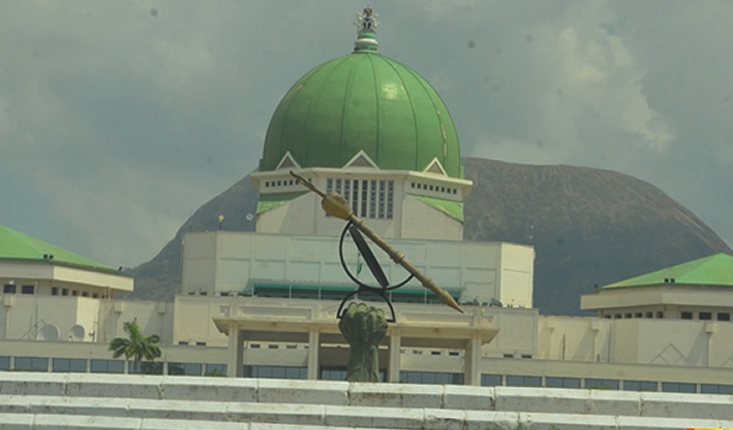
The 10th House of Representatives has released its six-point legislative agenda for the 10th Assembly to drive progress, prosperity and inclusivity across the country.
Rep. Julius Ihonvbere, the House Leader and Chairman of the Ad-hoc Committee on Legislative Agenda, announced the agenda on Monday in Abuja.
He listed the agenda as economic empowerment and diversification, infrastructure development, education and human capital development.
Others include healthcare for all; transparent governance, accountability, and the security and safety of persons and property, as well as economic empowerment and diversification.
Ihonvbere said the agenda, being the vision of the 10th Assembly, would be the fulcrum upon which the 10th Legislature’s operation would be based.
He said one of the House’s foremost goals would be to drive economic empowerment and diversification, adding that Nigeria’s over-reliance on oil exports had left the economy vulnerable to fluctuations in global oil prices.
According to him, to mitigate this risk and build a sustainable economy, they would incentivize investments in non-oil sectors such as agriculture, technology and renewable energy.
He said, “In the agriculture sector, we will pass legislation to modernise farming practices, improve access to credit for farmers, and support agricultural research and development.”
He said the Green Chamber would explore opportunities in agro-processing to add value to the country’s agricultural produce and create more jobs.
He said, “In the technology and innovation space, we will foster an environment that encourages start-ups, nurtures innovation hubs, and incentivizes research and development”.
He said the aim was to position Nigeria as a technology powerhouse, leveraging her young and dynamic population to drive innovation and digital transformation.
He said the agenda was to prioritise renewable energy projects to reduce the country’s carbon footprint, improve energy security and create jobs in the renewable energy sector.
This, according to him, will be done by embracing renewable energy, which would not only protect the environment but also open up new investment opportunities.
“Our overall goals are job creation, higher foreign exchange earnings, new skills development, diversification of exports and strengthening and deepening our technological foundations,” he explained.
The News Agency of Nigeria reports that some of the stakeholders that contributed to the agenda are the Nigerians Union of Teachers, Nigerian Metallurgical Society and the Federal Ministry of Health.
(NAN)




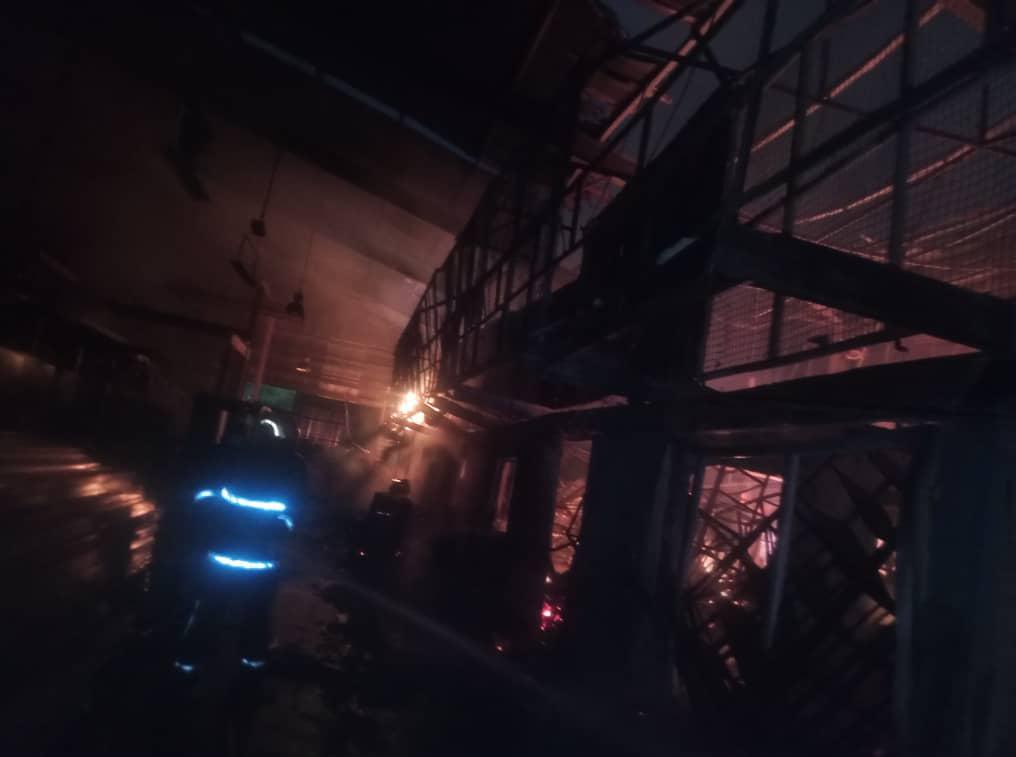
The Lagos State Fire and Rescue Service has confirmed the successful containment of two separate fire incidents that occurred overnight in different parts of the state.
The first incident was reported at 22:46 hours on Saturday at Tower Aluminum Village, along Abeokuta Expressway, Dopemu, Agege.
Fire crews from Ikeja and Agege stations responded promptly to the emergency, effectively dousing the fire which affected multiple offices and stores of varying sizes.
The structures, situated on a land area of approximately 2,592 square meters within a premises spanning about four acres, suffered significant damage to affected sections and their contents.
The second incident occurred in the early hours of Sunday at about 03:15 hours at a three-storey commercial building located on Oyabiyi Street, opposite the NLC Office, Tejuosho, Yaba. The building, which housed shops and stores containing stacked textile materials, was engulfed by fire.
Firefighters from Somolu, Ilupeju, and Sari Iganmu Fire Stations were swiftly mobilized to the scene and successfully contained the blaze, preventing further spread to adjoining properties.
In both incidents, the Lagos State Fire and Rescue Service demonstrated professionalism and rapid response, ensuring that the fires were brought under control without escalation and casualty.
The Controller General of Lagos state fire and rescue reiterates the importance of fire safety precautions and urges members of the public to remain vigilant, especially in commercial areas where flammable materials are stored.
Further investigations into the causes of the fires are ongoing to unravel their causes.
News
Police must pay transport fares, says AIG
” No police officer has the right to enter your vehicle without paying. We should assist one another willingly, not by force,” he said.


• The Assistant Inspector-General of Police(AIG) in charge of Zone 2 Command, Mr Olohundare Jimoh, speaking with transporters at Obalende garage, Lagos State, on Wednesday.
The Assistant Inspector-General of Police, Zone 2 Command, Mr Olohundare Jimoh, has declared that officers must pay fares before boarding commercial vehicles, warning against abuse of authority.
Jimoh spoke on Wednesday at Obalende garage during a sensitisation meeting with drivers and transport workers marking National Police Day 2026.
He stressed that relations between police and the public must be based on partnership, not coercion, urging both sides to support each other voluntarily.
“No police officer has the right to enter your vehicle without paying. We should assist one another willingly, not by force,” he said.
Jimoh called for stronger cooperation to maintain safety and order on roads, insisting there was no conflict between officers and transport unions.
“I don’t collect money from officers. We don’t arrest people arbitrarily. If you have issues with any officer, report directly to me,” he said.
(Vanguard)
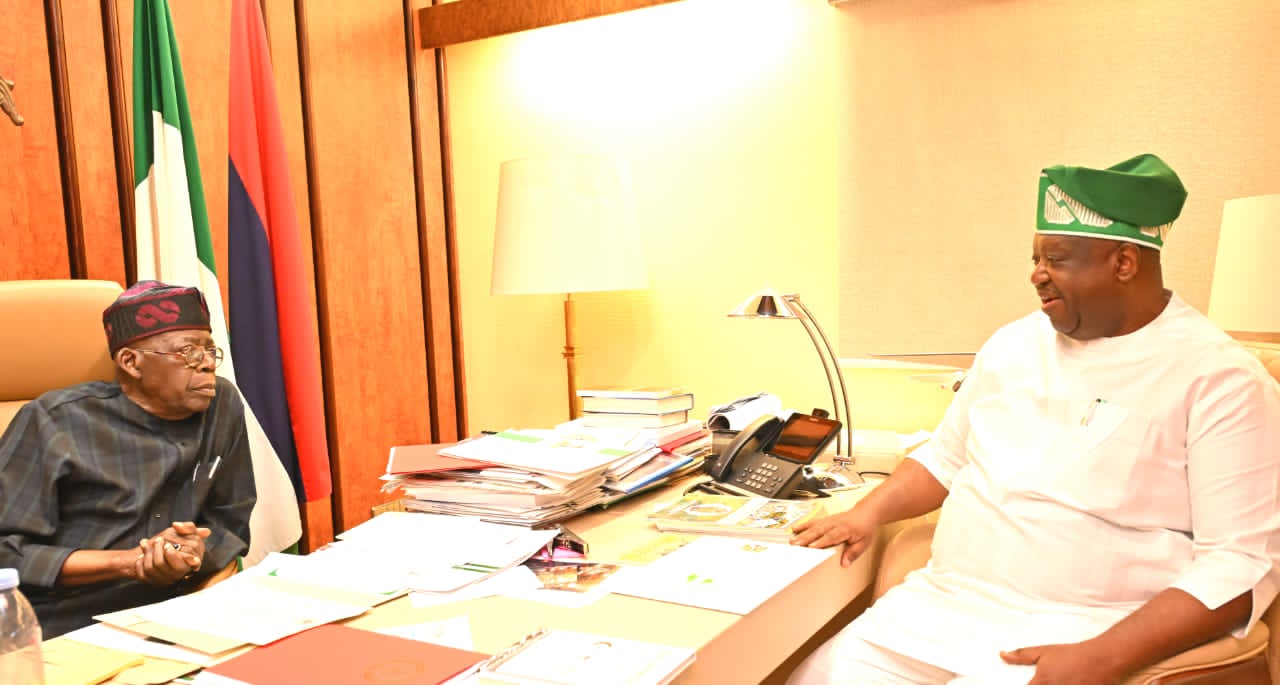
President Bola Ahmed Tinubu will leave for Jos tomorrow to commiserate with the state government and residents over recent deadly gun attacks that lefts dozens dead.
This was following Governor Caleb Mutfwang’s security briefing to the President on the recent violent attack in Angwan Rukuba, Plateau State.
During the meeting on Wednesday at the presidential villa in Abuja, Governor Caleb Mutfwang told Mr President that although security forces have restored calm after fresh disturbances involving looters on Wednesday morning, following the deadly Palm Sunday attack that left more than a dozen dead and many others injured.
He said that investigations are continuing to determine the identities or motives of the attackers who are yet to be apprehended .
Presidency source said that President Tinubu was initially scheduled for a planned trip to Ogun State to flag off operations at the Gateway International Cargo Airport on Thursday.
From Jos, the President will travel to Lagos to observe Good Friday.
On Saturday, April 4, he will visit Ogun State to commission projects including the cargo airport.
He will then return to Lagos during the Easter holiday to commission several state infrastructure projects, including the Ojota/Opebi Link Bridge.
Before heading back to Abuja, the president will visit Bayelsa State on April 10 to commission projects completed under Governor Duoye Diri.


JUST IN: Lagos Fire Service Successfully Contains Two Overnight Fire Incidents iin Lagos

Three Killed, One Injured in Fresh Jos Attack (Video)

Onyejeocha resigns as Minister of State for Labour

Tech Expert, Zuckerberg trains with UFC champions, Adesanya, Alexander

Organ Trafficking: Ekweremadu bags 10 years in UK prison

SAINT OBI: Between his marriage and his death
-
 Business3 days ago
33 Nigerian Banks Beat CBN’s Recapialisation with ₦4.65trn Combined Capital Base
-

 Politics3 days ago
BREAKING: INEC Withdraws Recognition of David Mark’s ADC
-
 News3 days ago
JUST IN: Tinubu Heads to Jos Tomorrow, Postpones Ogun Trip for 5-State Visits
-
 News3 days ago
Easter: FG declares Friday, Monday public holidays
-

 Entertainment3 days ago
Super Eagles Iwobi to launch music album ‘More To Life’
-
 News3 days ago
Gas Leak in Ogun School: 30 Students, Teacher Hospitalised
-

 Politics3 days ago
Arise News Anchor Ikokwu in Political Race for Reps Seat
-
 Crime3 days ago
Tinubu Briefed on Jos Attack, Approves Extra Security – Mutfwang