
Business
President Tinubu Hails NGX for Crossing ₦100 Trillion Market Capitalisation Milestone

Urges Deeper Local Investments
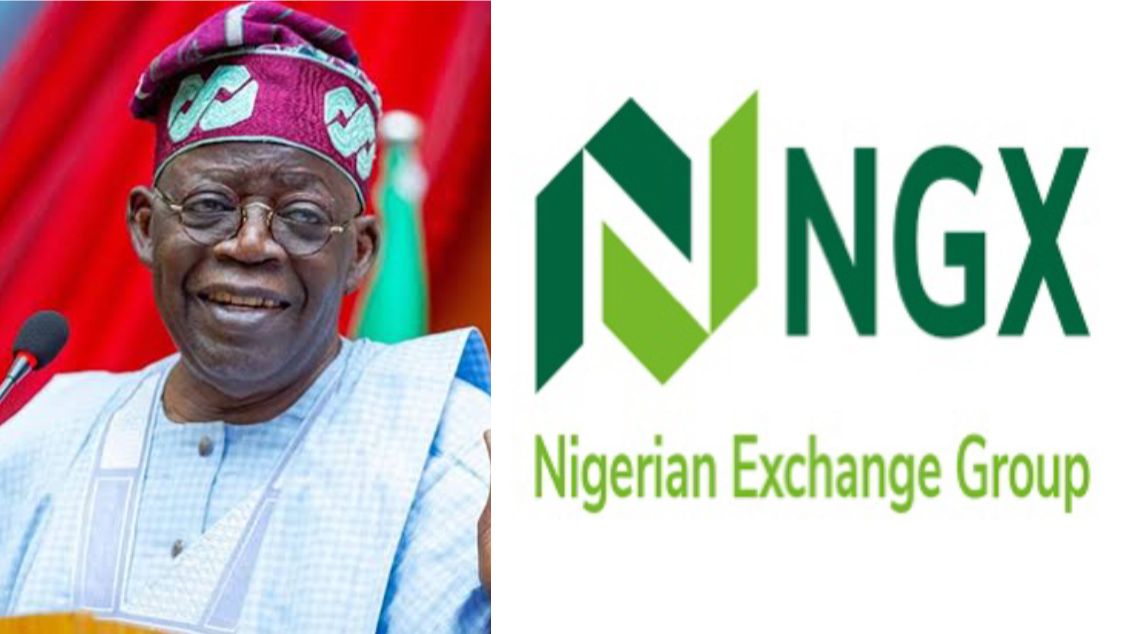
President Bola Tinubu has commended corporate Nigeria, investors, and stakeholders in the capital market for propelling the Nigerian Exchange (NGX) beyond the historic ₦100 trillion market capitalisation threshold.
In a statement issued by his Special Adviser on Information and Strategy, Bayo Onanuga, the President described the achievement as a “new economic reality and rejuvenation,” signalling strong investor confidence in Nigeria’s reforming economy.
“With the Nigerian Exchange crossing the historic N100 trillion mark, the country is witnessing the birth of a new economic reality,” President Tinubu said. He highlighted the NGX All-Share Index’s impressive 51.19% return in 2025 — outperforming the previous year’s 37.65% and ranking among the world’s top performers — even as many global markets faced stagnation.
The President noted year-to-date gains surpassing benchmarks like the S&P 500 and FTSE 100, positioning Nigeria as an attractive investment destination rather than a overlooked frontier market.
He praised resilient performances across sectors, from industrial giants localising supply chains to innovative banks, and anticipated further growth with upcoming listings in energy, tech, telecoms, and infrastructure.
President Tinubu linked the stock market’s success to broader reforms yielding macroeconomic stability. Inflation has declined for eight consecutive months, dropping from a peak of 34.8% in December 2024 to 14.45% in November 2025, with forecasts suggesting 12% in 2026 and potentially single digits by year-end.
Nigeria recorded a $16 billion current account surplus in 2024, projected to rise to $18.81 billion in 2026, driven by surging non-oil exports (up 48% to ₦9.2 trillion in Q3 2025) and manufacturing growth. Foreign reserves have exceeded $45 billion, with the naira stabilising and projections to surpass $50 billion in early 2026.
Infrastructure advances, including rail expansions, major highways like Lagos-Calabar and Sokoto-Badagry, and port revitalisation, were also highlighted, alongside improvements in healthcare, education loans via NELFUND, and research funding.
Urging Nigerians to invest more domestically, President Tinubu assured that “2026 will yield even greater returns” as reforms mature. He pledged continued efforts toward a transparent, egalitarian, high-growth economy, bolstered by tax and fiscal changes effective January 1, 2026.
“Nation-building is a process requiring hard work and focus. This ₦100 trillion milestone signals to the world that Nigeria’s economy is robust and productive,” he concluded.









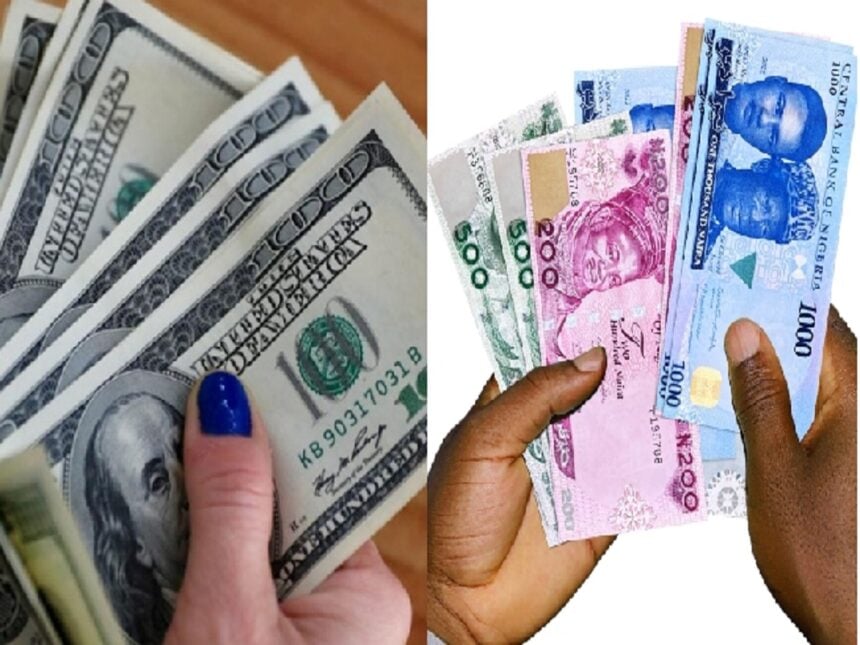
BLACK MARKET RATES
US Dollar (USD) Buy ₦1,400 Sell ₦1,405
Great British Pound(GBP) Buy ₦1,900 Sell: ₦1,920
EURO (EUR) Buy ₦1,590 Sell ₦1,610
Canadian Dollar (CAD) Buy ₦1,020 Sell ₦1,080
South African Rand (ZAR) Buy ₦75 Sell ₦90
Ghana CEDI (GHS) Buy ₦95 Sell ₦110
West African CFA Buy ₦2, 300 Sell ₦2, 400
CENTRAL AFRICAN CFA Buy ₦2,150 Sell 2,250
CBN Exchange Rates
US Dollar (USD) ₦1,346.98
Great British Pound (GBP) ₦1,837 54
EURO (EUR) ₦1,571.52
Swiss Franc (CHF) ₦1,678.89
Chinese Yuan (CNY) ₦200.37
Japanese Yen (Yen) ₦8.46
West African CFA (XOF) ₦2. 40
West African Unit Account (WAUA) ₦1,849. 43
Saudi Riyal (SAR) ₦358.73
South African Rand (ZAR) ₦84.11
Business
NAFDAC Gives Conditions For Reopening Sealed Factories of Alcoholic Manufacturers
The reopening and continued opening of any facility shall be subject to:Full compliance with the nationwide recall directive. Payment of all applicable investigative charges and regulatory fees…

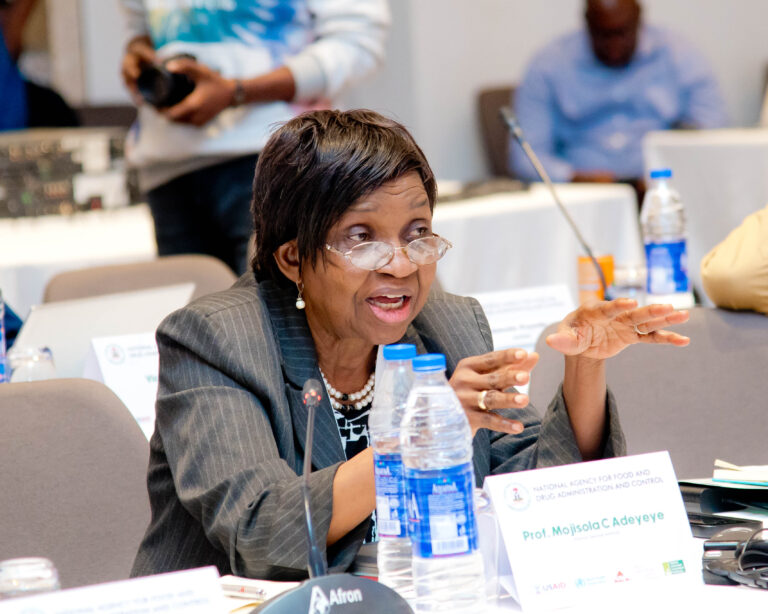
• NAFDAC DG, Prof Mojisola Christianah Adeyeye
The National Agency for Food and Drug Administration and Control (NAFDAC) on Monday gave the conditions for the reopening of sealed factories of alcoholic beverages manufacturers nationwide.
At a press briefing in Lagos, the agency’s Director – General, Prof Mojisola Christianah Adeyeye, also directed the Distillers and Blenders Association of Nigeria (DIBAN), the Association of Food, Beverage and Tobacco Employers (AFBTE), and their member companies who have not comply with the ban on alcoholic beverages packaged in sachets and PET (plastic) bottles below 200ml to do so.
“Affected manufacturers are required to immediately commence a nationwide recall of all alcoholic drinks packaged in sachets and PET bottles below 200ml from distributors, warehouses, and other points within the supply chain and submit to the agency for destruction,” she said.
Emphasising on reopening sealed factories, she said: ” NAFDAC imposed investigative charges on defaulting companies found to have violated regulatory directives relating to the manufacture and distribution of alcoholic beverages in prohibited package sizes.
The affected companies are required to settle the applicable charges within the stipulated period and comply fully with all regulatory directives issued by the Agency.
The Agency wishes to emphasize that all recalled alcoholic products shall be subjected to inventory verification and destruction under NAFDAC supervision in accordance with the terms of the enforcement undertaking. Manufacturers shall bear the full cost of such destruction exercises.
Furthermore, before any sealed facility involved in the production of alcoholic beverages in sachets or PET bottles below 200ml can be reopened, NAFDAC will require satisfactory evidence that the production lines used for the prohibited package sizes have been dismantled, permanently disabled, or reconfigured to prevent the manufacture and packaging of alcoholic products in sachets and PET bottles below 200ml.
Such dismantling or reconfiguration shall be carried out under the direct supervision and verification of NAFDAC officers.
The reopening and continued opening of any facility shall be subject to:Full compliance with the nationwide recall directive. Payment of all applicable investigative charges and regulatory fees.Successful destruction of recalled products under NAFDAC supervision. Verification of the dismantling, reconfiguration, or decommissioning of equipment used for prohibited package sizes.Satisfactory inspection and certification by NAFDAC that the facility is compliant with all regulatory requirements.”
Business
Cybercriminals cloning DStv, other brands to steal bank accounts across Africa
According to cybersecurity company NordVPN, the campaign distributes Remote Access Trojans (RATs) and banking trojans, forms of malware that can give criminals control over infected devices and access to sensitive information.

Cybercriminals are impersonating popular companies and government agencies across Africa in a campaign designed to take over smartphones and bank accounts.
More than 100 fake websites linked to the malware campaign have been identified since August 2025.
Brands including DStv, Takealot and South African Airways, as well as the South African Revenue Service (SARS), are being used to make fraudulent messages and websites appear legitimate.
According to cybersecurity company NordVPN, the campaign distributes Remote Access Trojans (RATs) and banking trojans, forms of malware that can give criminals control over infected devices and access to sensitive information.
The attacks are particularly concerning in South Africa, where Android dominates the mobile operating system market.
NordVPN said the attacks typically begin with social engineering, where criminals send convincing messages through SMS, WhatsApp or social media.
The messages may contain urgent offers or requests involving job opportunities, tax refunds, identity renewals or pension verification.
Victims are then directed to fake websites designed to closely resemble the official websites of trusted organisations.
The sites encourage users to download an Android application. Once installed, the malicious software can operate quietly in the background, including after the smartphone is restarted.


Lawyers Back Tax Ombud’s Push for Greater Voluntary Compliance

BREAKING: Country music icon Dolly Parton dies at 80

Sanwo-Olu Wins 2026 Global Governance Prize

Tech Expert, Zuckerberg trains with UFC champions, Adesanya, Alexander

Organ Trafficking: Ekweremadu bags 10 years in UK prison

SAINT OBI: Between his marriage and his death
-

 Business12 hours ago
Naira Exchange Rates Tuesday, August 25
-

 Politics11 hours ago
President Tinubu Retrieves APC Campaign List For Readjustment
-

 Politics11 hours ago
Amaechi to Sowore: Close Your Mouth When Politicians Are Talking
-
 Politics2 days ago
APC Chair Dies After Collapse at Kogi Meeting
-

 News12 hours ago
FG Moves To Fix Benin-Asaba Federal Highway
-
 News10 hours ago
Enugu iron-smelting site Gets $125,000 US Grant
-

 Politics9 hours ago
[UPDATED] 2027: APC dismisses report of campaign council list withdrawal
-

 News2 days ago
NGE 2026 Conference: Onaiyekan, Mbah, Osigwe, Others to Speak in Enugu